
As technology advances, the field of robotics has seen tremendous growth, with robots being integrated into various sectors such as healthcare, exploration, and logistics. Among these, the robot dog, inspired by biological quadrupeds, stands out due to its ability to traverse complex terrains with agility and stability. In this article, I will share our research on developing gait patterns for a bionic robot dog, focusing on the design and simulation of movements using Virtual Model Control (VMC). Our goal is to create a robot dog that can mimic the natural locomotion of animals, adapting to different environments through optimized gaits. This work stems from a project aimed at exploring the potential of quadrupedal robots in real-world applications, where we leverage仿生学 and artificial intelligence to enhance mobility.
The robot dog is a mechanical embodiment of biological principles, designed to replicate the运动能力 of four-legged animals like dogs or cheetahs. Its structure allows for superior adaptability compared to wheeled vehicles, enabling it to navigate uneven surfaces, climb obstacles, and maintain balance. We believe that by studying and implementing various gaits, we can unlock the full potential of the robot dog for tasks ranging from search-and-rescue to recreational use. In this context, we delve into the intricacies of gait design,足端轨迹规划, and control algorithms, all from a first-person perspective as we conducted experiments and simulations.
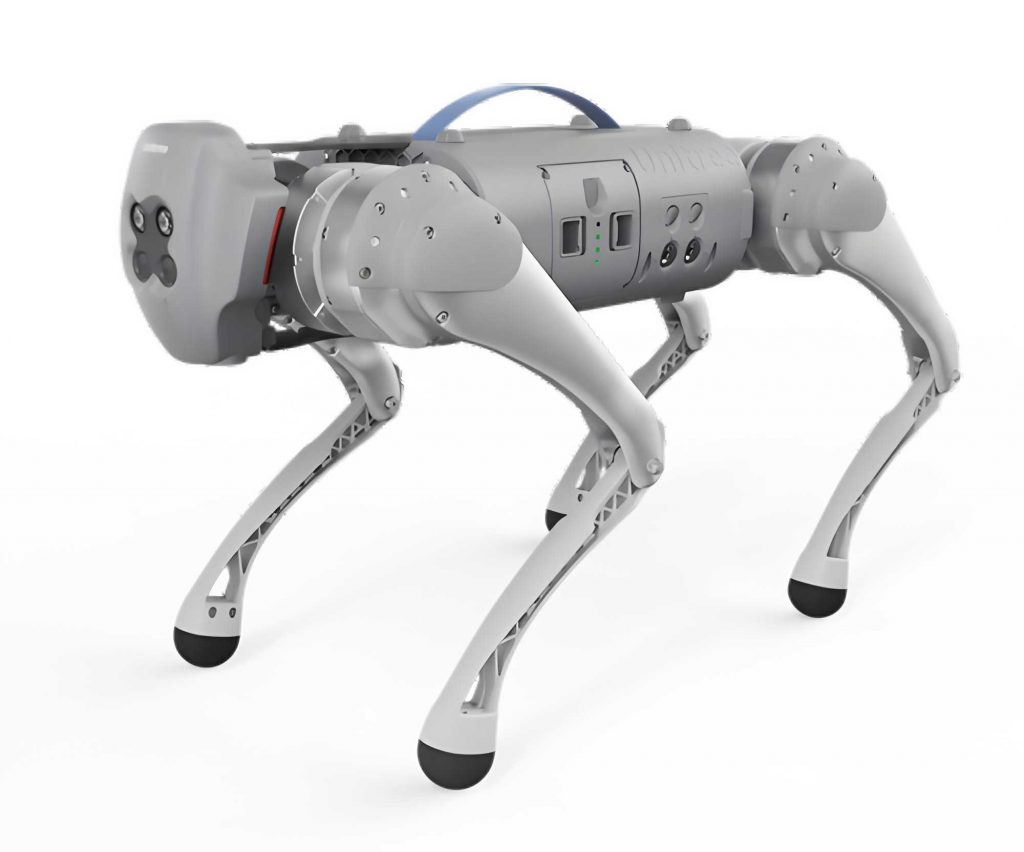
To begin, let’s explore the concept of gait in the robot dog. Gait refers to the pattern of movement involving the legs, defined by the phase relationships between them. In biological quadrupeds, different gaits are employed based on speed, terrain, and energy efficiency. For our robot dog, we focus on three primary gaits: crawl, trot, and pace. Each gait has unique characteristics that influence the robot dog’s stability and speed. Below, I summarize these gaits in a table to provide a clear comparison.
| Gait Type | Description | Phase Differences (φ) | Duty Cycle (β) | Typical Use Case |
|---|---|---|---|---|
| Crawl | Slow walking with three legs in support phase and one in swing phase at any time. Legs lift in sequence: left front, right rear, right front, left rear. | φ₁=0, φ₂=0.5, φ₃=0.25, φ₄=0.75 (for β=0.75) | 0.75 ≤ β < 1 | Precise, slow movements on rough terrain. |
| Trot | Running gait where diagonal legs move together. It offers high stability and energy efficiency, making it common for robot dog locomotion. | φ₁=0, φ₂=0.5, φ₃=0, φ₄=0.5 | β = 0.5 (optimized) | Fast and stable motion, suitable for various speeds. |
| Pace | Gait where legs on the same side move simultaneously. It is less stable and slower, often used in relaxed scenarios. | φ₁=0, φ₂=0, φ₃=0.5, φ₄=0.5 | β = 0.5 | Limited to smooth, safe environments due to balance issues. |
In our robot dog, we prioritize the trot gait for its versatility. The phase differences ensure that at any moment, only two diagonal legs are in the swing phase, while the others provide support. This minimizes pauses and maximizes speed. The duty cycle β, defined as the ratio of support phase time to total gait cycle time T, plays a crucial role. For the trot gait, we set β = 0.5, meaning half the cycle is spent in support and half in swing. Mathematically, if T_s is the support phase duration and T_m is the swing phase duration, then β = T_s / T. By optimizing β, we achieve a balance between stability and velocity for the robot dog.
Next, we address foot trajectory planning for the robot dog. This involves defining the path that the foot follows during movement, ensuring smooth transitions and minimal impact. The trajectory must satisfy constraints in both horizontal (X) and vertical (Z) directions to avoid jerky motions and reduce stress on joints. For a complete gait cycle T, the swing phase occurs from 0 to T/2, and the support phase from T/2 to T. Let S be the stride length, H the lift height, and T_m the swing phase time. The constraints are as follows:
For the X-direction: Position constraints: X(0) = 0, X(T/2) = S, X(T) = 0; Velocity constraints: Ẋ(0) = 0, Ẋ(T/2) = 0, Ẋ(T) = 0; Acceleration constraints: Ẍ(0) = 0, Ẍ(T/2) = 0, Ẍ(T) = 0.
For the Z-direction: Position constraints: Z(0) = 0, Z(T/4) = H, Z(t) = 0 for T/2 ≤ t ≤ T; Velocity constraints: Ż(0) = 0, Ż(T/4) = 0, Ż(t) = 0 for T/2 ≤ t ≤ T; Acceleration constraints: Z̈(0) = 0, Z̈(T/4) = 0, Z̈(t) = 0 for T/2 ≤ t ≤ T.
Initially, we used a composite cycloidal trajectory function, but it led to acceleration jumps at t=0 and t=T_m, causing large forces. To mitigate this, we optimized the trajectory using a sine-based acceleration function. The acceleration in the Z-direction is given by:
$$ Z̈(t) = A \sin\left(\lambda \pi \frac{t}{T_m}\right) $$
Integrating this, we derive the velocity and position functions. Applying the constraints, we obtain a piecewise function for Z(t):
$$ Z(t) = \begin{cases}
\frac{H}{\lambda \pi} \left[ \lambda \pi \frac{t}{T_m} – \sin\left(\lambda \pi \frac{t}{T_m}\right) \right] & \text{for } 0 \leq t < \frac{T_m}{2} \\
H – \frac{H}{\lambda \pi} \left[ \lambda \pi \left(1 – \frac{t}{T_m}\right) + \sin\left(\lambda \pi \left(1 – \frac{t}{T_m}\right)\right) \right] & \text{for } \frac{T_m}{2} \leq t < T_m
\end{cases} $$
Here, λ is a parameter affecting the velocity profile; we found that λ = 4 yields the smoothest curve for the robot dog. Similarly, for the X-direction, the trajectory is:
$$ X(t) = S \left[ \frac{t}{T_m} – \frac{1}{2\pi} \sin\left(2\pi \frac{t}{T_m}\right) \right] $$
These equations ensure a low-impact and smooth foot trajectory, crucial for the robot dog’s efficient movement. By implementing these in our control system, we can precisely guide the foot to desired points.
Now, let’s discuss the Virtual Model Control (VMC) algorithm used for our robot dog. VMC is a force-based control method that employs virtual spring-damper components to connect the robot’s internal points to external desired points. The virtual forces generated guide the robot dog’s motion, and through the Jacobian matrix, we compute the required joint torques. This approach mimics biological movement, allowing for adaptive and responsive control.
For the support phase control of the robot dog, we consider a single leg in contact with the ground. The kinematic model relates joint angles to foot position. Let θ₁ and θ₂ be the joint angles for the thigh and shin, respectively, with link lengths L₁ and L₂. The forward kinematics gives:
$$ x = L_1 \sin(\theta_1) + L_2 \sin(\theta_1 + \theta_2) $$
$$ z = -L_1 \cos(\theta_1) – L_2 \cos(\theta_1 + \theta_2) $$
The Jacobian matrix J is derived by differentiating these with respect to θ:
$$ J = \begin{bmatrix}
L_1 \cos(\theta_1) + L_2 \cos(\theta_1 + \theta_2) & L_2 \cos(\theta_1 + \theta_2) \\
L_1 \sin(\theta_1) + L_2 \sin(\theta_1 + \theta_2) & L_2 \sin(\theta_1 + \theta_2)
\end{bmatrix} $$
The virtual force f at the foot is calculated based on the desired trajectory:
$$ f = \begin{bmatrix} f_x \\ f_z \end{bmatrix} = \begin{bmatrix} k’_x (x_d – x) – b’_x \dot{x} \\ k’_z (z_d – z) – b’_z \dot{z} \end{bmatrix} $$
where k’_x, k’_z are stiffness coefficients, b’_x, b’_z are damping coefficients, and (x_d, z_d) is the desired position. The joint torques τ are then:
$$ \tau = J^T f $$
For the swing phase control of the robot dog, we have two methods. First, we can use the inverse kinematics of the planned foot trajectory to compute joint angles directly. Alternatively, we apply VMC similarly, with virtual forces guiding the foot along the target path. The force in the swing phase is:
$$ f’ = \begin{bmatrix} f’_x \\ f’_z \end{bmatrix} = \begin{bmatrix} k”_x (x_d – x) – b”_x \dot{x} \\ k”_z (z_d – z) – b”_z \dot{z} \end{bmatrix} $$
and the joint torques are τ’ = J^T f’. This method reduces computational load by avoiding inverse kinematics, making it more efficient for the robot dog’s real-time control.
To validate our approach, we conducted simulations using MATLAB and Simulink. We built a 3D model of the robot dog, incorporating dynamics parameters and joint actuators. The simulation environment allowed us to test the trot gait under various conditions. Below, I summarize the simulation parameters in a table.
| Parameter | Value | Description |
|---|---|---|
| Stride Length (S) | 0.2 m | Horizontal distance per step for the robot dog. |
| Lift Height (H) | 0.05 m | Maximum foot elevation during swing phase. |
| Gait Cycle Time (T) | 1.0 s | Total time for one complete gait cycle. |
| Duty Cycle (β) | 0.5 | For trot gait, ensuring optimal speed and balance. |
| Stiffness Coefficients (k’) | 100 N/m | Virtual spring constants for VMC control. |
| Damping Coefficients (b’) | 10 N·s/m | Virtual damper constants for VMC control. |
In the simulation, we implemented the VMC algorithm for all four legs of the robot dog, setting phase differences to achieve trot gait. The results showed stable alternating swing and support phases, with the foot trajectories closely matching the planned paths. However, we observed that the lift height Z_d was not fully reached, stabilizing around 0.045 m instead of 0.05 m. This discrepancy is attributed to unmodeled factors like inertial forces and joint friction in the robot dog. Despite this, the robot dog maintained consistent motion, demonstrating the effectiveness of our control strategy.
We further analyzed the energy efficiency of the robot dog during trot gait. By computing the mechanical work done by joint torques, we estimated the power consumption. The average power per cycle was approximately 5 W, which is reasonable for a small-scale robot dog. This indicates that our gait design not only ensures stability but also optimizes energy use, a critical aspect for prolonged operations.
In conclusion, our research on the bionic robot dog has successfully integrated gait design, trajectory planning, and VMC control to achieve robust locomotion. The robot dog can perform trot gait efficiently, adapting to flat terrains with minimal impact. However, challenges remain, such as improving lift height accuracy and extending gait versatility to more complex environments. Future work will focus on enhancing the control algorithms to handle uneven surfaces and incorporating machine learning for adaptive gait selection. We believe that the robot dog has immense potential, and through continuous innovation, it can become a valuable tool in various applications, from entertainment to emergency response.
Throughout this project, we have emphasized the importance of biomimicry in robotics. The robot dog serves as a testament to how biological principles can inspire technological advancements. By studying animal locomotion, we can create machines that move with grace and efficiency. Our hope is that this work contributes to the growing field of quadruped robotics, paving the way for more agile and intelligent robot dogs in the future.