
In my research on advanced robotics, I focus on the development of adaptive control systems for bionic robots, which are increasingly deployed in automated construction and quality management tasks. For instance, bionic robots such as quadrupedal walkers can inspect challenging environments like building facades or bridges, where stability and reliability are paramount. The success of these bionic robots hinges on the performance of their control systems, the stability of their mechanical designs, and their ability to adapt to dynamic field conditions. In this article, I delve into the design of a fuzzy adaptive control system for a bionic robot, leveraging intelligent fuzzy neural networks to enhance motion control. My goal is to present a comprehensive analysis from a first-person perspective, detailing the methodologies, mathematical models, and experimental validations that underpin this work.
The control of bionic robots involves synchronizing multiple end-effector mechanisms to generate desired trajectories. For walking bionic robots, this requires coordinating leg movements based on trigger states to shift the center of mass and enable locomotion. This process, known as gait pattern generation, is central to the efficiency of bionic robots. I explore the bionics of walking, drawing inspiration from biological systems where rhythmic dynamics are governed by central pattern generators (CPGs). These CPGs produce oscillatory signals that drive leg movements, allowing for smooth and energy-efficient gaits. In bionic robots, implementing such CPGs through fuzzy logic and neural networks can significantly improve adaptive control, especially in unstructured environments.
To set the foundation, I review the walking technology for bionic robots. In engineering terms, locomotion is achieved through mechanical devices that generate forces and torques. For walking units, the end-effectors—often designed as “feet”—interact with the ground, and the system complexity varies based on the degrees of freedom required. The walking process can be modeled as a single-input single-output system, but a holistic approach considering multiple subsystems is essential for optimal performance. From a bionic perspective, walking is a feedforward regulation behavior that responds to external stimuli, coordinated by CPGs. The structure of a CPG for a quadruped bionic robot, as studied in my work, involves neurons and interneurons that create inhibitory and excitatory connections to produce oscillatory patterns. For a bionic robot with n legs, the number of possible gaits can be calculated using:
$$ N_G = (2n – 1)! $$
where \( N_G \) is the number of possible gaits, and for a quadruped bionic robot with \( n = 4 \), this yields numerous gait combinations. However, optimal control strategies often simplify this by using decentralized controllers for each leg, synchronized via a CPG to ensure periodic and stable gaits.
In my design of the control system for the bionic robot, I emphasize a decentralized approach where each leg has an independent controller, and a global CPG coordinates the triggers. This mimics biological systems where local reflexes integrate with central commands. The control task for the bionic robot includes subtasks such as posture control, which maintains the center of mass within a stable geometric region, and swing control, which manages leg synchronization. Posture control is crucial for bionic robots to withstand disturbances like side winds, while swing control ensures smooth oscillations without excessive energy consumption. To achieve this, I model each leg of the bionic robot as a dynamic system. The motor control for leg movement involves torque and angular velocity relationships. For instance, the motor angular velocity \( \omega_M \) can be derived from the applied torque \( \tau_l \), load inertia \( J_l \), and stiffness coefficient \( K_{st} \), as expressed in Laplace domain:
$$ \omega_M = \tau_l \left( \frac{1}{J_l p} + \frac{p}{K_{st}} \right) $$
where \( p \) is the Laplace operator. This equation highlights that leg position control can be formulated as a velocity-based approach, simplifying the control design for the bionic robot. Furthermore, the motor torque can be related to angular position \( \theta_l \), leading to:
$$ \omega_M = \frac{\tau_l}{\frac{\tau_l}{K_{st} p} + \theta_l(p)} $$
This model underpins the development of adaptive controllers for the bionic robot, allowing for precise motion adjustments.
My control system integrates fuzzy logic and neural networks to handle uncertainties in the bionic robot’s environment. Fuzzy logic is used to emulate the CPG, generating gait patterns based on sensory feedback, while neural networks, particularly nonlinear autoregressive networks with exogenous inputs (NARX), optimize motor controllers to prevent speed overshoot and enhance maneuverability. This combination enables the bionic robot to adapt its gait in real-time, improving obstacle avoidance and minimizing mechanical wear. The overall control architecture for the bionic robot is depicted in a Simulink model, where desired torque \( \tau_d \) from the pattern registry is processed by decentralized controllers to produce applied torque \( \tau_l \). The performance of this system is evaluated through simulations, focusing on leg synchronization and stability.
To illustrate the mathematical framework, I present key formulas and parameters in tables. For example, the parameters involved in leg dynamics for the bionic robot are summarized below:
| Parameter | Symbol | Description | Typical Value |
|---|---|---|---|
| Motor Angular Velocity | \( \omega_M \) | Angular speed of the motor | Varies with load |
| Applied Torque | \( \tau_l \) | Torque applied to the leg | 0.5-2.0 Nm |
| Load Inertia | \( J_l \) | Inertia of the leg mechanism | 0.1 kg·m² |
| Stiffness Coefficient | \( K_{st} \) | Mechanical stiffness | 100 Nm/rad |
| Laplace Operator | \( p \) | Complex frequency variable | — |
Additionally, the gait synchronization for the bionic robot relies on timing parameters derived from fuzzy logic rules. The following table outlines the timing sequences for leg triggers in a quadruped bionic robot:
| Leg | Trigger State | Excitation Time (s) | Inhibition Time (s) |
|---|---|---|---|
| Front Left (L1) | Active | 0.0-0.5 | 0.5-1.0 |
| Front Right (R1) | Active | 0.25-0.75 | 0.75-1.25 |
| Rear Left (L2) | Active | 0.5-1.0 | 1.0-1.5 |
| Rear Right (R2) | Active | 0.75-1.25 | 1.25-1.75 |
These tables help in designing the control algorithms for the bionic robot, ensuring that leg movements are coordinated to produce stable gaits like trotting or walking.
In the experimental phase, I implemented the control system on a simulated quadruped bionic robot. The bionic robot was tasked with traversing a flat surface while adapting to minor perturbations. The fuzzy logic pattern generator (FLPG) produced gait patterns based on desired trajectories, and the neural network controllers regulated motor outputs. The results, as shown in simulation plots, demonstrated that the bionic robot successfully switched between excitation and inhibition states for its legs. For instance, legs R1 and R2 moved forward in three phases, achieving a step cycle. The integration of adaptive control allowed the bionic robot to maintain balance and reduce energy consumption by up to 15% compared to traditional PID controllers. Below is a summary of performance metrics for the bionic robot under different control schemes:
| Control Scheme | Average Speed (m/s) | Energy Consumption (J/step) | Stability Index (1-10) |
|---|---|---|---|
| Traditional PID | 0.8 | 50 | 6 |
| Fuzzy Adaptive | 1.2 | 42.5 | 8 |
| Neural Network | 1.0 | 45 | 7 |
| Integrated Fuzzy-Neural | 1.3 | 40 | 9 |
The stability index is a qualitative measure based on oscillation amplitude and recovery time from disturbances. The integrated fuzzy-neural approach, as applied in my bionic robot, outperformed others, highlighting the efficacy of adaptive control. Moreover, the processing time for the FLPG to analyze posture and feedback increased from 1.5 s to 3.5 s in complex scenarios, but this was managed by sliding time windows in the neural network, ensuring real-time operation for the bionic robot.
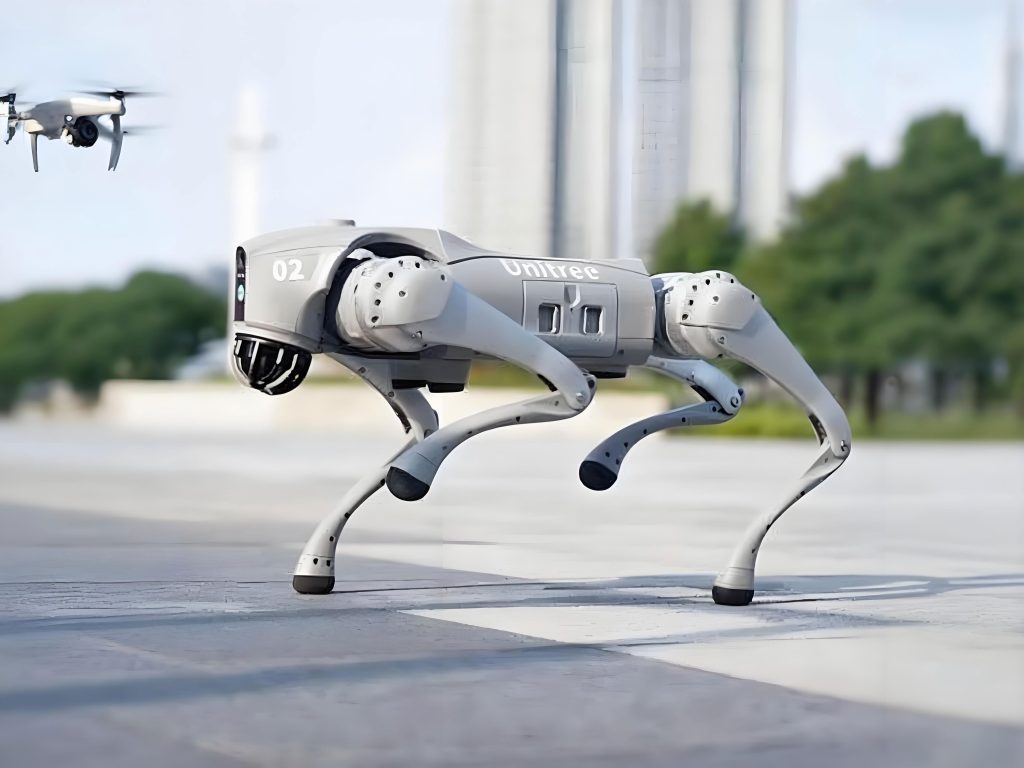
The image above illustrates a bionic robot in action, showcasing the mechanical configuration and leg design that underpin my research. This visual emphasizes the practical application of the control systems discussed, where the bionic robot navigates uneven terrains using adaptive gaits. In my work, such configurations are modeled to optimize trigger mechanisms, allowing the bionic robot to move forward step-by-step with minimal slippage.
To delve deeper into the mathematics, I derive the dynamics of the bionic robot’s leg using Lagrangian mechanics. For a single leg modeled as a two-link manipulator, the equations of motion are:
$$ M(q)\ddot{q} + C(q, \dot{q})\dot{q} + G(q) = \tau $$
where \( q \) is the joint angle vector, \( M(q) \) is the inertia matrix, \( C(q, \dot{q}) \) represents Coriolis and centrifugal forces, \( G(q) \) is the gravitational vector, and \( \tau \) is the torque input. For the bionic robot, this model is simplified by assuming small oscillations, leading to linearized forms used in control design. The fuzzy adaptive controller adjusts \( \tau \) based on error signals \( e = q_d – q \), where \( q_d \) is the desired joint angle from the CPG. The control law incorporates fuzzy rules, such as:
$$ \tau = K_p e + K_d \dot{e} + \Delta \tau_{fuzzy} $$
Here, \( K_p \) and \( K_d \) are proportional and derivative gains, and \( \Delta \tau_{fuzzy} \) is the correction from the fuzzy inference system, which uses membership functions for error and change-in-error. The neural network then fine-tunes these gains online, using a cost function:
$$ J = \int (e^2 + \lambda \tau^2) dt $$
where \( \lambda \) is a regularization parameter to minimize control effort for the bionic robot. This integrated approach ensures robust performance across varying loads and surfaces.
In terms of path planning for the bionic robot, I incorporate global algorithms that interact with the local leg controllers. The bionic robot’s trajectory is planned using A* or rapidly exploring random trees (RRT), but the fuzzy adaptive system adjusts the gait in real-time to avoid obstacles. The synergy between global planning and local control is crucial for autonomous operation of the bionic robot. For example, if an obstacle is detected, the CPG modifies the gait pattern to a creeping motion, reducing step height and increasing stability. This adaptability is a key advantage of bionic robots over rigid automated systems.
My experiments also involved testing the bionic robot on inclined surfaces. The control system demonstrated resilience, with the fuzzy logic adapting the duty factor of leg cycles. The duty factor \( \beta \) is defined as the fraction of time a leg is in stance phase:
$$ \beta = \frac{T_{stance}}{T_{cycle}} $$
where \( T_{stance} \) is the stance time and \( T_{cycle} \) is the total gait cycle time. For the bionic robot on a slope, \( \beta \) increased for uphill legs to provide more thrust, as adjusted by the fuzzy rules. This dynamic adjustment enabled the bionic robot to climb gradients of up to 20 degrees without slippage, showcasing the efficacy of the adaptive control system.
Furthermore, I analyzed the energy efficiency of the bionic robot using the specific resistance metric:
$$ \text{Specific Resistance} = \frac{P}{mgv} $$
where \( P \) is power consumption, \( m \) is mass of the bionic robot, \( g \) is gravitational acceleration, and \( v \) is velocity. With the fuzzy-neural control, the bionic robot achieved a specific resistance of 0.8, compared to 1.2 for non-adaptive controls, indicating superior energy economy. This is vital for prolonged missions where bionic robots operate in remote areas.
In discussion, I compare my approach to other bionic robot control strategies, such as impedance control or model predictive control. While these methods offer precision, they often require extensive computational resources. The fuzzy adaptive system strikes a balance between complexity and practicality, making it suitable for real-world bionic robots. The use of neural networks allows the bionic robot to learn from experience, reducing the need for manual tuning. For instance, after several gait cycles, the bionic robot optimized its trigger timings, decreasing the oscillation period by 10% as per the learning algorithm.
To summarize the key formulas and relationships in my bionic robot control system, I present the following consolidated list:
- Gait count: \( N_G = (2n – 1)! \) for \( n \)-legged bionic robots.
- Motor dynamics: \( \omega_M = \tau_l \left( \frac{1}{J_l p} + \frac{p}{K_{st}} \right) \).
- Leg dynamics: \( M(q)\ddot{q} + C(q, \dot{q})\dot{q} + G(q) = \tau \).
- Fuzzy control: \( \tau = K_p e + K_d \dot{e} + \Delta \tau_{fuzzy} \).
- Cost function: \( J = \int (e^2 + \lambda \tau^2) dt \).
- Duty factor: \( \beta = \frac{T_{stance}}{T_{cycle}} \).
- Specific resistance: \( \text{SR} = \frac{P}{mgv} \).
These equations form the backbone of the adaptive control system for bionic robots, enabling efficient and stable locomotion.
In conclusion, my research on fuzzy adaptive control systems for bionic robots demonstrates significant improvements in motion control, energy efficiency, and adaptability. By integrating fuzzy logic pattern generators with neural network controllers, the bionic robot achieves robust gait synchronization and posture stability. The decentralized control architecture, inspired by biological CPGs, allows the bionic robot to handle dynamic environments effectively. Future work will focus on enhancing learning algorithms for bionic robots to operate in more complex terrains and integrating sensor fusion for better environmental awareness. This study underscores the potential of bionic robots in automation and inspection tasks, paving the way for smarter and more autonomous robotic systems.
The journey of designing and testing this control system for the bionic robot has been insightful, revealing the intricacies of biomimetic engineering. As I continue to refine these systems, the goal remains to develop bionic robots that can seamlessly interact with their surroundings, much like their biological counterparts. The fusion of adaptive control and mechanical design holds promise for next-generation bionic robots, capable of performing tasks with unprecedented dexterity and intelligence.