
In the realm of advanced ceramic production, the adoption of robotic systems to replace manual operations has become a pivotal research and development focus, particularly in the firing stage. The use of robots or manipulators in ceramic kilns has gained widespread popularity due to high automation levels, offering significant advancements in efficiency and safety. However, the high-temperature environment post-firing poses substantial challenges, such as intense labor requirements and operational difficulties for human workers. As a designer involved in this field, I aim to address these issues by developing a specialized end effector for industrial robots. This end effector is designed to handle ceramic products after firing, leveraging the Huashu JR612 industrial robot platform. The primary goal is to create a solution that enhances productivity, ensures reliability under extreme conditions, and integrates seamlessly into automated production lines. In this article, I will detail the structural design process, from initial requirements to final validation, emphasizing key aspects like positioning accuracy, clamping force, thermal deformation reduction, and adaptability to high-temperature scenarios. The end effector, as a critical component, must meet stringent criteria to perform tasks such as grabbing and placing ceramic items efficiently and safely.
The design process begins with a comprehensive set of requirements derived from the specific application in the ceramic industry. Based on my analysis, the end effector must fulfill several critical parameters to ensure optimal performance. First, the clamping force is essential for securing workpieces during manipulation. I calculated that a force range of 3–4 N is necessary to prevent slippage or dropping, especially given the delicate nature of ceramic surfaces. This can be expressed using the basic force formula: $$F = P \times A$$ where $F$ is the clamping force, $P$ is the pneumatic pressure, and $A$ is the effective piston area of the actuator. For precision, the end effector must achieve a high positioning accuracy, with a repeatability of ±0.1 mm, to accommodate fine operations in automated setups. Additionally, structural simplicity and lightweight design are paramount to reduce the load on the robot arm, aligning with the payload capacity of the Huashu JR612 robot. The total weight of the assembled end effector should not exceed 4 kg to maintain dynamic performance and energy efficiency.
Another crucial requirement is adaptability to high-temperature environments. Ceramic products emerge from kilns with surface temperatures reaching up to 400°C, which necessitates the use of heat-resistant materials to minimize thermal deformation. Thermal expansion can be modeled using the formula: $$\Delta L = \alpha L \Delta T$$ where $\Delta L$ is the change in length, $\alpha$ is the coefficient of thermal expansion, $L$ is the original length, and $\Delta T$ is the temperature change. To avoid damage to fragile ceramic surfaces, the end effector must incorporate soft gripping mechanisms, such as compliant pads, that distribute force evenly and prevent scratches. Furthermore, the design should support batch handling to improve throughput; specifically, the end effector must be capable of grabbing four pieces simultaneously with a production cycle time of 6 seconds per operation. This necessitates a modular and scalable architecture, allowing for quick更换 of components to suit different product shapes and sizes. Table 1 summarizes the key design requirements for the end effector.
| Parameter | Specification |
|---|---|
| Clamping Force | 3–4 N |
| Positioning Accuracy | ±0.1 mm |
| Maximum Weight | 4 kg |
| Operating Temperature | Up to 400°C |
| Number of Pieces per Grab | 4 |
| Cycle Time | 6 seconds |
| Repeatability | High (as per robot specs) |
Selecting an appropriate driving mechanism is a fundamental step in the design of the end effector. I evaluated two common pneumatic options: traditional telescopic cylinders and finger cylinders. Telescopic cylinders operate by using气压 to extend and retract a piston, providing linear motion through multiple stages. While they offer significant stroke lengths, their complexity in structure and potential for increased mass make them less suitable for lightweight, precision applications. In contrast, finger cylinders, also known as pneumatic grippers, convert pneumatic energy into linear or angular motion to open and close gripping fingers. Their compact, integrated design allows for direct attachment to robot arms, reducing overall complexity and weight. For this end effector, the primary consideration is the ability to generate sufficient clamping force with minimal footprint. The force output of a finger cylinder can be derived from the same formula $F = P \times A$, where $A$ depends on the cylinder bore diameter. After analyzing various models, I chose the MHZ2 series finger cylinders due to their high rigidity, precise导轨 alignment, and customizable initial positions. Specifically, the MHZ2-16D model was selected based on its bore diameter of 16 mm, which provides a clamping force of 3.4 N for external gripping and 4.5 N for internal gripping at standard pneumatic pressures (typically 0.4–0.6 MPa). This aligns well with the required 3–4 N range. Table 2 outlines the specifications of the MHZ2 series finger cylinders, highlighting key parameters for decision-making.
| Bore Diameter (mm) | Opening/Closing Stroke (mm) | Closed Jaw Distance (mm) | Open Jaw Distance (mm) | External Grip Force (N) | Internal Grip Force (N) |
|---|---|---|---|---|---|
| 6 | 4 | 8.0 | 12.0 | 0.33 | 0.61 |
| 10 | 4 | 11.2 | 15.2 | 1.1 | 1.7 |
| 16 | 6 | 14.9 | 20.9 | 3.4 | 4.5 |
| 20 | 10 | 16.3 | 26.3 | 4.2 | 6.6 |
| 25 | 14 | 19.3 | 33.3 | 6.5 | 10.4 |
The installation base of the end effector serves as the critical interface between the robot arm and the gripping mechanism. For the Huashu JR612 industrial robot, the mounting dimensions must be precisely matched to ensure stable连接. I referred to the robot’s end flange specifications, which include a circular pattern of mounting holes for screw attachment. Using 3D modeling software, I designed an installation base that replicates these dimensions, incorporating features like alignment pins and threaded inserts to facilitate accurate and repeatable assembly. The base is constructed from lightweight aluminum alloy to minimize weight while maintaining structural integrity. The design also accounts for thermal isolation, as the base may be exposed to radiant heat from the ceramic products. By incorporating insulating spacers or coatings, I reduced heat transfer to the robot arm, thereby protecting sensitive components. The installation base is engineered to support the modular attachment of multiple finger cylinders, enabling the simultaneous operation of four gripping units. This modular approach enhances the versatility of the end effector, allowing for quick reconfiguration based on production needs. The overall design emphasizes robustness and precision, ensuring that the end effector can withstand the dynamic loads encountered during high-speed operations.
The gripping jaws are the components that directly interact with the ceramic products, making their design crucial for both functionality and product protection. I considered two contact methods: surface contact and point contact. Surface contact involves large-area interaction between the jaws and the workpiece, which provides stable gripping and even force distribution. This method is suitable for flat or regular-shaped items but may not be ideal for high-temperature applications due to potential thermal expansion issues. Point contact, on the other hand, uses limited contact points to reduce thermal传导 and minimize the risk of damage to fragile surfaces. For ceramic products, which are prone to cracking under stress concentration, point contact with compliant materials is preferred. To address the high-temperature requirement, I integrated heat-resistant pads made of materials like asbestos or ceramic fibers onto the jaw tips. These pads are attached via adjustable screws, allowing for fine-tuning of the grip position and force distribution. The jaw design follows a two-finger configuration, which is simple and effective for cylindrical or box-shaped ceramic items. The fingers are actuated by the selected MHZ2-16D finger cylinders, with the stroke length optimized to accommodate variations in product dimensions. The force exerted by the jaws can be calculated using the lever principle: $$F_g = \frac{F_c \times L_a}{L_b}$$ where $F_g$ is the gripping force at the jaw tip, $F_c$ is the cylinder force, $L_a$ is the distance from the pivot to the cylinder attachment, and $L_b$ is the distance from the pivot to the contact point. By adjusting these lengths, I achieved the desired 3–4 N clamping force while ensuring that the end effector remains lightweight and responsive.
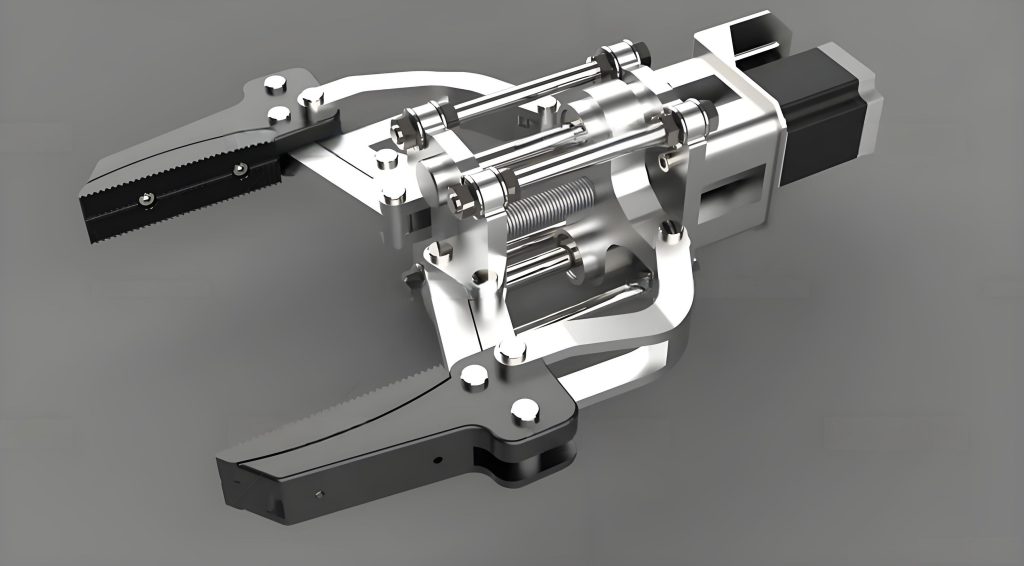
The overall structure of the end effector integrates the installation base, finger cylinders, and gripping jaws into a cohesive unit. My design employs a modular layout where four MHZ2-16D finger cylinders are mounted on a common底板, arranged in a rectangular pattern to handle four ceramic pieces at once. This configuration maximizes space efficiency and allows for independent operation of each gripping unit, enhancing flexibility. The use of standardized components, such as the finger cylinders, reduces manufacturing costs and simplifies maintenance. To further enhance adaptability, the jaw fingers are designed as interchangeable modules, enabling quick swaps for different product geometries. The structural analysis focused on minimizing weight while ensuring stiffness to prevent deflection during operation. I applied finite element analysis (FEA) to evaluate stress distributions under load, using the formula for bending stress: $$\sigma = \frac{M \times y}{I}$$ where $\sigma$ is the stress, $M$ is the bending moment, $y$ is the distance from the neutral axis, and $I$ is the moment of inertia. The results confirmed that the aluminum alloy structure can withstand the anticipated forces without significant deformation. Additionally, thermal analysis was conducted to assess the impact of high temperatures on material properties. By selecting materials with low thermal expansion coefficients and incorporating cooling channels or heat shields, I mitigated potential thermal变形. The end effector’s total weight was kept under 4 kg, aligning with the robot’s payload capacity, and its compact dimensions ensure it does not interfere with the robot’s workspace. This holistic approach to structural design ensures that the end effector meets all functional requirements while being cost-effective and easy to deploy.
Assembly analysis is a critical phase in the digital design process, allowing for the verification of fit and function before physical prototyping. Using 3D CAD software, I created a virtual assembly of the end effector, incorporating all components from the installation base to the gripping jaws. The software’s interference detection tools were employed to identify any conflicts between parts, such as clashes or incorrect clearances. Through iterative adjustments, I resolved issues like misaligned mounting holes or insufficient gaps for thermal expansion. The assembly process emphasized precise constraints, such as concentricity for rotating joints and parallelism for sliding surfaces, to ensure smooth operation. I also simulated the assembly sequence to optimize manufacturing and maintenance procedures. For instance, the finger cylinders are designed with quick-release mechanisms for easy replacement, reducing downtime in production environments. The digital model facilitated the generation of detailed technical drawings, including tolerance specifications and surface finish requirements. This comprehensive assembly analysis not only validated the design but also provided a foundation for future modifications, supporting the goal of a versatile and reliable end effector. The use of digital tools significantly accelerated the development timeline and reduced costs associated with physical prototyping.
Motion simulation analysis was conducted to evaluate the dynamic performance of the end effector during gripping operations. I defined the kinematic chain starting from the robot arm flange, through the installation base, to the finger cylinders and jaws. The simulation involved two primary states: the open position, where the jaws are retracted to avoid contact with the workpiece, and the closed position, where the jaws grip the ceramic products. By applying pneumatic pressure inputs to the finger cylinders, I modeled the linear motion of the pistons, which translates into the opening and closing of the jaws. The displacement over time can be described by the equation of motion for a pneumatic actuator: $$s = \frac{P \times A}{m} \times t^2$$ where $s$ is the displacement, $P$ is the pressure, $A$ is the area, $m$ is the mass of moving parts, and $t$ is time. However, for simplicity, I used software-based dynamic simulation to capture realistic behaviors, including acceleration and deceleration phases. The results showed that the end effector can complete a full gripping cycle within the required 6-second timeframe, with the jaws achieving the specified stroke of 6 mm for the MHZ2-16D cylinders. The simulation also confirmed that the clamping force reaches 3.4 N at standard operating pressure, sufficient to secure the ceramic items without causing damage. Additionally, I analyzed the trajectory of the end effector during robot arm movements, ensuring that no collisions occur with surrounding equipment. The motion simulation provided valuable insights into the responsiveness and reliability of the design, highlighting areas for improvement such as reducing inertia by optimizing mass distribution. Overall, the simulation validated that the end effector performs as intended, meeting all operational criteria for automated ceramic handling.
In conclusion, the design of this end effector for the Huashu JR612 industrial robot successfully addresses the challenges of high-temperature ceramic handling. Through a methodical approach, I integrated key aspects such as precise clamping force, thermal resistance, lightweight construction, and modularity. The selection of MHZ2 series finger cylinders provided an optimal balance of force and compactness, while the use of heat-resistant jaw pads ensured product safety under extreme conditions. The modular architecture allows for easy adaptation to different product shapes, enhancing the end effector’s versatility across various production scenarios. Digital tools, including 3D modeling and motion simulation, played a crucial role in refining the design and validating performance without physical prototypes, thereby reducing development costs and time. This end effector not only improves efficiency in ceramic manufacturing by enabling batch handling and faster cycle times but also contributes to cost savings through reduced labor and material waste. Furthermore, the design principles explored here can be extended to other industries requiring specialized end effectors for harsh environments. As automation continues to evolve, the importance of tailored end effector solutions cannot be overstated, and this project underscores the value of integrating mechanical design with digital仿真 to achieve robust and adaptable systems. The successful implementation of this end effector demonstrates how targeted engineering can overcome specific industrial challenges, paving the way for more advanced robotic applications in the future.
To further elaborate on the technical details, I have included additional formulas and tables that summarize the design parameters and performance metrics. For instance, the relationship between pneumatic pressure and clamping force can be expressed in a tabular format for different cylinder sizes, as shown in Table 3. This helps in selecting appropriate components for similar applications. Additionally, the thermal analysis involved calculating the heat flux through the end effector structure using Fourier’s law: $$q = -k \frac{dT}{dx}$$ where $q$ is the heat flux, $k$ is the thermal conductivity, and $\frac{dT}{dx}$ is the temperature gradient. By modeling this, I ensured that critical components remain within safe temperature limits. The use of such analytical methods enhances the reliability of the end effector in real-world conditions. Moreover, the modular design approach facilitates scalability; for example, the end effector can be configured with different numbers of finger cylinders to handle varying batch sizes, as summarized in Table 4. This flexibility is key to meeting diverse production demands while maintaining cost-effectiveness. Overall, this project highlights the iterative nature of end effector design, where continuous refinement based on simulation and analysis leads to optimized outcomes. The integration of these elements ensures that the end effector not only meets immediate needs but also adapts to future challenges in industrial automation.
| Cylinder Model | Bore Diameter (mm) | Pressure (MPa) | Clamping Force (N) |
|---|---|---|---|
| MHZ2-10 | 10 | 0.4 | 1.1 |
| MHZ2-10 | 10 | 0.6 | 1.65 |
| MHZ2-16 | 16 | 0.4 | 3.4 |
| MHZ2-16 | 16 | 0.6 | 5.1 |
| MHZ2-20 | 20 | 0.4 | 4.2 |
| MHZ2-20 | 20 | 0.6 | 6.3 |
| Configuration | Number of Finger Cylinders | Maximum Pieces per Grab | Estimated Weight (kg) |
|---|---|---|---|
| Basic | 2 | 2 | 2.5 |
| Standard | 4 | 4 | 3.8 |
| Extended | 6 | 6 | 5.2 |
The development of this end effector also involved considerations for energy efficiency and sustainability. By optimizing the pneumatic system, I minimized air consumption, which can be quantified using the formula for volumetric flow rate: $$Q = A \times v$$ where $Q$ is the flow rate, $A$ is the cross-sectional area of the cylinder, and $v$ is the piston velocity. Reducing flow rate lowers operational costs and environmental impact. Furthermore, the choice of recyclable materials, such as aluminum, aligns with green manufacturing principles. The end effector’s durability reduces the need for frequent replacements, contributing to waste reduction. In terms of safety, the design incorporates fail-safe mechanisms, such as spring-return features in the finger cylinders, to ensure that the jaws open in case of power loss, preventing workpiece damage or accidents. These aspects underscore the holistic approach taken in this project, where technical performance is balanced with economic and ecological factors. The end effector serves as a testament to how innovative design can drive progress in industrial robotics, offering solutions that are not only effective but also responsible. As I reflect on this process, it is clear that the iterative integration of digital tools and practical insights is essential for advancing end effector technology, and I anticipate that future developments will build upon these foundations to achieve even greater efficiencies and capabilities.