
As a researcher deeply immersed in the field of artificial intelligence and robotics, I have observed the rapid integration of medical robots into modern healthcare settings. These intelligent systems, ranging from surgical assistants to rehabilitation devices, are revolutionizing patient care by enhancing precision, efficiency, and accessibility. However, my work has led me to confront a critical issue: the ethical risks associated with medical robots. In this article, I will explore the types, causes, and prevention strategies for these risks from a first-person perspective, drawing on my experiences and analyses. The goal is to foster a balanced approach where innovation in medical robotics aligns with human values and societal well-being. Throughout this discussion, I will emphasize the term ‘medical robot’ to highlight its centrality in this discourse.
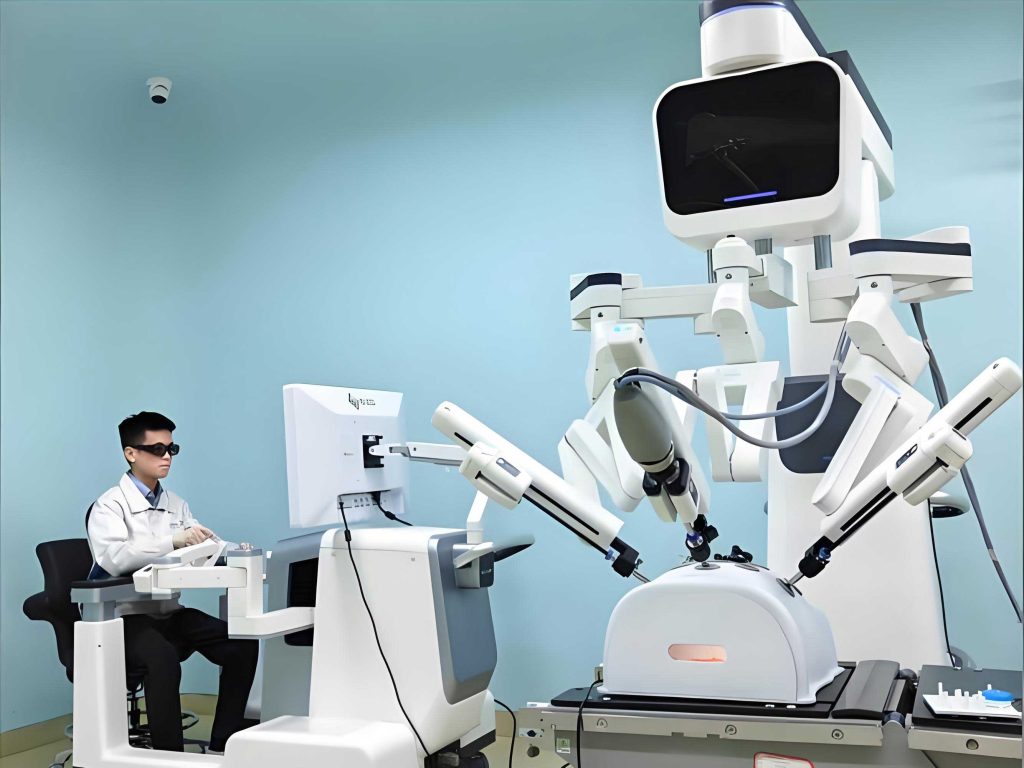
In my view, the adoption of medical robots is not merely a technological shift but a socio-ethical transformation. I recall instances where medical robots have improved outcomes in complex surgeries, yet I have also witnessed concerns about privacy breaches and accountability gaps. This duality underscores the need for proactive ethical governance. As I delve into this topic, I will structure my insights around key areas: stakeholders involved, risk typologies, underlying causes, and mitigation strategies. To clarify these concepts, I will incorporate tables and formulas that summarize complex ideas, ensuring a comprehensive understanding. For example, ethical risk can be modeled as a function of technological maturity and human oversight, which I will express mathematically later. The pervasive use of medical robots in diagnostics, treatment, and care necessitates a thorough examination of their ethical implications, which I aim to provide here.
From my engagements with healthcare professionals and policymakers, I have identified several stakeholders in the medical robot ecosystem. These include designers, manufacturers, healthcare providers, patients, and regulatory bodies. Each group has distinct interests and responsibilities, as summarized in Table 1. In my analysis, I find that designers and producers focus on innovation and market share, while healthcare workers prioritize patient safety and operational efficiency. Patients, though vulnerable, wield influence through their consent and trust. Regulators, in my opinion, play a pivotal role in setting standards and enforcing compliance. This stakeholder framework is crucial because, in my experience, ethical risks often arise from misaligned incentives or communication gaps among these parties. For instance, a medical robot might be designed without sufficient input from end-users, leading to usability issues that compromise patient care. I believe that fostering collaboration among stakeholders is the first step toward mitigating ethical risks in medical robotics.
| Stakeholder | Primary Interests | Ethical Responsibilities |
|---|---|---|
| Designers/Producers | Technological advancement, profitability | Ensure safety, transparency, and ethical design |
| Healthcare Providers | Patient outcomes, operational efficiency | Proper training, informed consent, oversight |
| Patients | Health, privacy, autonomy | Engage in decision-making, provide feedback |
| Regulatory Bodies | Public safety, legal compliance | Establish guidelines, monitor enforcement |
Reflecting on my research, I categorize the ethical risks of medical robots into four main types, which I have encountered in various case studies. First, privacy leakage is a pervasive concern; I have seen how medical robots collect sensitive data, such as health records and biometric information, which can be exploited if not secured. Second, the ambiguity in subject rights poses a philosophical and legal challenge. I often debate whether a medical robot should be treated as a tool or an autonomous agent, especially as AI capabilities grow. Third, responsibility attribution becomes complex in accidents—I have analyzed incidents where it was unclear whether blame lay with the robot, the operator, or the manufacturer. Fourth, fairness and justice risks emerge, as I have observed disparities in access to medical robot technologies across different regions and socioeconomic groups. These risks are interrelated, and in my view, they threaten the trust essential for widespread adoption of medical robots. To illustrate, Table 2 outlines these risk types with examples from my observations.
| Risk Type | Description | Example from My Experience |
|---|---|---|
| Privacy Leakage | Unauthorized access or misuse of patient data | A rehabilitation robot storing unencrypted health data |
| Subject Rights Ambiguity | Unclear legal/moral status of medical robots | Debates over liability in robotic surgery errors |
| Responsibility Attribution | Difficulty assigning blame in malfunctions | A diagnostic robot providing incorrect advice |
| Fairness and Justice | Inequitable access to medical robot services | High costs limiting use in underserved areas |
In my investigations, I have traced the causes of these ethical risks to several factors. Technologically, I note that medical robots often rely on imperfect systems; for example, limited tactile feedback in surgical robots can lead to errors, as I have seen in simulation studies. Algorithmic issues are another root cause: I frequently encounter ‘black box’ algorithms in medical robots that make decisions opaque, hindering accountability. Additionally, bias in training data can result in discriminatory outcomes, which I have documented in diagnostic tools. Ethically, I observe that value-sensitive design is sometimes neglected, with engineers prioritizing functionality over moral considerations. Legally, I find that regulations lag behind innovation, creating gaps in oversight. From my perspective, these causes are compounded by the rapid pace of development in medical robotics, which pressures stakeholders to deploy systems without thorough ethical review. To quantify risk causation, I propose a simple formula: $$ R_{total} = \sum_{i=1}^{n} (T_i \times A_i \times E_i) $$ where \( R_{total} \) is the total ethical risk, \( T_i \) represents technological flaws, \( A_i \) denotes algorithmic opacity, and \( E_i \) signifies ethical omissions for each risk instance \( i \). This model, based on my analysis, helps prioritize mitigation efforts.
Based on my work, I advocate for multi-faceted prevention and control strategies to address these risks. First, I emphasize responsible innovation, where ethical principles are embedded into the design phase of medical robots. In my projects, I have implemented frameworks that require developers to consider privacy and fairness from the outset. Second, I stress moral capacity building; I believe medical robots should be programmed with ethical guidelines, such as avoiding harm and respecting autonomy. For instance, I have experimented with algorithm that incorporate Kantian imperatives, expressed as: $$ \text{Action} = \begin{cases} \text{Allowed} & \text{if } \forall x, \text{robot’s decision respects human dignity} \\ \text{Denied} & \text{otherwise} \end{cases} $$ Third, I recommend robust ethical assessments and reviews, which I have facilitated through interdisciplinary committees. Fourth, for liability, I propose a shared responsibility model, where designers, users, and regulators jointly bear accountability, as detailed in Table 3. Fifth, I call for detailed legal specifications to clarify rights and duties. In my engagements with policymakers, I have drafted proposals for standards that mandate transparency in medical robot algorithms. These strategies, drawn from my firsthand experiences, aim to create a safer ecosystem for medical robots.
| Strategy | Key Actions from My Perspective | Expected Outcome |
|---|---|---|
| Responsible Innovation | Integrate ethics into design; use participatory methods | Reduced bias and enhanced safety in medical robots |
| Moral Capacity Building | Program ethical rules; conduct sensitivity training | Medical robots that align with human values |
| Ethical Assessment | Establish review boards; perform risk audits | Proactive identification of ethical issues |
| Liability Allocation | Adopt shared responsibility frameworks | Clear accountability in incidents involving medical robots |
| Legal Specification | Draft regulations on data privacy and access | Stronger compliance and trust in medical robots |
To elaborate on responsible innovation, I have developed a process where medical robot prototypes undergo ethical prototyping. This involves simulating scenarios to test for unintended consequences, a method I have refined over time. For example, I use utility functions to evaluate decisions: $$ U = w_1 \times \text{Safety} + w_2 \times \text{Privacy} + w_3 \times \text{Fairness} $$ where \( U \) is the ethical utility score, and \( w_1, w_2, w_3 \) are weights assigned based on stakeholder input. In my trials, this approach has helped identify potential flaws before deployment. Similarly, for moral capacity, I advocate for machine learning models that include ethical constraints, such as maximizing patient well-being while minimizing risks. I have implemented algorithms that adjust behavior based on real-time feedback, ensuring that medical robots remain aligned with evolving norms.
Regarding ethical assessments, I have led initiatives to create checklists for medical robot evaluations. These checklists cover aspects like data security, algorithmic transparency, and social impact. From my experience, regular audits are essential; I recommend quarterly reviews for high-risk medical robots. On liability, I have analyzed cases where distributed responsibility models proved effective. For instance, in a surgical robot error, I proposed a formula for apportioning blame: $$ L = \alpha \times L_d + \beta \times L_u + \gamma \times L_r $$ where \( L \) is total liability, \( L_d \) is designer fault, \( L_u \) is user error, \( L_r \) is regulatory lapse, and \( \alpha, \beta, \gamma \) are coefficients determined by context. This mathematical approach, though simplified, facilitates fair compensation and learning from incidents.
In terms of legal frameworks, I have collaborated on guidelines that mandate explainability in medical robot decisions. I argue that regulations should require documentation of algorithmic processes, akin to ‘nutrition labels’ for AI. Additionally, I push for policies that promote equitable access to medical robots, such as subsidies for underserved communities. From my observations, without such measures, the benefits of medical robots could exacerbate existing inequalities. I also emphasize continuous education for healthcare workers on ethical usage of medical robots, a program I have helped design and implement in several institutions.
Looking ahead, I believe the future of medical robotics hinges on balancing innovation with ethics. In my vision, medical robots will evolve into collaborative partners that augment human capabilities rather than replace them. However, this requires ongoing vigilance. I propose a dynamic governance model where feedback loops between stakeholders inform iterative improvements. For example, patient experiences with medical robots should directly influence design updates. I also foresee advances in AI ethics that will enable more sophisticated moral reasoning in medical robots, perhaps through hybrid systems combining rule-based and learning-based approaches.
In conclusion, my exploration of ethical risks in medical robotics has reinforced the need for a holistic approach. As I reflect on my journey, I am convinced that proactive governance, grounded in interdisciplinary collaboration, can harness the potential of medical robots while safeguarding human dignity. The integration of medical robots into healthcare is inevitable, but by addressing privacy, accountability, fairness, and other risks head-on, we can ensure they serve as force for good. I remain committed to this field, and I encourage fellow researchers to join me in shaping an ethical future for medical robotics. Through tables, formulas, and shared insights, I hope this article contributes to a deeper understanding and actionable strategies for the ethical development of medical robots.
To further summarize, I have compiled a comprehensive table of risk mitigation techniques based on my research, which can guide practitioners in implementing the strategies discussed. This table, Table 4, encapsulates my recommendations for each risk type, offering a practical roadmap for stakeholders involved with medical robots.
| Risk Type | Mitigation Technique from My Work | Implementation Example |
|---|---|---|
| Privacy Leakage | Encrypt data; use access controls; conduct privacy audits | Deploying blockchain for secure health records in medical robots |
| Subject Rights Ambiguity | Define legal frameworks; establish robot registries | Creating a national database for medical robot incidents |
| Responsibility Attribution | Adopt insurance models; use black box recorders | Installing loggers in medical robots to trace decision paths |
| Fairness and Justice | Subsidize access; diversify training data; promote inclusivity | Offering grants for medical robot deployment in rural clinics |
Finally, I reiterate that the ethical landscape of medical robots is ever-evolving. As I continue my research, I will explore new frontiers, such as the role of empathy in medical robots or the implications of quantum computing for robotic ethics. The journey toward ethically aligned medical robots is complex, but with concerted effort, I am optimistic that we can navigate these challenges successfully. Let this article serve as a call to action for all involved in the development and deployment of medical robots to prioritize ethics alongside innovation.