
In the field of power transmission and motion control, the planetary roller screw mechanism (PRSM) stands out due to its exceptional load-carrying capacity, high precision, and long service life. As a researcher deeply involved in the design and analysis of such mechanisms, I have observed that the uneven distribution of load among the threads of the planetary roller screw can significantly impair performance, leading to reduced fatigue life and operational instability. Therefore, achieving a balanced load distribution—where the applied axial force is as uniformly as possible across all engaged threads—is paramount. This article presents a comprehensive study on the load balance design method for planetary roller screw mechanisms, focusing on two key aspects: structural parameter design and thread tolerance design. Through theoretical analysis and computational modeling, we aim to provide guidelines that enable designers to optimize planetary roller screw mechanisms for enhanced load distribution, thereby improving their reliability and longevity in demanding applications such as maritime, oil and gas, and precision machinery.
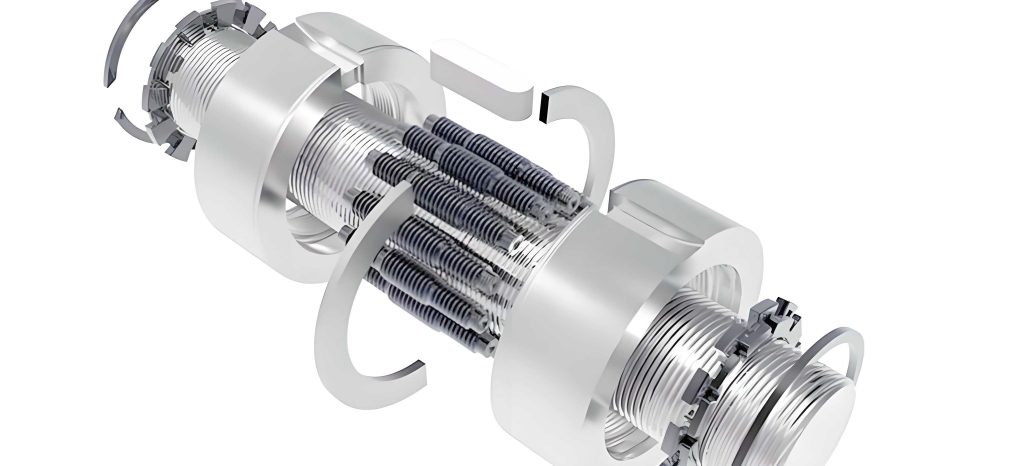
The planetary roller screw mechanism operates based on the meshing of threads among the screw, rollers, and nut. When an axial load is applied, the threads experience contact stresses, bending, and shear forces. Ideally, the load should be evenly shared by all threads in contact. However, due to elastic deformations of the components and manufacturing inaccuracies, the load distribution often becomes non-uniform, with some threads carrying excessively high loads (overloading) while others bear little or no load (underloading). This non-uniformity can lead to premature failure, increased wear, and reduced efficiency. Hence, the goal of load balance design is to minimize the disparity in load sharing, effectively achieving “no zero-load” and “no over-load” conditions. Our approach involves establishing design criteria based on thread strength and contact yield conditions, optimizing key parameters to influence load distribution, and actively controlling thread tolerances to compensate for deformations. This holistic method ensures that the planetary roller screw mechanism performs optimally under specified operational loads.
Thread Form Design Criteria for Planetary Roller Screw Mechanisms
Before delving into parameter optimization, it is essential to define the fundamental design criteria for the threads of a planetary roller screw mechanism. These criteria ensure that the threads can withstand the applied loads without failure or excessive plastic deformation. We consider two primary aspects: the strength of the thread root against bending and shear, and the contact yield condition to prevent plastic deformation at the contact points. Based on these, we derive the rated load and limit load for a single thread, which serve as benchmarks for design validation.
Strength Criteria for Thread Root
The threads of the screw, rollers, and nut in a planetary roller screw mechanism engage in point contacts. Under load, the thread teeth behave like cantilever beams, with the root section being critical for failure. To analyze this, we consider the engagement geometry. Let the screw, roller, and nut have nominal radii denoted as \( R_S \), \( R_R \), and \( R_N \), respectively. The half-angle of engagement for each component can be derived from geometric relations. For instance, for the screw side engagement, the half-angle \( \beta_S \) is given by:
$$ \beta_S = \arccos\left( \frac{OS^2 + OC_S^2 – O_RC_S^2}{2 \cdot OS \cdot OC_S} \right) $$
where \( OS \) is the distance from the screw center to the roller center, \( OC_S \) is the distance from the screw center to the contact point, and \( O_RC_S \) is the distance from the roller center to the contact point. Similar expressions hold for the roller and nut sides. The length of the engaged thread segment that carries load is then:
$$ l = \frac{2\pi \beta_X \cdot R_X}{180} $$
where \( \beta_X \) is the engagement half-angle for component X (screw, roller, or nut), and \( R_X \) is its nominal radius. The thread root is subjected to shear and bending stresses. The shear stress \( \tau \) at the root section m-m (assuming a rectangular cross-section with thickness \( c \) and load-bearing length \( l \)) due to an axial load \( f_a \) on the thread is:
$$ \tau = \frac{f_a}{c \cdot l} $$
The bending stress \( \sigma \) at the root, with thread flank height \( h_f \), is:
$$ \sigma = \frac{6 f_a h_f}{c^2 l} $$
To prevent failure, these stresses must not exceed the allowable values for the material. Let \( [\tau] \) be the allowable shear stress and \( [\sigma_b] \) be the allowable bending stress. Thus, the strength conditions are:
$$ \tau \leq [\tau], \quad \sigma \leq [\sigma_b] $$
Contact Yield Criterion
In addition to root strength, the contact between threads must remain elastic to avoid plastic deformation, which would degrade fatigue life. Using Hertzian contact theory, the elastic approach \( \delta \) between two contacting bodies under load \( Q \) is:
$$ \delta = \delta^* \left( \frac{3Q}{2\Sigma\rho \cdot E’} \right)^{2/3} \cdot \frac{\Sigma\rho}{2} $$
where \( \Sigma\rho \) is the sum of curvatures, \( E’ \) is the equivalent elastic modulus given by \( \frac{1}{E’} = \frac{1-\xi_1^2}{E_1} + \frac{1-\xi_2^2}{E_2} \) (with \( \xi \) and \( E \) being Poisson’s ratio and elastic modulus, respectively), and \( \delta^* \) is a contact parameter dependent on the curvature functions. The contact ellipse semi-axes \( a \) and \( b \) are:
$$ a = a^* \left( \frac{3Q}{2\Sigma\rho \cdot E’} \right)^{1/3}, \quad b = b^* \left( \frac{3Q}{2\Sigma\rho \cdot E’} \right)^{1/3} $$
where \( a^* \) and \( b^* \) are also contact parameters. The maximum contact pressure \( \sigma_{\text{max}} \) is:
$$ \sigma_{\text{max}} = \frac{3Q}{2\pi a b} $$
Applying the von Mises yield criterion, the yield limit in shear is \( \tau_s = \frac{1}{\sqrt{3}} \sigma_s \), where \( \sigma_s \) is the yield strength of the material. The relationship between maximum shear stress and contact pressure is \( \tau_{\text{max}} = k_{st} \sigma_{\text{max}} \), with \( k_{st} \) ranging from 0.30 to 0.33 depending on the ellipse aspect ratio \( b/a \). Setting \( \tau_{\text{max}} \leq \tau_s \) to avoid yield, we derive the critical contact load \( Q \) that prevents plastic deformation:
$$ Q = \frac{2}{3} \pi a^* b^* \left( \frac{\sigma_s}{\sqrt{3} k_{st}} \right)^3 \cdot \frac{1}{E’^2 \Sigma\rho^2} $$
The corresponding axial load per thread \( Q_{\text{axial}} \) is then:
$$ Q_{\text{axial}} = Q \cdot \cos\alpha_R \cdot \cos(\theta/2) $$
where \( \alpha_R \) is the helix angle of the roller and \( \theta \) is the thread profile angle.
Rated Load and Limit Load Definitions
Based on the above criteria, we define the rated load \( f_c \) as the maximum axial load per thread that ensures neither plastic contact deformation nor thread root failure. The limit load \( f_{\text{max}} \) is the maximum axial load per thread without thread root failure, regardless of contact yield. Thus:
$$ f_c = \min\left( Q_{\text{axial}}, \, c l [\tau], \, \frac{c^2 l [\sigma_b]}{6 h_f} \right) $$
$$ f_{\text{max}} = \min\left( c l [\tau], \, \frac{c^2 l [\sigma_b]}{6 h_f} \right) $$
These loads are crucial for evaluating the suitability of thread design parameters in a planetary roller screw mechanism. They must be considered alongside the load distribution characteristics to ensure that the maximum load on any thread does not exceed these limits.
Design Criteria for Planetary Roller Screw Parameters
To formalize the design process, we introduce a load distribution non-uniformity coefficient \( i_{Xj} \) for thread j on side X (screw side S or nut side N):
$$ i_{Xj} = \frac{f_{Xj}}{f_{\text{ave}}} $$
where \( f_{Xj} \) is the actual load on thread j, and \( f_{\text{ave}} \) is the average load per thread under uniform distribution. The maximum value \( \max[i_{Xj}] \) indicates the degree of non-uniformity. This coefficient is a function of the planetary roller screw design parameters:
$$ \max[i_{Xj}] = F(k, z, P, n, D_{\text{out}}, \dots) $$
where \( k \) is the screw-to-roller pitch diameter ratio, \( z \) is the number of rollers, \( P \) is the pitch, \( n \) is the number of threads per roller, and \( D_{\text{out}} \) is the nut outer diameter. The design must satisfy:
$$ \max[i_{Xj}] \cdot f_{\text{ave}} \leq f_{\text{max}} $$
This inequality ensures that even the most heavily loaded thread remains within safe limits. Therefore, parameter selection should aim to minimize \( \max[i_{Xj}] \) while meeting other performance requirements. The subsequent sections explore how each parameter influences load distribution and how to optimize them for load balance.
Parameter Design for Load Balance in Planetary Roller Screw Mechanisms
The structural parameters of a planetary roller screw mechanism play a pivotal role in determining load distribution. Our analysis focuses on key parameters: the screw-to-roller pitch diameter ratio \( k \), number of rollers \( z \), pitch \( P \), number of threads per roller \( n \), and nut outer diameter \( D_{\text{out}} \). Using a single-factor method, we investigate their effects on load distribution patterns, aiming to derive optimization guidelines that promote uniformity. The baseline design used for analysis is a planetary roller screw mechanism with a capacity of 15 kN, with parameters summarized in Table 1.
| Parameter | Symbol | Value |
|---|---|---|
| Screw pitch diameter | \( d_S \) | 12 mm |
| Roller pitch diameter | \( d_R \) | 4 mm |
| Nut pitch diameter | \( d_N \) | 20 mm |
| Nut outer diameter | \( D_{\text{out}} \) | 26 mm |
| Pitch | \( P \) | 0.8 mm |
| Screw starts | \( n_S \) | 5 |
| Roller starts | \( n_R \) | 1 |
| Nut starts | \( n_N \) | 5 |
| Thread profile angle | \( \theta \) | 90° |
| Threads per roller | \( n \) | 30 |
The material for all components is GCr15 bearing steel, with elastic modulus \( E = 212 \) GPa and Poisson’s ratio \( \xi = 0.29 \).
Influence of Screw-to-Roller Pitch Diameter Ratio \( k \) and Number of Rollers \( z \)
The ratio \( k = d_S / d_R \) is fundamentally linked to the number of screw starts \( n_S \) by the relation \( k = n_S – 2 \). This ratio affects the stiffness of the screw and roller shafts, which in turn influences load distribution. The axial stiffness ratio between screw and roller shafts is proportional to \( k^2 / z \), as shown in Table 2.
| \( k \) | \( n_S \) | Max rollers \( z_{\text{max}} \)** | Stiffness ratio \( k_{SS}/k_{SR} \)** |
|---|---|---|---|
| 1 | 3 | 5 | \( 2/z \) |
| 2 | 4 | 9 | \( 8/z \) |
| 3 | 5 | 12 | \( 18/z \) |
| 4 | 6 | 15 | \( 32/z \) |
We analyze load distribution for \( k = 1, 2, 3 \) with corresponding roller numbers \( z = 5, 8, 10 \), and for \( k = 4 \) with \( z = 9, 12, 15 \). The results indicate that non-uniformity is more pronounced on the screw side than on the nut side. As \( k \) increases or \( z \) increases, the load distribution becomes less uniform on both sides. For instance, with higher \( k \), the stiffness ratio decreases, making the interaction between screw-side and nut-side loads more significant. This leads to increased non-uniformity coefficients. However, increasing \( z \) reduces the load per roller and per thread, which can enhance fatigue life. Thus, a trade-off exists: while higher \( k \) and more rollers may improve load sharing among rollers, they exacerbate non-uniformity among threads. The design should select \( k \) based on spatial constraints, transmission requirements, and then fine-tune other parameters to mitigate non-uniformity. Essentially, the goal is to balance shaft stiffnesses to favor uniform load distribution.
Influence of Pitch \( P \)
The pitch is a critical thread form parameter that dictates other dimensions and manufacturing complexity. It also significantly affects load distribution due to its impact on shaft stiffness. We examine pitches of 0.4 mm, 0.6 mm, 0.8 mm, 1.0 mm, and 1.2 mm while keeping other parameters constant. The load distribution patterns show that as pitch increases, non-uniformity worsens on both sides. For example, on the screw side, the non-uniformity coefficient range expands from [0.83, 1.36] at \( P = 0.4 \) mm to [0.64, 2.13] at \( P = 1.2 \) mm. On the nut side, it changes from [0.95, 1.09] to [0.89, 1.39]. Notably, for pitches above 0.8 mm, the nut-side distribution exhibits a distinct “high at ends, low in middle” pattern. This occurs because larger pitches reduce the axial stiffness of both screw and nut shafts, increasing cumulative deformations and enhancing the coupling between screw-side and nut-side loads. Since the nut shaft is generally stiffer than the screw shaft, it is more sensitive to these interactions, leading to the observed pattern. Therefore, while a larger pitch may ease manufacturing, it can degrade load balance. The design must choose a pitch that balances stiffness requirements with distribution uniformity. Often, increasing pitch with larger screw diameters can relax precision demands, as discussed later.
Influence of Number of Threads per Roller \( n \)
Once pitch is set, the number of threads per roller \( n \) must be determined. This parameter directly influences how many threads share the load. We analyze \( n = 14, 20, 26, 32, 38 \). The results demonstrate that increasing \( n \) increases non-uniformity on both sides, with the screw side being more sensitive. For \( n > 26 \), the nut side again shows the “high at ends, low in middle” trend. However, too few threads would raise the average load per thread, potentially exceeding contact yield or strength limits. Thus, \( n \) should be chosen to satisfy the thread rated load criteria while minimizing non-uniformity. The optimal \( n \) often lies in a range where shaft stiffnesses are compatible. Using the earlier derived \( f_c \) and \( f_{\text{max}} \), we can iteratively select \( n \) such that \( \max[i_{Xj}] \cdot f_{\text{ave}} \leq f_{\text{max}} \). This ensures that even with non-uniform distribution, no thread is overloaded.
Influence of Nut Outer Diameter \( D_{\text{out}} \)
The nut outer diameter affects the radial size and the stiffness of the nut shaft. We vary \( D_{\text{out}} \) from 26 mm to 45 mm. Interestingly, changes in \( D_{\text{out}} \) have minimal impact on screw-side load distribution but significantly affect the nut side. As \( D_{\text{out}} \) increases, nut shaft stiffness rises, leading to more uniform load distribution initially. However, beyond a certain point (e.g., 40 mm in our case), the nut becomes too stiff, making it less able to accommodate deformations from the screw side, resulting in the “high at ends, low in middle” pattern. This highlights that excessive stiffness mismatch can be detrimental. Ideally, the nut shaft stiffness should be of the same order as the screw shaft stiffness to promote balanced load sharing. Therefore, \( D_{\text{out}} \) should be selected not merely for radial constraints but to achieve a favorable stiffness ratio. Table 3 summarizes the effects of each parameter on load distribution non-uniformity.
| Parameter | Effect on Non-uniformity | Guideline for Load Balance |
|---|---|---|
| Screw-to-roller ratio \( k \) | Increases with higher \( k \) | Choose based on starts; optimize other parameters to compensate. |
| Number of rollers \( z \) | Increases with more rollers | Balance between reducing per-roller load and increasing non-uniformity. |
| Pitch \( P \) | Increases with larger pitch | Select pitch that balances stiffness; consider diameter-pitch relation. |
| Threads per roller \( n \) | Increases with more threads | Choose to meet strength criteria while minimizing \( \max[i_{Xj}] \). |
| Nut outer diameter \( D_{\text{out}} \) | Initially improves, then worsens | Aim for nut stiffness comparable to screw stiffness. |
The underlying principle is that load distribution non-uniformity in a planetary roller screw mechanism stems from axial deformations of the screw and nut shafts, which accumulate along the engagement length. Thread deformations and contact deformations are local. Therefore, achieving load balance requires designing parameters so that the shaft stiffnesses of screw, rollers, and nut are matched to minimize differential deformations. This often involves iterative optimization using computational models to evaluate \( \max[i_{Xj}] \) for candidate designs.
Precision Design for Load Balance in Planetary Roller Screw Mechanisms
Beyond structural parameters, manufacturing inaccuracies, particularly pitch errors, play a crucial role in load distribution. In an ideal planetary roller screw mechanism, all threads would contact simultaneously under load. However, pitch deviations cause some threads to engage earlier (pre-load) or later (post-load), leading to uneven initial contact. This can exacerbate non-uniformity, especially if shaft stiffnesses are high, as errors are less compensated by elastic deformations. Therefore, precision design—actively controlling thread tolerances—is essential for load balance. We focus on pitch error control and tolerance band positioning.
Effect of Pitch Accuracy on Load Distribution
We simulate the impact of random pitch errors following normal distributions on load distribution. Consider three cases for roller pitch errors on the screw side: \( N(0, 0.25) \), \( N(0, 1) \), and \( N(0, 2.25) \), where the mean is zero and variance is in micrometers squared. The resulting load distributions show that positive errors increase load on corresponding threads, while negative errors decrease it. Higher variance leads to greater fluctuations. For \( N(0, 0.25) \), distribution closely resembles the error-free case. For \( N(0, 1) \), non-uniformity increases noticeably. For \( N(0, 2.25) \), severe fluctuations occur, with some threads heavily overloaded and others underloaded, even reversing the overall distribution trend. Similar effects are observed on the nut side, but with opposite patterns due to contact on the opposite flank. This sensitivity underscores the need for tight pitch tolerance in planetary roller screw mechanisms. Moreover, sensitivity increases with higher shaft stiffness (e.g., larger screw diameter or smaller pitch). Thus, for larger diameters, pitch should be increased to reduce stiffness, relaxing precision requirements. Alternatively, for a given design, tolerance grades must be chosen based on stiffness to prevent excessive load fluctuations.
Tolerance Design and Tolerance Band Positioning
Instead of merely minimizing errors, we can proactively design tolerances to compensate for deformations. By controlling the pitch accuracy and tolerance band position of screw, roller, and nut threads, we can tailor initial contact conditions to offset axial deformations under load, thereby promoting uniform load distribution. This requires knowledge of the expected deformations from the parameter design phase. For instance, if the screw shaft tends to elongate under load, causing end threads to carry more load, we can introduce slight positive pitch errors on the roller threads engaging with the screw (or negative errors on the nut side) to ensure middle threads contact earlier, balancing the load.
As an example, we specify pitch errors for the screw side as \( N(0.15, 0.25) \) and for the nut side as \( N(0.075, 0.25) \) (in micrometers). The mean shifts introduce deliberate biases. The resulting load distribution shows significant improvement: screw-side non-uniformity coefficient range becomes [0.96, 1.08], and nut-side becomes [0.98, 1.02], both much closer to unity than in the non-controlled case. The distribution patterns shift to a mild “high at ends, low in middle” shape, which is acceptable. This demonstrates that by strategically setting tolerance bands, we can achieve load balance even when structural parameters alone yield some non-uniformity.
The process for tolerance design in a planetary roller screw mechanism involves: (1) calculating expected axial deformations of screw and nut shafts under rated load using stiffness models; (2) determining the required pitch error profiles to compensate these deformations; (3) specifying tolerance grades and mean shifts for screw, roller, and nut threads accordingly. Typically, the screw lead determines the system lead, so its pitch accuracy must be highest. Roller and nut tolerances can be adjusted more freely. The allowable pitch error \( \Delta P \) can be related to deformation compensation by:
$$ \Delta P_{\text{comp}} = \frac{\delta_{\text{deform}}}{n} $$
where \( \delta_{\text{deform}} \) is the cumulative deformation over engagement length and \( n \) is threads per roller. Tolerance bands should be positioned such that the mean pitch error aligns with \( \Delta P_{\text{comp}} \). This proactive approach transforms tolerance control from a constraint into a design tool for load balance.
Comprehensive Load Balance Design Methodology
Integrating the above aspects, we propose a systematic methodology for load balance design of planetary roller screw mechanisms. This methodology ensures that threads share loads as uniformly as possible, maximizing capacity and life. The steps are outlined below.
- Establish Design Requirements: Define axial load capacity, speed, life, envelope dimensions, and material properties for the planetary roller screw mechanism.
- Preliminary Parameter Selection: Choose screw pitch diameter \( d_S \) based on load and space. Determine screw starts \( n_S \) and compute roller pitch diameter \( d_R = d_S / k \) with \( k = n_S – 2 \). Select number of rollers \( z \) within allowable range (Table 2). Choose pitch \( P \) considering stiffness and manufacturing. Estimate threads per roller \( n \) using strength criteria.
- Thread Form Design Check: Calculate rated load \( f_c \) and limit load \( f_{\text{max}} \) per thread using equations from Section 1. Ensure \( f_{\text{ave}} = F_{\text{axial}} / (z \cdot n) \leq f_c \), where \( F_{\text{axial}} \) is total axial load. If not, adjust \( n \) or \( z \).
- Load Distribution Analysis: Using a computational model (e.g., based on deformation compatibility and force equilibrium), compute load distribution for the candidate design. Obtain non-uniformity coefficients \( i_{Xj} \) and \( \max[i_{Xj}] \).
- Parameter Optimization: Iteratively adjust parameters \( P, n, D_{\text{out}} \) to minimize \( \max[i_{Xj}] \) while satisfying \( \max[i_{Xj}] \cdot f_{\text{ave}} \leq f_{\text{max}} \). Prioritize parameters that most affect stiffness matching. Use sensitivity analysis from Section 2.
- Precision Design: Based on optimized deformations, specify pitch tolerance grades and tolerance band positions for screw, roller, and nut threads. Aim for error distributions that compensate deformations (e.g., mean shifts as in Section 3). Validate via load distribution simulation with errors included.
- Final Verification: Ensure all design criteria are met: strength, contact yield, load distribution uniformity, and functional requirements. Perform fatigue life estimation if needed.
This methodology emphasizes the interplay between parameter design and precision design. For instance, if parameter optimization cannot reduce \( \max[i_{Xj}] \) below a threshold, precision design can be leveraged to further improve distribution. The core idea is to harmonize shaft stiffnesses through parameters and then fine-tune initial contacts through tolerances.
Discussion and Practical Considerations
Implementing load balance design for planetary roller screw mechanisms requires attention to practical aspects. First, computational models for load distribution must account for all relevant deformations: axial stretching of screw and nut shafts, bending of rollers, and local contact deformations. Our prior work uses matrix methods based on deformation compatibility, which accurately captures these effects. Second, material selection influences allowable stresses and stiffness. High-strength steels like GCr15 are common, but alternatives like tool steels or coatings may be used for extreme conditions. Third, manufacturing capabilities limit tolerance control. While tight tolerances improve balance, they increase cost. Hence, the designer must strike a balance between performance and manufacturability. Often, for large-diameter planetary roller screw mechanisms, slightly larger pitches can ease tolerance requirements without sacrificing load balance.
Another consideration is the effect of operating conditions. Thermal expansions, dynamic loads, and misalignments can alter load distribution. The design should incorporate safety factors. For example, the rated load \( f_c \) might be derated for dynamic applications. Additionally, lubrication and surface finish affect contact stresses and wear, indirectly influencing load distribution over time. Regular maintenance and monitoring are advised for critical applications.
The benefits of load balance design extend beyond longevity. Uniform load distribution reduces peak stresses, allowing a smaller, lighter planetary roller screw mechanism for the same capacity. It also minimizes vibration and noise, enhancing operational smoothness. Therefore, investing in thorough design analysis pays dividends in performance and reliability.
Conclusion
In this article, we have presented a comprehensive load balance design method for planetary roller screw mechanisms, addressing both structural parameter design and thread tolerance design. We derived thread form design criteria based on strength and contact yield conditions, providing equations for rated load and limit load. Through parametric studies, we elucidated the effects of key parameters—screw-to-roller ratio, number of rollers, pitch, threads per roller, and nut outer diameter—on load distribution non-uniformity. The fundamental insight is that optimizing these parameters aims to match the axial stiffnesses of screw, rollers, and nut to mitigate deformation-induced non-uniformity. Furthermore, we demonstrated that pitch errors significantly influence load distribution and that proactive tolerance design, involving control of accuracy and tolerance band positions, can compensate for deformations and enhance uniformity. The proposed methodology integrates these elements into a systematic design process, ensuring that planetary roller screw mechanisms achieve balanced load sharing among threads, thereby maximizing their load-carrying capacity, fatigue life, and operational stability. Future work may explore dynamic load distribution, thermal effects, and advanced manufacturing techniques for further refinement. Ultimately, this approach empowers engineers to design planetary roller screw mechanisms that meet the rigorous demands of modern high-performance applications.