
As I observe the rapid evolution of robotics, it becomes increasingly clear that we are standing at a pivotal juncture. The year 2025 is widely regarded as the commercial inception year for humanoid robots, marking a transition from laboratory curiosities to tangible economic actors. This shift is not merely about mechanical sophistication; it is fundamentally driven by an unprecedented convergence of compute power, generative models, and high-fidelity simulation. In this new era, the humanoid robot is evolving from a pre-programmed automaton into an entity capable of physical intelligence—understanding, reasoning, and acting autonomously in the complex, unstructured real world. My analysis delves into the core technological pillars enabling this transformation, with a particular focus on the comprehensive infrastructure provided by NVIDIA, which is laying the foundational bedrock for scalable physical AI.
The commercial landscape for humanoid robot platforms is experiencing explosive growth and intense competition. The so-called “commercialization元年” is evidenced by significant orders and the emergence of cost-competitive platforms. To quantify this momentum, consider the following projected market data:
| Market Segment | 2025 Projected Size (China) | Global Share (Approx.) | Primary Application Scenarios |
|---|---|---|---|
| Embodied AI Market | 5.295 Billion CNY | 27% | Factory floors, Service tasks |
| Humanoid Robot Market | 8.239 Billion CNY | 50% | Industrial manipulation, Logistics, Customer service |
This data underscores China’s significant role in the global humanoid robot ecosystem. The driving force behind this market readiness, however, is a paradigm shift in development philosophy. For decades, robotics advanced through iterative hardware refinement—a focus on the “body.” Today, the critical differentiator is the “brain.” The processing capability required for real-time perception, multimodal understanding, and safe control in dynamic environments has become the primary bottleneck and battleground. The performance of actuators and sensors across leading humanoid robot designs is converging; thus, the computational architecture determining the intelligence ceiling is now the key competitive frontier.
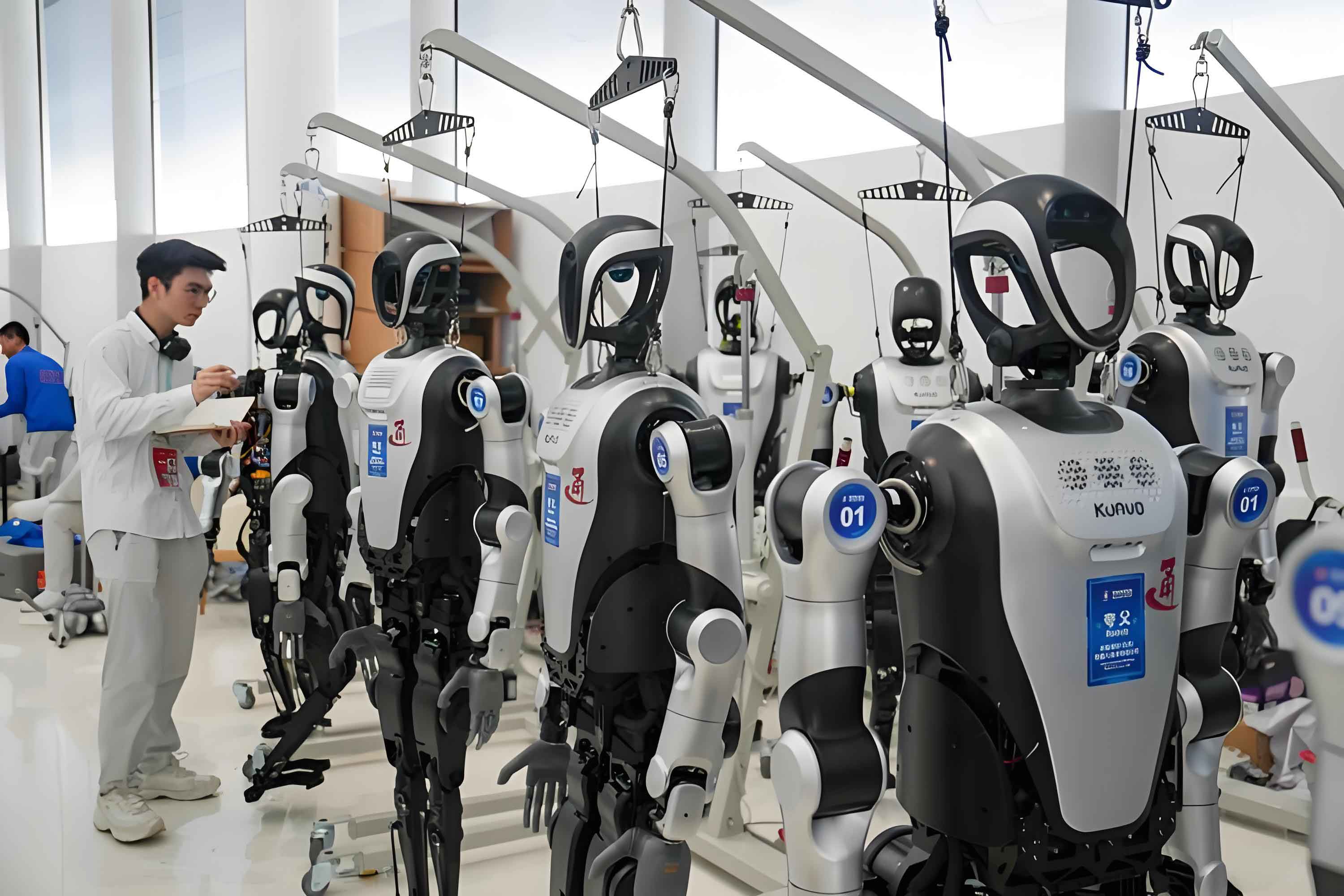
The journey to a capable humanoid robot is fraught with challenges. Training in the physical world is prohibitively expensive, time-consuming, and risky. This is where the triumvirate of simulation, generative models, and compute acts as a force multiplier, reshaping the entire technology landscape.
First, simulation has emerged as the indispensable “digital playground.” The paradigm is shifting from “build-then-test” to “simulate-first.” By creating physically accurate digital twins of robots and their environments, developers can conduct millions of training iterations in parallel, exploring edge cases and failure modes without the risk of damage or injury. This accelerates learning cycles from years to days. The efficacy of a simulation is often evaluated by its physical accuracy, which can be related to the fidelity of its numerical solvers. For instance, the stability of a humanoid robot‘s gait in simulation depends on accurately solving the equations of motion. A simplified representation of the dynamics for a robotic joint might involve:
$$ \tau = I \ddot{\theta} + b \dot{\theta} + k \theta + \tau_{ext} $$
where \( \tau \) is the motor torque, \( I \) is the inertia, \( \theta \) is the joint angle, \( b \) is the damping coefficient, \( k \) is the stiffness, and \( \tau_{ext} \) represents external disturbances. High-fidelity simulators model these and far more complex interactions (e.g., soft-body contacts, fluid dynamics) to generate training data that reliably transfers to reality.
Second, the model architecture itself has undergone a revolution. Large Language Models (LLMs) and Vision-Language Models (VLMs) excel in pattern recognition within text and images but lack an intrinsic understanding of 3D physics and cause-and-effect. The breakthrough for humanoid robots lies in the development of world models. A world model is a generative AI model that learns a compressed spatial and temporal representation of environmental dynamics. It predicts future states based on actions, effectively learning the “rules” of physics. Formally, we can think of it as learning a transition function:
$$ s_{t+1} = f(s_t, a_t) $$
where \( s_t \) is the world state (from multimodal sensor inputs) at time \( t \), and \( a_t \) is the action taken by the humanoid robot. The model \( f \) is trained to predict \( s_{t+1} \). More advanced models, like Vision-Language-Action (VLA) models, integrate linguistic understanding, enabling a humanoid robot to follow complex natural language instructions like “Pick up the blue tool on the left and place it gently in the red bin.”
Third, and most fundamentally, is compute. It is the engine for both training these massive models and for executing them in real-time at the edge. The computational demand follows a power law with model size and environment complexity. Training a world model for a humanoid robot requires petaflops-scale compute for weeks or months. Meanwhile, deployment demands teraflops-scale compute with strict latency constraints (often <10 ms) for stable control. The trend is unequivocal: data processing is moving to the edge. It is estimated that by 2025, the majority of data will be generated and processed outside traditional data centers. For a humanoid robot, this means its onboard computer must be a supercomputer in miniature.
Recognizing this holistic challenge, NVIDIA has architected a full-stack computing system tailored specifically for the lifecycle of physical AI. This system is not a single product but an integrated triad of platforms: one for training, one for simulation, and one for deployment. This trinity forms a closed-loop development pipeline that makes advanced humanoid robot intelligence feasible.
| Compute Platform | Primary Role | Key Technologies | Output for Humanoid Robot |
|---|---|---|---|
| NVIDIA DGX AI Supercomputer | Training the “General Brain” | Massive GPU Clusters, Distributed Training Frameworks | Pre-trained World Models, VLA Models (e.g., GR00T), Control Policies |
| NVIDIA Omniverse & Cosmos on RTX PRO | Simulation & Synthetic Data Generation | PhysX, MDL, USD, Generative AI for 3D Scenes | High-fidelity Digital Twins, Infinite Synthetic Training Data, Validated Robot Behaviors |
| NVIDIA Jetson AGX Thor | Edge Deployment & Real-time Inference | Blackwell GPU Arch, Transformer Engine, NVFP4 Precision | Onboard execution of multi-modal models, millisecond-latency control, sensor fusion |
The training pillar, centered on NVIDIA DGX systems, addresses the colossal data and compute requirements for foundational models. Training a robust policy for a humanoid robot often involves reinforcement learning (RL) or imitation learning (IL) on billions of simulated timesteps. The objective in RL can be to maximize the expected cumulative reward:
$$ J(\pi) = \mathbb{E}_{\tau \sim \pi} \left[ \sum_{t=0}^{T} \gamma^t r(s_t, a_t) \right] $$
where \( \pi \) is the robot’s policy, \( \tau \) is a trajectory of states and actions, \( \gamma \) is a discount factor, and \( r \) is the reward function. DGX clusters enable parallelized sampling from thousands of simulated humanoid robot instances, drastically reducing training wall-clock time.
The simulation pillar, powered by Omniverse and the Cosmos foundation model, provides the “world engine.” Cosmos generates vast, diverse, and physically consistent 3D environments for training, while Omniverse’s Isaac Sim offers a high-fidelity robotics simulation toolkit. The value here is not just in graphics but in accurate physics. For example, simulating the contact forces between a humanoid robot‘s foot and an uneven surface requires solving complex constrained dynamics problems. The synthetic data generated is paramount because real-world data for every possible scenario a humanoid robot might encounter is impossible to collect. The fidelity of this data directly impacts the sim-to-real transfer performance, often measured by the success rate \( \sigma \) on real-world tasks after training purely in simulation.
The culmination of this stack is the deployment computer: the NVIDIA Jetson AGX Thor. This module represents a quantum leap in edge AI compute for robotics, designed from the ground up for the demands of a humanoid robot. Its significance cannot be overstated. Where previous generations could run perception networks or simple controllers, Jetson AGX Thor is capable of running entire world models and large VLA models directly on the robot. Let’s quantify its generational improvement. Compared to its predecessor, Jetson AGX Orin, the Jetson AGX Thor offers transformative gains, particularly in generative AI performance crucial for a humanoid robot‘s reasoning.
| Metric | Jetson AGX Orin (Previous Gen) | Jetson AGX Thor | Approximate Improvement |
|---|---|---|---|
| Generative AI Performance | Baseline (1x) | Up to 5x higher | 500% |
| FP4 Compute (TFLOPs) | ~400* | 2070 | ~5.2x |
| FP8 Compute (TFLOPs) | ~200* | 1035 | ~5.2x |
| CPU Processing (DMIPS) | ~20K* | 60K | 3x |
| Key Architectural Feature | Ampere GPU Arch | Blackwell GPU Arch, Transformer Engine | Designed for LLM/VLA inference |
*Representative estimates for comparison; exact Orin specs vary by configuration.
The architectural innovations are critical. The integrated Transformer Engine accelerates the attention mechanisms that are foundational to modern VLA and world models. Support for NVFP4 (4-bit floating point) precision allows these massive models to be compressed and run efficiently without catastrophic loss in accuracy. This is governed by the quantization process, where a full-precision weight \( w_{fp32} \) is mapped to a lower-precision value \( w_{n} \). The error introduced is a key trade-off:
$$ \epsilon_{quant} = \frac{1}{N} \sum | w_{fp32} – Q(w_{fp32}) | $$
where \( Q() \) is the quantization function. Advanced quantization-aware training used in conjunction with hardware like Jetson AGX Thor minimizes \( \epsilon_{quant} \), enabling a humanoid robot to run billion-parameter models in real-time.
The software glue that binds this hardware trilogy together is the NVIDIA Isaac platform. It is a comprehensive suite of tools, libraries, and frameworks that span the entire development cycle. For a humanoid robot developer, Isaac provides pre-built perception modules (Isaac Perceptor), manipulation libraries (Isaac Manipulator), and the Isaac Lab for reinforcement learning research. Most importantly, it ensures seamless portability from a DGX-trained model, to an Omniverse-validated policy, and finally to a Jetson AGX Thor-deployed application, all within a consistent ROS/ROS 2-friendly environment. This dramatically reduces integration overhead and accelerates time-to-deployment for any humanoid robot project.
The practical implications of this technological stack are already manifesting. Advanced humanoid robot platforms are integrating Jetson AGX Thor as their computational core to achieve new levels of autonomy. The capability for onboard processing of multiple sensor streams (lidar, RGB-D cameras, force-torque sensors) and simultaneous execution of a perception model, a world model, and a low-level controller is now a reality. This enables a humanoid robot to perform complex tasks like disassembling a nested set of objects or navigating a cluttered, dynamic warehouse aisle entirely based on its own instantaneous reasoning, without relying on a lag-prone connection to a remote server.
Consider a practical task: a humanoid robot is instructed to “unload the fragile components from the top shelf of the cart.” This requires a sequence of steps: 1) Visual grounding to identify the cart, shelf, and components, 2) 3D spatial reasoning to plan a collision-free trajectory for its arm and body, 3) Force-controlled manipulation to grasp items with appropriate pressure, and 4) Continuous monitoring and re-planning if the cart moves. The latency budget for the entire perception-planning-action loop is tight, often bounded by the dynamics of the humanoid robot itself. If we model the system as a control loop, the total latency \( L_{total} \) must be less than a stability threshold \( L_{max} \):
$$ L_{total} = T_{perceive} + T_{plan} + T_{act} < L_{max} $$
Jetson AGX Thor, by consolidating all compute on-device, minimizes network latency and ensures \( T_{perceive} \) and \( T_{plan} \) are in the low millisecond range, making such dexterous, safe operation feasible.
The impact extends beyond single-robot performance. In a future factory where dozens of humanoid robots collaborate with humans, the scalability of the NVIDIA stack becomes evident. Training and simulation happen at scale in the cloud using DGX and Omniverse, creating robust generalized skills. These skills are then instantiated on individual robots via Jetson AGX Thor. Each humanoid robot becomes an autonomous agent capable of adapting its pre-trained knowledge to local variations, all while a central digital twin in Omniverse monitors overall fleet performance and safety. This architecture elegantly solves the dilemma of needing both centralized learning and decentralized execution.
Looking forward, the trajectory is set. The fusion of exponentially growing compute, generative world models, and photorealistic simulation is creating a positive feedback loop. Each more capable humanoid robot generates more valuable real-world data, which improves the simulators and models, leading to even more capable robots. NVIDIA’s role has been to build the essential infrastructure—the compute substrate—upon which this loop can spin. The DGX/Omniverse/Jetson triad is not just a set of tools; it is an enabling ecosystem that lowers the barrier to entry and raises the ceiling of possibility for the entire field.
In conclusion, the dawn of physical intelligence for humanoid robots is not a speculative future but an unfolding present. The commercial race is underway, but the technological race to build the most competent and general-purpose “brain” is the deeper, more decisive contest. The shift from hardware-centric to software-and-compute-centric development marks a true divide in the history of robotics. With a full-stack approach that addresses the entire lifecycle from virtual training to physical deployment, the industry now possesses the framework to transition humanoid robots from impressive demonstrations in controlled settings to reliable, intelligent partners in our homes, workplaces, and public spaces. The age where every humanoid robot embodies a powerful, onboard AI capable of understanding and interacting with the richness of our world has definitively begun.