
In a spectacular display of technological prowess, the 2025 World Humanoid Robot Sports Meet unfolded across various cities including Beijing, Shanghai, Shenzhen, Wuhan, Hangzhou, and Yinchuan, showcasing the vibrant momentum of the humanoid robot industry. On the second day of competition, humanoid robots from diverse regions stood ready to compete, highlighting rapid advancements in speed, agility, and application versatility. This event not only served as a platform for athletic demonstrations but also underscored the accelerating innovation in humanoid robot development, with teams pushing the boundaries of what these machines can achieve.
The atmosphere was electric as spectators and participants alike marveled at the capabilities of humanoid robots, which are increasingly becoming integral to various sectors. From sprinting tracks to gymnastics mats, these humanoid robots demonstrated remarkable progress in balance, autonomy, and precision. The competition featured a range of events, including sprint races, high jumps, long jumps, freestyle gymnastics, and scenario-based challenges, all designed to test the limits of humanoid robot technology. As the humanoid robot industry gains traction, events like this provide a glimpse into a future where humanoid robots could play significant roles in everyday life.
-
Speed: Technical Iteration in Days
The sprint events were a highlight, with humanoid robots completing the 100-meter dash in just over 20 seconds, drawing exclamations of “Too fast!” from the audience. This speed is not just in movement but in the rapid pace of technological upgrades. For instance, the humanoid robot “Z1” from Suzhou Magic Atom Company leaped 52 centimeters in the high jump, earning a third-place finish. Engineer Zhu Xinyu explained that the high jump requires the humanoid robot to maintain optimal posture mid-air and land steadily, testing balance algorithms, posture optimization, and joint explosive power. Over a two-week preparation period, the algorithm for this humanoid robot was upgraded three to four times, reflecting an iteration cycle that can be as short as a day or two.
Suzhou Magic Atom, though established only last year, has already released multiple models of bipedal and quadrupedal humanoid robots, securing numerous orders. “Everyone is standing on the shoulders of giants to continuously break through their own limits,” Zhu Xinyu remarked, emphasizing the collaborative nature of innovation in the humanoid robot field. Similarly, the Langyi-Songyan team’s humanoid robot consistently completed races from the 1500 meters to the 100 meters. This compact humanoid robot, devoid of a traditional head, featured exposed perception devices like cameras that function as eyes, enabling it to run autonomously without remote control. The team’s engineer noted that this full autonomy mode presents greater technical challenges, as the humanoid robot must navigate the course independently, relying on its visual systems.
Tang Jian, CTO of the Beijing Humanoid Robot Innovation Center, observed that the evolution of humanoid robots is happening at an astonishing pace, often exceeding expectations. The influx of capital and sustained attention from various stakeholders is accelerating the maturity of the humanoid robot industry. This rapid development was evident in the performances, where humanoid robots from different teams showcased enhancements in hardware and software, driven by daily iterations. The humanoid robot competitions served as a real-time laboratory for testing new algorithms and designs, with each event pushing the humanoid robot capabilities further.
-
Height: Advancements in Motion Systems
In the freestyle gymnastics event, the humanoid robot “Little Naughty” from Songyan Power secured the gold medal with an impressive score of 41.60 points, far outpacing the second and third placers combined. Jiang Zheyuan, Chairman and CTO of Songyan Power, expressed confidence in their victory, citing the humanoid robot’s superior ability to perform complex maneuvers, particularly flips. Songyan Power, a Beijing-based startup, deeply engaged in the sports meet by fielding 27 humanoid robots across nine events, including the 100 meters, 400 meters, 4×100 meters relay, 100-meter obstacle course, standing high jump, standing long jump, freestyle gymnastics, and solo dance.
Jiang Zheyuan highlighted significant technical improvements since the semi-marathon in April, where their humanoid robot “N2” won second place. For the sports meet, the humanoid robot’s strategy was upgraded from a running speed of approximately 2 meters per second to 4 meters per second, showcasing enhanced motion capabilities. The humanoid robot also overcame previous limitations, such as navigating obstacles; initially capable of climbing 5-centimeter steps, it now handles 20-centimeter steps with ease. The standing long jump, considered one of the most challenging events, required the humanoid robot to propel its entire body forward and land steadily without falling, demonstrating strides in motion system stability.
Wang Haoran, a senior researcher at E Fund Index Research Department, noted during on-site inspections that some humanoid robots could perform intricate dance moves in sync with live music during the opening ceremony. This indicates substantial progress in the balance and motion systems of Chinese humanoid robots. The humanoid robot performances in gymnastics and jumps revealed advancements in dynamic control, where humanoid robots must coordinate multiple joints and sensors to execute fluid movements. These improvements are critical for broader applications, as humanoid robots need reliable motion systems to operate in unpredictable environments.
-
Breadth: Accelerated Application in Multiple Scenarios
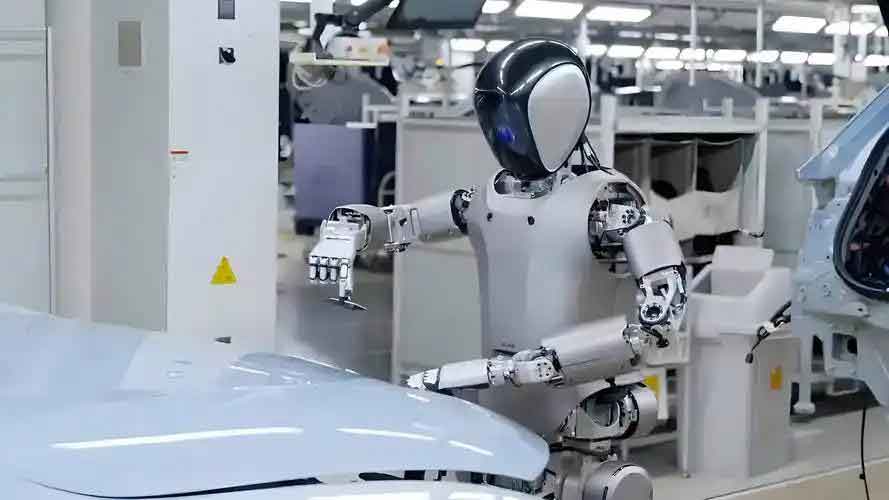
Beyond athletic contests, the sports meet featured scenario-based competitions focused on industrial, medical, hospitality, and warehouse settings, addressing public curiosity about when humanoid robots will become practical. In the industrial scenario, the material organization task required humanoid robots to insert 27 slender items with end diameters of just 8 millimeters into holes in a storage box, demanding extreme precision in grasping, stability, and operational accuracy. The wheeled humanoid robot “Tianyi 2.0,” a sibling to the “Tiangong” humanoid robot, excelled in this challenge, using its 7-degree-of-freedom mechanical arm to quickly and accurately complete the fine parts assembly, earning the first gold medal in the scenario competitions.
Later, “Tianyi 2.0” continued to impress by securing second and third places in the material handling event through full autonomy. This humanoid robot leverages an advanced “embodied brain” and “embodied cerebellum” platform called “Huisikaiwu,” enabling efficient coordination for complex tasks. This demonstrates that humanoid robots are evolving beyond pre-programmed machines or remotely controlled devices into autonomous entities capable of independent decision-making in varied contexts.
Tang Jian projected that in industrial and related scenarios, humanoid robots could see initial deployment by the end of next year. Within about five years, household service humanoid robots might emerge, though with limited functions, and within a decade, they could become quite sophisticated. The scenario competitions highlighted how humanoid robots are being tailored for real-world applications, such as sorting items in warehouses or assisting in medical settings, where their ability to handle delicate tasks autonomously could revolutionize efficiency and safety. The breadth of these applications underscores the potential for humanoid robots to integrate into daily life, driven by continuous innovation in perception, manipulation, and cognitive abilities.
The 2025 World Humanoid Robot Sports Meet not only celebrated athletic achievements but also served as a testament to the rapid progress in humanoid robot technology. From the track to the gymnasium, humanoid robots demonstrated that they are no longer mere prototypes but capable systems ready for real-world challenges. As teams from across China and beyond collaborate and compete, the humanoid robot industry is poised for exponential growth, with implications for manufacturing, services, and beyond. The event highlighted how humanoid robots are overcoming technical barriers, with each iteration bringing them closer to widespread adoption. In the years ahead, as humanoid robots become more affordable and capable, they could transform industries and households, making this sports meet a pivotal moment in the journey toward a robot-augmented future.
Looking forward, the integration of humanoid robots into society will depend on continued advancements in AI, mechanics, and energy efficiency. The sports meet provided a snapshot of this trajectory, with humanoid robots showcasing not only physical prowess but also cognitive abilities like autonomous navigation and task execution. As research and development intensify, the humanoid robot ecosystem is expected to expand, fostering new startups and collaborations. The enthusiasm from investors, engineers, and the public at this event signals a bright future for humanoid robots, where they could soon become commonplace helpers, athletes, and workers, pushing the boundaries of technology and human imagination.