
As an observer and researcher in the field of advanced robotics, I believe that the rapid evolution of artificial intelligence is fundamentally reshaping the technological landscape, with AI human robot systems emerging as a pivotal innovation. These AI human robot platforms integrate cutting-edge advancements in AI, manufacturing, and materials science, positioning themselves as the next disruptive product after computers, smartphones, and electric vehicles. The global market for AI human robot solutions is expanding at an impressive rate, with projections indicating exponential growth in the coming decades. In this article, I will explore the current state of the AI human robot industry, analyze comparative advantages, and propose detailed strategies for fostering high-quality development, supported by empirical data, tables, and mathematical models to illustrate key points.
The development of AI human robot technologies has traversed several phases, from early mechanical prototypes to today’s intelligent systems. Initially, research focused on basic mobility and interaction, but recent breakthroughs in AI have enabled more sophisticated cognitive and physical capabilities. The core of an AI human robot lies in its ability to mimic human-like movements and decision-making processes, which can be modeled using dynamical systems. For instance, the motion control of an AI human robot can be described by the following equation representing its kinematic chain: $$ \tau = M(q)\ddot{q} + C(q, \dot{q})\dot{q} + G(q) $$ where \( \tau \) denotes the joint torques, \( M(q) \) is the inertia matrix, \( C(q, \dot{q}) \) captures Coriolis and centrifugal forces, and \( G(q) \) represents gravitational effects. This equation highlights the complexity of achieving stable locomotion in AI human robot designs, a challenge that researchers worldwide are addressing through iterative improvements.
| Year | Global Market Size (USD Billion) | China’s Market Share (%) | Key Drivers |
|---|---|---|---|
| 2024 | ~30 | ~10 | AI integration, cost reduction |
| 2029 | ~75 | 32.7 | Industrial automation, service applications |
| 2035 | ~300 | ~40 | Widespread adoption in diverse sectors |
Internationally, countries like the United States, Japan, and those in Europe have established early leads in AI human robot development, thanks to decades of research and robust policy support. For example, Japanese initiatives date back to the 1960s, resulting in pioneering robots such as WABOT-1, which demonstrated basic walking and communication abilities. In the U.S., companies like Tesla and Boston Dynamics are driving innovation, with ambitious targets to produce billions of AI human robot units at low costs. These efforts are underpinned by substantial investments in R&D and a focus on practical applications, from manufacturing to personal assistance. In contrast, China’s AI human robot industry, while starting later, has accelerated rapidly, with domestic firms like Ubtech and Xiaomi launching commercially viable products. China now leads in patent applications for AI human robot technologies, reflecting a strong foundation in hardware and growing capabilities in software and AI integration.
Policy frameworks play a crucial role in shaping the AI human robot ecosystem. Overseas, governments employ incentives such as tax breaks and research grants to spur innovation, while also addressing safety and ethical concerns through standardized regulations. In China, recent policies like the “Guidelines for the Innovative Development of Humanoid Robots” outline clear objectives: by 2025, establish a preliminary innovation system, achieve breakthroughs in core technologies, and demonstrate applications in specialized fields. Local governments in regions such as Beijing, Shanghai, and Guangdong have introduced complementary measures, focusing on talent development and industrial clustering. This multi-layered approach aims to create a conducive environment for AI human robot advancements, aligning national goals with regional strengths.
| Region | Key Strengths | Weaknesses | Notable AI Human Robot Models |
|---|---|---|---|
| United States | Advanced AI, dynamic movement | High production costs | Tesla Bot, Atlas |
| Japan | Long research history, reliability | Slower AI adoption | ASIMO, Pepper |
| China | Hardware prowess, rapid scaling | Gaps in advanced AI | Walker, CyberOne |
China’s advantages in advancing the AI human robot sector are multifaceted. First, the country’s advanced equipment manufacturing industry has seen robust growth, with high-tech sectors contributing significantly to industrial output. In 2024, value-added in high-tech manufacturing increased by over 8% annually, underscoring its role as an economic pillar. Second, China’s comprehensive industrial system—spanning 41 major categories—provides a solid base for integrating AI human robot production into existing supply chains. Smart manufacturing initiatives have led to the emergence of digital factories and intelligent workshops, enhancing efficiency through technologies like IoT and big data. The productivity gains from these systems can be quantified using a Cobb-Douglas inspired function: $$ Y = A \cdot K^\alpha \cdot L^\beta \cdot R^\gamma $$ where \( Y \) represents output in AI human robot production, \( A \) is total factor productivity driven by AI, \( K \) denotes capital investment, \( L \) is labor input, and \( R \) symbolizes R&D expenditure, with \( \alpha, \beta, \gamma \) as elasticities. This model illustrates how investments in AI human robot technologies can yield increasing returns through innovation.
Moreover, China’s新材料 industry offers critical support for AI human robot development, with advancements in rare metals and composite materials enabling lighter, more durable designs. The innovation ecosystem, including national research centers and collaborative platforms, accelerates the translation of lab discoveries into commercial applications. For instance, the use of titanium and liquid metals in AI human robot components improves energy efficiency and mobility, which can be analyzed through material stress-strain relationships: $$ \sigma = E \epsilon $$ where \( \sigma \) is stress, \( E \) is Young’s modulus, and \( \epsilon \) is strain. Such fundamentals ensure that AI human robot structures withstand operational demands while minimizing weight.
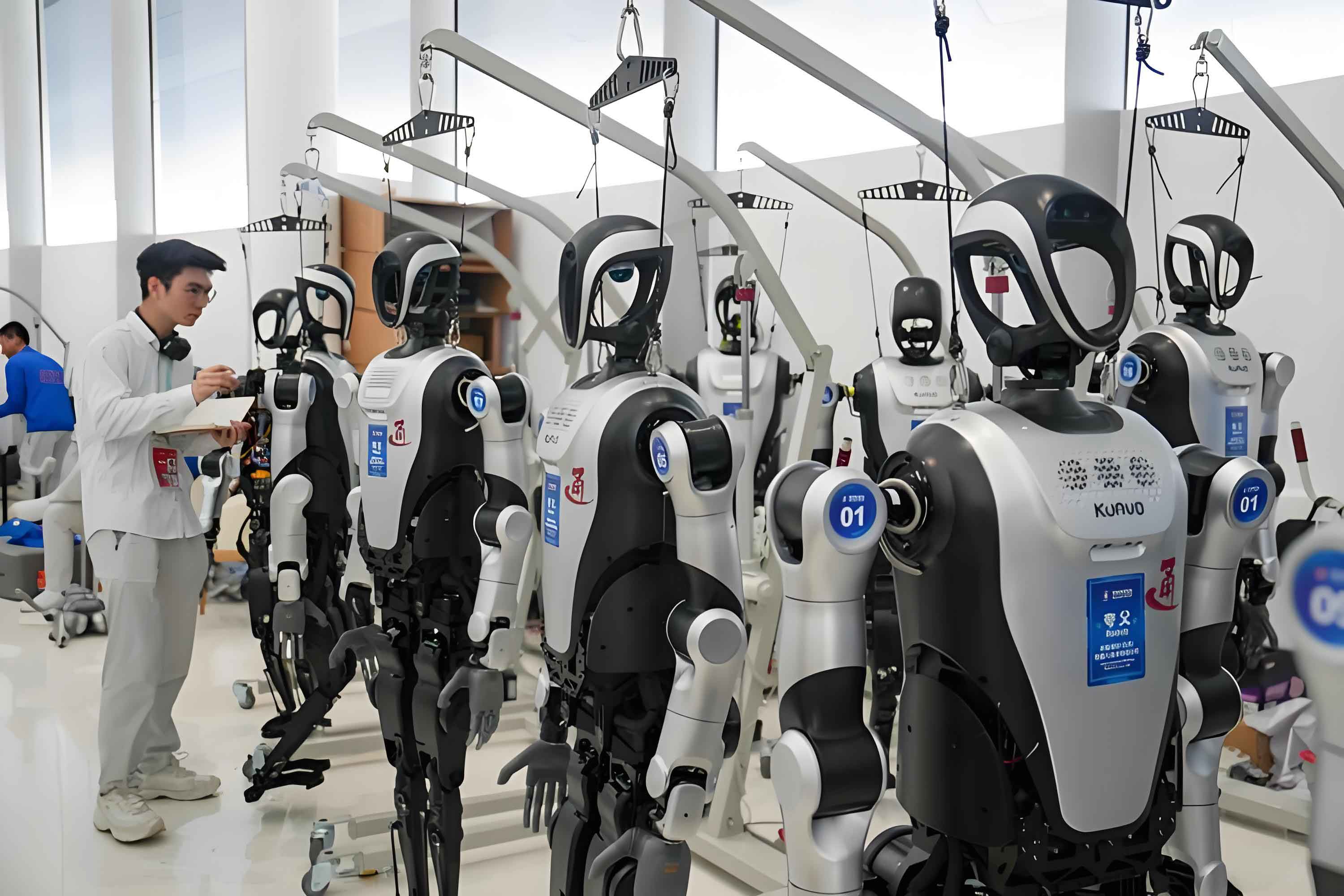
To capitalize on these strengths, I propose several actionable paths for high-quality development of the AI human robot industry in China. First, accelerating industrial policy planning is essential. By establishing specialized zones in tech hubs like Beijing and Shanghai, we can concentrate resources on R&D and manufacturing, while piloting cross-sector applications in regions such as Yunnan for tourism and agriculture. This decentralized yet coordinated approach fosters innovation clusters, similar to Silicon Valley’s model, but tailored to local conditions. Second, core technology R&D must be prioritized. Focusing on the “brain” (AI decision-making), “cerebellum” (motor control), and “limbs” (actuation) of AI human robots will require collaborative efforts between enterprises and research institutes. For example, enhancing perceptual algorithms can be framed as an optimization problem: $$ \min_{f} \sum_{i=1}^{n} L(y_i, f(x_i)) + \lambda \| f \|^2 $$ where \( f \) is the AI model, \( L \) is a loss function for sensor data, \( x_i \) and \( y_i \) are input-output pairs, and \( \lambda \) controls regularization. Solving this accelerates the development of intelligent AI human robot systems capable of real-world adaptation.
Third, building a robust product service and manufacturing system is critical. We should create industrial parks dedicated to AI human robot production, attracting upstream and downstream firms to form synergistic networks. Customization will be key—addressing specific market needs, such as elderly care or hazardous task performance, can drive demand. The economic impact can be assessed using a growth accounting framework: $$ g_Y = g_A + \alpha g_K + \beta g_L + \gamma g_R $$ where \( g \) denotes growth rates of output, productivity, capital, labor, and R&D, respectively. This highlights how scaling AI human robot production contributes to overall economic expansion. Fourth, expanding application scenarios through pilot projects in sectors like healthcare, logistics, and public services will demonstrate utility and build public acceptance. By engaging end-users in co-design, we can refine AI human robot functionalities, leading to iterative improvements based on feedback loops.
| Scenario | Potential Impact | Key Metrics | AI Human Robot Role |
|---|---|---|---|
| Manufacturing | 20-30% efficiency gain | Output per hour, error rate | Assembly, quality control |
| Healthcare | Reduced labor costs | Patient handling time, accuracy | Assistance, monitoring |
| Agriculture | Increased yield | Crop output, resource use | Harvesting, data collection |
Fifth, strengthening financial and talent support is indispensable. Establishing dedicated funds for AI human robot startups can de-risk innovation, while partnerships with universities can cultivate a skilled workforce. For instance, integrating AI human robot curricula into engineering programs addresses the talent gap. Additionally, developing international standards for safety and ethics ensures sustainable growth. The interplay between innovation and regulation can be modeled as a Nash equilibrium in a game theory context: $$ \max_{x_i} U_i(x_i, x_{-i}) $$ where \( U_i \) is the utility of stakeholder \( i \) (e.g., firms, regulators), and \( x_i \) represents their strategies (e.g., innovation investment, compliance). This equilibrium fosters a balanced ecosystem for AI human robot advancement.
In conclusion, the AI human robot industry represents a transformative opportunity for China, driven by its manufacturing prowess, policy agility, and technological ambitions. By implementing these paths—strategic policy layout, focused R&D, integrated production, scenario innovation, and holistic support—we can not only catch up with global leaders but also set new benchmarks in AI human robot development. The iterative nature of AI and robotics means that continuous learning and adaptation will be crucial, as encapsulated in the reinforcement learning update rule: $$ Q(s,a) \leftarrow Q(s,a) + \alpha [r + \gamma \max_{a’} Q(s’,a’) – Q(s,a)] $$ where \( Q \) values represent the expected rewards for actions in states, guiding AI human robot systems toward optimal performance. As we navigate this journey, collaboration across sectors and borders will amplify our progress, ensuring that AI human robots become a cornerstone of future economic and social progress.