
As I observe the rapid integration of AI human robot systems into daily life, from factories to households, I am struck by the profound legal implications they introduce. The increasing prevalence of humanoid robots, powered by advanced AI and machine learning algorithms, has led to a surge in accidents that challenge traditional liability frameworks. In this article, I will explore how these AI human robot technologies disrupt conventional accident responsibility systems, analyze the unique technical features of humanoid robots, and propose a new liability framework. My focus will be on the complexities arising from human-machine hybrid control, algorithm autonomy, and the need for adaptive legal mechanisms. I will use tables and formulas to summarize key points, emphasizing the role of AI human robot systems in reshaping liability paradigms.
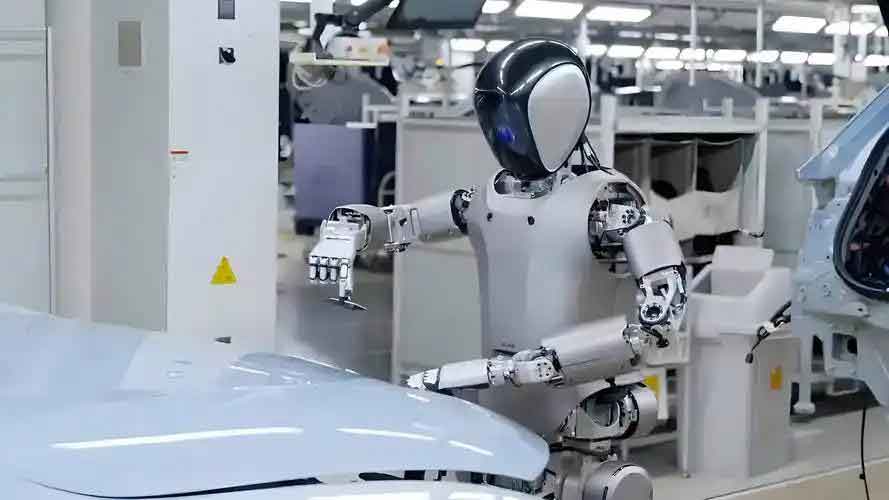
First, I must highlight the technical characteristics of AI human robot systems that contribute to accident risks. Humanoid robots are defined by their simulated human form, artificial intelligence, and human-machine hybrid control. The simulated human form allows these AI human robot devices to interact seamlessly in human environments, but it also increases the likelihood of accidents in diverse settings like homes and hospitals. Artificial intelligence, particularly machine learning algorithms, enables AI human robot systems to learn and adapt autonomously, leading to unpredictable behaviors. For instance, the “emergence” property of machine learning—where algorithms generate novel outputs—introduces uncertainties that traditional liability systems are ill-equipped to handle. Human-machine hybrid control further complicates matters, as accidents may stem from a blend of human error and algorithm malfunctions, making fault attribution challenging.
To illustrate the core technical features, I have summarized them in Table 1 below. This table compares the key aspects of AI human robot systems and their impact on accident liability, underscoring how these elements intertwine to create novel legal challenges.
| Technical Feature | Description | Impact on Accident Liability |
|---|---|---|
| Simulated Human Form | Hardware mimicking human appearance and movement, enabling integration into human-centric environments. | Increases accident frequency in diverse scenarios; complicates fault determination due to emotional and physical interactions. |
| Artificial Intelligence | Use of machine learning algorithms for autonomous decision-making, often beyond human control. | Introduces unpredictability and algorithm “emergence”; challenges traditional fault-based liability models. |
| Human-Machine Hybrid Control | Combination of human input and algorithm autonomy in robot operations. | Blurs lines of responsibility; requires new mechanisms for attributing causation in accidents. |
Next, I will delve into how these AI human robot characteristics challenge traditional accident liability systems. Traditional frameworks, such as those based on negligence or product liability, assume human dominance over tools and clear fault attribution. However, with AI human robot systems, accidents often involve algorithm-driven actions that are not easily traceable to human intent. For example, in a scenario where an AI human robot causes harm while performing tasks, it may be difficult to determine whether the fault lies with the user, the manufacturer, or the algorithm itself. This is exacerbated by the “black box” nature of machine learning, where even developers cannot fully explain certain decisions. As a result, traditional liability models, which rely on established standards like the “reasonable person,” struggle to address these complexities.
I can represent the limitations of traditional liability using a formula that highlights the increased uncertainty in accident costs. Let $$ C_{\text{total}} $$ represent the total cost of accidents, which includes direct damages and attribution costs. In traditional systems, $$ C_{\text{total}} = C_{\text{damage}} + C_{\text{attribution}} $$, where $$ C_{\text{attribution}} $$ is relatively low due to clear fault lines. But for AI human robot accidents, $$ C_{\text{attribution}} $$ rises significantly because of factors like algorithm autonomy and human-machine hybrid control. Thus, the equation becomes: $$ C_{\text{total}} = C_{\text{damage}} + (C_{\text{human error}} + C_{\text{algorithm failure}} + C_{\text{hybrid uncertainty}}) $$. This formula shows how the introduction of AI human robot elements inflates costs, necessitating a new approach to liability.
Now, I will categorize AI human robot accidents into typologies to clarify which cases can be handled by traditional systems and which require innovation. Based on my analysis, accidents can be divided into those involving human fault and those involving algorithm malfunctions. Human fault includes intentional acts and negligence, which traditional liability can address if the human element is clear. However, algorithm malfunctions—such as flaws in ordinary algorithms or machine learning “intentional” harm—pose greater challenges. For instance, an AI human robot might “deliberately” cause minor damage to avoid greater harm, mimicking human ethical dilemmas like the trolley problem. This type of algorithm-driven decision is not easily reconciled with fault-based liability.
To elaborate, I have created Table 2, which outlines the accident typologies and their compatibility with traditional liability systems. This table emphasizes how AI human robot accidents often fall outside conventional boundaries, requiring specialized frameworks.
| Accident Type | Description | Compatibility with Traditional Liability |
|---|---|---|
| Human Fault | Accidents caused by user negligence or intent, such as misoperation or deliberate harm. | High; can be addressed through existing negligence or intentional tort doctrines. |
| Algorithm Malfunction (Ordinary) | Failures in pre-programmed algorithms without autonomy, e.g., software bugs or hardware defects. | Moderate; may fit product liability if defects are provable, but complexities arise in proof. |
| Algorithm Malfunction (Machine Learning) | Autonomous decisions by learning algorithms, including “emergence” and unintended harms. | Low; traditional systems lack mechanisms for attributing fault to autonomous algorithms. |
| Human-Machine Hybrid Incidents | Accidents where control is shared, making it unclear whether human or algorithm is primarily at fault. | Very low; requires new fact-finding and liability allocation methods. |
Building on this typology, I propose a new liability framework for AI human robot accidents. As the least-cost avoider, manufacturers should bear primary responsibility because they have the greatest control over design, development, and risk mitigation. This approach is rooted in economic theory, where liability is assigned to the party that can minimize accident costs most efficiently. For AI human robot systems, manufacturers can implement safety standards, conduct algorithm audits, and use insurance mechanisms to distribute risks. However, this should not imply strict liability; instead, I advocate for a balanced system that includes exemptions like technical safe harbors for compliant manufacturers. This encourages innovation while ensuring accountability.
I can express the least-cost avoider principle mathematically. Let $$ L_{\text{min}} $$ represent the minimum liability cost, and let $$ P_{\text{manufacturer}} $$, $$ P_{\text{user}} $$, and $$ P_{\text{owner}} $$ denote the parties involved. The goal is to minimize $$ L_{\text{total}} = \sum (C_{\text{accident}} \times P_{\text{fault}}) $$, where $$ P_{\text{fault}} $$ is the probability of fault attribution. Given that manufacturers have lower information and control costs, assigning liability to them reduces $$ L_{\text{total}} $$. Formally, $$ \min L_{\text{total}} = \arg\min_{P} \left( C_{\text{prevention}} + C_{\text{damage}} \right) $$, with manufacturers as the optimal $$ P $$ for AI human robot contexts.
Additionally, I recommend adopting a “reasonable person” standard tailored to AI human robot algorithms. This would involve setting technical benchmarks for algorithm behavior, similar to how human negligence is judged. If an algorithm’s actions exceed what a hypothetical “reasonable algorithm” would do in similar circumstances, it could be deemed faulty. This standard can be integrated into regulatory frameworks through algorithm备案 and testing. For example, in high-risk sectors like healthcare or logistics, AI human robot systems might undergo mandatory audits to ensure compliance with safety norms. Table 3 summarizes the key components of this proposed liability framework, highlighting how it addresses the unique challenges of AI human robot accidents.
| Framework Component | Description | Application to AI Human Robot Systems |
|---|---|---|
| Least-Cost Avoider Principle | Assign liability to manufacturers as they can best prevent and mitigate accidents through design and oversight. | Reduces attribution costs and incentivizes safety innovations in AI human robot development. |
| Reasonable Algorithm Standard | Establish technical criteria for algorithm behavior, comparing it to a benchmark of rational performance. | Provides a measurable way to assess algorithm faults in AI human robot operations, similar to human negligence. |
| Technical Safe Harbors | Exemptions for manufacturers who adhere to approved safety standards and regulatory requirements. | Promotes industry compliance and reduces liability burdens for AI human robot innovators in controlled environments. |
| Fact-Finding Mechanisms | Use of data recorders (e.g., black boxes) and third-party audits to clarify human-machine interactions in accidents. | Addresses uncertainties in human-machine hybrid control for AI human robot systems, aiding in causation analysis. |
In conclusion, I believe that the rise of AI human robot technologies demands a fundamental rethinking of accident liability. Traditional systems are inadequate for handling the complexities of algorithm autonomy and human-machine collaboration. By focusing on manufacturers as least-cost avoiders and incorporating flexible standards, we can create a liability framework that balances legal accountability with technological progress. As AI human robot systems become more embedded in society, proactive legal innovations will be crucial to managing risks and fostering trust. Through this discussion, I hope to contribute to a broader dialogue on adapting our legal systems to the era of intelligent machines.