
In the field of robotics, aerospace, and precision manufacturing, the accurate measurement of multi-dimensional forces and torques is crucial. A six-axis force sensor is a device that converts forces and moments along three orthogonal axes and torques about these axes into electrical signals. Capacitive six-axis force sensors have gained attention due to their high sensitivity, accuracy, fast dynamic response, and cost-effectiveness. In this article, I present the design and development of a novel capacitive six-axis force sensor with a double L-beam elastic structure, optimized for improved isotropy and performance. The sensor utilizes differential parallel-plate capacitors to minimize measurement errors and enhance linearity. Through a combination of particle swarm optimization and finite element simulation, the structural parameters are optimized to achieve a low condition number for the transformation matrix, indicating high isotropy. Experimental results validate the design, showing competitive resolution and accuracy compared to commercial sensors.
The core of a six-axis force sensor lies in its elastic structure, which deforms under applied loads and converts mechanical signals into measurable electrical outputs. Traditional designs include vertical beam structures, which offer simplicity and high load capacity but suffer from low vertical sensitivity and significant cross-axis coupling. Cross-shaped horizontal beam structures improve symmetry and compactness but still exhibit limitations in sensitivity for certain force components. To address these issues, I propose a double L-beam elastic structure that combines the advantages of T-beam and cross-shaped double straight beam designs. This configuration enhances sensitivity isotropy and reduces coupling, making it ideal for high-performance six-axis force sensor applications. The double L-beam consists of multiple parameters, such as beam lengths, widths, and thickness, which can be tuned to optimize performance.
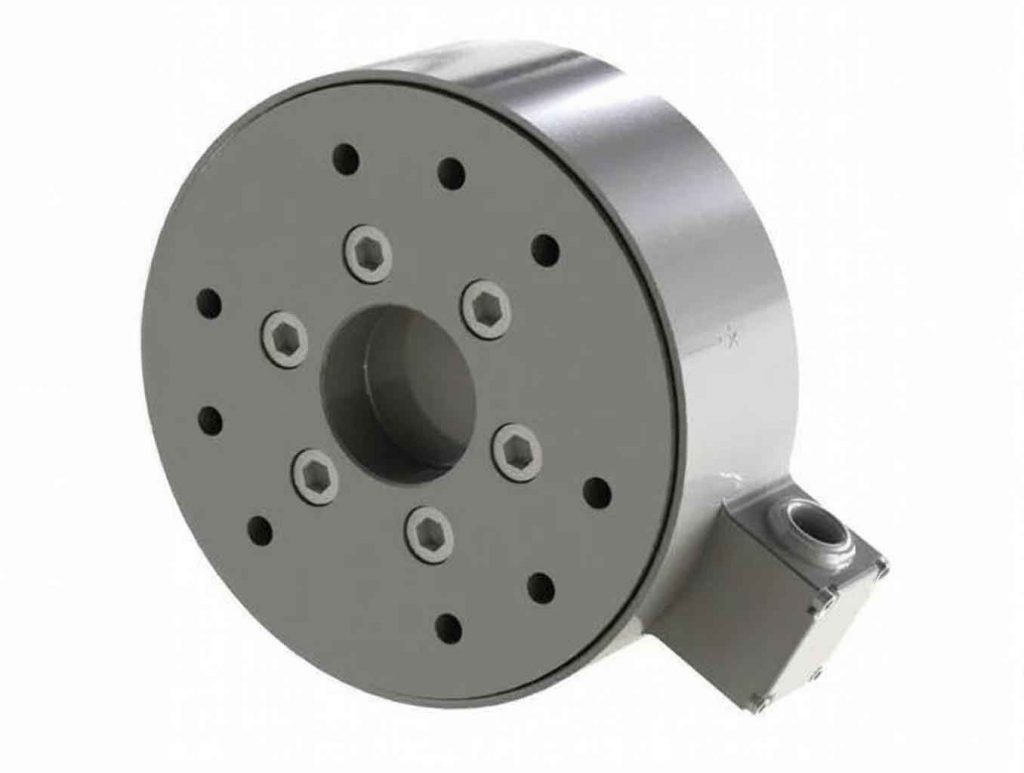
The transformation element of the sensor is based on differential parallel-plate capacitors, which are arranged in a symmetric layout to mitigate errors from environmental factors like temperature and electromagnetic interference. For a parallel-plate capacitor, the capacitance is given by:
$$C = \frac{\varepsilon S}{d}$$
where \(C\) is the capacitance, \(\varepsilon\) is the permittivity of the dielectric, \(S\) is the overlapping area of the plates, and \(d\) is the distance between the plates. Under an external force, the plate distance changes by \(\Delta d\), leading to a capacitance change. For small displacements relative to the initial distance, the change can be approximated linearly. In a differential configuration, two capacitors are used where one plate moves in opposite directions, resulting in a combined output that doubles the sensitivity and reduces nonlinearity. The differential capacitance change \(\Delta C_d\) is expressed as:
$$\Delta C_d = \Delta C_1 – \Delta C_2 \approx \frac{2\varepsilon S}{d_0^2} \Delta d$$
where \(d_0\) is the initial plate distance. This setup is employed in the sensor with three groups of vertically arranged differential capacitors and three groups of horizontally arranged ones, providing comprehensive coverage for six-axis force and moment detection.
The sensor’s performance is characterized by its transformation matrix \(K\), which relates the applied forces and moments to the capacitance changes. For a six-axis force sensor, the input vector \(F\) includes three force components \(F_x\), \(F_y\), \(F_z\) and three moment components \(M_x\), \(M_y\), \(M_z\), while the output vector \(\Delta C\) consists of capacitance changes from multiple capacitors. The linear relationship is:
$$\Delta C = K \cdot F$$
To evaluate isotropy, the transformation matrix is normalized. The normalized matrix \(\hat{K}\) is derived by scaling the force and moment components with their full-scale values, and its condition number is used as a metric. A condition number close to 1 indicates good isotropy, meaning the sensor responds similarly to loads in all directions. The optimization goal is to minimize the condition number of \(\hat{K}\), defined as:
$$\min f(x) = \|\hat{K}\| \cdot \|\hat{K}^{-1}\|$$
where \(x\) represents the design variables of the elastic structure. The double L-beam parameters include the straight beam length \(l_1\), cross beam length \(l_2\), straight beam width \(b_1\), cross beam width \(b_2\), beam thickness \(h\), and gap \(a\). These are optimized within constraints to ensure structural integrity and avoid exceeding the material’s yield strength.
The optimization process uses the particle swarm algorithm, a global optimization method that iteratively updates a population of solutions. Each particle represents a set of parameters, and its velocity and position are adjusted based on individual and group best values. The update equations are:
$$v_{id}^{t+1} = \omega v_{id}^t + c_1 r_1 (p_{id} – x_{id}^t) + c_2 r_2 (p_{gd} – x_{id}^t)$$
$$x_{id}^{t+1} = x_{id}^t + v_{id}^{t+1}$$
where \(v_{id}\) is the velocity, \(x_{id}\) is the position, \(\omega\) is the inertia weight, \(c_1\) and \(c_2\) are cognitive and social factors, and \(r_1\), \(r_2\) are random numbers. The algorithm is coupled with finite element simulation in COMSOL Multiphysics to compute the condition number for each parameter set. After multiple iterations, the optimal parameters are determined, leading to a double L-beam structure with high isotropy.
For the six-axis force sensor, the target specifications are based on commercial benchmarks, with force ranges of ±200 N for \(F_x\) and \(F_y\), ±400 N for \(F_z\), and moment ranges of ±10 N·m for \(M_x\), \(M_y\), and \(M_z\). The material is 2A12-T4 aluminum alloy, and constraints ensure that maximum stress does not exceed 172.5 MPa. The optimized parameters are rounded to practical values for manufacturing.
| Parameter | Symbol | Value (mm) |
|---|---|---|
| Gap | \(a\) | 1.8 |
| Straight Beam Width | \(b_1\) | 6.1 |
| Cross Beam Width | \(b_2\) | 2.2 |
| Straight Beam Length | \(l_1\) | 22.2 |
| Cross Beam Length | \(l_2\) | 15.9 |
| Beam Thickness | \(h\) | 18.8 |
Finite element simulation results show that under full-scale loading, the maximum displacement occurs at the moving plates, with a value of approximately 0.016 mm, and the maximum stress is around 40 MPa, well within the material limits. The initial plate distance is set to 0.15 mm after considering machining and assembly tolerances. The capacitance changes under various loads are simulated, demonstrating linear behavior. The normalized transformation matrix \(\hat{K}\) derived from simulation is:
$$\hat{K} = \begin{bmatrix}
-0.1732 & 0.3398 & -0.1724 & -0.0025 & 0.0015 & 0.0011 \\
0.2944 & -0.0002 & -0.2941 & -0.0011 & 0.0018 & -0.0011 \\
0.0003 & -0.0002 & 0.0002 & 0.2410 & 0.2389 & 0.2401 \\
0.1012 & -0.0001 & -0.1003 & 0.2936 & -0.5828 & 0.2941 \\
0.0596 & -0.1162 & 0.0592 & -0.5062 & -0.0014 & 0.5058 \\
0.2488 & 0.2451 & 0.2487 & -0.0001 & 0.0005 & 0.0011
\end{bmatrix}$$
The condition number of this matrix is 1.79, indicating good isotropy. Key performance metrics from simulation include sensitivities, resolutions, and errors. The sensitivity for each axis is calculated as the capacitance change per unit force or moment, and resolution is the minimum detectable change based on the ADC resolution (16-bit AD7147 with 1/4096 pF step). Systematic and random errors are derived from linearity and repeatability analyses.
| Axis | Sensitivity | Resolution | Systematic Error (%) | Random Error (%) |
|---|---|---|---|---|
| \(F_x\) | 0.0244 pF/N | 0.0106 N | 0.2554 | 0.1022 |
| \(F_y\) | 0.0222 pF/N | 0.0109 N | 0.3242 | 0.1016 |
| \(F_z\) | 0.0113 pF/N | 0.0232 N | 0.2953 | 0.0828 |
| \(M_x\) | 0.2437 pF/(N·m) | 0.0011 N·m | 0.1736 | 0.1631 |
| \(M_y\) | 0.2114 pF/(N·m) | 0.0012 N·m | 0.1763 | 0.1284 |
| \(M_z\) | 0.4299 pF/(N·m) | 0.0006 N·m | 0.2212 | 0.1047 |
The overall simulation accuracy, excluding hysteresis and drift, is 0.4258%. The sensor assembly includes upper and lower covers, a PCB with the ADC, and the elastic body, forming a compact unit. The differential capacitors are wired to minimize parasitic effects, and the digital output is processed for real-time force and moment estimation.
To validate the design, a prototype of the six-axis force sensor is manufactured and calibrated. The calibration system consists of a fixed platform, loading flange, weights for force application, and a data acquisition system connected to a computer. Forces and moments are applied incrementally from negative to positive full-scale values, with multiple cycles to assess repeatability. For example, \(F_x\) and \(F_y\) are loaded from -200 N to +200 N in 20 N steps, \(F_z\) from -400 N to +400 N in 40 N steps, and moments from -10 N·m to +10 N·m in 1 N·m steps. The capacitance changes are recorded and converted to digital values using the AD7147 chip.
The experimental results show capacitance change curves similar to simulations, with minor deviations due to assembly errors, such as unequal initial plate distances in differential pairs and additional moments from the loading flange. The normalized transformation matrix from experiments is:
$$\hat{K} = \begin{bmatrix}
0.1853 & -0.3854 & 0.1947 & 0.0388 & -0.0026 & -0.0413 \\
0.3314 & -0.0003 & -0.3423 & -0.0210 & 0.0496 & -0.0195 \\
0.0009 & -0.0019 & -0.0033 & 0.2756 & 0.2666 & 0.2671 \\
-0.2333 & -0.0076 & 0.2353 & -0.2940 & 0.5712 & -0.2890 \\
0.1372 & -0.2725 & 0.1338 & -0.5122 & -0.0049 & 0.5232 \\
0.2827 & 0.2777 & 0.2954 & -0.0021 & -0.0072 & -0.0016
\end{bmatrix}$$
with a condition number of 1.82. The sensitivities, resolutions, and errors are calculated from the data, demonstrating that the six-axis force sensor meets design goals. The normalized capacitance changes at full-scale are 4.5790 pF, 4.3212 pF, 3.6842 pF for forces and 2.3774 pF, 2.0865 pF, 3.8124 pF for moments, indicating balanced sensitivity across axes.
| Axis | Sensitivity | Resolution | Systematic Error (%) | Random Error (%) |
|---|---|---|---|---|
| \(F_x\) | 0.0243 pF/N | 0.0118 N | 0.2719 | 0.1160 |
| \(F_y\) | 0.0231 pF/N | 0.0116 N | 0.3288 | 0.1171 |
| \(F_z\) | 0.0098 pF/N | 0.0267 N | 0.4341 | 0.1141 |
| \(M_x\) | 0.2527 pF/(N·m) | 0.0012 N·m | 0.3911 | 0.1898 |
| \(M_y\) | 0.2218 pF/(N·m) | 0.0013 N·m | 0.4416 | 0.1960 |
| \(M_z\) | 0.4052 pF/(N·m) | 0.0007 N·m | 0.2771 | 0.1196 |
The experimental accuracy is 0.6376%, which is higher than the simulation due to practical factors like machining imperfections, friction in the calibration setup, and weight oscillations. However, the resolution and isotropy are competitive with commercial six-axis force sensors, as shown in the comparison below.
| Metric | Simulated Sensor | Experimental Sensor | Commercial Sensor |
|---|---|---|---|
| \(F_x\) Resolution (N) | 0.0106 | 0.0118 | 0.0250 |
| \(F_y\) Resolution (N) | 0.0109 | 0.0116 | 0.0250 |
| \(F_z\) Resolution (N) | 0.0232 | 0.0267 | 0.0500 |
| \(M_x\) Resolution (N·m) | 0.0011 | 0.0012 | 0.0013 |
| \(M_y\) Resolution (N·m) | 0.0012 | 0.0013 | 0.0013 |
| \(M_z\) Resolution (N·m) | 0.0006 | 0.0007 | 0.0013 |
| Accuracy (%) | 0.4258 | 0.6376 | 1.0000 |
In conclusion, the double L-beam capacitive six-axis force sensor demonstrates high performance through optimized design and experimental validation. The use of differential capacitors and particle swarm optimization effectively reduces errors and enhances isotropy. This six-axis force sensor is suitable for applications requiring precise multi-axis force measurement, and future work could focus on miniaturization and temperature compensation to further improve reliability. The methodology of optimizing for isotropy can be applied to other sensor designs, highlighting the versatility of this approach for advanced six-axis force sensor development.
The design process underscores the importance of integrating mechanical structure with electronic sensing in six-axis force sensors. By leveraging finite element analysis and global optimization, I achieved a balance between sensitivity, resolution, and cross-axis decoupling. The double L-beam structure, with its tunable parameters, provides a foundation for customizable six-axis force sensors in various industries. As robotics and automation evolve, the demand for accurate and compact six-axis force sensors will grow, and this work contributes to meeting those needs with a robust and efficient solution.