
The development of a six-axis force sensor is critical for applications requiring precise measurement of forces and moments in three-dimensional space. This paper details the design, analysis, and experimental evaluation of a six-axis force sensor, focusing on its structural integrity, performance metrics, and data interpretation. The sensor is designed to measure three force components (Fx, Fy, Fz) and three moment components (Mx, My, Mz), making it indispensable in fields like robotics, aerospace, and industrial automation. The primary challenges in designing such a six-axis force sensor include achieving high sensitivity, minimal coupling between axes, and sufficient stiffness for integration as a transmission component. Through finite element analysis (FEA) and experimental validation, this study addresses these aspects, providing a comprehensive framework for similar sensor designs.
The design objectives for the six-axis force sensor were derived from specific performance requirements, as summarized in Table 1. Key parameters include force and moment ranges, sensitivity, resolution, and torsional stiffness. Notably, the sensor must function as part of a rotational joint in robotic systems, necessitating a balance between resolution and stiffness. The moment measurement range (e.g., ±6 N·m for moments) was prioritized in design calculations to ensure overall performance, as it indirectly influences force measurement capabilities. The six-axis force sensor aims to achieve linearity errors below ±0.25% F·S, repeatability under ±0.2% F·S, and a torsional stiffness exceeding 3.5 × 10^4 N·m/rad, among other criteria.
| Parameter | Specification |
|---|---|
| Force Range | −20 to +20 N |
| Moment Range | −6 to +6 N·m |
| Sensitivity | (1 ± 0.2) mV/V |
| Resolution | 0.005 N·m |
| Torsional Stiffness | ≥ 3.5 × 10^4 N·m/rad |
| Nonlinearity | < ±0.25% F·S |
| Repeatability | < ±0.2% F·S |
Structural design of the six-axis force sensor employed an E-type membrane configuration, which offers advantages over traditional cross-beam designs, such as reduced coupling and improved linearity. The sensor comprises upper and lower E-type membranes connected by a cross-beam at their rigid centers, as illustrated in the following figure. This arrangement minimizes coupling between Mz and other force/moment components while maintaining high sensitivity. The overall dimensions are 85 mm in diameter and 52 mm in height, fabricated from hard aluminum to ensure durability and lightweight properties. The central annular membrane serves as the sensitive region for strain measurement, and the cross-beam facilitates force transmission and Mz detection.
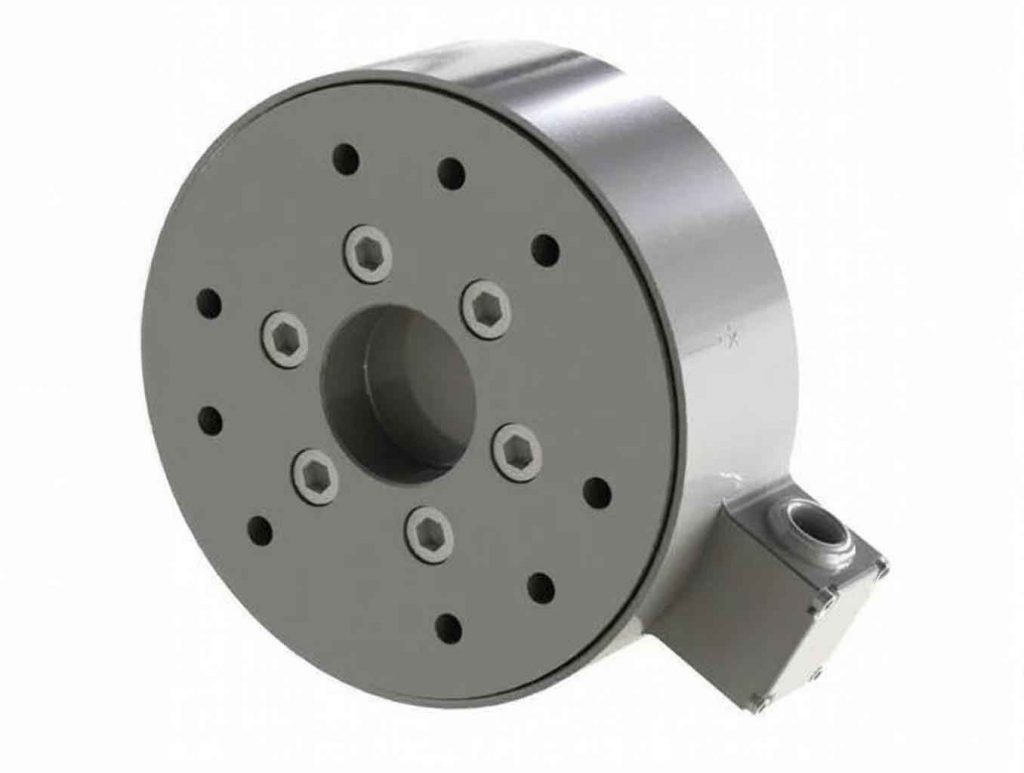
Finite element analysis was conducted to evaluate strain distribution under full-scale loads. For instance, applying Mx = 6 N·m resulted in strain values along the X, Y, and Z axes, as shown in Table 2. The analysis confirmed that strains remain within the 10^−4 mm/mm range, which is suitable for strain gauge applications. The six-axis force sensor exhibited minimal coupling for Mx, My, Mz, Fx, and Fy directions, but Fz showed significant coupling due to the E-type membrane structure, necessitating further decoupling efforts. The strain ε can be expressed in terms of stress σ and Young’s modulus E using Hooke’s law: $$ \epsilon = \frac{\sigma}{E} $$ where σ is derived from applied loads and geometric properties.
| Load Direction | Min X | Max X | Min Y | Max Y | Min Z | Max Z |
|---|---|---|---|---|---|---|
| Mx | −1.6797 | 1.487 | −4.7876 | 4.7996 | −3.3274 | 2.7821 |
| My | −4.8139 | 5.0469 | −1.7437 | 1.7607 | −3.3122 | 2.945 |
| Mz | −3.1334 | 3.4852 | −3.2525 | 3.288 | −1.2874 | 1.196 |
| Fx | −3.2083 | 2.9747 | −1.2271 | 1.2143 | −1.7706 | 2.037 |
| Fy | −1.1317 | 1.2962 | −2.8494 | 3.0105 | −2.0513 | 1.6416 |
| Fz | −2.6855 | 3.6162 | −2.6048 | 3.2926 | −2.3318 | 3.3578 |
Stiffness analysis is crucial for the six-axis force sensor, as it impacts performance in rotational applications. Torsional stiffness k is defined as the ratio of applied moment M to angular displacement θ: $$ k = \frac{M}{\theta} $$ Using FEA, stiffness coefficients were calculated for each direction, as listed in Table 3. The Mz direction achieved the highest stiffness (522,701.7 N·m/rad), exceeding the design requirement, while Fz had the lowest (31,323.0 N·m/rad). Although Fz stiffness is slightly below the target, the sensor’s primary role in rotation focuses on Mz performance, validating the design. The overall stiffness matrix K for the six-axis force sensor can be represented as: $$ \mathbf{K} = \begin{bmatrix} k_{Fx} & 0 & 0 & 0 & 0 & 0 \\ 0 & k_{Fy} & 0 & 0 & 0 & 0 \\ 0 & 0 & k_{Fz} & 0 & 0 & 0 \\ 0 & 0 & 0 & k_{Mx} & 0 & 0 \\ 0 & 0 & 0 & 0 & k_{My} & 0 \\ 0 & 0 & 0 & 0 & 0 & k_{Mz} \end{bmatrix} $$ where diagonal elements denote stiffness in respective directions.
| Direction | Stiffness (N·m/rad) |
|---|---|
| Mx | 47,101.21 |
| My | 179,971.1 |
| Mz | 522,701.7 |
| Fx | 34,362.31 |
| Fy | 524,796.2 |
| Fz | 31,323.0 |
Experimental data analysis focused on the My direction to assess repeatability, linearity, and coupling. Moments were applied in increments (0, 3, 6, 9 N·m) with five repetitions each, and output voltages were recorded via analog-to-digital conversion. The voltage V is related to the digital output N by: $$ V = \frac{5 \times N}{65,536} $$ Table 4 summarizes the raw data for My and other components under various loads. For example, at 3 N·m, the My outputs were 26,726, 26,695, 26,748, 26,737, and 26,733, with a mean of 26,728. The maximum deviation was 53, resulting in a fluctuation of 0.19% relative to the mean, which meets the repeatability specification of < ±0.2% F·S. This demonstrates the high stability of the six-axis force sensor under repeated loading.
| Load (N·m) | Fx | Fy | Fz | Mx | My | Mz |
|---|---|---|---|---|---|---|
| 0 | 8,437 | 33,750 | 36,292 | 34,555 | 12,043 | 32,988 |
| 3 | 16,878 | 33,794 | 36,045 | 34,746 | 19,430 | 33,528 |
| 6 | 25,275 | 33,837 | 35,673 | 34,864 | 26,726 | 33,937 |
| 9 | 33,659 | 33,848 | 35,353 | 34,998 | 33,923 | 34,412 |
Linearity was evaluated using the mean values of My outputs across different loads, as shown in Table 5. A least-squares linear regression was applied to fit the data, resulting in the equation: $$ y = kx + b $$ where y is the applied moment, x is the digital output, k = 0.0004, and b = −13.5858. The coefficient of determination R² was close to 1, indicating excellent linearity. The linearity error was calculated as the maximum deviation from the fitted line, which was within ±0.25% F·S, satisfying the design criteria for the six-axis force sensor.
| Load (N·m) | Mean Digital Output |
|---|---|
| 0 | 12,114 |
| 3 | 19,392 |
| 6 | 26,728 |
| 9 | 33,949 |
Coupling analysis revealed interactions between axes, particularly for Fx and Fz. When My was applied, Fx outputs showed significant changes, indicating coupling. The relationship between applied loads F and output signals N is modeled as: $$ \mathbf{F} = \mathbf{W} \mathbf{N} + \mathbf{B} $$ where F is the load vector {Fx, Fy, Fz, Mx, My, Mz}, N is the output vector {Nx, Ny, Nz, Nmx, Nmy, Nmz}, W is a 6×6 decoupling matrix, and B is the bias vector. The diagonal elements of W represent sensitivity coefficients, while off-diagonal elements indicate coupling magnitudes. For instance, W(1,5) quantifies the effect of My on Fx. Decoupling methods, such as matrix inversion or neural networks, are essential to minimize these effects in the six-axis force sensor.
In conclusion, the design and analysis of this six-axis force sensor demonstrate its capability to meet rigorous performance standards. The E-type membrane structure effectively reduces coupling for most components, while FEA validates strain and stiffness characteristics. Experimental results confirm high repeatability, linearity, and manageable coupling, with decoupling techniques further enhancing accuracy. This approach provides a valuable reference for developing advanced multi-axis sensors, emphasizing the importance of integrated design and validation processes. Future work could focus on dynamic performance optimization and real-time decoupling algorithms for the six-axis force sensor.