
In the field of spatial force measurement, the six-axis force sensor plays a critical role in applications such as rocket engine thrust testing and spacecraft docking. As a key device for monitoring complex spatial forces, the Stewart-type six-axis force sensor is renowned for its high load capacity, precision, and compact design. However, achieving lightweight design without compromising performance remains a significant challenge due to multiple conflicting design objectives, including mass, stiffness, strength, and sensitivity. This study addresses these challenges through an integrated approach combining theoretical modeling, numerical simulation, and experimental validation. We focus on optimizing the structural parameters and introducing a novel weight reduction strategy to enhance the mass distribution and overall efficiency of the sensor. The results demonstrate a substantial reduction in mass while maintaining or improving other critical performance metrics, providing a reference for future developments in six-axis force sensor design.
The Stewart-type six-axis force sensor consists of upper and lower loading plates connected by six force-sensing branches, each acting as a two-force member. The primary structural parameters influencing its performance include the radii of the hinge points on the upper and lower plates (\(R_2\) and \(R_1\)), the orientation angles of these points (\(\phi_2\) and \(\phi_1\)), and the distance between the plates (\(H_c\)). To model the force transmission, we employ screw theory, which relates the axial forces in the branches to the external forces and moments applied at the center of the upper plate. The equilibrium equation is expressed as:
$$ \sum_{i=1}^{6} f_i \times \mathbf{l}_i = \mathbf{F}_w + \mathbf{M}_w $$
where \(f_i\) is the axial force in the \(i\)-th branch, \(\mathbf{l}_i\) is the unit vector along the branch axis pointing to the origin, and \(\mathbf{F}_w\) and \(\mathbf{M}_w\) represent the external force and moment vectors, respectively. This can be rewritten in matrix form as:
$$ \mathbf{F} = \mathbf{G} \mathbf{f} $$
Here, \(\mathbf{F} = [\mathbf{F}_w, \mathbf{M}_w]^T\) is the generalized external force vector, \(\mathbf{G}\) is the first-order force influence coefficient matrix, and \(\mathbf{f}\) is the vector of branch forces. If \(\mathbf{G}\) is non-singular, its inverse \(\mathbf{J} = \mathbf{G}^{-1}\) defines the Jacobian matrix, leading to:
$$ \mathbf{J} \mathbf{F} = \mathbf{f} $$
The isotropy of the sensor, which reflects its ability to respond uniformly to forces and moments in different directions, is quantified using the condition numbers of submatrices \(\mathbf{G}_1\) and \(\mathbf{G}_2\) (for forces and moments) and their corresponding Jacobians \(\mathbf{J}_1\) and \(\mathbf{J}_2\). The isotropy measures are defined as:
$$ \eta_1 = \frac{1}{\text{cond}(\mathbf{G}_1)} = \frac{[\lambda_{\min}(\mathbf{G}_1^T \mathbf{G}_1)]^{1/2}}{[\lambda_{\max}(\mathbf{G}_1^T \mathbf{G}_1)]^{1/2}} $$
$$ \eta_2 = \frac{1}{\text{cond}(\mathbf{G}_2)} = \frac{[\lambda_{\min}(\mathbf{G}_2^T \mathbf{G}_2)]^{1/2}}{[\lambda_{\max}(\mathbf{G}_2^T \mathbf{G}_2)]^{1/2}} $$
$$ \eta_3 = \frac{1}{\text{cond}(\mathbf{J}_1)} = \frac{[\lambda_{\min}(\mathbf{J}_1^T \mathbf{J}_1)]^{1/2}}{[\lambda_{\max}(\mathbf{J}_1^T \mathbf{J}_1)]^{1/2}} $$
$$ \eta_4 = \frac{1}{\text{cond}(\mathbf{J}_2)} = \frac{[\lambda_{\min}(\mathbf{J}_2^T \mathbf{J}_2)]^{1/2}}{[\lambda_{\max}(\mathbf{J}_2^T \mathbf{J}_2)]^{1/2}} $$
To optimize the sensor’s performance, we formulate a comprehensive objective function that minimizes the weighted sum of the reciprocals of these isotropy measures:
$$ P(R_2, R_1, H_c, \phi_{12}) = \min \left( \frac{k_1}{\eta_1} + \frac{k_2}{\eta_2} + \frac{k_3}{\eta_3} + \frac{k_4}{\eta_4} \right) $$
where \(k_1\) to \(k_4\) are weight coefficients, and \(\phi_{12} = |\phi_1 – \phi_2|\). Constraints on the parameters include angle differences between 30° and 100°, radii between 0 and 200 mm, and plate separation between 75 and 150 mm. Solving this optimization problem using MATLAB yields the theoretically optimal parameters, as summarized in Table 1.
| Parameter | Value |
|---|---|
| \(R_1\) (mm) | 143 |
| \(R_2\) (mm) | 118 |
| \(\phi_1\) (°) | 98 |
| \(\phi_2\) (°) | 31 |
| \(H_c\) (mm) | 86 |
The corresponding theoretical isotropy values are listed in Table 2, indicating a well-balanced design.
| Isotropy Measure | Value |
|---|---|
| \(\eta_1\) | 0.3621 |
| \(\eta_2\) | 0.7845 |
| \(\eta_3\) | 0.3884 |
| \(\eta_4\) | 0.7442 |
Based on these parameters, an initial prototype of the six-axis force sensor was fabricated, with a specified load capacity of 1500 N for forces and 2000 N·m for moments. The sensor comprises upper and lower loading plates made of ultra-hard aluminum 7A04, and branch components (including hinges, elastic bodies, and decoupling elements) made of titanium alloy TB9. The initial design, however, exhibited excessive stiffness, suboptimal sensitivity, and a high mass contribution from the loading plates, prompting further optimization.
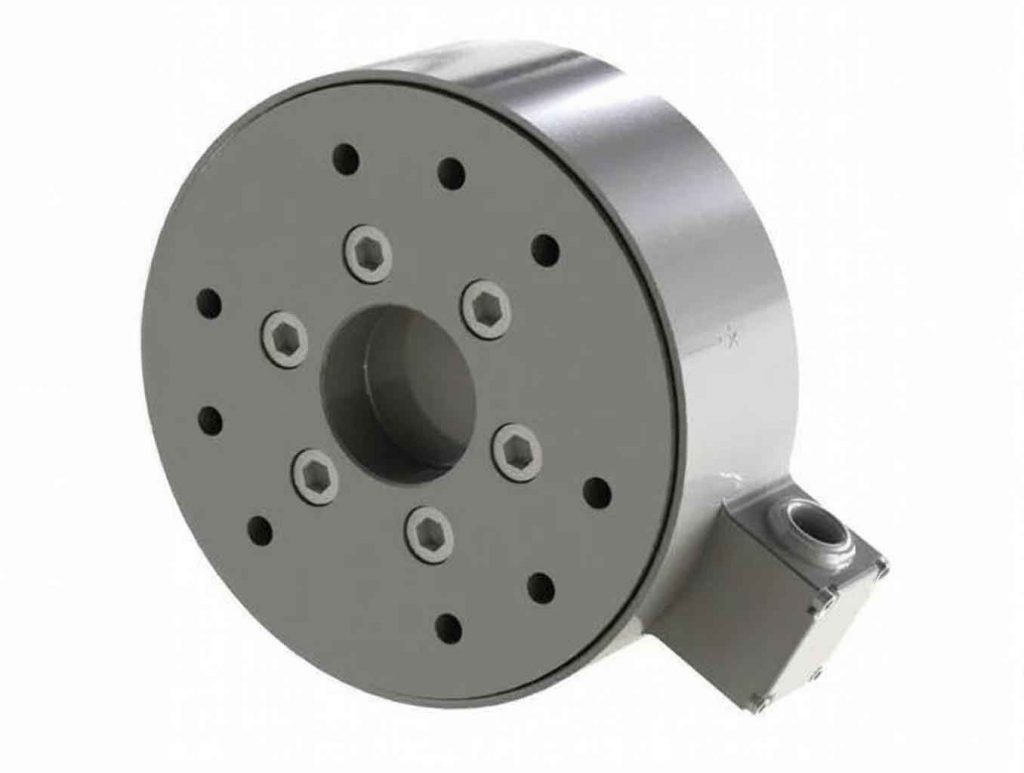
To analyze the initial prototype, a finite element model was developed using ABAQUS. The model incorporated tie constraints to simulate actual connections and employed C3D10M tetrahedral elements for meshing, with a global size of 4 mm to ensure accuracy and computational efficiency. The model consisted of approximately 1.5 million elements. Boundary conditions included fixed constraints at the lower plate and force application via beam constraints at the upper plate. Performance metrics such as stress, strain, stiffness, and sensitivity were evaluated under full load conditions. The results, compared against design requirements, are shown in Table 3.
| Load Condition | Max Stress (MPa) | Max Strain (×10⁻⁶) | Avg. Stress in Elastic Body (MPa) | Stiffness (Simulated) | Stiffness (Measured) | Sensitivity (mV/V) |
|---|---|---|---|---|---|---|
| \(F_x = 1500\) N | 31.39 | 138 | 17.85 | 0.8091×10⁸ N/m | 0.7832×10⁸ N/m | 0.24 |
| \(F_y = 1500\) N | 45.28 | 187 | 18.79 | 0.8217×10⁸ N/m | 0.7959×10⁸ N/m | 0.25 |
| \(F_z = 1500\) N | 23.77 | 112 | 15.83 | 1.5330×10⁸ N/m | 1.3990×10⁸ N/m | 0.19 |
| \(M_x = 2000\) N·m | 282.89 | 916 | 178.57 | 1.5570×10⁶ N·m/rad | 1.2690×10⁶ N·m/rad | 1.18 |
| \(M_y = 2000\) N·m | 417.79 | 1124 | 216.11 | 1.2990×10⁶ N·m/rad | 1.0930×10⁶ N·m/rad | 1.43 |
| \(M_z = 2000\) N·m | 293.57 | 897 | 173.24 | 2.4510×10⁶ N·m/rad | 2.1950×10⁶ N·m/rad | 1.12 |
The initial prototype had a total mass of 6.437 kg, with the loading plates accounting for 77.54% of the mass. This highlighted the need for lightweight design focused on the plates. We first optimized the dimensional parameters of the plates, specifically the through-hole diameters (\(\phi_1\) and \(\phi_2\)) and recess depths (\(H_1\) and \(H_2\)). After analysis, \(\phi_1\) and \(\phi_2\) were set to 188 mm and 212 mm, respectively, while \(H_1\) and \(H_2\) were optimized to 4.5 mm and 4.0 mm based on their significant impact on mass and stiffness. This reduced the mass to 5.991 kg and improved sensitivity, though further weight reduction was necessary.
Next, we designed a novel hemispherical weight reduction structure with regular tetrahedron symmetry to replace the original rectangular grooves. This structure enhances mass distribution uniformity and resistance to torsional and tensile loads. The hemispherical units are arranged in concentric circles on the plate surfaces, with radii determined by the tetrahedral geometry. Two optimization schemes were proposed for each plate, and finite element analysis was used to determine the optimal hemispherical radius \(R\) under constraints on stiffness and strength. The optimization model is defined as:
$$ \min V = f(R) $$
subject to:
$$ K_{Fx} \geq 0.50 \times 10^8 \, \text{N/m}, \quad K_{Fy} \geq 0.50 \times 10^8 \, \text{N/m}, \quad K_{Fz} \geq 0.60 \times 10^8 \, \text{N/m} $$
$$ K_{Mx} \geq 0.70 \times 10^6 \, \text{N·m/rad}, \quad K_{My} \geq 0.70 \times 10^6 \, \text{N·m/rad}, \quad K_{Mz} \geq 1.20 \times 10^6 \, \text{N·m/rad} $$
$$ 5 \, \text{mm} \leq R \leq 10 \, \text{mm} $$
The final design adopted Scheme 1 for the upper plate (with three rows of hemispheres on the top and four on the bottom) and Scheme 2 for the lower plate (with five rows on the top and six on the bottom), with hemispherical radii of 8.2 mm and 7.8 mm, respectively. This achieved a mass reduction to 5.216 kg, a 18.97% decrease from the initial optimized design. The performance of the optimized six-axis force sensor is summarized in Table 4.
| Load Condition | Max Stress (MPa) | Max Strain (×10⁻⁶) | Avg. Stress in Elastic Body (MPa) | Stiffness (Simulated) | Sensitivity (mV/V) |
|---|---|---|---|---|---|
| \(F_x = 1500\) N | 35.15 | 163 | 19.36 | 0.7491×10⁸ N/m | 0.27 |
| \(F_y = 1500\) N | 50.21 | 258 | 21.07 | 0.7737×10⁸ N/m | 0.29 |
| \(F_z = 1500\) N | 26.25 | 147 | 17.24 | 1.2790×10⁸ N/m | 0.22 |
| \(M_x = 2000\) N·m | 325.19 | 1031 | 202.14 | 1.3690×10⁶ N·m/rad | 1.42 |
| \(M_y = 2000\) N·m | 396.21 | 1271 | 208.97 | 1.2060×10⁶ N·m/rad | 1.39 |
| \(M_z = 2000\) N·m | 318.93 | 974 | 187.31 | 2.1930×10⁶ N·m/rad | 1.26 |
The optimized sensor was fabricated and subjected to experimental validation. The total mass, including external components, was 5.738 kg, a 17.65% reduction from the initial prototype. Static calibration was performed using a dedicated setup with S-type force sensors and loading mechanisms. The calibration matrix \(\mathbf{C}\) was derived via least squares fitting, and the error matrix \(\delta\) was computed to evaluate accuracy:
$$ \delta = (\mathbf{F}_s – \mathbf{F}_j) \mathbf{F}_k^{-1} $$
where \(\mathbf{F}_s\) is the applied force/moment matrix, \(\mathbf{F}_j\) is the theoretical force/moment matrix, and \(\mathbf{F}_k\) is a diagonal matrix of full-scale values. The resulting error matrix \(\delta_u\) showed maximum errors of 1.34% in force measurement and 2.72% in moment coupling, meeting design specifications. Stiffness and sensitivity measurements aligned closely with simulations, as shown in Table 5.
| Load Condition | Stiffness (Measured) | Sensitivity (mV/V) |
|---|---|---|
| \(F_x = 1500\) N | 0.7257×10⁸ N/m | 0.27 |
| \(F_y = 1500\) N | 0.7512×10⁸ N/m | 0.29 |
| \(F_z = 1500\) N | 1.1730×10⁸ N/m | 0.20 |
| \(M_x = 2000\) N·m | 1.1150×10⁶ N·m/rad | 1.69 |
| \(M_y = 2000\) N·m | 1.0240×10⁶ N·m/rad | 1.65 |
| \(M_z = 2000\) N·m | 1.9620×10⁶ N·m/rad | 1.39 |
Additionally, the operational bandwidth of the optimized six-axis force sensor was tested and found to be approximately 1 kHz, consistent with the initial design, confirming that the lightweight modifications did not adversely affect dynamic performance.
In conclusion, this study successfully demonstrates a lightweight design for the Stewart-type six-axis force sensor through theoretical optimization, numerical simulation, and experimental validation. The integration of a hemispherical weight reduction structure with regular tetrahedron symmetry significantly improved mass distribution and utilization, resulting in a 17.65% mass reduction while maintaining compliance with stiffness, strength, sensitivity, and accuracy requirements. The proposed methodology offers a efficient and cost-effective approach for optimizing multi-objective performance in six-axis force sensors, with potential applications in aerospace and other high-precision fields. Future work could explore advanced materials or further geometric refinements to enhance performance metrics.