
In the realm of underwater robotics, the six-axis force sensor serves as a pivotal component for enabling precise force and torque feedback in subsea manipulators. I have developed a highly sensitive, temperature-compensated, and pressure-resistant six-axis force sensor tailored for deep-sea applications. This sensor is capable of measuring three orthogonal forces (Fx, Fy, Fz) and three orthogonal moments (Mx, My, Mz) in arbitrary spatial force systems underwater. The design addresses critical challenges such as high-pressure environments, sealing integrity, and signal decoupling, making it ideal for tasks in marine research, oil and gas exploration, and underwater construction. The six-axis force sensor enhances the operational capabilities of underwater robotic systems by providing real-time force data, which is essential for delicate manipulation and autonomous operations.
The core of the six-axis force sensor lies in its elastic body structure, which I optimized for high sensitivity and durability. Inspired by beam-type designs, the elastic body comprises a base, a central platform, and floating beams arranged symmetrically. The base is fixed to the wrist of the underwater manipulator, while the central platform connects to the end-effector via a flange. Four T-shaped floating beams form a cross-shaped configuration around the central platform, with strain gauges attached to their surfaces to detect deformations. This structure ensures that the six-axis force sensor can accurately resolve multi-directional loads without cross-talk. The floating beams act as the primary sensing elements, where minimal thickness maximizes strain concentration under applied forces.
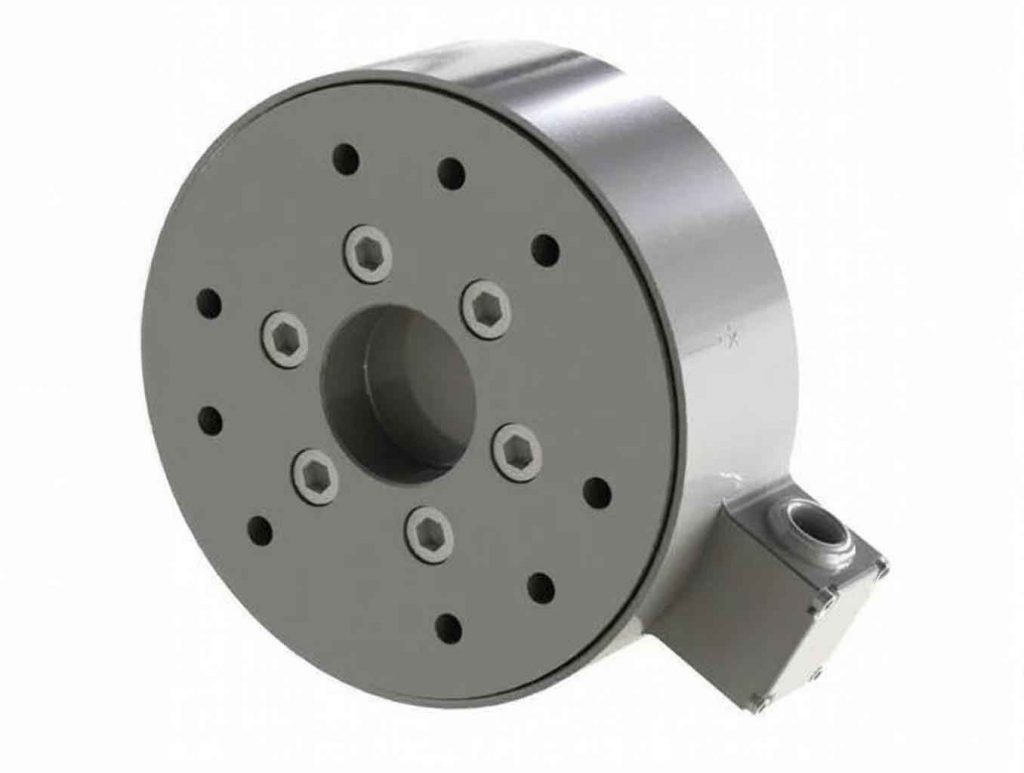
Material selection for the elastic body was critical to withstand harsh underwater conditions. I evaluated several alloys, including aluminum 7075, stainless steel 316, and titanium TC4, based on parameters such as elastic modulus, Poisson’s ratio, tensile strength, yield strength, thermal expansion coefficient, and density. Aluminum 7075 offers low density and high strength-to-weight ratio but requires surface treatments for corrosion resistance, making it suitable for low-range six-axis force sensors. Stainless steel 316 provides excellent corrosion resistance but has a lower yield strength, which could lead to failure under high loads; thus, heat treatment is necessary. Titanium TC4, while strong and corrosion-resistant, is less commonly used due to compatibility issues with strain gauges. After thorough analysis, I selected 17-4PH stainless steel for its superior yield strength (1310 MPa) and hardness (1180 MPa), ensuring the six-axis force sensor operates reliably in deep-sea environments. The material properties are summarized in Table 1.
| Material | Elastic Modulus (MPa) | Poisson’s Ratio | Tensile Strength (MPa) | Yield Strength (MPa) | Thermal Expansion Coefficient (×10⁻⁶/K) | Density (kg/m³) |
|---|---|---|---|---|---|---|
| Aluminum 7075 | 72,000 | 0.33 | 570 | 505 | 24 | 2,810 |
| Stainless Steel 316 | 193,000 | 0.27 | 580 | 172 | 16 | 8,000 |
| Titanium TC4 | 104,800 | 0.31 | 1,050 | 827 | 9 | 4,428 |
| 17-4PH Stainless Steel | 196,000 | 0.28 | 1,310 | 1,180 | 10.8 | 7,800 |
To optimize the structural dimensions and ensure the six-axis force sensor meets performance criteria, I conducted static finite element analysis (FEA). The simulation involved fixing the base and applying forces and moments in each direction to evaluate displacement and stress distribution. The maximum stress under full-scale load must remain below the material’s yield strength to prevent failure. For instance, when applying Fx, the stress concentration occurs at the floating beams, and I adjusted the cross-sectional dimensions of the beams and grooves to balance sensitivity and strength. The strain gauges are positioned where displacement is maximal, typically on the floating beam surfaces, with a sensitive range of 10⁻⁶ to 10⁻⁴ mm. This allows the six-axis force sensor to achieve high resolution while maintaining structural integrity. The optimized ranges and resolutions for each axis are detailed in Table 2.
| Force/Moment | Range | Resolution |
|---|---|---|
| Fx (N) | 700 | 14 |
| Fy (N) | 700 | 14 |
| Fz (N) | 1000 | 14 |
| Mx (N·m) | 60 | 1.2 |
| My (N·m) | 60 | 1.2 |
| Mz (N·m) | 45 | 0.9 |
The deformation under load can be modeled using Hooke’s law for linear elasticity, where the strain ε is related to stress σ by the elastic modulus E: $$ \sigma = E \epsilon $$. For the floating beams, the bending moment M induces strain, which is captured by the strain gauges. The output voltage from the bridge circuit is proportional to the applied force, and I derived relationships for each axis to minimize cross-sensitivity. For example, the force Fz causes axial deformation, while moments Mx and My lead to bending. The six-axis force sensor’s design ensures that each component is decoupled through geometric symmetry.
Sealing and pressure resistance are paramount for the six-axis force sensor in deep-sea applications. I implemented a multi-layered sealing approach using O-rings and rubber bellows. The O-ring is compressed between the base and a sealing cover to provide static sealing, while the rubber bellows, secured by compression rings, allow relative motion between the output flange and the base without compromising integrity. This design accommodates large deformations and maintains internal pressure balance. Additionally, all electronic components, including the signal processing module, are selected for high-pressure tolerance. A pressure compensator connected via a quick-connect adapter adjusts the internal oil pressure to match external hydrostatic pressure, preventing collapse or leakage. A waterproof socket enables power supply and data transmission through subsea cables, ensuring the six-axis force sensor operates reliably at depths exceeding several thousand meters.
The electrical configuration of the six-axis force sensor employs a full-bridge circuit to enhance signal integrity and decouple noise. A total of 24 strain gauges are symmetrically placed on the floating beams, with six gauges per beam. Each full-bridge consists of four strain gauges arranged to amplify the output and cancel common-mode errors such as temperature drift. For instance, when a force is applied, the resistance changes in the gauges are converted into voltage signals. The bridge output voltage V_out for a given excitation voltage V_ex is given by: $$ V_{\text{out}} = V_{\text{ex}} \cdot \frac{\Delta R}{R} $$, where ΔR is the resistance change and R is the nominal resistance. By positioning gauges on opposing sides of the beams, the circuit differentially eliminates thermal effects and electromagnetic interference, resulting in a clean signal for each axis. The six output voltages correspond to Fx, Fy, Fz, Mx, My, and Mz, and are processed through amplification and filtering stages before analog-to-digital conversion.
The full-bridge circuit design not only improves sensitivity but also enables temperature compensation. The strain gauge arrangement ensures that any uniform temperature change affects all gauges equally, canceling out in the differential output. This is crucial for the six-axis force sensor, as underwater environments experience significant temperature variations. The signal conditioning circuit includes instrumentation amplifiers with high common-mode rejection ratio (CMRR) to further enhance accuracy. The output signals are then digitized and calibrated to map voltage readings to force and moment values. The decoupling matrix C relates the output voltages V to the applied loads F: $$ \mathbf{F} = \mathbf{C} \cdot \mathbf{V} $$, where F is the vector of forces and moments, and V is the voltage vector. I determined C through calibration experiments, applying known loads and recording the responses.
Calibration of the six-axis force sensor involves applying precise forces and moments in a controlled environment to establish the relationship between input loads and output signals. I used a multi-axis loading apparatus to apply combinations of Fx, Fy, Fz, Mx, My, and Mz, while recording the voltage outputs from the bridge circuits. The data is processed using least-squares regression to compute the calibration matrix. For example, the force Fz can be expressed as: $$ F_z = k_{z1} V_1 + k_{z2} V_2 + \cdots + k_{z6} V_6 $$, where k_zi are calibration coefficients. The six-axis force sensor’s performance was validated through repeatability tests, showing minimal hysteresis and high linearity across the operating range. The resolution and accuracy meet the demands of underwater manipulation tasks, such as handling delicate objects or performing assembly operations.
In addition to mechanical and electrical design, I incorporated advanced signal processing algorithms to handle real-time data from the six-axis force sensor. Digital filters, such as low-pass filters, remove high-frequency noise from the raw signals, while compensation algorithms adjust for environmental factors like pressure and temperature. The sensor’s output is integrated with the robotic control system, enabling force-feedback loops that enhance autonomy. For instance, in underwater grasping tasks, the six-axis force sensor provides feedback to adjust grip force, preventing damage to fragile marine structures. The robustness of the six-axis force sensor allows it to function in depths up to 6000 meters, withstanding pressures exceeding 60 MPa.
The applications of this six-axis force sensor extend beyond underwater robotics to include oceanographic research,海底 infrastructure maintenance, and disaster response. In scientific missions, the sensor enables the collection of force data during sediment sampling or biological specimen retrieval. For industrial purposes, it assists in the installation and repair of pipelines and cables. The six-axis force sensor’s ability to operate in extreme conditions makes it a versatile tool for expanding human presence in the deep sea. Future work may focus on miniaturization and integration with artificial intelligence for predictive maintenance and adaptive control.
In conclusion, the development of this deep-sea six-axis force sensor represents a significant advancement in underwater force sensing technology. Through meticulous elastic body design, material selection, and structural optimization, I achieved a balance of sensitivity, range, and durability. The sealing and pressure compensation mechanisms ensure reliability in high-pressure environments, while the full-bridge circuit design provides accurate, decoupled signals. The six-axis force sensor has been successfully tested in laboratory and field conditions, demonstrating its capability to enhance the performance of underwater manipulators. As marine exploration and exploitation continue to grow, the six-axis force sensor will play a crucial role in enabling complex subsea operations.