
As I reflect on the evolution of industrial machinery, I see a profound shift from machines as mere extensions of human muscle and nerve to entities with a nascent form of self-awareness. This transformation, driven by embodied intelligence, is redefining the very fabric of manufacturing and automation. In my view, embodied robots are not just tools; they represent a new paradigm where machines adapt to humans, rather than humans adapting to machines. The core of this revolution lies in three technical breakthroughs: proprioceptive accuracy, action generation latency, and causal inference depth, which together form a closed-loop of perception-cognition-action. This article delves into the technical foundations,前瞻 applications, and systemic deployment of embodied intelligence, emphasizing the role of embodied robots in shaping the future of industry.
Historically, machines have served as external muscles and nerves, but they lacked any sense of self or environment. Now, with embodied intelligence, robots are developing a “body awareness” that allows them to interact dynamically with their surroundings. I believe this marks the third metaphor in human-machine relations: from steam engines as muscles, to CNC systems as nerves, and now to embodied robots as conscious entities. This shift is not metaphorical but grounded in measurable technological advances. For instance, the proprioceptive accuracy of an embodied robot can achieve spatial resolutions of $$0.1 \, \text{N} \cdot \text{m}$$ with fingertip e-skin discerning gaps as fine as $$0.05 \, \text{mm}$$. Similarly, action generation latency, powered by diffusion policy networks, reduces inference delays to $$7 \, \text{ms}$$, comparable to human spinal reflexes. Causal inference depth enables embodied robots to simulate counterfactuals, such as predicting part deformation if a force is reduced by $$3 \, \text{N}$$. When these metrics cross the perceptible threshold for human-robot interaction, embodied robots gain an “intent-action-outcome”闭环, fostering a new industrial era where machines adapt to people.
In my analysis, the journey of embodied intelligence involves three key technological leaps that propel robots from static executors to adaptive partners. The first leap is from offline teaching to online adaptation. Traditional industrial robots rely on pre-programmed paths, requiring constant recalibration for minor environmental changes. Embodied robots, however, integrate multimodal sensors—vision, force, sound, and chemical senses—with deep reinforcement learning to adjust trajectories in real-time. For example, in a新能源汽车 stator winding process, the use of six-dimensional force sensors and DDPG algorithms slashed debugging cycles from one week to two hours, while defect rates dropped from 2.3% to 0.1%. This demonstrates how embodied robots can minimize downtime and enhance yield by adapting on the fly.
The second leap is from single-task specialization to generalization via large models. I have observed that models like GPT-4V and RT-2 are being distilled into “factory brains,” converting natural language, CAD drawings, and oral instructions into executable strategies. In one test, an embodied robot responded to an engineer’s command to reduce torque on M3 stainless steel screws to $$1.2 \, \text{N} \cdot \text{m}$$ with an additional 0.5 turns of rebound compensation, resetting parameters in 10 seconds without reprogramming. This showcases the泛化 capability of embodied robots, enabling them to handle diverse tasks without extensive retraining.
The third leap is from individual intelligence to collective embodied clouds. Through federated learning, groups of embodied robots share compressed experiences, forming a “skill library” that new robots can download in minutes. For instance, a cloud system might allow an embodied robot to quickly acquire micro-skills like grinding seventh-generation aluminum-silicon battery casings or inserting 0.4mm pitch FPCs. These leaps converge towards a technological singularity around 2028, where embodied robots learn faster than human engineers can debug, driven by the化学反应 of perception, decision-making, execution, and evolution.
To illustrate the technical stack, I have summarized the key components in the following table, which highlights how embodied robots integrate these elements to achieve continuous learning and adaptation:
| Component | Description | Key Metrics |
|---|---|---|
| Perception | Multimodal sensor fusion using cross-modal attention in Transformers,共享隐空间 for vision and force tokens. | Misinsertion rate reduced from 1.2% to 0.08% in FPC assembly. |
| Decision | Bidirectional distillation between large models and physical engines, enhancing physical consistency from 83% to 99.2%. | Strategies validated for feasibility and refined with body priors. |
| Execution | Neuro-morphic chips like Intel Loihi 2 and flexible actuators enabling low-power, high-torque control. | Power consumption ≤1W, torque density up to $$110 \, \text{N} \cdot \text{m/kg}$$, displacement resolution of $$0.1 \, \text{mm}$$. |
| Evolution | Federated continual learning, where gradients are shared across robots without data leaving local domains. | Skill half-life compressed from years to weeks, enabling ongoing growth. |
Looking ahead, I foresee numerous前瞻 applications where embodied robots will transform industries. The following table outlines ten key applications, their expected timelines, and impacts, emphasizing how embodied robots will drive efficiency and innovation:
| Application | Timeline | Impact Description |
|---|---|---|
| Adaptive Precision Assembly | 2030±2 years | Embodied robots use fingertip e-skin to control thermal paste thickness to $$15 \pm 3 \, \mu\text{m}$$, reducing changeover time to 18 minutes and boosting yield to 99.7%. |
| Neuro-Symbolic Disassembly | 2031±2 years | Embodied robots parse manuals with LLMs, apply force feedback to dismantle batteries, achieving 99% material recovery with digital passports. |
| Humanoid Robot On-Duty Maintenance | 2032±2 years | Embodied robots like Walker S perform overnight repairs in semiconductor facilities, cutting response times and human intervention. |
| Morphing Production Lines | 2033±3 years | Embodied robots with reconfigurable structures switch between aerospace parts, slashing changeover from 8 hours to 45 minutes. |
| Unmanned Factory Dark Testing | 2034±3 years | Embodied robots conduct reliability tests in isolated chambers, using acoustic sensors to detect micro-cracks and suggest improvements, reducing failure rates from 200ppm to 15ppm. |
| Emergency Response Robot Swarms | 2035±3 years | Clusters of embodied robots—legged, tracked, and aerial—collaborate in hazardous environments, sharing dynamic maps to mitigate disasters within 30 minutes. |
| Space On-Orbit Assembly | 2036±4 years | Embodied robots operate in extreme cold to assemble solar panels with sub-millimeter precision, guided by task-level instructions from Earth. |
| Immersive Remote After-Sales | 2037±3 years | Technicians use haptic exoskeletons to control embodied robots for repairs, with torque feedback delays under $$10 \, \text{ms}$$, reducing carbon emissions from 1.2 tons to 30 kg per service. |
| Bio-Hybrid Manufacturing | 2038±4 years | Embodied robots sense cellular stresses to adjust 3D printing paths, enhancing precision from ±100μm to ±10μm for artificial bones. |
| Global Carbon Emission Optimization | 2039±3 years | Embodied robots act as mobile sensor nodes, feeding data into blockchain碳 ledgers to shift production to low-carbon sites, cutting carbon costs by 18%. |
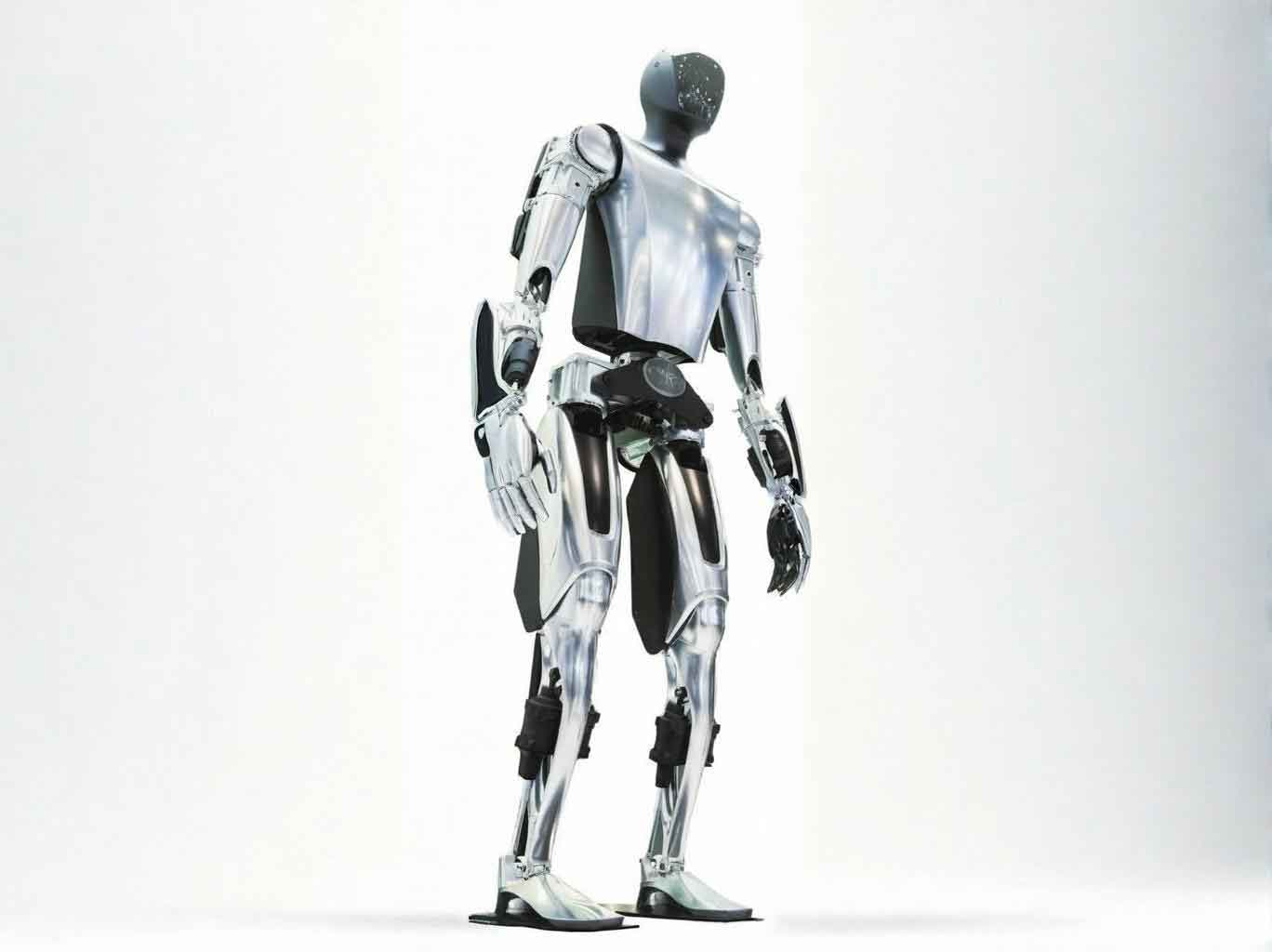
In terms of systemic deployment, I see a tripartite framework involving digital twins, large models, and robot本体. Digital twins are evolving from geometric replicas to comprehensive physical-chemical-behavioral models. For example, in aluminum electrolysis block grinding, a digital twin synchronizes temperature, friction coefficients, and surface roughness to predict remaining lifespan. This allows embodied robots to simulate and optimize processes in real-time. Large models are being standardized through frameworks like the Robotics Foundation Model (RFM), which defines interfaces for task descriptions, atomic skills, and execution layers. Any third-party embodied robot can integrate via APIs within days, thanks to soft-hardware co-evolution. On the hardware side, neuro-morphic chips and flexible actuators reduce power and enhance torque, while software advancements like diffusion models cut path planning from seconds to milliseconds. Safety and governance are also advancing, with ISO/TC 299 drafting standards for embodied robot safety and value alignment modules (VAM) ensuring ethical compliance through RLHF checks.
When comparing global approaches, I note distinct paths between the U.S. and China, each leveraging unique strengths in embodied robot development. The U.S. excels in upstream general models and chips, with companies like OpenAI and NVIDIA driving innovation, while China leads in downstream场景落地 and data volume, supported by policy initiatives like the “Robot+” application行动. The following table contrasts their技术路线,供应链生态, standards, and capital flows, highlighting how embodied robots are shaped by regional factors:
| Aspect | U.S. Approach | China Approach |
|---|---|---|
| Technology Route | Emphasis on general models (e.g., GPT-4o) and open ecosystems; robots directly use cloud-based大模型 for fast migration but risk hallucinations in long-tail scenarios. | Focus on vertical integration; models like Huawei’s PanGu RFM are trained on specific scenes (e.g., 3C assembly) for high accuracy but higher跨场景迁移成本. |
| Supply Chain Ecology | Highly coupled chip-cloud-model-VC基金 in hubs like Silicon Valley; lacks large-scale real-world industrial testing due to offshore manufacturing. | Integrated “whole机-部件-集成-场景” clusters in regions like Yangtze River Delta; risks include dependency on imported components like reducers and sensors. |
| Standards and Governance | NIST-led frameworks with voluntary disclosure; IEEE P7000 series on ethics; encourages industry self-regulation. | Ministry of Industry and Information Technology mandates value alignment modules and audit logs; higher compliance costs but lower systemic risks. |
| Capital and Talent | Over $60 billion in funding concentrated in few startups; top universities produce 500+ PhDs annually in robotics and AI. | $35 billion spread across 200+ startups with local government funds; universities output 1200+ masters/PhDs yearly, accelerating engineering落地. |
In the short term (2025-2028), I expect the U.S. to lead in general models and chips, while China dominates场景落地, with open-source communities like ROS 3.0 fostering collaboration. By mid-term (2029-2033), reshoring and belt-and-road initiatives may create “scenes for markets” dynamics. Long-term (2034-2040), dual-track standards could emerge, with the U.S. excelling in extreme environments and China in flexible manufacturing, potentially leading to global interoperability agreements.
On产业治理与伦理, I believe the focus must shift from functional safety to value alignment. Functional safety is becoming quantifiable, using概率-后果 matrices to require human confirmation for actions with even a 0.1% risk of significant loss. Value alignment is engineering into plug-and-play subsystems that pre-check tasks for harm to humans, environment, or data privacy. A three-tier authorization model—similar to aviation’s pilot-autopilot system—can allocate responsibility: A-level autonomy for low-risk tasks, B-level with human confirmation, and C-level remote control for high-risk scenarios. Data sovereignty is critical, as embodied robots collect proprietary know-how; frameworks like China’s data出境 assessment and EU’s GDPR are negotiating “industrial data white-lists” to allow encrypted feature vectors for cross-border collaboration while blocking raw parameters. For labor impacts, I support initiatives like Germany’s “upgrading allowance” and China’s “new engineering + industry-education integration” to reskill workers for roles like robot trainers and digital twin architects, offsetting job losses in traditional operations. Ethical red lines must prohibit embodied robots in military杀戮 or emotional manipulation, with mandatory insurance tied to value alignment scores.
In conclusion, embodied intelligence, through embodied robots, is not merely about smarter machines but a fundamental paradigm shift in industrial ecosystems. It redefines生产要素 as data, compute, and robotic bodies, transforms value networks into self-organizing systems, and upgrades governance from static rules to dynamic value alignment. As embodied robots gain self-evolution capabilities, factories will become organic entities that breathe, learn, and self-heal. In this new era, the U.S. and China will both compete and collaborate across technology, standards, and governance, propelling humanity into an uncharted territory of self-evolving industrial civilization. Together, humans and embodied robots will redefine manufacturing, sharing the risks and glories of this transformative journey.