
In this comprehensive analysis, I explore the burgeoning field of embodied intelligence, a frontier where artificial intelligence intersects with robotics to create systems that learn and evolve through dynamic interactions with their environment. Embodied intelligence emphasizes the deep integration of perception, action, and cognition, enabling autonomous adaptation in physical spaces. As global interest surges, driven by policy initiatives and technological advancements, I delve into the core challenges and emerging trends shaping this domain. The embodied robot represents a paradigm shift from virtual AI to physical-world applications, aiming to fully replace human labor in various sectors, potentially heralding a new industrial revolution. Throughout this discussion, I will incorporate mathematical formulations and comparative tables to elucidate key concepts, ensuring a thorough understanding of the complexities involved.
The development of embodied intelligence faces significant hurdles, which I categorize into five major challenges. These obstacles stem from the inherent complexity of bridging digital and physical worlds, contrasting sharply with large-scale AI models that operate solely in virtual realms. Below, I detail each challenge, supported by equations and examples to highlight the intricacies of embodied robot systems.
First, the complexity of physical interaction poses a fundamental barrier. Embodied robots must engage directly with their surroundings, requiring precise dynamics modeling and real-time adjustments. For instance, when an embodied robot grasps an object, it must control force feedback accurately to prevent slippage or damage, while adapting to environmental variables like lighting and friction. This can be modeled using Newtonian dynamics: $$ \vec{F} = m \vec{a} $$ where $\vec{F}$ is the force vector, $m$ is mass, and $\vec{a}$ is acceleration. In contrast, large models handle symbolic data without physical constraints, relying on input-output mappings. The embodied robot’s need for real-time physics-based control introduces uncertainties absent in purely digital systems.
Second, multi-modal data fusion and real-time requirements demand seamless integration of sensory inputs. An embodied robot relies on vision, touch, and audio sensors to form a coherent perception of its environment, necessitating millisecond-level closed-loop responses. For example, in autonomous driving, an embodied robot must detect obstacles and plan paths within tight timeframes. This can be expressed through sensor fusion equations, such as the Kalman filter update: $$ \hat{x}_{k|k} = \hat{x}_{k|k-1} + K_k (z_k – H \hat{x}_{k|k-1}) $$ where $\hat{x}$ is the state estimate, $K$ is the Kalman gain, $z$ is the measurement, and $H$ is the observation matrix. Large models, however, tolerate higher latencies, as in text generation tasks. Additionally, data acquisition for embodied robots incurs higher costs due to the need for physical or high-fidelity simulation environments, whereas large models leverage existing internet datasets.
Third, environmental adaptation and generalization present ongoing challenges. While large models achieve generalization through pre-training on vast datasets for static tasks, embodied robots must operate in dynamic settings, requiring cross-scene migration. For instance, a home service embodied robot must adjust to varying room layouts and unexpected interruptions. Reinforcement learning frameworks address this, with the Q-learning update: $$ Q(s,a) \leftarrow Q(s,a) + \alpha [r + \gamma \max_{a’} Q(s’,a’) – Q(s,a)] $$ where $Q$ is the action-value function, $\alpha$ is the learning rate, $r$ is the reward, and $\gamma$ is the discount factor. Current embodied robot systems often struggle with policy generalization and multi-task coordination, necessitating online optimization unlike the offline training common in large models.
Fourth, safety and ethical constraints are paramount for embodied robots due to their physical operations. These systems must exhibit robustness and explainability to prevent harm, such as in medical robots where millimeter-level precision is critical. The risk can be quantified using reliability metrics: $$ R(t) = e^{-\lambda t} $$ where $R(t)$ is reliability over time $t$, and $\lambda$ is the failure rate. In contrast, large models primarily face ethical risks like misinformation generation, which can be mitigated through prompt engineering. The embodied robot’s integration into human environments amplifies the need for stringent safety protocols.
Fifth, cross-disciplinary integration of technology stacks complicates embodied robot development. This field merges robotics, control theory, and cognitive science, requiring cohesive architectures for multi-modal perception and action planning. The complexity exceeds that of large models, which focus on algorithm optimizations like attention mechanisms. A hierarchical control model for an embodied robot might involve: $$ \pi(a|s) = \arg\max_a \sum_s P(s|a) U(s) $$ where $\pi$ is the policy, $P$ is the transition probability, and $U$ is the utility function. This multi-layered approach underscores the interdisciplinary nature of embodied intelligence.
| Comparison Dimension | Humanoid Robots | Large Models |
|---|---|---|
| Core Objective | Interaction and action in the physical world (e.g., robot grasping, navigation) | Language understanding and generation, cross-modal content creation |
| Technical Focus | Sensor fusion, motion control, real-time decision making | Text modeling, attention mechanisms, generative capabilities |
| Data Dependency | Physical environment data (e.g., RGB-D images, force feedback) | Large-scale text, multi-modal datasets |
| Application Scenarios | Robotics, autonomous driving, smart homes | Dialogue systems, content generation, knowledge Q&A |
| Hardware Dependency | Strong (requires sensors, actuators, embedded systems) | Weak (mainly relies on GPU, TPU computing power) |
| Training Methods | Reinforcement learning, “simulation training + real environment” transfer | “Pre-training + fine-tuning”, prompt engineering |
| Real-time Requirements | High (millisecond-level response) | Low (can accept second-level delay) |
| Environmental Interaction | Actively changes the physical environment | Passively responds to input (text, images) |
| Typical Challenges | Safety and fault tolerance, physical uncertainty | Hallucination problems, long-context memory |
| Representative Technologies | ROS robot system, deep reinforcement learning | Transformer architecture, mixture of experts |
Having outlined the challenges, I now turn to the six key trends driving the evolution of embodied intelligence. These trends reflect advancements in technology, commercialization, and ecosystem development, highlighting the transformative potential of embodied robots.
First, the integration of large models with humanoid robots is accelerating. The embodied robot’s “embodiment” necessitates embedding intelligence into physical forms for closed-loop perception-reasoning-execution, while large models offer semantic understanding and task planning capabilities. This synergy, exemplified by upgrades like GPT-4 and DeepSeek R1, enhances the commercial viability of embodied robots. For example, the fusion can be modeled as: $$ P(\text{task success}) = f(\text{semantic understanding}, \text{physical execution}) $$ where $f$ represents the integration function. This trend underscores how embodied robots leverage large models to overcome perceptual and cognitive bottlenecks.
Second, multi-modal perception and simulation technologies are converging deeply, enabling virtual-to-real migration. Embodied robots increasingly combine 3D vision with tactile sensors like electronic skin for precise environmental interaction. Simulation platforms, such as NVIDIA Isaac Sim, facilitate pre-training in high-fidelity virtual environments, with Sim2Real transfer reducing real-world debugging cycles by over 70%. The perception accuracy can be quantified as: $$ A = \frac{TP + TN}{TP + TN + FP + FN} $$ where $A$ is accuracy, $TP$ is true positives, $TN$ is true negatives, $FP$ is false positives, and $FN$ is false negatives. This trend empowers embodied robots to adapt to dynamic industrial settings more efficiently.
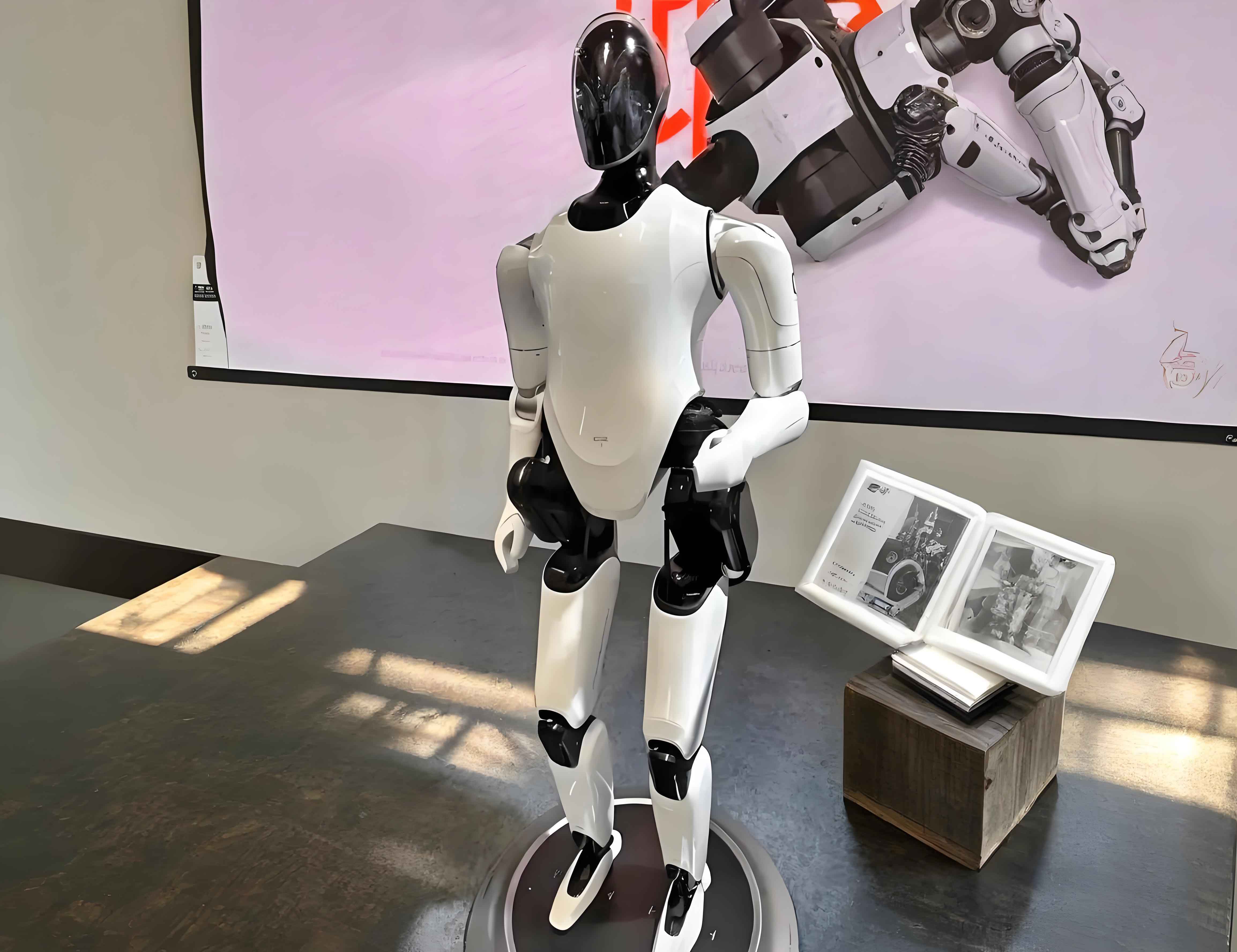
Third, synthetic data-driven training is alleviating physical world data bottlenecks. With real data often costly or privacy-sensitive (e.g., in surgical embodied robots), generative adversarial networks produce diverse synthetic datasets. This approach has increased the share of synthetic data in embodied AI training to over 40%, boosting generalization by 35% in areas like autonomous driving. The data generation process can be described as: $$ G(z) \sim p_{\text{data}} $$ where $G$ is the generator and $z$ is noise vector. As physical engines improve, synthetic data will cover more edge cases, enhancing the robustness of embodied robots.
Fourth, innovative rental models and commercialization scenarios are driving market penetration from B2B to B2C. High hardware costs (e.g., humanoid embodied robots exceeding $10,000) make leasing attractive, with daily rents ranging from $1,000 to $25,000 for applications in exhibitions and home services. The cost recovery for an embodied robot like Unitree’s G1 can be modeled as: $$ T_{\text{recovery}} = \frac{C_{\text{hardware}}}{R_{\text{daily}} \cdot U_{\text{rate}}} $$ where $T_{\text{recovery}}$ is recovery time, $C$ is cost, $R$ is daily rent, and $U$ is utilization rate. Coupled with AI large models, “experience-as-a-service” models allow users to access intelligent services without ownership, expanding embodied robot applications into education and healthcare.
Fifth, the industrial ecosystem is maturing, transitioning from policy-driven initiatives to supply chain collaboration. Guidance documents emphasize building innovation systems and securing core components by 2025, aligning with demonstrations of embodied robot mobility and adaptability. In regions like Beijing E-Town, clustering of over 140 companies has created a $10 billion annual output, representing 50% of the local robotics industry. Policy instruments, such as $10 billion investment funds and national innovation centers, foster industry-academia-research integration. The growth of embodied robot ecosystems can be expressed as: $$ G_{\text{ecosystem}} = \alpha P_{\text{policy}} + \beta I_{\text{innovation}} + \gamma A_{\text{application}} $$ where $G$ is growth, and $\alpha, \beta, \gamma$ are coefficients. This trend highlights how embodied robots benefit from synergistic policy and industrial efforts.
Sixth, innovation pathways are shifting from laboratory research to industrialization. Despite progress, embodied robot development faces core technology gaps (e.g., reliance on imported servos and sensors), limited application scenarios, and fragmented funding. Addressing these requires expanding into home services and medical care, while fostering aggregation through policy. The “Robot Year” concept gains traction with events like the 2025 World Robot Cup, validating embodied robot agility and multi-tasking capabilities. The innovation trajectory can be modeled as: $$ I(t) = I_0 e^{kt} $$ where $I$ is innovation level, $t$ is time, and $k$ is the growth rate. This trend underscores the journey of embodied robots from prototypes to pervasive solutions.
In conclusion, the realization of embodied intelligence hinges on overcoming technical hurdles and fostering open ecosystems. As embodied robots evolve from basic mobility to practical utility, they promise to redefine human-AI coexistence in factories, offices, schools, communities, and homes. The embodied robot stands at the forefront of this transformation, embodying the fusion of digital and physical realms that could reshape our world. Through continued innovation and collaboration, the potential of embodied robots to fully replace human labor in physical tasks may soon become a reality, marking a significant leap in technological advancement.