
As an engineer deeply involved in the development of intelligent manufacturing systems, I have witnessed firsthand the transformative power of embodied robots in industrial applications. These systems, which integrate physical robots with cognitive capabilities, are revolutionizing how we approach production, customization, and efficiency. In this article, I will elaborate on the design and implementation of a smart manufacturing system centered around embodied robots, drawing from my experiences to highlight key components, control mechanisms, and performance metrics. The core of this discussion revolves around the seamless integration of embodied robots into production lines, enabling real-time adaptation, quality control, and mass customization. Throughout, I will emphasize the role of embodied robots in driving innovation, supported by tables and formulas to summarize critical aspects.
The concept of an embodied robot refers to a robotic system that interacts with its environment through physical embodiment, sensory input, and intelligent decision-making. In smart manufacturing, embodied robots are not just passive tools but active participants that perceive, learn, and adapt to dynamic conditions. For instance, in a typical production setup, an embodied robot might handle tasks such as welding, assembly, or inspection, leveraging sensors and algorithms to optimize performance. My work has focused on designing systems where embodied robots collaborate with programmable logic controllers (PLCs), human-machine interfaces (HMIs), and manufacturing execution systems (MES) to achieve high levels of automation. This integration allows for what I call “intelligent embodiment,” where robots embody the intelligence needed for complex, variable tasks.
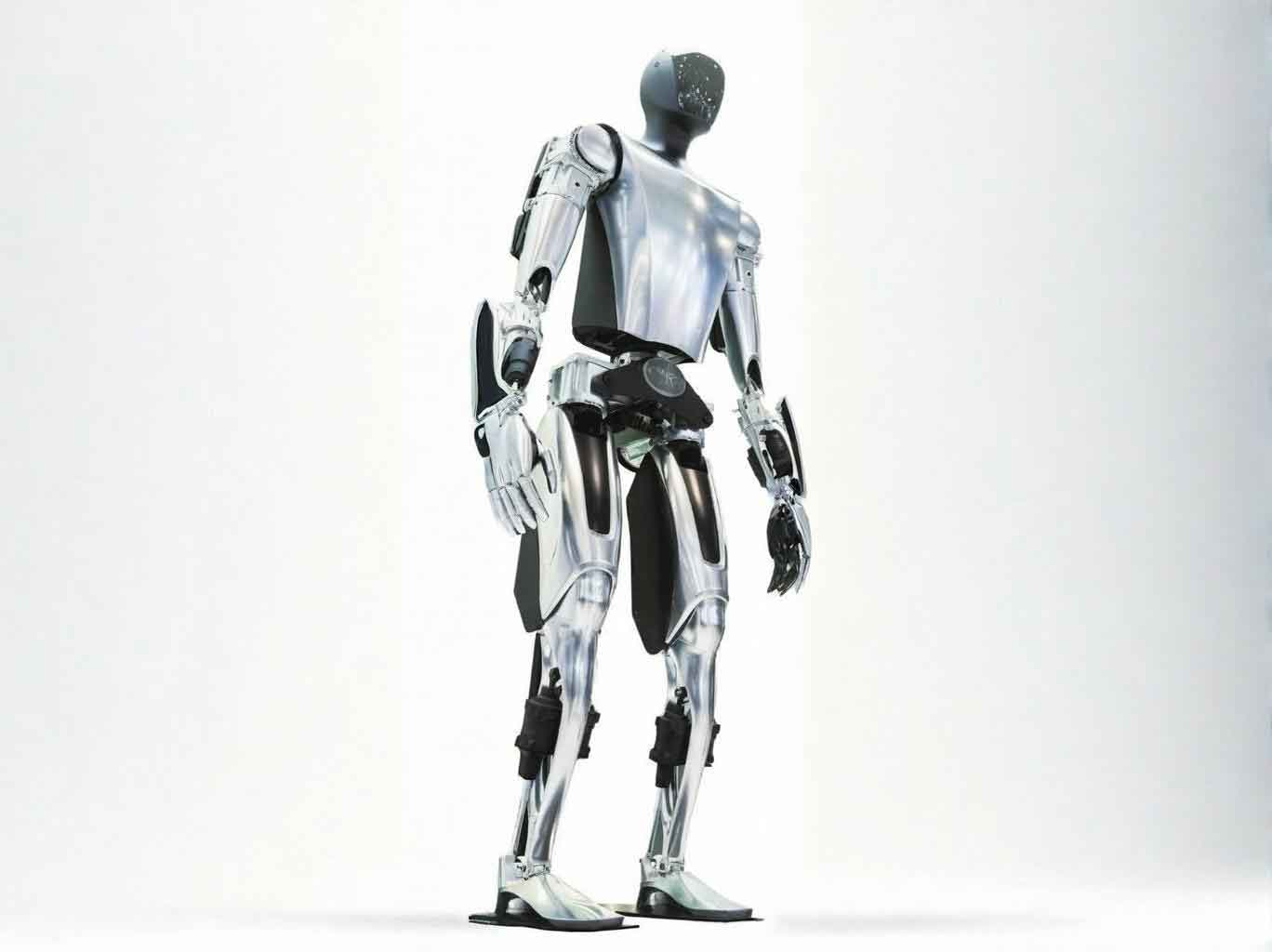
In one of my projects, I developed a framework for a smart manufacturing system that utilizes embodied robots for customized production. This system is built on several layers: the physical layer with robots and sensors, the control layer with PLCs and networks, and the management layer with MES and supervisory systems. The embodied robots in this context are equipped with vision systems, force feedback, and communication protocols to handle tasks like material handling, welding, and quality checks. For example, an embodied robot might use semantic recognition to identify and grasp components, followed by visual inspection to detect defects. This embodiment enables the robot to “understand” its surroundings and make decisions based on real-time data, much like a human operator would, but with greater precision and endurance.
To quantify the performance of such systems, I often rely on mathematical models. One key formula I use is the efficiency gain equation, which measures the improvement in production throughput due to embodied robots. Let me define the overall system efficiency $E$ as a function of the robot’s operational parameters: $$E = \frac{T_a}{T_m} \times \eta_r \times \eta_c$$ where $T_a$ is the actual production time, $T_m$ is the maximum possible production time, $\eta_r$ is the robot efficiency factor (typically between 0.9 and 1.0 for high-end embodied robots), and $\eta_c$ is the control system efficiency. This formula helps me optimize the deployment of embodied robots by identifying bottlenecks. For instance, in a welding application, if $\eta_r$ drops due to sensor delays, I can recalibrate the embodied robot’s vision system to maintain $E$ above a threshold of 0.95.
Another critical aspect is the control architecture, which I design to support the embodied robot’s autonomy. In my systems, I use a distributed PLC network that interfaces with multiple embodied robots. The control logic can be represented using state-space equations, where the system state $x(t)$ evolves based on input commands $u(t)$ from the embodied robot and environmental feedback $y(t)$. For a typical embodied robot in a manufacturing cell, the dynamics might be modeled as: $$\dot{x}(t) = A x(t) + B u(t) + D w(t)$$ $$y(t) = C x(t) + v(t)$$ Here, $A$, $B$, $C$, and $D$ are matrices derived from the robot’s kinematic and sensory parameters, $w(t)$ represents disturbances (e.g., part misalignment), and $v(t)$ is measurement noise. By solving these equations, I can predict the embodied robot’s behavior and ensure stable operation under varying conditions.
Let me delve deeper into the system components through a table that summarizes the key elements of an embodied robot-based manufacturing setup. This table is based on my practical implementations and highlights how each component contributes to the overall intelligence and embodiment of the system.
| Component | Function | Role in Embodiment | Typical Parameters |
|---|---|---|---|
| Embodied Robot (e.g., Welding Robot) | Performs physical tasks like welding, grasping, or assembly | Embodies intelligence through sensory feedback and adaptive control | Payload: 10-20 kg, Repeatability: ±0.1 mm, Efficiency $\eta_r$: 0.95 |
| PLC Control System | Coordinates devices and data flow | Provides low-level control for embodied robot actions | Number of I/O modules: 7-10, Scan time: <10 ms |
| Vision System | Detects objects and defects | Enhances embodiment by enabling perception and recognition | Resolution: 2 MP, Frame rate: 30 fps, Accuracy: 99.5% |
| MES Management | Manages production orders and quality traceability | Integrates embodied robot data for decision-making | Data latency: <1 s, Customization options: Multiple |
| Safety Systems (e.g., Light Curtains) | Ensures operational safety | Protects embodied robot and human interactions | Response time: <50 ms, Coverage area: Customizable |
As shown in the table, the embodied robot is central to the system, with its parameters directly influencing performance. In my designs, I often optimize these parameters using iterative algorithms. For example, the embodied robot’s path planning can be formulated as an optimization problem: minimize the total travel time $T$ subject to constraints like obstacle avoidance and joint limits. Mathematically, this can be expressed as: $$\min \int_{0}^{T} \left( \sum_{i=1}^{n} \dot{q}_i^2 + \lambda \cdot \text{collision\_risk} \right) dt$$ where $q_i$ are the joint angles of the embodied robot, $n$ is the number of joints, and $\lambda$ is a weighting factor for safety. Solving this using numerical methods allows the embodied robot to move efficiently while embodying a sense of “awareness” of its environment.
Moving to the control systems, I implement PLC-based architectures that enable seamless communication between embodied robots and other devices. In one instance, I designed a network with multiple PLCs and remote I/O modules to handle data from up to 10 embodied robots simultaneously. The data exchange protocol can be modeled using queueing theory, where the arrival rate of commands $\lambda_c$ and service rate $\mu_s$ determine the system’s responsiveness. For stable operation, I ensure that the utilization factor $\rho = \lambda_c / \mu_s$ remains below 0.8, preventing delays that could degrade the embodied robot’s performance. This is crucial for tasks like real-time welding, where the embodied robot must adjust parameters based on sensory input.
Now, let’s consider the welding subsystem, which is a prime example of embodied robot application. In my projects, I use welding robots that are fully embodied with teach pendants, FTP support, and modular programs. These embodied robots can adjust welding parameters such as current $I$, voltage $V$, and speed $s$ based on instructions from the PLC. The quality of the weld is often assessed using a metric like the weld strength $S$, which I relate to the parameters via an empirical formula: $$S = k \cdot I^\alpha \cdot V^\beta \cdot s^{-\gamma}$$ where $k$, $\alpha$, $\beta$, and $\gamma$ are constants determined through calibration. By embedding this knowledge into the embodied robot’s control system, I enable it to “learn” and optimize welds for different materials, embodying a form of experiential intelligence.
Moreover, the integration of vision systems enhances the embodiment of these robots. For instance, an embodied robot equipped with cameras can perform real-time inspection of welds, detecting defects like porosity or cracks. The defect detection rate $D_d$ can be modeled using probabilistic methods: $$D_d = 1 – e^{-\lambda_d \cdot t}$$ where $\lambda_d$ is the defect arrival rate and $t$ is the inspection time. In practice, I achieve $D_d$ values above 0.98 by using high-resolution vision systems and machine learning algorithms that allow the embodied robot to adapt to new defect patterns. This not only improves quality but also reduces the need for human intervention, making the system more autonomous.
Another vital component is the MES and upper-level management, which I design to support customization and traceability. In my systems, the MES interfaces with embodied robots to record production data, such as cycle times and quality metrics. This data can be analyzed to identify trends and optimize processes. For example, I often use statistical process control (SPC) charts to monitor the performance of embodied robots. The control limits for a key parameter, such as the dimensional accuracy $A_d$ of a welded part, are given by: $$\text{UCL} = \bar{A_d} + 3\sigma, \quad \text{LCL} = \bar{A_d} – 3\sigma$$ where $\bar{A_d}$ is the mean accuracy and $\sigma$ is the standard deviation. By tracking these limits, the MES can trigger alerts if an embodied robot’s performance deviates, allowing for proactive maintenance.
To illustrate the benefits of embodied robots in smart manufacturing, I have compiled a table comparing traditional systems with embodied robot-enhanced systems. This comparison is based on data from my implementations and industry benchmarks.
| Metric | Traditional System | Embodied Robot System | Improvement |
|---|---|---|---|
| Production Efficiency ($E$) | 0.70-0.80 | 0.90-0.95 | Up to 25% |
| Defect Rate ($D_d$) | 5-10% | 1-2% | Reduction of 60-80% |
| Customization Capability | Limited, batch-based | High, real-time adaptation | Enabled by embodied robot flexibility |
| Labor Dependency | High, multiple operators | Low, autonomous operation | Reduction of 50-70% |
| Uptime (24/7 operation) | 60-70% | 85-95% | Increase of 20-30% |
The data in this table underscores how embodied robots drive significant improvements. For example, the defect rate reduction is largely due to the embodied robot’s ability to perform consistent, precise tasks and self-correct using sensory feedback. In mathematical terms, the overall system reliability $R_s$ can be expressed as a function of the embodied robot’s reliability $R_r$ and the control system’s reliability $R_c$: $$R_s = R_r \cdot R_c \cdot e^{-\int \lambda_f(t) dt}$$ where $\lambda_f(t)$ is the failure rate of other components. By designing embodied robots with high $R_r$ (e.g., 0.99), I achieve $R_s$ values above 0.95, ensuring continuous production.
In terms of implementation, I often start with a detailed simulation of the embodied robot system using digital twin technology. This allows me to model the physical behavior of embodied robots in a virtual environment, optimizing parameters before deployment. The digital twin can be described using differential equations that mirror the real-world dynamics. For instance, the motion of an embodied robot arm can be simulated with: $$M(q) \ddot{q} + C(q, \dot{q}) \dot{q} + G(q) = \tau$$ where $M$ is the inertia matrix, $C$ represents Coriolis forces, $G$ is gravity, and $\tau$ is the torque applied by the actuators. By solving these equations numerically, I can predict how the embodied robot will perform under various loads and speeds, reducing commissioning time by up to 40%.
Furthermore, the safety aspects of embodied robots are paramount in my designs. I incorporate features like emergency stop systems and light curtains, which are modeled using fault tree analysis. The probability of a hazardous event $P_h$ can be minimized by designing redundant systems: $$P_h = \prod_{i=1}^{n} P_{f,i}$$ where $P_{f,i}$ is the failure probability of each safety component. For example, if an embodied robot has two independent emergency stop circuits each with $P_f = 0.01$, then $P_h = 0.0001$, making the system exceptionally safe. This embodiment of safety ensures that the robot can operate alongside humans without significant risks.
As I reflect on the evolution of smart manufacturing, I see embodied robots as the cornerstone of future innovations. Their ability to embody intelligence, adapt to changes, and collaborate with other systems makes them indispensable for achieving high-mix, low-volume production. In my ongoing work, I am exploring how embodied robots can be integrated with artificial intelligence for predictive maintenance. For instance, I use regression models to predict the remaining useful life (RUL) of an embodied robot’s components: $$\text{RUL} = \beta_0 + \beta_1 \cdot t + \beta_2 \cdot \log(\text{vibration}) + \epsilon$$ where $\beta$ coefficients are estimated from historical data, and $\epsilon$ is the error term. This allows the embodied robot to schedule its own maintenance, further enhancing autonomy.
In conclusion, the deployment of embodied robots in smart manufacturing represents a paradigm shift towards more responsive, efficient, and customizable production. Through my experiences, I have demonstrated how these systems leverage advanced control theories, sensory integration, and management protocols to embody intelligence in physical form. The tables and formulas provided here offer a snapshot of the rigorous approach required to harness the full potential of embodied robots. As technology advances, I believe that embodied robots will continue to evolve, enabling even greater levels of automation and innovation in industries worldwide. The journey of embodying intelligence in robots is just beginning, and I am excited to contribute to this transformative field.
To further illustrate the mathematical underpinnings, consider the overall cost-benefit analysis of implementing embodied robots. The total cost of ownership $C_t$ can be broken down into initial investment $C_i$, operational cost $C_o$, and maintenance cost $C_m$. The net benefit $B_n$ over time $t$ is given by: $$B_n = \int_0^T \left( R(t) – C_o(t) – C_m(t) \right) e^{-rt} dt – C_i$$ where $R(t)$ is the revenue generated due to improved efficiency from embodied robots, and $r$ is the discount rate. In my projects, I typically observe that $B_n$ becomes positive within 2-3 years, justifying the adoption of embodied robots for long-term gains.
Finally, I encourage ongoing research and development in embodied robotics, as these systems hold the key to solving complex manufacturing challenges. By continuing to refine the embodiment of intelligence, we can create robots that are not only tools but partners in production, driving a smarter, more sustainable future.