
Contemporary research in artificial intelligence is undergoing a profound paradigm shift, moving from the classical computational-representational approach to a phenomenological framework centered on embodied intelligence. I argue that intelligence does not stem from abstract computation divorced from the body but emerges from the dynamic, continuous coupling between an agent and its environment. This process relies on the intricate interrelation of the agent’s action capabilities, perceptual structures, and meaning construction. In this article, I explore how embodiment can be realized in artificial systems, with a particular focus on humanoid robots as a pivotal case study. Humanoid robots, with their anthropomorphic forms, accentuate the constitutive role of the body in intelligence, yet they fundamentally differ from human embodied cognition. Their functional simulations do not capture the transcendental structures of bodily experience, prompting a critical examination of the phenomenological conditions for true embodiment in AI.
The transition from non-embodied to embodied research paradigms in cognitive science and artificial intelligence represents a significant epistemological and ontological transformation. Traditional AI models, rooted in discrete symbol manipulation and formal logic systems, presuppose that intelligence can be abstracted from physical substrates and realized through algorithmic processes that indirectly map symbols to the world. This Cartesian mind-body dualism has been extensively critiqued by embodied cognition theories, which posit that intelligence arises from dynamic sensory-motor cycles where the agent and environment are continuously coupled. For instance, it is emphasized that cognition is not confined to symbolic processing within an isolated system but is a distributed process mediated by the body within a brain-body-world continuum. This shift challenges the very foundation of how we conceptualize intelligence in artificial systems.
| Aspect | Non-embodied Paradigm | Embodied Paradigm |
|---|---|---|
| Cognitive Basis | Symbolic computation and internal representations | Sensory-motor coupling and dynamic interactions |
| Role of Body | Peripheral input/output channel | Constitutive element of cognition |
| Environment Interaction | Static mapping via symbols | Real-time coupling and adaptation |
| Intelligence Emergence | Result of internal processing rules | Emergent property of agent-environment dynamics |
| Key Technologies | Rule-based systems and neural networks without bodily integration | Morphological computation and situated agents like humanoid robots |
To mathematically represent the dynamic coupling in embodied systems, consider a state-space model where the system state \( S \) evolves based on interactions with the environment \( E \) and actions \( A \). The change in state can be described by the differential equation: $$ \frac{dS}{dt} = f(S, E, A) + \eta $$ where \( f \) is a function capturing the coupling dynamics, and \( \eta \) represents noise or uncertainties. This formulation highlights how intelligence in humanoid robots is not a static computation but a continuous process of adjustment and learning.
The embodied intelligence framework can be dissected into three constitutive dimensions: sensorimotor embodiment as the pre-reflective basis of cognition, situated embodiment as the mechanism for meaning generation, and interactive embodiment as a paradigm for socially generated cognition. Each dimension contributes uniquely to the emergence of intelligence in systems like humanoid robots.
Sensorimotor embodiment underscores that cognition originates from the perceptual-motor loop between the agent and the world, with the body serving as the primary interface. The body is not a passive receiver of sensory inputs but an active participant that structures perception and action through pre-reflective mechanisms. In artificial systems, this is exemplified by architectures that prioritize direct environmental interaction over central representations. For example, the subsumption architecture layers behaviors such as obstacle avoidance and navigation, enabling complex actions to emerge from simple sensorimotor couplings. The morphological computation model further demonstrates that the physical properties of a robot’s body—such as joint flexibility and mass distribution—can intrinsically process information, reducing computational load. This can be modeled as: $$ C = g(B, E) $$ where \( C \) is the computational output, \( B \) represents bodily properties, and \( E \) is the environmental context. For humanoid robots, this means that their human-like limbs and sensors facilitate natural movements and responses, mimicking biological systems.
| Sensorimotor Feature | Description | Application in Humanoid Robots |
|---|---|---|
| Perceptual-Motor Loop | Continuous feedback between sensing and acting | Real-time balance adjustment in walking humanoid robots |
| Morphological Computation | Body structure contributes to information processing | Use of compliant materials for efficient energy transfer |
| Pre-reflective Action | Non-conscious, skilled responses to stimuli | Automatic grasping reflexes in robotic hands |
Situated embodiment emphasizes that intelligent behavior is embedded in specific physical and social contexts, where cognitive structures and goals co-vary with the situation. The environment offers affordances—action possibilities directly perceived based on the agent’s bodily capabilities—such as surfaces being walkable or objects being manipulable. For artificial intelligence, this requires systems to dynamically adapt to contextual changes and generate meaning through interaction. Neurorobotic approaches, for instance, simulate neural plasticity to enable robots to learn from environmental feedback, fostering self-organization. The relationship between an agent and its situation can be expressed as: $$ M = h(A, C) $$ where \( M \) is the generated meaning, \( A \) denotes agent actions, and \( C \) represents the situational context. Humanoid robots leverage this by integrating multi-sensor data to interpret ambiguous scenes, such as identifying objects in cluttered spaces or navigating crowded areas.
| Situated Element | Role in Embodiment | Example in Humanoid Robots |
|---|---|---|
| Affordances | Action opportunities in the environment | Recognizing doors as openable based on handle design |
| Contextual Adaptation | Adjusting behavior to situational changes | Modifying navigation paths in dynamic environments |
| Meaning Generation | Constructing significance through interaction | Interpreting user gestures for collaborative tasks |
Interactive embodiment focuses on how agents, through interactions with other agents and humans, co-construct meaning, establish norms, and achieve consensus. Drawing from phenomenological concepts like intercorporeality, this dimension posits that intersubjectivity is not merely about information exchange but about shared participation in a meaning-laden field. Participatory sense-making theory describes this as a higher-order autonomous system where interactions lead to mutual regulation and co-adaptation. In AI, this is realized in social robots that engage in legible and negotiable behaviors, such as expressing emotions or synchronizing movements with humans. The dynamics of interaction can be modeled using coupled differential equations: $$ \frac{dI_A}{dt} = k(I_B – I_A) + \epsilon $$ $$ \frac{dI_B}{dt} = k(I_A – I_B) + \epsilon $$ where \( I_A \) and \( I_B \) represent the interaction states of two agents, \( k \) is a coupling constant, and \( \epsilon \) denotes external influences. Humanoid robots, like those used in healthcare or education, exemplify this by fostering trust and collaboration through responsive dialogues and empathetic gestures.
Humanoid robots redefine traditional robotics by integrating human-like morphology with advanced AI, moving beyond tool-like functionality to become participatory agents in shared environments. Conventional robots often operate in structured, predictable settings with predefined tasks, whereas humanoid robots are designed for open-world scenarios where uncertainty and complexity prevail. For instance, Boston Dynamics’ Atlas demonstrates remarkable dynamic balance through its mechanical design, enabling jumps and flips that emerge from body-environment coupling rather than centralized control. Similarly, SoftBank’s Pepper utilizes multi-modal perception to understand vague commands in social contexts, such as interpreting “that shoe” in a retail setting by combining visual, auditory, and contextual cues. This redefinition highlights that intelligence in humanoid robots is not merely about executing algorithms but about embodied engagement that mirrors human-like adaptability.
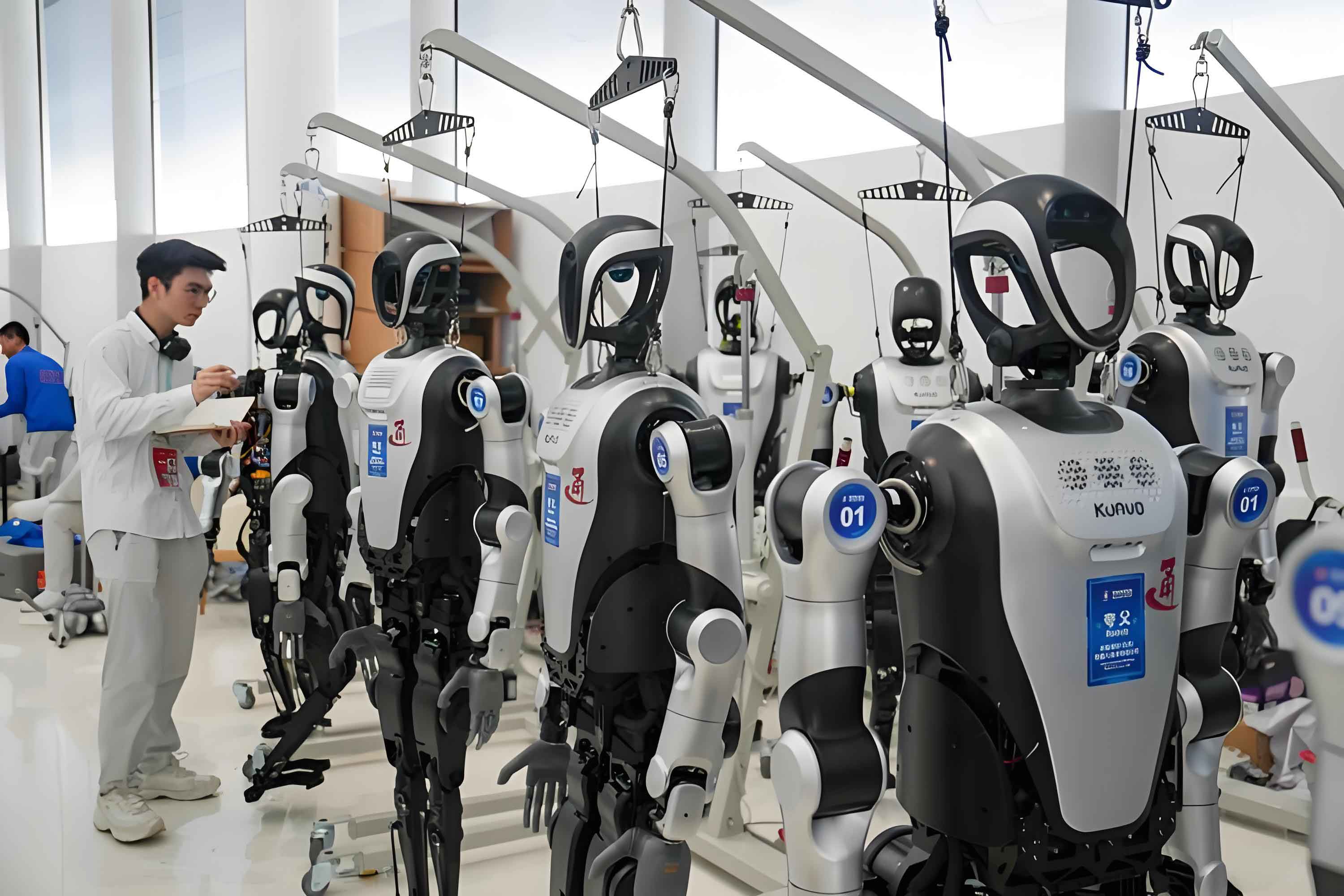
The embodiment in humanoid robots encompasses all three dimensions: sensorimotor capabilities allow for natural movement, situatedness enables context-aware decision-making, and interactivity facilitates social bonding. However, current humanoid robots face significant challenges, including high computational costs, limitations in understanding nuanced human emotions, and ethical concerns regarding autonomy and privacy. The gap between functional simulation and genuine embodiment lies in the inability to replicate the phenomenological depth of human experience, where the body is not just a physical entity but a locus of meaning and intentionality. Despite these hurdles, humanoid robots serve as crucial experimental platforms for advancing embodied AI, pushing the boundaries of what artificial systems can achieve.
In conclusion, the embodiment of artificial intelligence, as illustrated by humanoid robots, represents a paradigm shift that challenges non-embodied approaches by emphasizing the inseparable link between body, environment, and social interaction. Through the dimensions of sensorimotor, situated, and interactive embodiment, humanoid robots redefine robotics and offer insights into the ontological foundations of intelligence. Yet, they remain functional approximations that do not fully capture the transcendental structures of human bodily experience. This not only underscores engineering obstacles but also invites philosophical reflection on the nature of intelligence, the ethics of human-robot coexistence, and the future of AI development. As research progresses, humanoid robots will continue to illuminate the path toward truly embodied artificial systems, fostering a deeper understanding of cognition in both biological and artificial entities.