
As a researcher in the field of robotics, I have witnessed the remarkable evolution of humanoid robots over the decades. Humanoid robots, defined as machines with human-like form, mobility, and intelligent behavior, represent a convergence of advanced technologies such as artificial intelligence, mechanical engineering, and materials science. These humanoid robots are designed to achieve seamless integration and substitution in human environments, offering unparalleled versatility and adaptability. In this comprehensive review, I will explore the historical development, current challenges, and future prospects of humanoid robots, emphasizing key aspects through tables, formulas, and detailed analysis. The journey of humanoid robots spans nearly a century, reflecting breakthroughs in multiple disciplines, and today, they stand at the forefront of technological innovation, with applications ranging from industrial automation to personal assistance.
The development of humanoid robots can be categorized into distinct phases, each marked by significant technological milestones. I will begin by outlining these stages to provide a structured understanding of how humanoid robots have evolved. The progression from simple mechanical constructs to highly intelligent systems illustrates the interdisciplinary nature of this field. For instance, early humanoid robots focused on basic locomotion, while modern iterations incorporate advanced感知 and decision-making capabilities. Throughout this review, I will use the term “humanoid robots” repeatedly to underscore their centrality in robotics research, and I will integrate mathematical models to explain fundamental principles, such as the dynamics of bipedal walking. One critical formula in the stability analysis of humanoid robots is the Zero Moment Point (ZMP) criterion, which is essential for balanced motion. The ZMP is defined as the point on the ground where the net moment of forces is zero, and it can be expressed as:
$$ p_{zmp} = \frac{\sum_{i} m_i (g z_i – \ddot{z}_i x_i) – \sum_{i} m_i x_i \ddot{z}_i}{\sum_{i} m_i (g – \ddot{z}_i)} $$
where \( m_i \) represents the mass of segment i, \( g \) is gravitational acceleration, \( z_i \) and \( x_i \) are coordinates, and \( \ddot{z}_i \) denotes acceleration. This equation highlights the complexity of maintaining balance in humanoid robots, a challenge that has driven research for decades. Additionally, I will present tables to summarize key developments, making it easier to compare different eras and technologies. The following table outlines the major stages in the evolution of humanoid robots, based on my analysis of historical trends and technological shifts.
| Stage | Time Period | Key Characteristics | Notable Examples | Technological Focus |
|---|---|---|---|---|
| Conceptual | Before 1960 | Mechanical and electrical rudiments; limited functionality | Early automata and prototypes | Basic actuation and simple controls |
| Early Development | 1960-1990 | Bipedal walking; joint actuation; laboratory prototypes | WABOT series, Honda E series | Stability and dynamic walking algorithms |
| Integration | 1990-2015 | Enhanced mobility; added features like arms and heads | ASIMO, WABIAN series | Human-like motion and interaction |
| Breakthrough | 2015-2022 | AI-driven autonomy; dynamic actions | Atlas, Walker series | Perception and decision-making |
| Commercialization | 2022-present | Widespread applications; cost reduction | Optimus, Figure series, various commercial models | Scalability and real-world deployment |
In the conceptual stage, humanoid robots were primarily inspired by myths and early engineering, with designs that emphasized mechanical mimicry. For example, automata from this era could perform simple tasks like writing or playing instruments, but they lacked the sophistication of modern humanoid robots. The transition to the early development phase saw the emergence of bipedal locomotion, driven by research institutions. I find it fascinating how humanoid robots like the WABOT-1 pioneered lower-body movement, using basic sensors and control systems. The dynamics of such systems can be modeled using Lagrangian mechanics, where the equations of motion for a humanoid robot with multiple degrees of freedom are given by:
$$ \frac{d}{dt} \left( \frac{\partial L}{\partial \dot{q}_j} \right) – \frac{\partial L}{\partial q_j} = Q_j $$
Here, \( L = T – V \) is the Lagrangian, with \( T \) as kinetic energy and \( V \) as potential energy, \( q_j \) are generalized coordinates, and \( Q_j \) are generalized forces. This formulation is crucial for simulating the motion of humanoid robots and optimizing their gait patterns. As humanoid robots advanced into the integration stage, researchers focused on adding upper-body components and improving environmental interaction. The table above shows how humanoid robots like ASIMO incorporated arms and heads, enabling tasks such as object manipulation. This period also saw the rise of control theories, such as proportional-integral-derivative (PID) controllers, which can be expressed as:
$$ u(t) = K_p e(t) + K_i \int_0^t e(\tau) d\tau + K_d \frac{de(t)}{dt} $$
where \( u(t) \) is the control output, \( e(t) \) is the error signal, and \( K_p \), \( K_i \), \( K_d \) are tuning parameters. Such controllers are vital for maintaining stability in humanoid robots during complex movements. Moving to the breakthrough stage, the integration of artificial intelligence allowed humanoid robots to perform highly dynamic actions, like backflips or running, as seen in robots like Atlas. This era emphasized perception algorithms, often based on sensor fusion techniques. For instance, the Kalman filter is commonly used for state estimation in humanoid robots, with its update equations:
$$ \hat{x}_{k|k-1} = F_k \hat{x}_{k-1|k-1} + B_k u_k $$
$$ P_{k|k-1} = F_k P_{k-1|k-1} F_k^T + Q_k $$
where \( \hat{x} \) is the state estimate, \( F \) is the state transition matrix, \( B \) is control input matrix, \( u \) is control vector, \( P \) is error covariance, and \( Q \) is process noise covariance. These mathematical tools enable humanoid robots to navigate uncertain environments effectively. In the current commercialization stage, humanoid robots are becoming more accessible, with companies leveraging economies of scale. The diversity of applications is expanding, as illustrated by the following table, which compares different modern humanoid robots based on their specifications and capabilities.
| Robot Model | Height (m) | Weight (kg) | Degrees of Freedom | Key Features | Primary Applications |
|---|---|---|---|---|---|
| Optimus Gen-2 | ~1.7 | ~55 | 200+ | Fine manipulation; AI integration | Industrial automation; service tasks |
| Figure 02 | ~1.6 | ~60 | 40+ | Real-time speech interaction; autonomous tasks | Research; commercial services |
| Walker S | 1.7 | 60 | 41 | Multi-modal perception; industrial readiness | Manufacturing; logistics |
| GR-1 | 1.65 | 55 | 40 | Robust locomotion; cognitive AI | Human-robot collaboration; education |
| H1 | ~1.8 | ~50 | 20+ | High-speed running; adaptive control | Search and rescue; entertainment |
As I delve deeper into the challenges facing humanoid robots, it is clear that fine manipulation remains a significant hurdle. Humanoid robots must replicate the dexterity of human hands, which involves complex kinematics. The forward kinematics of a robotic arm can be described using the Denavit-Hartenberg parameters, with the transformation matrix between joints given by:
$$ T_i^{i-1} = \begin{bmatrix} \cos\theta_i & -\sin\theta_i \cos\alpha_i & \sin\theta_i \sin\alpha_i & a_i \cos\theta_i \\ \sin\theta_i & \cos\theta_i \cos\alpha_i & -\cos\theta_i \sin\alpha_i & a_i \sin\theta_i \\ 0 & \sin\alpha_i & \cos\alpha_i & d_i \\ 0 & 0 & 0 & 1 \end{bmatrix} $$
where \( \theta_i \), \( d_i \), \( a_i \), and \( \alpha_i \) are joint parameters. Achieving precise control in humanoid robots requires solving inverse kinematics problems, often through numerical methods like the Jacobian transpose approach:
$$ \Delta \theta = J^T (J J^T + \lambda I)^{-1} \Delta x $$
Here, \( J \) is the Jacobian matrix, \( \Delta x \) is the desired end-effector displacement, and \( \lambda \) is a damping factor. Despite advances, humanoid robots still struggle with tasks requiring delicate force control, such as handling fragile objects. This limitation stems from uncertainties in sensor feedback and modeling inaccuracies. Another critical challenge is perceptual decision-making. Humanoid robots rely on multi-sensor data fusion to understand their environment, but noise and latency can impair performance. A common approach is to use Bayesian filtering, where the posterior probability is updated as:
$$ p(x_k | z_{1:k}) \propto p(z_k | x_k) \int p(x_k | x_{k-1}) p(x_{k-1} | z_{1:k-1}) dx_{k-1} $$
This equation underpins algorithms like particle filters, which are employed in humanoid robots for localization and mapping. However, in dynamic settings, humanoid robots often fail to make rapid, adaptive decisions due to computational constraints. For example, path planning in cluttered environments can be formulated as an optimization problem:
$$ \min_{q(t)} \int_0^T \| \dot{q}(t) \|^2 dt \quad \text{subject to} \quad C(q(t)) \leq 0 $$
where \( q(t) \) is the trajectory and \( C \) represents constraints. Solving this in real-time for humanoid robots with high degrees of freedom is computationally intensive, leading to delays. Human-robot interaction poses additional challenges, as humanoid robots must interpret natural language and social cues. Language models, such as those based on transformer architectures, have improved dialogue capabilities, but their integration into humanoid robots is still evolving. The attention mechanism in transformers can be expressed as:
$$ \text{Attention}(Q, K, V) = \text{softmax}\left( \frac{QK^T}{\sqrt{d_k}} \right) V $$
where \( Q \), \( K \), and \( V \) are query, key, and value matrices, and \( d_k \) is the dimension. While this enables humanoid robots to generate context-aware responses, understanding nuanced human emotions remains difficult. To quantify these challenges, I have compiled a table summarizing the main issues and current mitigation strategies in humanoid robotics.
| Challenge | Description | Current Solutions | Limitations | Impact on Humanoid Robots |
|---|---|---|---|---|
| Fine Manipulation | Precise grasping and force control | Advanced grippers; impedance control | Limited adaptability; high cost | Reduces utility in delicate tasks |
| Perceptual Decision-Making | Real-time environment interpretation | Sensor fusion; machine learning | Computational overhead; sensor noise | Hinders autonomy in complex scenes |
| Human-Robot Interaction | Natural communication and empathy | AI chatbots; emotion recognition | Context misunderstanding; ethical concerns | Limits social integration |
| Energy Efficiency | Power management for prolonged operation | Battery innovations; low-power actuators | Weight trade-offs; limited runtime | Affects mobility and application scope |
| System Integration | Coordinating hardware and software | Modular designs; middleware | Complexity in debugging; interoperability issues | Slows down development and deployment |
Looking ahead, the future of humanoid robots is promising, with trends pointing toward greater intelligence and autonomy. I believe that advancements in embodied AI will enable humanoid robots to learn from their experiences, using reinforcement learning frameworks. The typical reward function in reinforcement learning for humanoid robots can be defined as:
$$ R(s, a) = \mathbb{E} \left[ \sum_{t=0}^{\infty} \gamma^t r_t | s_0 = s, a_0 = a \right] $$
where \( s \) is the state, \( a \) is the action, \( r_t \) is the immediate reward, and \( \gamma \) is the discount factor. This approach allows humanoid robots to optimize behaviors through trial and error, adapting to new environments. Moreover, the integration of large-scale models will enhance cognitive abilities, making humanoid robots more responsive. In industrial settings, humanoid robots are expected to collaborate with humans, necessitating safe interaction protocols. The dynamics of human-robot collaboration can be modeled using game theory, where payoff matrices guide decision-making. For instance, in a simple two-agent system, the Nash equilibrium can be found by solving:
$$ \max_{a_i \in A_i} u_i(a_i, a_{-i}) $$
where \( u_i \) is the utility function for agent i, and \( a_{-i} \) represents actions of others. This theoretical foundation supports the development of cooperative humanoid robots. Additionally, material science innovations will lead to lighter and stronger components, improving the power-to-weight ratio of humanoid robots. The stress-strain relationship in materials used for humanoid robot frames can be described by Hooke’s law for elastic deformation:
$$ \sigma = E \epsilon $$
where \( \sigma \) is stress, \( E \) is Young’s modulus, and \( \epsilon \) is strain. By optimizing these properties, humanoid robots can achieve better durability and efficiency. The following table projects potential application areas for humanoid robots in the coming decades, based on current technological trajectories.
| Application Domain | Potential Tasks | Required Technologies | Expected Impact | Timeline |
|---|---|---|---|---|
| Manufacturing | Assembly; quality inspection | Advanced manipulation; AI vision | Increased productivity; cost savings | Short-term (1-5 years) |
| Healthcare | Surgery assistance; patient care | Precision control; ethical AI | Improved outcomes; labor support | Medium-term (5-10 years) |
| Education | Personalized tutoring; skill training | Adaptive learning; natural language processing | Enhanced accessibility; engagement | Long-term (10+ years) |
| Disaster Response | Search and rescue; hazardous environment navigation | Robust locomotion; real-time decision-making | Life-saving; risk reduction | Ongoing development |
| Home Services | Cleaning; companionship | Human-robot interaction; energy management | Convenience; aging population support | Variable based on adoption |
In conclusion, humanoid robots have undergone a transformative journey, evolving from primitive automata to sophisticated systems capable of complex tasks. As I reflect on this progress, it is evident that interdisciplinary collaboration has been key to advancing humanoid robots. The challenges in fine manipulation, perception, and interaction are substantial, but ongoing research in AI, control theory, and materials science offers promising solutions. Humanoid robots are poised to revolutionize various sectors, and their continued development will rely on addressing these hurdles through innovation and ethical considerations. The mathematical models and tables presented in this review underscore the technical depth of the field, and I am optimistic about the future where humanoid robots become integral to society. To visualize the potential of humanoid robots in quality inspection and other industrial roles, consider the following image that depicts their application in a modern setting.
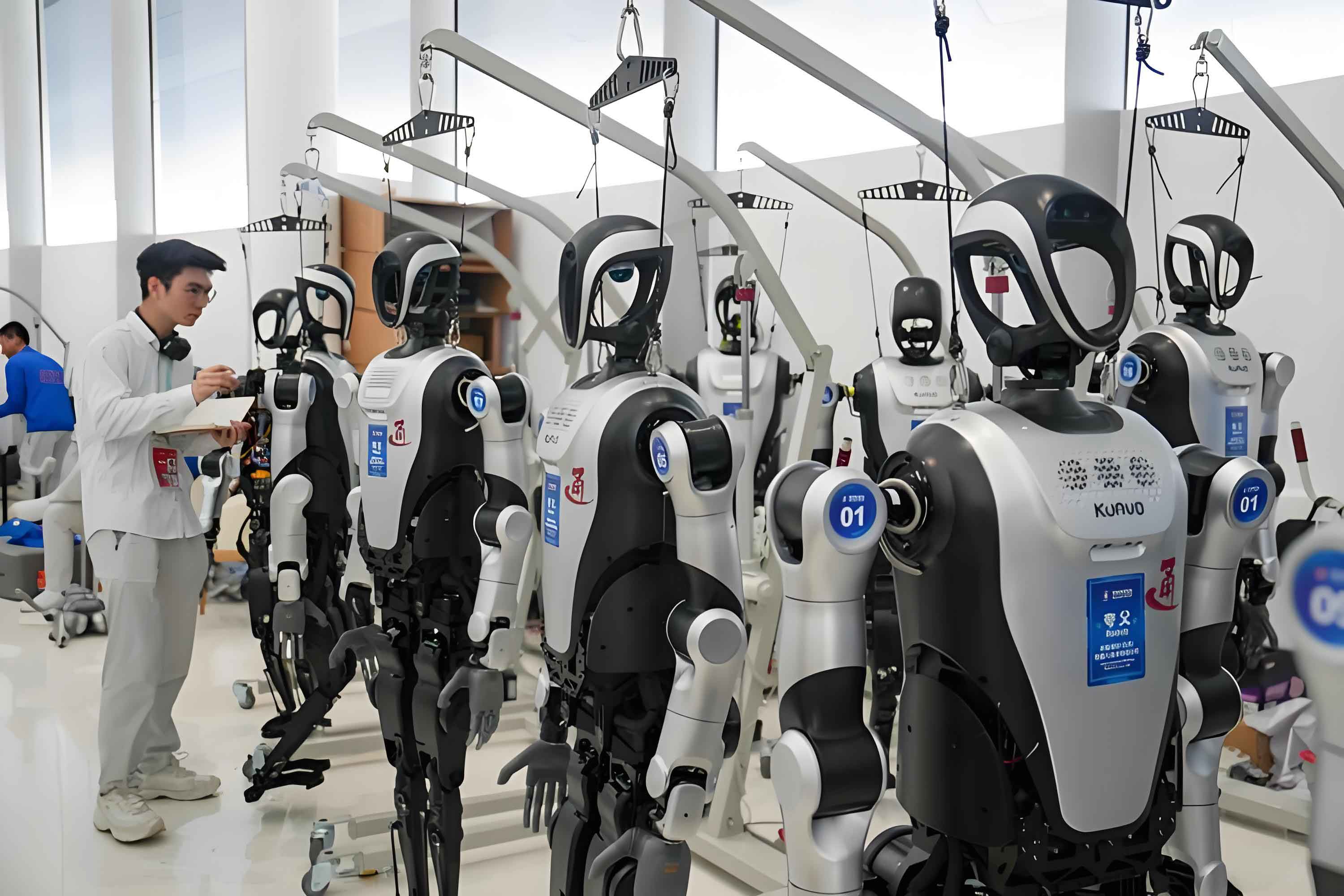
This image illustrates how humanoid robots can be deployed for tasks requiring precision and adaptability, highlighting their growing role in automation. As we move forward, the integration of humanoid robots into everyday life will necessitate robust frameworks for safety and ethics, ensuring that these machines augment human capabilities rather than replace them. The journey of humanoid robots is far from over, and I look forward to witnessing their continued evolution and impact on our world.