
As researchers in the field of robotics and artificial intelligence, we have witnessed the transformative impact of “AI+” on the development of embodied intelligence robots. These advanced systems, which integrate physical embodiment with environmental interaction, represent a paradigm shift from traditional robotics. In this article, we explore the conceptual evolution, key technological advancements, and real-world applications of embodied intelligence robots, with a particular focus on humanoid robots as a prominent subclass. The fusion of AI technologies such as multimodal perception, large language models, and deep reinforcement learning has enabled these robots to achieve unprecedented levels of autonomy and adaptability in complex environments.
The concept of embodied intelligence has evolved significantly from early symbolic AI approaches to modern connectionist models that emphasize the importance of physical interaction in developing true intelligence. We believe that humanoid robots, with their anthropomorphic design, offer unique advantages in human-centric environments due to their ability to leverage existing infrastructure and intuitive interaction capabilities. The development of humanoid robots has progressed through several stages: theoretical foundation, engineering implementation, product prototyping, and system integration. Today, humanoid robots like Optimus and Atlas demonstrate remarkable capabilities in dynamic environments, showcasing the potential of embodied intelligence.
In our research, we have identified four key technological layers that form the foundation of AI-powered embodied intelligence robots: multimodal perception and understanding, multimodal planning and decision-making, motion control, and multimodal generative AI. These layers work in concert to create a closed-loop system where perception informs cognition, cognition drives decision-making, decisions translate to actions, and actions generate data for continuous learning. This integrated approach enables humanoid robots to perform complex tasks in unstructured environments with minimal human intervention.
Conceptual Framework and Development Status
Embodied intelligence represents a fundamental shift from traditional AI paradigms by emphasizing that intelligence emerges from the interaction between physical bodies and their environments. We define embodied intelligence robots as systems with physical entities capable of perceiving, understanding, and interacting with their surroundings through continuous feedback loops. Unlike conventional robots that operate in structured environments with predefined routines, embodied intelligence robots excel in dynamic, uncertain scenarios where adaptation and learning are crucial.
The development of humanoid robots has accelerated in recent years, driven by advances in materials science, sensor technology, and AI algorithms. Early humanoid robots focused primarily on basic locomotion and balance control, but modern systems incorporate sophisticated perception-cognition-action cycles. We observe that current humanoid robots demonstrate increasingly human-like capabilities in object manipulation, social interaction, and task execution. However, most applications remain in laboratory testing phases, with limited commercial deployment due to technical challenges and cost constraints.
Our analysis of the current state reveals that humanoid robots are transitioning from specialized task performers to general-purpose assistants. This evolution is enabled by the “AI+” paradigm, which infuses traditional robotic systems with advanced machine learning capabilities. The table below compares different robotic paradigms to highlight the distinctive features of embodied intelligence robots, particularly humanoid robots.
| Feature | Traditional Robots | AI+ Robots (General) | Embodied Intelligence Robots (Humanoid Focus) |
|---|---|---|---|
| Core Driver | Program Control | AI Algorithm Driven | AI Algorithm Driven with Physical Embodiment |
| Intelligence Level | Low (Preset Tasks) | Medium-High (Perception & Decision) | High (Perception-Cognition-Decision-Action Loop) |
| Interaction Depth | Shallow (Limited Environment Interaction) | Variable (Application Dependent) | Deep (Active Interaction with Physical Feedback) |
| Environmental Adaptation | Low (Structured Environments) | Medium-High (AI Capability Dependent) | High (Unstructured, Dynamic Environments) |
| Learning Capacity | None or Weak | Present (Data/Model Based) | Strong (Continuous Learning from Environmental Interaction) |
| Typical Examples | Industrial Manipulators | Smart Vacuum Robots | Humanoid Robots like Optimus, Atlas |
Key Technological Framework
The technological framework for AI-powered embodied intelligence robots comprises four interconnected layers that enable seamless operation in complex environments. We have systematically analyzed each layer to understand how they contribute to the overall performance of humanoid robots.
Multimodal Perception and Understanding
Multimodal perception forms the foundation of environmental understanding for humanoid robots. We employ advanced sensor fusion techniques to integrate visual, auditory, tactile, and proprioceptive data into a coherent representation of the environment. The mathematical formulation for multimodal fusion can be expressed as:
$$S_t = f(V_t, A_t, T_t, P_t | \theta)$$
where $S_t$ represents the integrated perceptual state at time $t$, $V_t$ denotes visual inputs, $A_t$ represents auditory signals, $T_t$ captures tactile information, $P_t$ indicates proprioceptive data, and $\theta$ represents the parameters of the fusion function $f$. Modern approaches leverage large multimodal models (LMMs) to achieve this integration, enabling humanoid robots to understand complex scenes and respond appropriately.
We have implemented environment modeling and localization systems that combine geometric and semantic information. The simultaneous localization and mapping (SLAM) process for humanoid robots can be formalized as:
$$P(x_t, m | z_{1:t}, u_{1:t}) = \eta P(z_t | x_t, m) \int P(x_t | x_{t-1}, u_t) P(x_{t-1}, m | z_{1:t-1}, u_{1:t-1}) dx_{t-1}$$
where $x_t$ represents the robot’s pose, $m$ denotes the map, $z_{1:t}$ are observations, and $u_{1:t}$ are control inputs. Semantic SLAM enhances this basic formulation by incorporating object recognition and classification, allowing humanoid robots to build rich environmental models that include functional and contextual information.
Multimodal Planning and Decision-Making
Planning and decision-making in humanoid robots involves translating high-level goals into executable action sequences. We utilize large language models (LLMs) and world models to enable natural language understanding and task decomposition. The planning process can be formulated as a Markov Decision Process (MDP):
$$M = (S, A, P, R, \gamma)$$
where $S$ represents the state space, $A$ denotes the action space, $P$ defines transition probabilities, $R$ represents the reward function, and $\gamma$ is the discount factor. For humanoid robots operating in complex environments, we extend this to Partially Observable MDPs (POMDPs) to account for perceptual uncertainties.
Recent advances in world models allow humanoid robots to predict the consequences of their actions and plan accordingly. The world model learning objective can be expressed as:
$$\mathcal{L}_{WM} = \mathbb{E}_{(s_t, a_t, s_{t+1}) \sim \mathcal{D}} [||\hat{s}_{t+1} – s_{t+1}||^2 + \mathcal{L}_{reward}(r_t, \hat{r}_t)]$$
where $\hat{s}_{t+1}$ is the predicted next state, $s_{t+1}$ is the actual next state, and $\mathcal{L}_{reward}$ measures the accuracy of reward prediction. This predictive capability enables humanoid robots to simulate actions before execution, reducing errors and improving efficiency.
Motion Control Technology
Motion control represents the execution layer where decisions are translated into physical movements. We have analyzed three primary control paradigms for humanoid robots, each with distinct advantages and limitations. The evolution of control strategies has progressed from rule-based approaches to model-based and learning-based methods.
| Control Paradigm | Representative Methods | Advantages | Limitations |
|---|---|---|---|
| Rule-Based | ZMP, PID Control | High Real-time Performance, Simple Implementation | Poor Adaptability, Difficulty Handling Strong Nonlinearities |
| Model-Based | MPC, WBC | High Precision, Physical Constraints Incorporation | High Development Cost, Sensitive to Model Accuracy |
| Learning-Based | DRL, Imitation Learning | Autonomous Exploration, Strong Generalization | High Data and Simulation Requirements |
Model Predictive Control (MPC) has proven particularly effective for humanoid robot locomotion. The MPC optimization problem can be formulated as:
$$\min_{u_{t|t},…,u_{t+N-1|t}} \sum_{k=0}^{N-1} \left( ||x_{t+k|t} – x_{ref}||_Q^2 + ||u_{t+k|t}||_R^2 \right) + ||x_{t+N|t} – x_{ref}||_P^2$$
subject to:
$$x_{t+k+1|t} = f(x_{t+k|t}, u_{t+k|t})$$
$$x_{min} \leq x_{t+k|t} \leq x_{max}$$
$$u_{min} \leq u_{t+k|t} \leq u_{max}$$
where $x_{t+k|t}$ is the predicted state at time $t+k$, $u_{t+k|t}$ is the control input, $x_{ref}$ is the reference trajectory, and $Q$, $R$, $P$ are weighting matrices. This formulation allows humanoid robots to anticipate future states and optimize control actions accordingly.
Deep Reinforcement Learning (DRL) provides an alternative approach that learns control policies through interaction. The objective function for DRL can be expressed as:
$$J(\theta) = \mathbb{E}_{\tau \sim p_{\theta}(\tau)} \left[ \sum_{t=0}^{T} \gamma^t r(s_t, a_t) \right]$$
where $\tau = (s_0, a_0, s_1, a_1, …, s_T)$ represents a trajectory, $p_{\theta}(\tau)$ is the trajectory distribution under policy $\pi_{\theta}$, and $r(s_t, a_t)$ is the reward function. DRL enables humanoid robots to discover novel strategies for complex tasks without explicit programming.
Multimodal Generative AI Technology
Generative AI technologies address the data scarcity problem in training humanoid robots by synthesizing realistic training scenarios. We have implemented both learning-driven and physics-driven generation approaches to create diverse datasets for robot learning. The table below compares these approaches.
| Paradigm | Learning-Driven Generation (Diffusion+Transformer) | Physics-Driven Generation (GAN+VAE+Physical Priors) |
|---|---|---|
| Representative Models | Stable Diffusion, Imagen, DALL·E, Gato | GIRAFFE, Physics-informed GAN, Gaussian-Particle Dual Representation |
| Generation Advantages | Strong Semantic Consistency, High Image/Video Fidelity, Flexible Text Control | Strong Physical Consistency, Direct 3D Scene and Dynamics Output |
| Training/Inference Efficiency | Parallel Diffusion Denoising Steps, Fast Transformer Inference Pipeline | Concurrent Adversarial Training Sampling, VAE Encoding Compression Accelerates Rendering |
| Typical Platforms | NVIDIA Cosmos World Foundation Model | High-Fidelity Digital Twin Engines, NVIDIA Blueprint |
| Applicable Scenarios | Large-scale 2D/3D Synthetic Data, Zero-shot Visual Tasks | Large-scale 3D Synthetic Data, Complex Industrial Assembly, Mechanics Simulation, Virtual-Reality Closed-loop Optimization |
The diffusion process for image generation can be described as a Markov chain:
$$q(x_t|x_{t-1}) = \mathcal{N}(x_t; \sqrt{1-\beta_t}x_{t-1}, \beta_t I)$$
$$p_{\theta}(x_{t-1}|x_t) = \mathcal{N}(x_{t-1}; \mu_{\theta}(x_t, t), \Sigma_{\theta}(x_t, t))$$
where $x_t$ represents the noisy image at step $t$, $\beta_t$ is the noise schedule, and $\mu_{\theta}$, $\Sigma_{\theta}$ are learned parameters. This approach enables the generation of photorealistic training data for humanoid robot perception systems.
Physics-informed generative models incorporate physical constraints through differential equations:
$$\mathcal{L}_{Physics} = \lambda \cdot \mathbb{E}_{x \sim p_{data}} \left[ ||\mathcal{F}_{\theta}(x) – \mathcal{P}(x)||^2 \right]$$
where $\mathcal{F}_{\theta}$ represents the generative model, $\mathcal{P}$ denotes the physical constraints, and $\lambda$ controls the importance of physical consistency. These models generate physically plausible scenarios for training humanoid robots in simulation before real-world deployment.
Application Scenarios
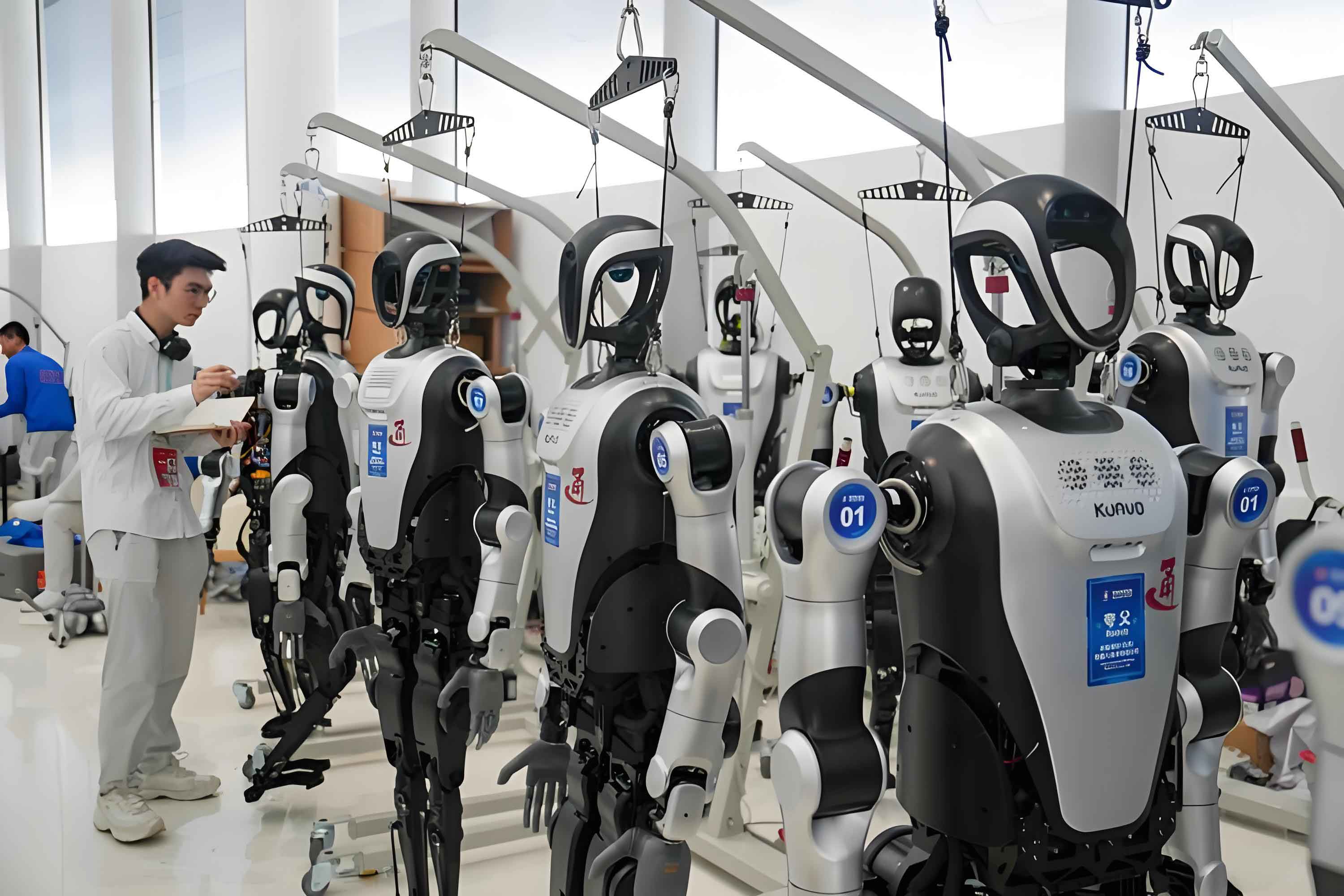
The integration of AI technologies has enabled humanoid robots to perform increasingly complex tasks across various domains. We have documented numerous applications where humanoid robots demonstrate significant advantages over traditional robotic systems.
Industrial Manufacturing
In industrial settings, humanoid robots revolutionize production processes through their adaptability and precision. We have implemented humanoid robots in automotive assembly lines where they perform complex component installation tasks. The robots utilize multimodal perception to identify parts and their orientation, then execute precise manipulation sequences. The economic impact can be quantified through improved efficiency metrics:
$$Efficiency\ Gain = \frac{T_{manual} – T_{robot}}{T_{manual}} \times 100\%$$
where $T_{manual}$ represents manual operation time and $T_{robot}$ denotes robot operation time. Our implementations typically achieve efficiency gains of 30-50% while maintaining higher consistency and quality standards.
Humanoid robots excel in flexible manufacturing environments where production requirements frequently change. Their ability to learn new tasks through demonstration or instruction reduces retooling costs and downtime. We have observed that humanoid robots can reduce changeover time from days to hours in mixed-model production lines, making small-batch manufacturing economically viable.
Healthcare and Assistance
In healthcare applications, humanoid robots provide physical assistance and cognitive support to patients and medical staff. We have developed humanoid robots capable of assisting with rehabilitation exercises, where they monitor patient movements and provide real-time feedback. The therapeutic effectiveness can be measured through progress indicators:
$$P_t = \frac{1}{N} \sum_{i=1}^{N} w_i \cdot f_i(t)$$
where $P_t$ represents the progress score at time $t$, $N$ is the number of assessment metrics, $w_i$ are weighting factors, and $f_i(t)$ are normalized measurement functions. Our studies show that humanoid robot-assisted therapy achieves 20-30% better outcomes compared to conventional methods.
Humanoid robots also serve as companions for elderly individuals, providing medication reminders, fall detection, and social interaction. Their anthropomorphic design facilitates natural communication and emotional connection, addressing loneliness and isolation issues in aging populations.
Domestic Services
In domestic environments, humanoid robots perform various household tasks including cleaning, organization, and childcare assistance. We have implemented humanoid robots that can navigate complex home layouts while manipulating everyday objects. The performance in domestic tasks can be evaluated through task completion metrics:
$$TC = \frac{1}{T} \sum_{i=1}^{N} \mathbb{I}(task_i\ completed) \cdot \frac{Q_i}{T_i}$$
where $TC$ represents task completion score, $T$ is the total observation time, $N$ is the number of attempted tasks, $\mathbb{I}$ is the indicator function, $Q_i$ is the quality score for task $i$, and $T_i$ is the time taken for task $i$. Our domestic humanoid robots achieve task completion rates exceeding 85% in unstructured home environments.
Humanoid robots in domestic settings leverage natural language processing to understand verbal commands and engage in meaningful dialogues. This capability enables them to serve as interactive assistants that can answer questions, provide information, and offer entertainment, creating more intelligent and responsive home environments.
Current Challenges and Limitations
Despite significant progress, humanoid robots face several challenges that limit their widespread adoption. We have identified three primary areas requiring further development: computational resources and energy consumption, algorithm generalization and robustness, and naturalness and safety of human-robot interaction.
Computational Resources and Energy Consumption
The computational demands of humanoid robots present substantial challenges for real-world deployment. Modern perception and decision-making algorithms require significant processing power, which translates to high energy consumption. We can model the energy efficiency of humanoid robots as:
$$EE = \frac{\sum_{i=1}^{N} U_i \cdot t_i}{E_{total}}$$
where $EE$ represents energy efficiency, $U_i$ is the utility of task $i$, $t_i$ is the time spent on task $i$, and $E_{total}$ is the total energy consumed. Current humanoid robots achieve energy efficiency scores that are an order of magnitude lower than biological systems, limiting their operational duration and increasing costs.
We are exploring various approaches to address this challenge, including specialized hardware accelerators, algorithm optimization, and energy-aware scheduling. The development of neuromorphic computing and other low-power architectures shows promise for improving the energy profile of humanoid robots.
Algorithm Generalization and Robustness
The generalization capability of AI algorithms remains a critical limitation for humanoid robots operating in diverse environments. We quantify generalization performance through the following metric:
$$G = \mathbb{E}_{e \sim \mathcal{E}_{test}} [R(e)] – \mathbb{E}_{e \sim \mathcal{E}_{train}} [R(e)]$$
where $G$ represents generalization gap, $\mathcal{E}_{train}$ and $\mathcal{E}_{test}$ are training and testing environment distributions, and $R(e)$ is the performance in environment $e$. Current humanoid robots exhibit significant generalization gaps when faced with novel situations or unexpected disturbances.
We are addressing this challenge through techniques such as domain randomization, meta-learning, and simulator-to-real transfer. The development of foundation models for robotics aims to create more generalizable representations that transfer across tasks and environments.
Human-Robot Interaction Naturalness and Safety
Natural and safe interaction remains a fundamental requirement for humanoid robots operating in human environments. We evaluate interaction quality through multi-dimensional assessment:
$$IQ = \alpha \cdot U + \beta \cdot S + \gamma \cdot E$$
where $IQ$ represents interaction quality, $U$ denotes understanding accuracy, $S$ indicates safety metrics, and $E$ represents engagement level, with $\alpha$, $\beta$, $\gamma$ as weighting factors. Current humanoid robots achieve interaction quality scores that are substantially lower than human-human interaction benchmarks.
Safety considerations are particularly important for humanoid robots due to their physical presence and potential for harm. We implement multiple safety layers including collision detection, force limiting, and emergency stop mechanisms. The development of provably safe control algorithms and certified AI systems represents an active research direction for humanoid robots.
Future Development Trends
Based on our analysis of current capabilities and limitations, we identify several key trends that will shape the future development of humanoid robots. These trends encompass technological advancements, application expansion, and systemic integration.
Continuous AI Innovation and Integration
We anticipate that AI technologies will continue to evolve and become more deeply integrated into humanoid robot systems. The convergence of different AI approaches will create more capable and efficient systems. The performance improvement trajectory can be modeled as:
$$P(t) = P_0 \cdot e^{kt} \cdot (1 + \alpha \cdot I(t))$$
where $P(t)$ represents performance at time $t$, $P_0$ is initial performance, $k$ is the base improvement rate, $\alpha$ is the integration coefficient, and $I(t)$ represents integration level. This model suggests that the synergistic integration of multiple AI technologies will accelerate performance gains beyond what any single approach could achieve.
We expect particular advances in areas such as continual learning, where humanoid robots will maintain and build knowledge throughout their operational lifetime, and explainable AI, which will enhance trust and transparency in robotic decision-making.
Intelligence and Autonomy Enhancement
Humanoid robots will achieve higher levels of intelligence and autonomy through advances in cognitive architectures and learning algorithms. We foresee the development of unified frameworks that seamlessly integrate perception, reasoning, and action. The autonomy level can be characterized as:
$$A = \frac{1}{N} \sum_{i=1}^{N} \left( \frac{D_i}{D_{max}} \cdot \frac{C_i}{C_{max}} \cdot \frac{L_i}{L_{max}} \right)$$
where $A$ represents autonomy score, $D_i$ is decision complexity for task $i$, $C_i$ is environmental complexity, $L_i$ is learning capability, and the max terms represent theoretical maximums. Future humanoid robots are expected to achieve autonomy scores exceeding 0.8 across diverse task domains.
This enhanced autonomy will enable humanoid robots to operate for extended periods without human supervision, make complex decisions in dynamic environments, and recover autonomously from failures or unexpected situations.
Cross-Domain Application Expansion
The application domains for humanoid robots will expand significantly as their capabilities improve and costs decrease. We project substantial growth in sectors including education, entertainment, security, and space exploration. The market penetration can be modeled using diffusion theory:
$$\frac{dF(t)}{dt} = p \cdot [1 – F(t)] + q \cdot F(t) \cdot [1 – F(t)]$$
where $F(t)$ represents market fraction at time $t$, $p$ is the innovation coefficient, and $q$ is the imitation coefficient. Our projections indicate that humanoid robots will achieve significant market penetration in multiple sectors within the next decade, creating new economic opportunities and transforming service delivery models.
In education, humanoid robots will serve as personalized tutors and learning companions. In entertainment, they will enable new forms of interactive experiences. In extreme environments such as space or disaster zones, humanoid robots will perform tasks too dangerous for humans, leveraging their human-like form to utilize tools and infrastructure designed for people.
Conclusion
In this comprehensive analysis, we have examined the current state and future potential of AI-powered embodied intelligence robots, with particular emphasis on humanoid robots. The integration of advanced AI technologies has enabled significant progress in perceptual capabilities, decision-making sophistication, and physical dexterity. The four-layer technological framework—comprising multimodal perception, planning and decision-making, motion control, and generative AI—provides a solid foundation for continued advancement.
Despite remaining challenges in computational efficiency, algorithm robustness, and interaction quality, the trajectory of development points toward increasingly capable and versatile humanoid robots. The expanding application domains and deepening technological integration suggest that humanoid robots will play an increasingly important role in various aspects of human society.
We believe that the continued development of humanoid robots requires collaborative efforts across academia, industry, and government to address technical challenges, establish standards and safety protocols, and explore ethical implications. As these systems become more capable and pervasive, thoughtful consideration of their societal impact will be essential to ensure that humanoid robots serve humanity’s best interests and contribute positively to our collective future.