
In recent years, the integration of humanoid robots into daily life and commercial services has accelerated, necessitating designs that foster user acceptance and trust. We focus on exploring affinity-driven外观 for humanoid robots, as外观 significantly influences emotional and functional perceptions. Traditional design approaches often prioritize engineering perspectives, resulting in冷峻僵硬 and uninviting appearances. To address this, we employ Kansei Engineering to quantify affinity characteristics and leverage AI tools, specifically Stable Diffusion (SD) models, to generate high-affinity designs efficiently. This study outlines a comprehensive methodology for identifying affinity traits and training AI models to produce diverse,亲和力-focused设计方案 for humanoid robots.
Affinity in design refers to the alignment of product features with human physiological and psychological factors, evoking emotions such as comfort and ease. For humanoid robots, this involves optimizing elements like form, material, and color. We define affinity through three dimensions:亲和度 (closeness),温柔度 (gentleness), and活泼度 (liveliness), derived from Kansei Engineering principles. These dimensions are measured using semantic differential surveys, where users rate various design attributes. Our goal is to translate these感性 evaluations into actionable design guidelines and train SD models to generate亲和力-enhanced humanoid robots.
We conducted a questionnaire-based study involving 645 participants to assess preferences for design elements, including head shape, eye design, body proportion, material, and color. The survey materials included abstract representations of humanoid robots to isolate specific features. For instance, head shapes were categorized as square, circle, vertical跑道圆, horizontal跑道圆, and semi-circle, while eye designs included circular, square, and elliptical forms. Body proportions ranged from infant-like to adult figures, and materials covered plastic, fabric, metal, and transparent finishes with varying textures. Colors were selected from warm, cool, and neutral palettes with adjusted saturation and brightness levels. Statistical analyses, such as Kendall’s correlation and Kruskal-Wallis H tests, revealed significant relationships between design elements and affinity dimensions. For example, horizontal跑道圆 heads and vertical跑道圆 eyes scored highest in亲和度, while fabric materials with textured surfaces outperformed smooth metals. Color analysis showed that lower saturation and higher brightness enhance亲和力, with warm tones like light yellow being most favorable.
| Element Type | Specific Feature | Affinity Score | Gentleness Score | Liveliness Score |
|---|---|---|---|---|
| Head Shape | Square (A1) | 3 | 3 | 3 |
| Circle (A2) | 3 | 3 | 3 | |
| Vertical跑道圆 (A3) | 0 | 0 | 1 | |
| Horizontal跑道圆 (A4) | 3 | 3 | 3 | |
| Semi-circle (A5) | 0 | 1 | 1 | |
| Eye Design | Circular (B1) | 1 | 1 | 1 |
| Square (B2) | 1 | 1 | 1 | |
| Vertical跑道圆 (B3) | 3 | 3 | 3 | |
| Horizontal跑道圆 (B4) | 0 | 0 | 0 | |
| Body Proportion | Infant-like (C1) | 3 | 3 | 3 |
| Child Stocky (C2) | 2 | 2 | 2 | |
| Child Slim (C3) | 4 | 4 | 4 | |
| Teen Slim (C4) | 3 | 3 | 3 | |
| Teen Stocky (C5) | 2 | 2 | 2 | |
| Adult Stocky (C6) | 1 | 1 | 1 | |
| Adult Stocky (C7) | 0 | 0 | 1 | |
| Material | Plastic Smooth (D1) | 1 | 1 | 2 |
| Plastic Textured (D2) | 2 | 2 | 1 | |
| Fabric Fuzzy (D3) | 3 | 3 | 2 | |
| Fabric Woven (D4) | 3 | 3 | 2 | |
| Metal Smooth (D5) | 0 | 0 | 1 | |
| Metal Textured (D6) | 0 | 0 | 2 | |
| Transparent Smooth (D7) | 1 | 1 | 2 | |
| Transparent Textured (D8) | 1 | 1 | 1 | |
| Color | White (E1) | 4 | 4 | 4 |
| Gray (E2) | 2 | 2 | 2 | |
| Black (E3) | 0 | 0 | 1 | |
| High Sat Warm (E4) | 1 | 1 | 2 | |
| Low Sat Warm (E5) | 3 | 3 | 2 | |
| High Sat Cool (E6) | 0 | 0 | 1 | |
| Low Sat Cool (E7) | 1 | 1 | 1 |
The correlation between affinity dimensions can be expressed using Kendall’s tau coefficient. For instance, the relationship between亲和度 and温柔度 for head shapes is given by: $$\tau = 0.356$$ indicating a moderate positive correlation. Similarly, for eye designs, the correlation between亲和度 and活泼度 is: $$\tau = 0.345$$ These statistical insights confirm that the three dimensions are interdependent, reinforcing the need for a holistic design approach for humanoid robots.
To translate these findings into practical designs, we employed Stable Diffusion models, which utilize latent diffusion processes to generate images from noise through iterative denoising. The SD architecture includes components like Clip for text encoding, Unet for diffusion, and Vae for decoding. We trained the models using Dreambooth and Lora methods, with Dreambooth adjusting all neural network weights for comprehensive learning, and Lora inserting additional layers for efficient fine-tuning. This dual approach balances quality and speed in generating亲和力-focused humanoid robots.
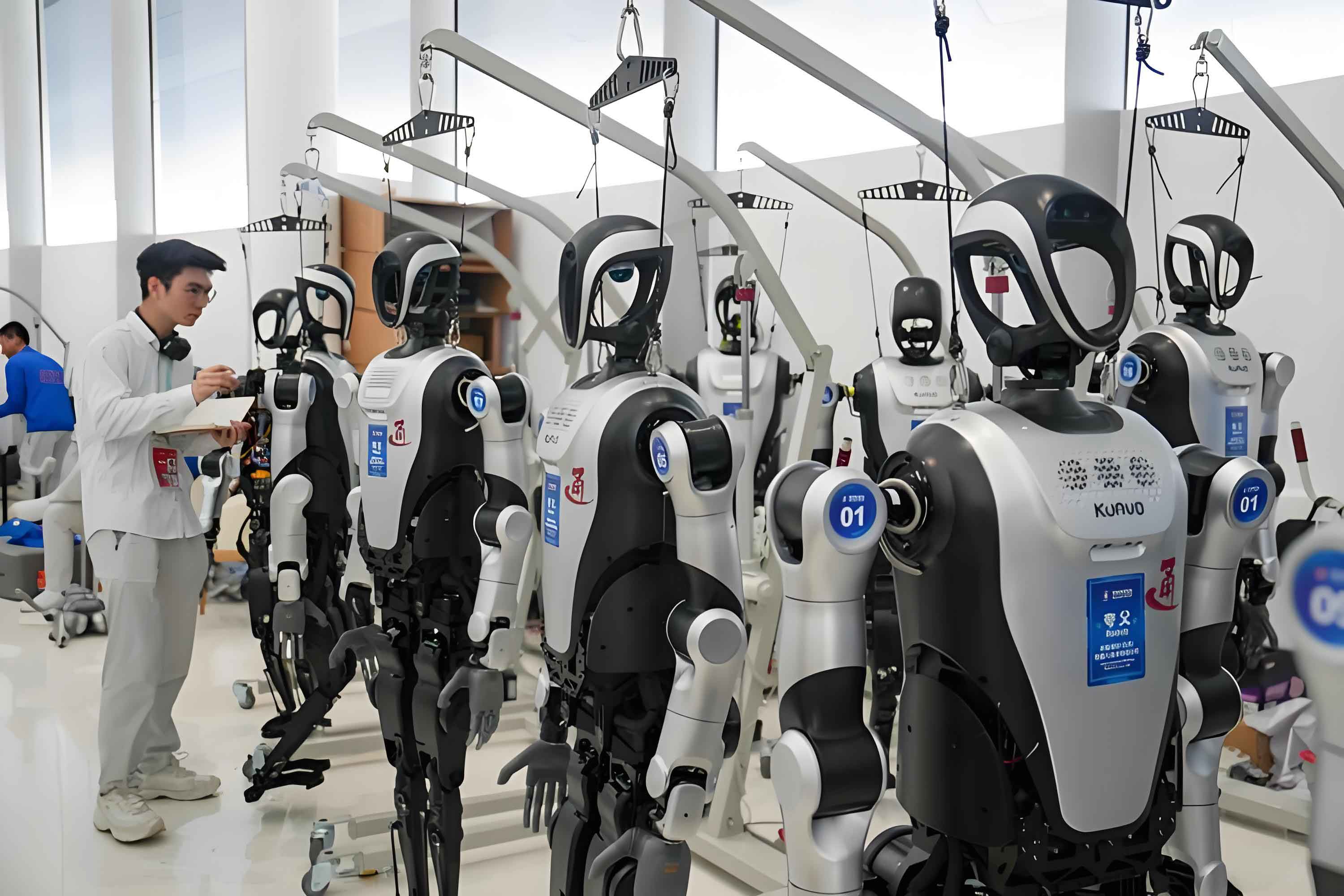
Training involved multiple iterations, starting with sample selection based on affinity scores. We used tools like Controlnet and Photoshop to refine initial素材, ensuring alignment with high-affinity features. For example, samples with horizontal跑道圆 heads, vertical跑道圆 eyes, and slim teenage proportions were prioritized. Each sample was annotated with descriptive tags, such as “affinity robot, minimalism, organic form,” to guide the SD model. The training parameters were optimized through experimentation, with key settings including a learning rate of $$1 \times 10^{-4}$$, batch size of 5, and 10 epochs. The loss function, monitored during training, aimed for values around 0.08, indicating effective convergence. The loss reduction over epochs can be modeled as: $$L(\theta) = \frac{1}{N} \sum_{i=1}^{N} \| x_i – \hat{x}_i \|^2$$ where \(L(\theta)\) is the loss, \(N\) is the batch size, \(x_i\) is the target image, and \(\hat{x}_i\) is the generated image.
| Parameter | Value | Description |
|---|---|---|
| Learning Rate | \(1 \times 10^{-4}\) | Step size for weight updates |
| Iteration | 10 | Number of training steps per epoch |
| Batch Size | 5 | Number of samples processed together |
| Epoch | 10 | Full passes through the dataset |
| Optimizer | 8bit-Adam | Algorithm for minimizing loss |
| Scheduler | Cosine | Learning rate adjustment schedule |
| DIM | 128 | Dimension of latent space |
| Alpha | 64 | Parameter for Lora scaling |
Model selection was based on Loss values and XY cross-analysis, where different epoch models and weights were evaluated. For instance, at epoch 6 with a weight of 0.6-0.8, the generated humanoid robots exhibited the highest affinity scores. The XY cross-analysis table summarizes the affinity evaluations across epochs and weights, with scores calculated using the affinity分值表. This process ensured that the final SD model could generate diverse, high-affinity designs for humanoid robots, which were then organized into a style matrix for rapid selection.
The trained models successfully produced a variety of亲和力-enhanced humanoid robots, with designs featuring rounded forms, soft materials, and warm colors. The style matrix allowed for quick identification of optimal designs based on affinity scores. For example, in one style group, the first design scored 15 points, indicating superior亲和力. This approach demonstrates the efficacy of combining Kansei Engineering with AI, enabling the rapid generation of humanoid robots that resonate emotionally with users. Future work could expand to cross-cultural studies and integrate交互行为 for more comprehensive affinity design.
In conclusion, our study provides a robust framework for designing亲和力-driven humanoid robots through quantitative analysis and AI model training. By defining affinity dimensions and correlating them with design elements, we established a clear evaluation system. The use of Stable Diffusion models, trained on affinity-based samples, facilitates efficient generation of appealing designs, addressing the limitations of traditional methods. This methodology not only enhances user acceptance of humanoid robots but also opens avenues for future research in emotional design and AI-assisted creativity.