
As I reflect on the rapid evolution of robotics and artificial intelligence, I am convinced that humanoid robots represent a transformative fusion of these technologies, poised to redefine productivity and societal progress. Humanoid robots, with their human-like form and advanced cognitive capabilities, are not merely tools but partners in shaping future industries. In this article, I will delve into the strengths, challenges, and strategic pathways for fostering a robust ecosystem for humanoid robots, drawing from global insights while emphasizing the need for innovation and collaboration. The integration of humanoid robots into various sectors promises to enhance efficiency, but it requires a concerted effort to overcome existing barriers and leverage synergistic approaches.
Humanoid robots are engineered to mimic human movements and interactions, making them ideal for complex tasks in dynamic environments. The core technologies driving humanoid robots include artificial intelligence, sensor integration, and precision mechanics. For instance, the dynamics of humanoid robot motion can be modeled using equations like the Lagrangian formulation: $$ L = T – V $$ where \( T \) is the kinetic energy and \( V \) is the potential energy, leading to the equations of motion: $$ \frac{d}{dt} \left( \frac{\partial L}{\partial \dot{q}_i} \right) – \frac{\partial L}{\partial q_i} = Q_i $$ Here, \( q_i \) represents generalized coordinates, and \( Q_i \) denotes non-conservative forces. Such mathematical foundations are crucial for developing stable and efficient humanoid robots, enabling them to perform tasks like walking or object manipulation with human-like grace.
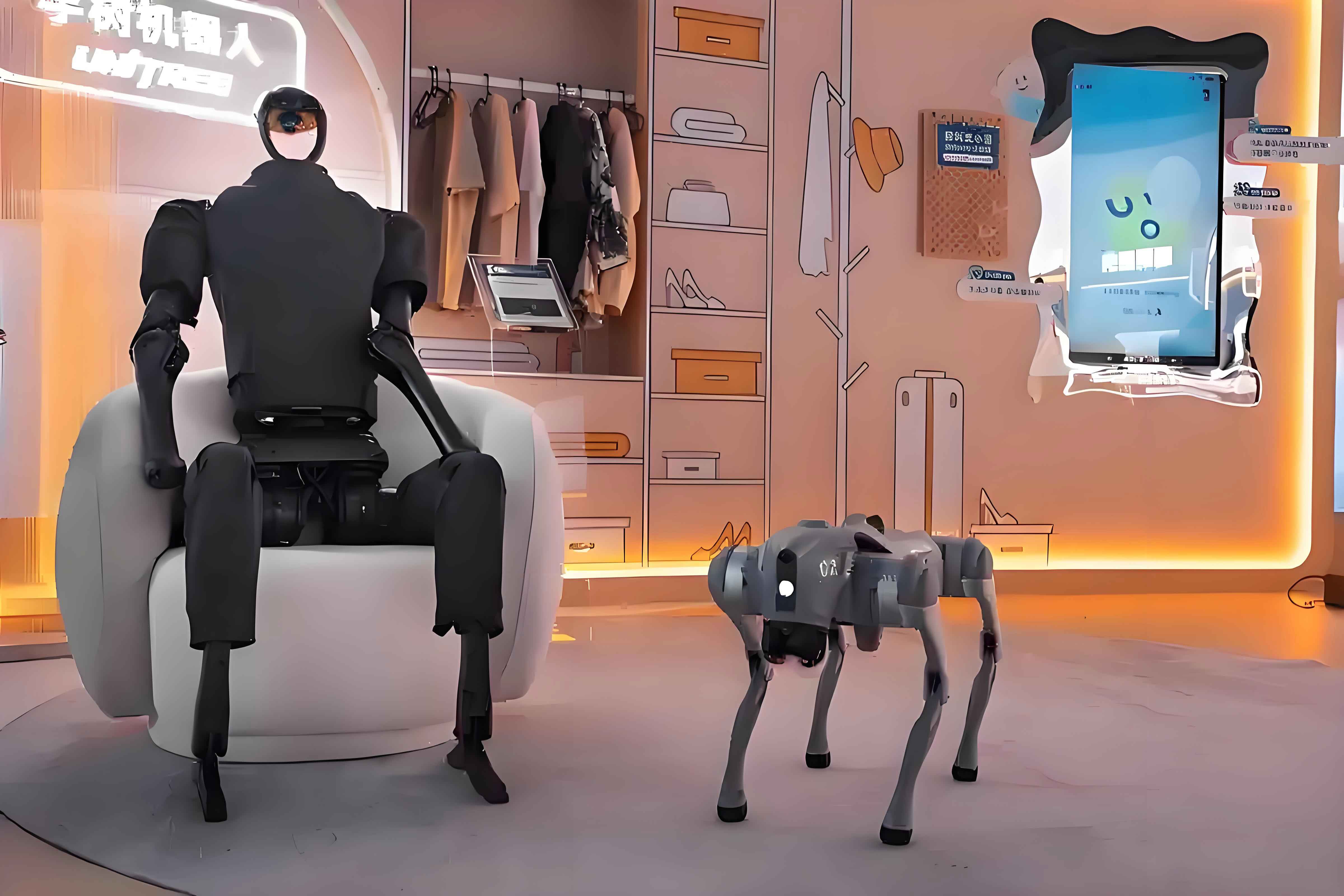
In assessing the developmental advantages of humanoid robots, I observe that regions with strong industrial bases and innovation networks have a head start. The ecosystem for humanoid robots thrives on three pillars: industrial depth, innovation ecology, and technological breakthroughs. These elements work in tandem to create a fertile ground for advancing humanoid robots. Below, I summarize these advantages in a table to highlight key aspects:
| Advantage Category | Description | Impact on Humanoid Robots |
|---|---|---|
| Industrial Depth | Comprehensive supply chains spanning materials, components, and system integration | Enables scalable production and cost reduction for humanoid robots |
| Innovation Ecology | Collaborative networks among universities, research institutions, and industries | Accelerates R&D and talent development for humanoid robots |
| Technological Breakthroughs | Advances in reducers, motors, sensors, and AI algorithms | Enhances performance and reliability of humanoid robots |
Industrial depth is a cornerstone for humanoid robots, as it ensures a seamless flow from raw materials to end-use applications. I have seen how integrated industrial parks and clusters foster innovation, with humanoid robots benefiting from specialized zones that promote collaboration. For example, the production efficiency of humanoid robots can be quantified using a simple formula: $$ E = \frac{O}{I} $$ where \( E \) is efficiency, \( O \) is output (e.g., number of humanoid robots produced), and \( I \) is input (e.g., resources invested). This highlights the importance of optimizing supply chains to support the mass adoption of humanoid robots.
Moving to innovation ecology, I emphasize that humanoid robots rely on a vibrant ecosystem of knowledge exchange. Universities play a pivotal role by offering specialized programs in robotics and AI, which I believe are essential for nurturing the next generation of engineers. Joint research centers facilitate the translation of academic discoveries into commercial products for humanoid robots. The innovation process can be modeled as a feedback loop: $$ I_{t+1} = I_t + \alpha R_t $$ where \( I_t \) is innovation at time \( t \), \( R_t \) is research investment, and \( \alpha \) is a productivity factor. This equation underscores how sustained investment in R&D drives progress in humanoid robots.
Technological breakthroughs in humanoid robots are often measured by improvements in key components. For instance, the accuracy of a reducer in humanoid robots can be expressed as: $$ A = 1 – \frac{\epsilon}{\theta} $$ where \( A \) is accuracy, \( \epsilon \) is error, and \( \theta \) is the target angle. Such advancements have enabled humanoid robots to achieve precision comparable to international standards, breaking long-standing monopolies and reducing dependency on imports. I have witnessed how local innovations in sensors and control systems have elevated the capabilities of humanoid robots, making them more adaptable to real-world scenarios.
However, the journey for humanoid robots is not without obstacles. As I analyze the bottlenecks, I identify three main challenges: insufficient core整机 enterprises, gaps in key technologies, and underdeveloped standard systems. These issues hinder the widespread adoption of humanoid robots and must be addressed through targeted strategies. The table below outlines these challenges in detail:
| Challenge | Description | Impact on Humanoid Robots |
|---|---|---|
| Core整机 Enterprises | Lack of leading companies in整机 development and system integration | Limits scalability and innovation in humanoid robots |
| Key Technologies | Deficiencies in AI decision-making, motion control, and human-robot interaction | Reduces the functionality and reliability of humanoid robots |
| Standard Systems | Absence of unified standards for safety, testing, and ethics | Increases costs and risks for humanoid robots deployment |
Regarding core整机 enterprises, I note that while there are specialists in components, the absence of dominant整机 manufacturers for humanoid robots leads to fragmented markets. This results in high costs, which I estimate using a cost function: $$ C = F + V \cdot Q $$ where \( C \) is total cost, \( F \) is fixed cost, \( V \) is variable cost per unit, and \( Q \) is quantity. For humanoid robots, high \( F \) due to R&D expenses makes affordability a barrier, slowing down adoption in sectors like healthcare and logistics.
In terms of key technologies, humanoid robots face hurdles in areas like environmental perception and intelligent decision-making. The performance of an AI system in humanoid robots can be modeled with a neural network equation: $$ y = f(Wx + b) $$ where \( y \) is the output, \( x \) is input data, \( W \) is weight matrix, \( b \) is bias, and \( f \) is activation function. Current limitations in training data and algorithm efficiency mean that humanoid robots often struggle with real-time adaptability. I advocate for increased investment in foundational research to overcome these gaps, as humanoid robots require robust algorithms to handle unpredictable environments.
Standard systems for humanoid robots are still nascent, posing risks in safety and interoperability. The lack of ethical frameworks, for instance, complicates the deployment of humanoid robots in sensitive areas. I propose that standardization efforts include metrics like the safety index: $$ S = \frac{R_s}{R_t} $$ where \( S \) is safety score, \( R_s \) is safe operations, and \( R_t \) is total operations. Establishing such standards would build trust and facilitate the global exchange of humanoid robots technologies.
To address these challenges, I support a four-dimensional synergistic approach focusing on technology, industry, resources, and scenarios. This framework aims to create a holistic ecosystem for humanoid robots, driving innovation from lab to market. The synergy can be expressed as a multi-objective optimization: $$ \max Z = \alpha T + \beta I + \gamma R + \delta S $$ where \( T \) is technology advancement, \( I \) is industrial integration, \( R \) is resource allocation, \( S \) is scenario application, and \( \alpha, \beta, \gamma, \delta \) are weighting factors. This model emphasizes balanced development for humanoid robots.
First, strengthening key technology攻关 is vital for humanoid robots. I recommend establishing dynamic monitoring systems and policy mechanisms to guide R&D. For example, a “揭榜挂帅” style program could attract global talent to solve critical problems in humanoid robots. The innovation output can be quantified as: $$ O_i = k \cdot R_d \cdot H $$ where \( O_i \) is innovation output, \( k \) is a constant, \( R_d \) is R&D investment, and \( H \) is human capital. By fostering public-private partnerships, we can accelerate the development of core technologies for humanoid robots, such as improved actuators and AI-driven control systems.
Second, optimizing industrial chain synergy enhances the competitiveness of humanoid robots. I encourage the formation of industrial alliances to promote resource sharing and standard alignment. A supply chain model for humanoid robots can be represented as: $$ SC = \sum_{i=1}^n (C_i + L_i) $$ where \( SC \) is supply chain cost, \( C_i \) is component cost, and \( L_i \) is logistics cost. Reducing these costs through collaborative procurement and modular design would make humanoid robots more accessible. Additionally, building resilient supply chains with shared resources across sectors like automotive and electronics can mitigate risks for humanoid robots production.
Third, accelerating the aggregation of core resources is essential for humanoid robots. I stress the importance of interdisciplinary education and international collaboration to build a skilled workforce. The talent growth for humanoid robots can be modeled as: $$ N_t = N_0 e^{rt} $$ where \( N_t \) is the number of experts at time \( t \), \( N_0 \) is initial number, and \( r \) is growth rate. Initiatives like “robot英才 plans” and joint labs can attract overseas experts, while capital infusion through venture funds supports early-stage projects for humanoid robots. Data sharing platforms, offering anonymized datasets on motion control, would further fuel algorithm refinement for humanoid robots.
Fourth, innovating business models and scaling application scenarios are crucial for humanoid robots. I advocate for “robot-as-a-service” models to lower entry barriers, with cost-sharing formulas like: $$ P = \frac{C_t}{U} $$ where \( P \) is price per use, \( C_t \) is total cost, and \( U \) is usage units. Piloting humanoid robots in logistics, healthcare, and public services can demonstrate their value. Policy incentives, such as application funds, would encourage cross-industry integration, helping humanoid robots gain traction in real-world settings like flexible manufacturing and elderly care.
In conclusion, humanoid robots stand at a pivotal juncture, with the potential to revolutionize industries and improve quality of life. As I see it, the future of humanoid robots depends on our ability to foster a collaborative ecosystem that addresses technological, industrial, and regulatory hurdles. By embracing the four-dimensional synergy, we can position regions as leaders in the global humanoid robots landscape, driving innovation and setting standards. Humanoid robots are not just a technological marvel but a testament to human ingenuity, and I am optimistic that with sustained effort, they will become integral to our daily lives, offering solutions to complex challenges and unlocking new frontiers in automation and AI.
Throughout this discussion, I have highlighted the multifaceted nature of humanoid robots, from their technical foundations to their societal implications. The repeated emphasis on humanoid robots underscores their centrality in the ongoing industrial transformation. As we move forward, it is imperative to continue investing in research, collaboration, and ethical frameworks to ensure that humanoid robots evolve in a way that benefits humanity as a whole. The journey for humanoid robots is just beginning, and I believe that by working together, we can build a sustainable and inclusive future powered by these remarkable machines.