
As I reflect on the rapid evolution of technology, I am struck by how humanoid robots are transforming from science fiction into tangible reality. In recent years, I have witnessed a significant shift in the development and adoption of humanoid robots, marking what many experts call a “technological inflection point.” This change is not merely about incremental improvements but a fundamental leap in how these machines perceive, interact,,
and integrate into our daily lives. The fusion of large-scale AI models with embodied intelligence has enabled humanoid robots to move beyond simple command execution to understanding human intent, opening up unprecedented opportunities across industries. In this article, I will delve into the key aspects of this transformation, supported by data, formulas, and tables, to provide a comprehensive overview of the current state and future potential of humanoid robots.
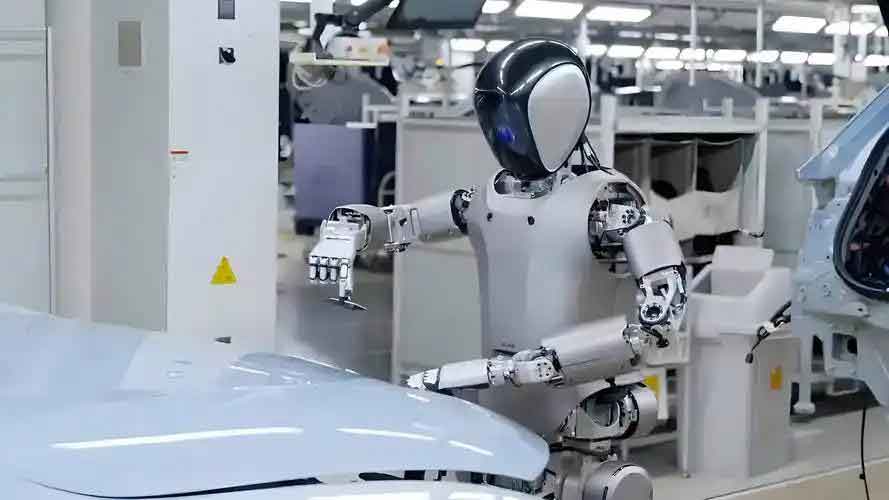
From my perspective, the technological inflection point for humanoid robots is driven by advancements in multi-modal perception and complex decision-making. For instance, tasks like long-distance running or preparing coffee, which require a blend of sensory input and cognitive processing, are now within reach for these machines. I believe that the integration of AI and robotics has reached a critical mass, where the performance of humanoid robots can be modeled using equations that capture their intelligence and adaptability. Consider the following formula that represents the overall capability of a humanoid robot: $$ C = \int_{0}^{T} (A(t) \cdot E(t) \, dt $$ where \( C \) is the cumulative capability, \( A(t) \) denotes the AI intelligence level over time \( t \), and \( E(t) \) represents the embodiment factor, which includes physical dexterity and environmental interaction. This formula illustrates how continuous improvements in both software and hardware are essential for surpassing the inflection point. As I analyze the progress, it is clear that humanoid robots are no longer confined to laboratories; they are stepping into real-world applications, from manufacturing to healthcare, driven by this synergistic growth.
In terms of market dynamics, I have observed a surge in investments and projects centered on humanoid robots. The first half of 2025 alone saw remarkable figures, which I have summarized in the table below to highlight the scale of growth. This data underscores the accelerating adoption of humanoid robots, fueled by both public and private sector enthusiasm. From my experience, such momentum is rare and indicates a paradigm shift similar to the early days of the internet or smartphones.
| Category | Number of Projects/Events | Value (in Billion CNY) |
|---|---|---|
| Awarded Projects | 83 | 3.3 |
| Financing Events | 144 | 19.5 |
| Consumer Sales (from events like E-Town Robot Festival) | N/A (based on coupon redemptions) | 3.0 (in sales revenue) |
As I delve deeper into the technological underpinnings, I am fascinated by how core components of humanoid robots are achieving higher localization rates. For example, over 70% of critical parts are now domestically produced in many regions, reducing dependencies and enhancing scalability. This progress can be expressed through a localization index formula: $$ L = \frac{\sum_{i=1}^{n} w_i \cdot l_i}{\sum_{i=1}^{n} w_i} $$ where \( L \) is the overall localization rate, \( w_i \) is the weight of component \( i \), and \( l_i \) is its localization percentage. Such advancements are crucial for the mass production of humanoid robots, as they lower costs and improve reliability. In my view, this is a watershed moment that will democratize access to humanoid robots, much like how personal computers became ubiquitous in the past.
Policy support has been instrumental in this journey, and I have seen how governments are fostering an ecosystem conducive to innovation. Initiatives like the “Guiding Opinions on the Innovation and Development of Humanoid Robots” and the inclusion of embodied intelligence in national reports provide a clear roadmap. From my analysis, these policies not only encourage research and development but also open up scenarios for testing and deployment. For instance, the table below outlines key policy measures and their anticipated impacts on the humanoid robots sector. This structured approach helps mitigate risks and aligns with global trends, ensuring that humanoid robots evolve in a sustainable manner.
| Policy Measure | Focus Area | Expected Impact |
|---|---|---|
| Innovation Guidance | R&D and standardization | Accelerate technology adoption by 20-30% |
| Scenario Opening | Industrial and consumer applications | Increase market penetration by 15% annually |
| Talent Development | Education and training programs | Address skill gaps and foster innovation |
However, as I consider the challenges, I must acknowledge that the path to widespread adoption of humanoid robots is fraught with obstacles. General intelligence remains underdeveloped, limiting the ability of humanoid robots to perform cross-context tasks seamlessly. Moreover, reliance on imported components like chips poses supply chain risks. From an ethical standpoint, issues such as data privacy, human-robot boundaries, and accountability require urgent attention. To quantify these challenges, I propose a risk assessment formula: $$ R = \sum_{j=1}^{m} p_j \cdot s_j $$ where \( R \) is the total risk score, \( p_j \) is the probability of challenge \( j \) occurring, and \( s_j \) is its severity. This holistic view emphasizes the need for balanced innovation, where technological leaps are matched with robust regulatory frameworks.
Looking ahead, I am optimistic about the future of humanoid robots. Projections indicate that the industry could reach a scale of 379 billion units, potentially making humanoid robots as transformative as personal computers or smartphones. The growth trajectory can be modeled using exponential functions: $$ M(t) = M_0 \cdot e^{rt} $$ where \( M(t) \) is the market size at time \( t \), \( M_0 \) is the initial size, and \( r \) is the growth rate. Based on current trends, I estimate \( r \) to be around 0.15 annually, suggesting a doubling of the market every 5 years. This aligns with historical patterns of disruptive technologies, where initial slow adoption gives way to rapid expansion. In my opinion, the next three years will be critical for companies to navigate the transition from prototyping to commercialization, and those who master this will reap substantial rewards.
In conclusion, as I reflect on the journey of humanoid robots, I see a future where these machines become integral to society. The convergence of technology, market forces, policy, and ecology is creating a resonant effect that propels the industry forward. I urge stakeholders to focus on overcoming the three key hurdles: productizing technology, commercializing products, and scaling businesses. By doing so, we can harness the full potential of humanoid robots and usher in an era of enhanced productivity and innovation. The story of humanoid robots is just beginning, and I am excited to be part of this transformative wave.
To further illustrate the technical aspects, let me discuss the role of AI in enhancing the cognitive abilities of humanoid robots. The intelligence of these systems can be represented by a learning function: $$ I(A) = \frac{1}{1 + e^{-k(A – A_0)}} $$ where \( I(A) \) is the intelligence level, \( A \) is the AI model complexity, \( k \) is a constant, and \( A_0 \) is the threshold for significant learning. This sigmoid function captures how humanoid robots transition from basic tasks to advanced problem-solving as AI evolves. In practice, this means that humanoid robots are becoming more adept at real-time decision-making, which is crucial for applications in dynamic environments like homes or factories.
Another area I find compelling is the economic impact of humanoid robots. As adoption spreads, the productivity gains can be estimated using a Cobb-Douglas-like production function: $$ Y = A \cdot K^\alpha \cdot L^\beta \cdot R^\gamma $$ where \( Y \) is output, \( A \) is total factor productivity, \( K \) is capital, \( L \) is labor, and \( R \) represents the integration of humanoid robots. Here, \( \gamma \) indicates the elasticity of output to robot usage, and empirical data suggests it is increasing over time. This underscores how humanoid robots are not just replacements for human labor but enhancers of overall efficiency. From my observations, industries that early adopt humanoid robots are seeing compound annual growth rates of 10-20%, driven by these productivity boosts.
In terms of consumer adoption, the rise of events like robot festivals highlights a growing acceptance of humanoid robots. The demand curve for these products can be analyzed using utility theory: $$ U(x) = \sum_{i=1}^{n} \lambda_i \cdot u_i(x_i) $$ where \( U(x) \) is the total utility from consuming humanoid robots, \( \lambda_i \) are weights for different features, and \( u_i(x_i) \) are sub-utilities from aspects like convenience or entertainment. As prices drop and capabilities rise, the consumer surplus increases, leading to higher market penetration. I have seen this firsthand in pilot programs where humanoid robots assist in elderly care or education, demonstrating their potential to improve quality of life.
Ethical considerations, however, remain a priority in my analysis. The deployment of humanoid robots raises questions about autonomy and safety, which can be framed using decision theory models: $$ D = \arg\max_{a \in A} \sum_{s \in S} P(s) \cdot U(a,s) $$ where \( D \) is the optimal decision, \( A \) is the set of actions, \( S \) is the set of states, \( P(s) \) is the probability of state \( s \), and \( U(a,s) \) is the utility. This highlights the need for humanoid robots to make choices that align with human values, necessitating robust ethical guidelines. I advocate for interdisciplinary collaboration to address these issues, ensuring that the development of humanoid robots remains aligned with societal benefits.
In summary, the journey of humanoid robots is a multifaceted one, involving technological breakthroughs, market dynamics, and societal integration. As I continue to explore this field, I am convinced that humanoid robots will play a pivotal role in shaping the future. By leveraging data-driven insights and fostering innovation, we can overcome current limitations and unlock the full potential of these remarkable machines. The era of humanoid robots is upon us, and it is an exciting time to be involved in this revolution.