
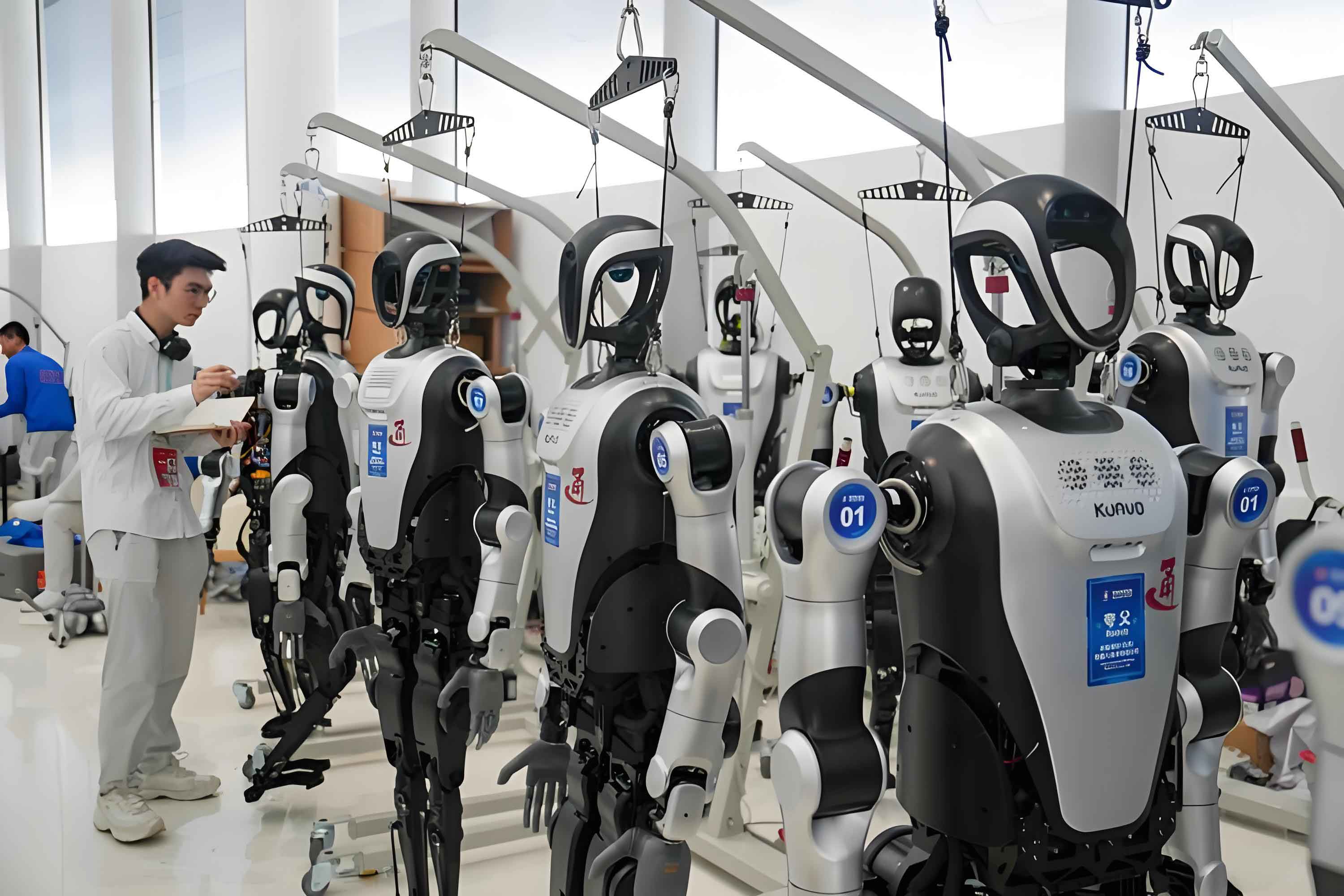
In recent years, the integration of artificial intelligence (AI) large models with humanoid robots has revolutionized the field of robotics, enabling unprecedented levels of autonomy, adaptability, and interaction. As a researcher in this domain, I have witnessed how these advancements are transforming humanoid robots from mere automated machines into embodied intelligent agents capable of complex tasks in dynamic environments. Humanoid robots, with their anthropomorphic design, are particularly suited for seamless integration into human-centric spaces, such as manufacturing floors, disaster response scenarios, and everyday households. The convergence of large-scale AI models—including natural language processing, computer vision, and multimodal learning—has endowed humanoid robots with critical capabilities like language understanding, visual generalization, and commonsense reasoning. This article delves into the core technologies driving this evolution, explores practical applications, and addresses the challenges and future directions for humanoid robots empowered by AI large models. Throughout this discussion, the term “humanoid robots” will be emphasized to underscore their unique role in bridging the gap between machines and humans.
The development of humanoid robots represents a pinnacle in robotics, combining mechanical engineering, sensor technology, and AI to create systems that mimic human form and function. Historically, robots evolved from simple automated mechanisms to programmable systems, and now to intelligent entities capable of learning and decision-making. The advent of AI large models has accelerated this progression, allowing humanoid robots to process multimodal data—such as text, images, and sensor inputs—and generate appropriate actions in real-time. For instance, large language models (LLMs) enable humanoid robots to interpret natural language commands, while vision-language models (VLMs) facilitate scene understanding and task execution. In this article, I will first outline the foundational large model technologies, then examine key approaches like distributed modular, end-to-end integrated, and cloud-edge collaborative systems, and finally highlight applications in areas like智能制造 and unmanned systems. Along the way, I will incorporate mathematical formulations and tables to summarize complex concepts, ensuring a comprehensive yet accessible analysis.
Foundational Large Model Technologies for Humanoid Robots
The core of AI-driven humanoid robots lies in large models that process and generate data across multiple modalities. These models, often based on architectures like the Transformer, have billions of parameters, allowing them to capture intricate patterns in data. Below, I describe the primary types of large models relevant to humanoid robots, using equations and comparisons to illustrate their capabilities.
Large Natural Language Models
Large natural language models (LLMs) are designed to understand and generate human language, making them essential for human-robot interaction. Models like GPT-3 and GPT-4 use autoregressive or sequence-to-sequence architectures based on the Transformer, which relies on self-attention mechanisms. The self-attention function can be expressed as:
$$ \text{Attention}(Q, K, V) = \text{softmax}\left(\frac{QK^T}{\sqrt{d_k}}\right)V $$
where \( Q \), \( K \), and \( V \) represent query, key, and value matrices, and \( d_k \) is the dimensionality. This allows humanoid robots to process language inputs, such as user commands, and generate coherent responses or action sequences. For example, in humanoid robots, LLMs can decompose complex instructions into sub-tasks, enabling tasks like “fetch a tool” to be broken down into navigation, recognition, and grasping steps. The scalability of LLMs, with parameters ranging from billions to trillions, ensures robust performance in diverse scenarios. Techniques like chain-of-thought prompting further enhance reasoning, allowing humanoid robots to justify decisions logically.
| Model | Parameters | Architecture | Application in Humanoid Robots |
|---|---|---|---|
| GPT-3 | 175B | Autoregressive | Task decomposition and dialogue |
| GPT-4 | ~1T | Multimodal | Integrated vision-language reasoning |
| LLaMA | 7B-70B | Transformer-based | Efficient on-device processing |
Vision Transformer Models
Vision Transformers (ViTs) adapt the Transformer architecture for image processing, enabling humanoid robots to perform tasks like object detection and scene understanding. Unlike convolutional neural networks, ViTs divide images into patches and process them as sequences. The core equation for patch embedding is:
$$ z_0 = [x_{\text{class}}; x_p^1 E; x_p^2 E; \dots; x_p^N E] + E_{\text{pos}} $$
where \( x_p^i \) are image patches, \( E \) is the embedding matrix, and \( E_{\text{pos}} \) is the positional encoding. This approach allows humanoid robots to achieve state-of-the-art results in visual perception, such as identifying objects in cluttered environments. For instance, humanoid robots equipped with ViTs can navigate unstructured spaces by recognizing obstacles and planning paths accordingly. Improvements like DeiT incorporate knowledge distillation to enhance efficiency, making ViTs suitable for resource-constrained humanoid robots.
Vision-Language Models
Vision-language models (VLMs) combine visual and linguistic data, enabling humanoid robots to understand scenes described in text. Models like Flamingo and BLIP-2 use cross-modal fusion, where visual features from an encoder are aligned with text embeddings from an LLM. The fusion process can be modeled as:
$$ h_{\text{fusion}} = \text{CrossAttn}(V, L) $$
where \( V \) represents visual features and \( L \) represents language embeddings. This allows humanoid robots to perform tasks like visual question answering, where they can respond to queries about their environment. For example, a humanoid robot might be asked “What is on the table?” and use a VLM to identify and describe objects. This capability is crucial for humanoid robots operating in domestic or industrial settings, where they must interpret ambiguous commands.
| Model | Key Feature | Use Case in Humanoid Robots |
|---|---|---|
| Flamingo | Few-shot learning | Adapting to new tasks with minimal data |
| BLIP-2 | Frozen encoders | Efficient multimodal alignment |
| KOSMOS-1 | General interface | Unified perception and language generation |
Visual Generation Models
Visual generation models, such as diffusion models and GANs, enable humanoid robots to create or predict visual content. Diffusion models, for instance, iteratively denoise data to generate images, described by:
$$ x_{t-1} = \frac{1}{\sqrt{\alpha_t}} \left( x_t – \frac{1 – \alpha_t}{\sqrt{1 – \bar{\alpha}_t}} \epsilon_\theta(x_t, t) \right) + \sigma_t z $$
where \( \epsilon_\theta \) is a learned noise function. Humanoid robots can use these models for simulation-based training, such as generating synthetic environments to practice tasks. This reduces the need for physical data collection, accelerating the learning process for humanoid robots. For example, a humanoid robot might generate variations of a workspace to improve its grasping strategies.
Embodied Multimodal Large Models
Embodied multimodal large models integrate sensory inputs with action outputs, allowing humanoid robots to interact physically with their environment. Vision-language-action (VLA) models, like RT-1 and RT-2, directly map perceptions to control commands. The policy can be formulated as:
$$ a_t = \pi(o_t, c) $$
where \( a_t \) is the action, \( o_t \) is the observation, and \( c \) is the context or command. This end-to-end approach enables humanoid robots to perform complex manipulation tasks, such as assembling components or handling tools, by leveraging pre-trained knowledge from large-scale datasets. Humanoid robots benefit from this by generalizing across tasks without extensive retraining.
Key Technologies for AI Large Model-Driven Humanoid Robots
To effectively deploy large models in humanoid robots, three technological paradigms have emerged: distributed modular, end-to-end integrated, and cloud-edge collaborative systems. Each addresses specific challenges in scalability, efficiency, and real-time performance for humanoid robots.
Distributed Modular Large Model Technology
In distributed modular approaches, large models are decomposed into specialized modules for perception, planning, decision-making, and control in humanoid robots. This modularity allows humanoid robots to handle complex tasks by breaking them down into manageable components. For instance, a perception module might use a VLM to identify objects, while a planning module employs an LLM to generate action sequences. The coordination between modules can be expressed as a hierarchical process:
$$ \text{Task} \rightarrow \text{Perception} \rightarrow \text{Planning} \rightarrow \text{Control} $$
Mathematically, the perception module might output a state estimate \( s_t = f_p(o_t) \), where \( f_p \) is a perception model, and the planning module generates a plan \( P = f_{\text{plan}}(s_t, g) \) based on a goal \( g \). Humanoid robots using this approach can achieve robust performance in structured environments, such as factories, where tasks are well-defined. However, this method may require significant integration effort and can be less adaptable to novel situations.
| Module | Large Model Used | Function |
|---|---|---|
| Perception | ViT or VLM | Object recognition and scene parsing |
| Planning | LLM | Task decomposition and trajectory generation |
| Control | VLA | Executing low-level actions |
End-to-End Integrated Large Model Technology
End-to-end integration involves training a single large model to handle all aspects of humanoid robot operation, from sensory input to motor control. Models like RT-2 exemplify this by fine-tuning VLMs on robotics data to output direct control commands. The learning objective can be framed as maximizing the likelihood of actions given observations:
$$ \mathcal{L} = \mathbb{E} \left[ \log p(a_t | o_t, c) \right] $$
where \( p \) is the model’s probability distribution. This approach reduces the need for explicit intermediate representations, allowing humanoid robots to learn directly from data. For example, a humanoid robot trained end-to-end can navigate a room and manipulate objects based solely on visual and language inputs, demonstrating improved generalization. However, end-to-end models require large, diverse datasets and substantial computational resources, which can be a bottleneck for humanoid robots in resource-limited settings.
Cloud-Edge Collaborative Large Model Technology
Cloud-edge collaborative systems distribute computation between cloud servers and edge devices (e.g., the humanoid robot itself), balancing power and latency. Large models reside in the cloud for heavy processing, while smaller models on the edge handle real-time tasks. The collaboration can be modeled as an optimization problem:
$$ \min_{f_c, f_e} \mathbb{E}[\text{Cost}(f_c(o), f_e(o))] $$
where \( f_c \) is the cloud model and \( f_e \) is the edge model, with costs accounting for communication and computation. Humanoid robots benefit from this by offloading complex reasoning to the cloud while performing immediate actions locally. For instance, a humanoid robot might use a cloud-based LLM for detailed task planning but rely on an edge-based VLM for obstacle avoidance. This approach addresses challenges like data privacy and network reliability, making it suitable for humanoid robots in dynamic environments like homes or outdoor areas.
| Component | Location | Function |
|---|---|---|
| Cloud | Remote server | Heavy model training and complex reasoning |
| Edge | On-robot | Real-time perception and control |
| Collaboration | Both | Adaptive task offloading and learning |
Applications of AI Large Model-Driven Humanoid Robots
The integration of large models has expanded the applications of humanoid robots into domains that require advanced cognition and dexterity. Below, I discuss two key areas:智能制造 and unmanned systems, where humanoid robots are making significant impacts.
智能制造
In智能制造, humanoid robots perform tasks such as assembly, quality inspection, and logistics in manufacturing environments. Equipped with large models, humanoid robots can understand natural language instructions, adapt to production line changes, and collaborate with human workers. For example, humanoid robots like Walker S and Optimus Gen2 use VLMs for visual quality checks, identifying defects in products without human intervention. The decision-making process can be formalized using probabilistic reasoning:
$$ P(\text{defect} | o) = \frac{\exp(f_{\text{VLM}}(o))}{\sum \exp(f_{\text{VLM}}(o))} $$
where \( o \) is the observation of a product. Humanoid robots also leverage LLMs for task planning, enabling them to switch between roles—e.g., from packaging to inspection—based on real-time demands. This flexibility reduces downtime and enhances efficiency in smart factories. Moreover, humanoid robots can learn from demonstrations, using diffusion models to generate realistic training scenarios, which improves their skill acquisition over time.
Unmanned Systems
In unmanned systems, such as military or disaster response, humanoid robots operate autonomously in hazardous environments. Large models provide capabilities for navigation, threat detection, and strategic planning. For instance, humanoid robots like Atlas and PETMAN use VLA models to traverse rough terrain and handle objects, with policies learned through reinforcement learning:
$$ \pi^* = \arg \max_\pi \mathbb{E} \left[ \sum_{t} \gamma^t r(s_t, a_t) \right] $$
where \( r \) is the reward function. Humanoid robots in these settings can interpret high-level commands—e.g., “search for survivors”—and execute coordinated actions with other unmanned assets. The cloud-edge collaborative approach is particularly valuable here, as it allows humanoid robots to process sensor data locally while accessing cloud-based models for complex decision-making. This ensures robust performance even in communication-limited scenarios, making humanoid robots indispensable for missions requiring human-like versatility.
Challenges and Future Prospects
Despite the progress, several challenges hinder the widespread adoption of AI large model-driven humanoid robots. Data scarcity is a primary issue, as collecting high-quality, diverse datasets for humanoid robots is expensive and time-consuming. This can be addressed through synthetic data generation using visual generation models, but it requires careful validation. Computational demands also pose a barrier; large models necessitate significant power and memory, which may exceed the resources available on humanoid robots. Optimization techniques, such as model quantization and pruning, can help reduce these requirements. Additionally, safety and reliability are critical, as humanoid robots must operate safely around humans. Formal verification methods, incorporating constraints into model training, could mitigate risks:
$$ \min_\theta \mathcal{L}(\theta) \text{ subject to } g(o, a) \leq 0 $$
where \( g \) represents safety constraints.
Looking ahead, the future of humanoid robots is bright, with trends pointing toward greater autonomy and generalization. Advances in neuromorphic computing and energy-efficient hardware will enable humanoid robots to run large models locally, enhancing real-time responsiveness. Furthermore, the fusion of large models with reinforcement learning will allow humanoid robots to learn from fewer interactions, accelerating their deployment in novel environments. As these technologies mature, humanoid robots will become ubiquitous in sectors like healthcare, education, and entertainment, ultimately transforming how humans and machines coexist.
In conclusion, AI large models have propelled humanoid robots into a new era of embodied intelligence, enabling them to perceive, reason, and act with human-like proficiency. By leveraging distributed, end-to-end, and collaborative architectures, humanoid robots can tackle complex tasks across various domains. However, overcoming challenges in data, computation, and safety will be essential for realizing their full potential. As research continues, I am confident that humanoid robots will evolve into versatile partners, enriching our daily lives and pushing the boundaries of what machines can achieve.