
Humanoid robots, designed to mimic human appearance and behavior, represent the pinnacle of robotics integration with artificial intelligence, advanced manufacturing, and new materials. As a first-person perspective, I explore the rapid growth of this field, driven by technological innovations and policy support, yet challenged by core technology gaps, mass production difficulties, and commercialization hurdles. This article delves into the key segments, global trends, and strategic pathways for humanoid robots, emphasizing the need for breakthroughs in embodied intelligence, large models, and core components to enhance global competitiveness.
The development of humanoid robots is accelerating worldwide, with applications spanning industrial manufacturing, healthcare, and service sectors. These systems integrate “brain” (decision-making), “cerebellum” (motion control), and “limbs” (physical components) to achieve human-like tasks. For instance, the brain utilizes multimodal large models for perception and cognition, while the cerebellum employs control algorithms like model predictive control (MPC) and reinforcement learning for stable movement. The limbs rely on high-performance actuators, sensors, and motors. However, issues such as high costs, sensor limitations, and ethical concerns persist. This analysis provides an in-depth examination of technological frontiers, industry layouts, and recommendations for fostering innovation.
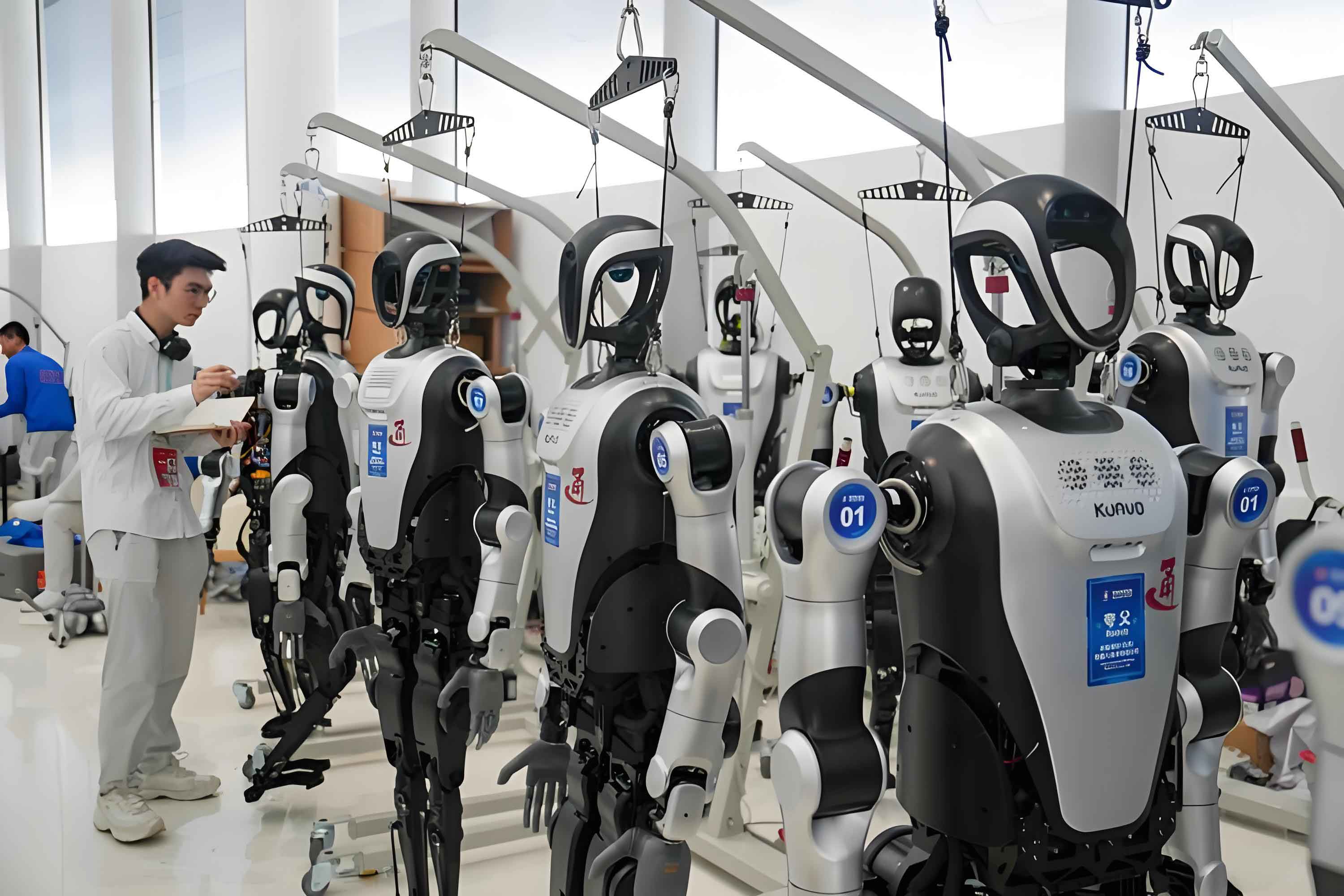
In the realm of humanoid robots, the “brain” serves as the central decision-making unit, leveraging multimodal large models to process sensory inputs and enable advanced functions like object recognition, emotional interaction, and creative generation. For example, vision transformers and diffusion models allow humanoid robots to interpret complex scenes and generate realistic simulations. The mathematical representation of a transformer-based model can be expressed as:
$$ \text{Attention}(Q, K, V) = \text{softmax}\left(\frac{QK^T}{\sqrt{d_k}}\right)V $$
where \( Q \), \( K \), and \( V \) denote query, key, and value matrices, respectively, and \( d_k \) is the dimensionality. This facilitates tasks such as language understanding and environment mapping for humanoid robots. Additionally, large language models (LLMs) enhance decision-making through logical reasoning, as shown in the probability distribution for text generation:
$$ P(w_t | w_{1:t-1}) = \frac{\exp(\text{score}(w_t, w_{1:t-1}))}{\sum_{w’}\exp(\text{score}(w’, w_{1:t-1}))} $$
where \( w_t \) is the word at time \( t \). These capabilities allow humanoid robots to adapt to dynamic environments and perform tasks like navigation and manipulation.
The “cerebellum” of humanoid robots translates decisions into precise motions using control strategies. MPC optimizes actions by predicting future states, with the cost function formulated as:
$$ J = \sum_{k=0}^{N-1} \left( x_{t+k|t}^T Q x_{t+k|t} + u_{t+k}^T R u_{t+k} \right) + x_{t+N|t}^T P x_{t+N|t} $$
where \( x \) is the state vector, \( u \) is the control input, and \( Q \), \( R \), and \( P \) are weighting matrices. Reinforcement learning, on the other hand, maximizes cumulative rewards:
$$ V^\pi(s) = \mathbb{E}\left[ \sum_{t=0}^\infty \gamma^t r_t \mid s_0 = s \right] $$
where \( \gamma \) is the discount factor and \( r_t \) is the reward at time \( t \). Imitation learning reduces exploration costs by leveraging human demonstrations, enabling humanoid robots to learn gaits and manipulation tasks efficiently.
The “limbs” consist of core components like motors, reducers, and sensors. For instance, torque in actuators can be modeled as:
$$ \tau = K_t \cdot I $$
where \( \tau \) is torque, \( K_t \) is the motor constant, and \( I \) is current. Harmonic drives provide high reduction ratios, critical for joint movements in humanoid robots. Table 1 summarizes key components and their functions in humanoid robots.
| Component | Function | Example Types |
|---|---|---|
| Motor | Converts electrical energy to motion | Brushless DC, frameless torque |
| Reducer | Amplifies torque for joints | Harmonic, planetary, RV |
| Sensor | Perceives environment and state | Torque, tactile, IMU |
Globally, humanoid robot development is shaped by policies and technological investments. Countries like the United States, Japan, and members of the European Union have launched initiatives such as the National Robotics Initiative and Horizon Europe to fund research. Technologically, companies like Tesla and Boston Dynamics have advanced humanoid robots with electric drives and AI integration. For example, Tesla’s Optimus uses harmonic reducers and frameless motors, while Boston Dynamics’ Atlas employs MPC for dynamic balance. The industry faces challenges in sensor fusion, energy efficiency, and real-time processing, which can be addressed through improved algorithms and materials.
In China, the humanoid robot industry is growing rapidly, supported by policies like the “14th Five-Year Plan” for robotics. Domestic companies are making strides in core components, such as harmonic reducers and motors, but still rely on imports for high-precision sensors. Table 2 compares the global distribution of humanoid robot industries, highlighting regional strengths.
| Region | Focus Areas | Key Players |
|---|---|---|
| North America | AI integration, electric drives | Tesla, Boston Dynamics |
| East Asia | Precision manufacturing, components | Japanese motor suppliers, Chinese integrators |
| Europe | Industrial applications, sensors | German engineering firms |
Despite progress, humanoid robots in China face issues like high costs, with production expenses reaching 400,000–500,000 RMB per unit due to imported parts. Technical bottlenecks in perception and control algorithms further hinder performance. To overcome these, development paths include fostering innovation through R&D grants, establishing demonstration projects in agriculture and healthcare, and enacting laws for data privacy and safety. The “cloud-edge-device” architecture for humanoid robots, as shown in the equation for data processing:
$$ \text{Data Flow} = f_{\text{cloud}}(\text{sensors}) + f_{\text{edge}}(\text{local control}) $$
enhances real-time decision-making. Recommendations emphasize core technology breakthroughs, such as developing domestic sensors and AI chips, and building open-source platforms to reduce costs. By implementing pilot projects and international collaborations, humanoid robots can achieve mass production and commercialization, ultimately transforming industries and daily life.
In conclusion, humanoid robots are at the forefront of technological evolution, with the potential to address labor shortages and enhance productivity. Through concerted efforts in innovation, policy, and infrastructure, the future of humanoid robots looks promising, paving the way for smarter and more adaptable robotic systems.