
We are thrilled to share our latest endeavors in the realm of humanoid robots, which represent a significant leap forward in robotics technology. As a key player in the chemical and materials industry, we recognize the immense potential of humanoid robots to transform various sectors, from manufacturing to healthcare. Our recent collaborations are centered on developing innovative material solutions that enhance the performance, durability, and sustainability of humanoid robots. In this comprehensive overview, we delve into the technical aspects, strategic partnerships, and future prospects, all from our first-hand perspective. We will explore how advanced materials like engineering plastics and polyurethanes are being tailored for humanoid robots, supported by data tables and mathematical models to illustrate key concepts. Throughout this discussion, the term humanoid robots will be emphasized to underscore their pivotal role in our initiatives.
The collaboration with Fourier Intelligence marks a milestone in our journey toward creating next-generation humanoid robots. We are jointly assessing and developing new material solutions that address the unique challenges faced by humanoid robots, such as weight reduction, flexibility, and energy efficiency. Humanoid robots require materials that mimic human-like movements while maintaining structural integrity. To this end, we are focusing on engineering plastics, polyurethanes, and thermoplastic polyurethanes, which offer excellent mechanical properties and can be customized for specific applications in humanoid robots. This partnership, initiated by our venture capital arm, aims to foster innovation in both technical and commercial domains, ultimately accelerating the evolution of humanoid robots. We believe that by combining our material expertise with Fourier’s robotics prowess, we can drive breakthroughs in humanoid robots that benefit industries worldwide.
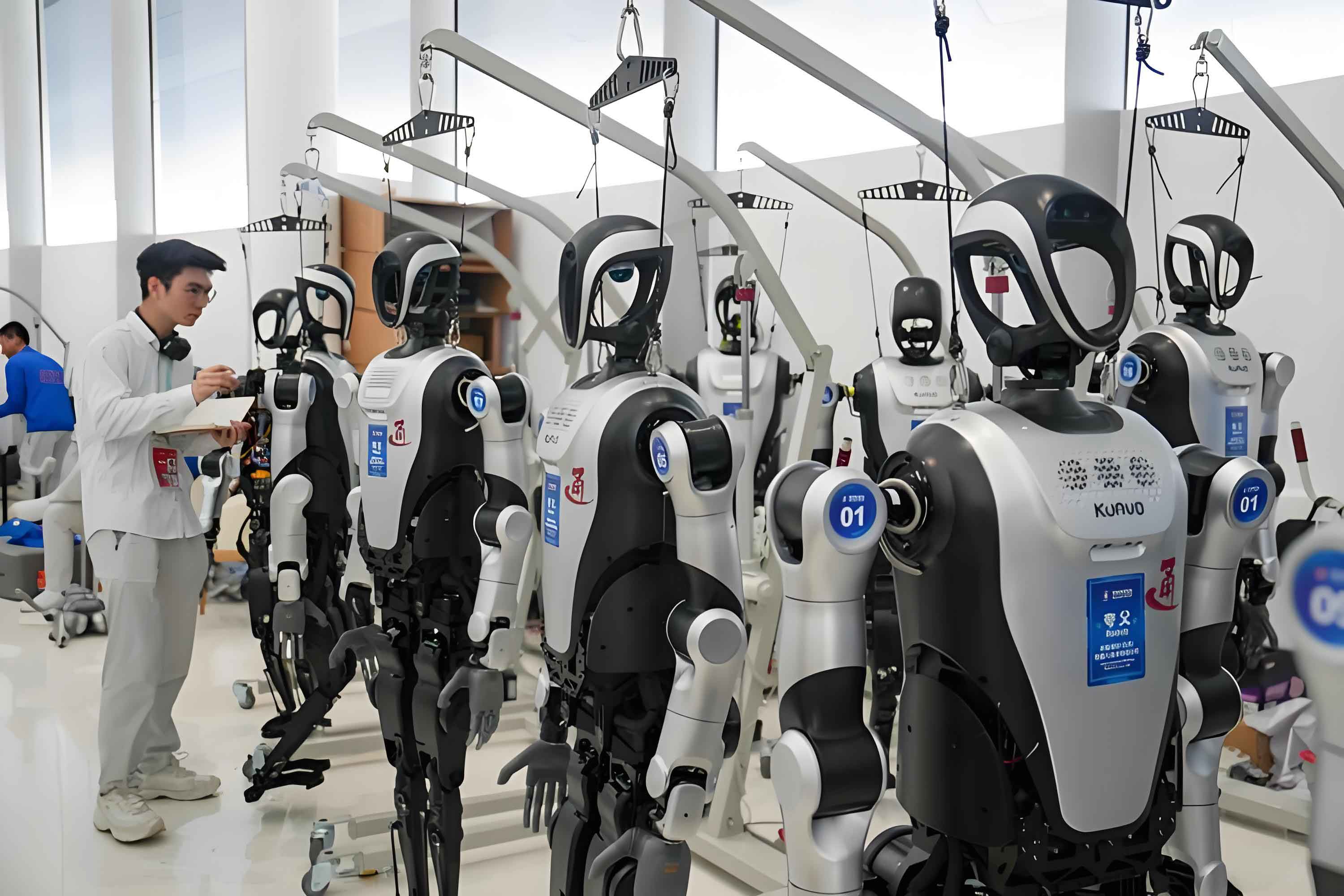
In the development of humanoid robots, material selection is critical for achieving optimal performance. We have identified several key parameters that influence the design and functionality of humanoid robots, including tensile strength, elasticity, and thermal stability. The following table summarizes the properties of materials commonly used in humanoid robots, based on our ongoing research and testing. This data helps us compare different options and select the most suitable materials for various components of humanoid robots, such as joints, actuators, and exoskeletons.
| Material Type | Tensile Strength (MPa) | Elongation at Break (%) | Thermal Conductivity (W/m·K) | Application in Humanoid Robots |
|---|---|---|---|---|
| Engineering Plastics | 50-100 | 10-50 | 0.2-0.5 | Structural frames and casings for humanoid robots |
| Polyurethanes | 20-60 | 100-600 | 0.1-0.3 | Flexible joints and shock absorption in humanoid robots |
| Thermoplastic Polyurethanes | 30-70 | 200-800 | 0.15-0.4 | Grippers and mobility components for humanoid robots |
To further illustrate the mechanical behavior of these materials in humanoid robots, we employ mathematical models that describe stress-strain relationships and dynamic responses. For instance, the stress ($\sigma$) in a material under load can be related to strain ($\epsilon$) using Hooke’s law for linear elastic materials: $$\sigma = E \epsilon$$ where $E$ is the Young’s modulus. This equation is fundamental in designing components for humanoid robots, as it helps predict how materials will deform under the forces encountered during operation. Additionally, for humanoid robots involving complex motions, we use kinematic equations to model joint movements. The position of an end-effector in a humanoid robot can be expressed as: $$\vec{p} = f(\vec{q})$$ where $\vec{p}$ is the position vector and $\vec{q}$ represents the joint angles. Such formulas are essential for optimizing the agility and precision of humanoid robots.
Our commitment to humanoid robots extends beyond material development to include sustainable innovation. In partnership with Zhejiang University Quzhou Institute, we are exploring sustainable materials and processes that can be integrated into humanoid robots. This collaboration leverages our industrial capabilities and the institute’s academic resources, focusing on areas like advanced materials, industrial ecology, and bio-based chemicals. We aim to reduce the environmental footprint of humanoid robots by incorporating recyclable and biodegradable materials, thereby aligning with global sustainability goals. The following table outlines the key research areas and their potential impact on humanoid robots, highlighting how sustainable practices can enhance the lifecycle of humanoid robots.
| Research Focus | Key Objectives | Expected Benefits for Humanoid Robots |
|---|---|---|
| Advanced Materials | Develop lightweight, high-strength composites | Improved energy efficiency and mobility in humanoid robots |
| Industrial Ecology | Minimize waste and emissions in production | Lower environmental impact of manufacturing humanoid robots |
| Molecular Manufacturing | Create smart materials with self-healing properties | Enhanced durability and reduced maintenance for humanoid robots |
| Bio-based Chemicals | Utilize renewable resources for material synthesis | Sustainable sourcing for components in humanoid robots |
In the context of humanoid robots, we also consider thermal management and energy dissipation, which are crucial for prolonged operation. The heat transfer in humanoid robots can be modeled using Fourier’s law of heat conduction: $$\vec{q} = -k \nabla T$$ where $\vec{q}$ is the heat flux vector, $k$ is the thermal conductivity, and $\nabla T$ is the temperature gradient. This equation helps us design cooling systems for humanoid robots, ensuring they remain functional under varying conditions. Moreover, we are investigating the use of phase-change materials in humanoid robots to absorb and release heat, thereby maintaining optimal performance. The integration of such materials into humanoid robots requires careful analysis, often involving finite element simulations to predict thermal behavior.
The market for humanoid robots is expanding rapidly, and we are strategically positioning ourselves to capitalize on this growth. Our investments in research and development, including the establishment of an application development center in the Asia-Pacific region, underscore our dedication to advancing humanoid robots. We see immense opportunities in sectors like construction, healthcare, and logistics, where humanoid robots can perform tasks with human-like dexterity. For example, in quality inspection processes, humanoid robots can utilize advanced sensors and materials to detect defects with high accuracy. The following table provides a snapshot of market trends and applications for humanoid robots, based on our internal analyses and projections.
| Application Sector | Current Adoption Rate (%) | Projected Growth by 2030 (%) | Key Material Requirements for Humanoid Robots |
|---|---|---|---|
| Manufacturing | 25 | 60 | High-strength plastics for assembly tasks in humanoid robots |
| Healthcare | 15 | 50 | Biocompatible materials for surgical humanoid robots |
| Logistics | 20 | 55 | Lightweight composites for mobility in humanoid robots |
| Consumer Services | 10 | 40 | Durable polymers for interactive humanoid robots |
From a technical standpoint, the control systems of humanoid robots involve complex algorithms that can be represented mathematically. For instance, the dynamics of a humanoid robot can be described by the Lagrangian formulation: $$L = T – U$$ where $L$ is the Lagrangian, $T$ is the kinetic energy, and $U$ is the potential energy. The equations of motion are then derived using: $$\frac{d}{dt} \left( \frac{\partial L}{\partial \dot{q}_i} \right) – \frac{\partial L}{\partial q_i} = Q_i$$ where $q_i$ are the generalized coordinates and $Q_i$ are the generalized forces. This framework is vital for simulating the movements of humanoid robots and optimizing their energy consumption. We are applying these principles to develop more efficient humanoid robots that can adapt to dynamic environments.
In addition to hardware innovations, we are exploring software integration for humanoid robots, particularly in the area of embodied intelligence. This involves machine learning models that enable humanoid robots to learn from interactions and improve their performance over time. The learning process can be modeled using reinforcement learning algorithms, where the goal is to maximize a reward function $R$: $$R = \sum_{t=0}^{\infty} \gamma^t r_t$$ where $r_t$ is the immediate reward at time $t$ and $\gamma$ is the discount factor. By incorporating such algorithms, humanoid robots can achieve higher levels of autonomy and functionality. Our collaborations are focused on embedding these intelligent systems into humanoid robots, making them more versatile and capable of handling complex tasks.
Sustainability remains a core pillar of our strategy for humanoid robots. We are committed to reducing the carbon footprint of humanoid robots through life-cycle assessments and eco-design principles. The environmental impact of humanoid robots can be quantified using metrics like the global warming potential (GWP), which we aim to minimize by selecting low-impact materials. For example, the GWP of a material can be calculated as: $$\text{GWP} = \sum_i \text{EF}_i \times m_i$$ where $\text{EF}_i$ is the emission factor for substance $i$ and $m_i$ is its mass. This approach allows us to compare different material options for humanoid robots and choose those that align with sustainability targets. We are also investigating circular economy models for humanoid robots, where components are reused or recycled at the end of their life, thereby reducing waste.
Looking ahead, we anticipate that humanoid robots will play an increasingly important role in addressing global challenges, such as labor shortages and aging populations. Our ongoing research and partnerships are designed to push the boundaries of what humanoid robots can achieve. We are confident that through continuous innovation and collaboration, we can develop humanoid robots that are not only technologically advanced but also socially responsible. The future of humanoid robots is bright, and we are excited to be at the forefront of this transformation, driving progress in materials science and robotics for generations to come.
In summary, our efforts in humanoid robots encompass a wide range of activities, from material development and sustainability initiatives to market expansion and technological integration. By leveraging tables and formulas, we have highlighted the key aspects of our work, emphasizing the importance of humanoid robots in modern industry. We remain dedicated to advancing this field and look forward to sharing more updates as we continue to innovate and collaborate on humanoid robots. The potential of humanoid robots is limitless, and we are committed to unlocking it through strategic partnerships and cutting-edge research.