
As humanoid robots increasingly integrate into manufacturing environments, ensuring their safe operation becomes paramount. The manufacturing sector demands rigorous safety standards, yet specific industry regulations for humanoid robots are still under development. Therefore, a comprehensive safety analysis approach is essential to evaluate and mitigate risks associated with humanoid robot applications. In this article, I will present an integrated safety analysis method that combines industrial safety management principles, human-robot collaboration strategies, and Hazard and Operability (HAZOP) analysis. This method provides a holistic framework for assessing safety factors in manufacturing scenarios involving humanoid robots. I will illustrate this through a detailed case study, highlighting potential risks and improvement measures, with a focus on common industrial challenges such as external emergency stop responses and locomotion-related emergency handling. By incorporating tables and mathematical formulations, I aim to offer a thorough exploration that underscores the importance of safety in deploying humanoid robots.
The adoption of humanoid robots in manufacturing is driven by their ability to mimic human movements and adapt to existing manual processes, tools, and control systems. Unlike specialized industrial robots, humanoid robots can perform a wide range of tasks in environments designed for humans, such as assembly lines or quality inspection stations. However, this versatility introduces unique safety challenges, particularly in human-robot collaboration. Traditional safety standards for industrial and collaborative robots, such as ISO/TS 15066 and GB/T 39402, provide a foundation but cannot be directly applied to humanoid robots due to differences in design, mobility, and interaction capabilities. For instance, humanoid robots often incorporate bipedal locomotion, complex sensor systems, and advanced manipulators, which necessitate tailored safety assessments. My integrated approach addresses these nuances by leveraging established methodologies while adapting them to the specific characteristics of humanoid robots.
To begin, I will outline the integrated safety analysis method, which is structured around the “Man, Machine, Material, Method, Environment, and Measurement” (5M1E) management framework commonly used in industrial quality and safety control. This framework ensures that all aspects of the manufacturing process are considered, from human operators and robot components to workflow procedures and environmental factors. The analysis process involves six key steps: defining evaluation objectives and scope, identifying elements using 5M1E, conducting HAZOP analysis, comparing results with existing safety measures, implementing improvements, and establishing ongoing monitoring and updates. This method not only identifies potential hazards but also promotes continuous safety enhancement through iterative refinement. For humanoid robots, this is crucial as their technology evolves and new applications emerge.
In the context of humanoid robots, safety analysis must account for their distinct components, such as sensors, actuators, end-effectors, and power sources. Humanoid robots typically employ a variety of sensors, including vision, force-torque, and inertial measurement units, to perceive their environment and maintain balance. Actuators, often servo motors with harmonic drives, provide high torque and precision but require careful management to prevent overheating or mechanical failure. End-effectors, such as dexterous hands or industrial grippers, must handle objects securely to avoid drops that could lead to injuries or damage. Power sources, like lithium-polymer batteries, need monitoring to ensure reliable operation. Comparing these components to those of collaborative robots reveals significant differences, as summarized in Table 1. This comparison highlights the need for modified safety measures, such as additional position verification mechanisms for incremental encoders or battery status monitoring to prevent power loss during critical tasks.
| Humanoid Robot Component | Collaborative Robot Component | Key Differences | Safety Measure Adjustments |
|---|---|---|---|
| Incremental Encoders | Absolute Encoders | Initial position of drive system affects subsequent trajectory execution | Implement additional position verification, e.g., periodic zero-point calibration or auxiliary fixtures |
| Battery Power Supply | External AC Power Supply | Battery capacity and aging performance | Monitor battery status and assess power sustainability |
| Dexterous Hands | Industrial End-Effectors | More complex servo joints and linkages | Add limits and protection for quasi-static collision points |
| Bipedal Locomotion | Fixed or AGV Mounting | Additional range of motion and trajectory interference risks | Independently assess motion range, force application, and failure risks |
The integrated safety analysis process, as depicted in the flowchart, starts with defining the evaluation scope, such as human-robot collaboration modes and workstation layout. Next, elements are identified using 5M1E, focusing on interactions between human operators, humanoid robot attributes, workpiece characteristics, procedural documents, environmental conditions, and calibration checks. For example, human factors include operator training and psychological comfort with humanoid robots, while environmental factors involve lighting consistency and floor surface properties to prevent slips or falls. The HAZOP analysis then applies guidewords like “none,” “more,” “less,” “partial,” and “abnormal” to each element and process node, identifying deviations and their potential consequences. This step is critical for uncovering risks specific to humanoid robots, such as balance loss during locomotion or sensor malfunctions due to environmental changes.
To demonstrate this method, I will describe a case study involving a humanoid robot in an automotive manufacturing scenario, where the robot assembles high-voltage circuit connectors on battery modules. This application reduces electrocution risks for human workers by handling potentially hazardous components. The humanoid robot performs tasks such as picking connectors and bolts, walking between workstations, adjusting workpiece orientations, using tools for tightening, and conducting quality inspections. Human-robot collaboration is implemented through speed and separation monitoring, with limited use of power and force control to avoid abrupt stops that could destabilize the robot. The 5M1E analysis for this scenario identifies key influences: operators must be trained in collaboration protocols; the robot’s components require regular calibration; workpieces should be designed for easy grasping; procedures must define interaction zones; lighting must be stable for sensor accuracy; and measurements must track battery levels and joint positions.
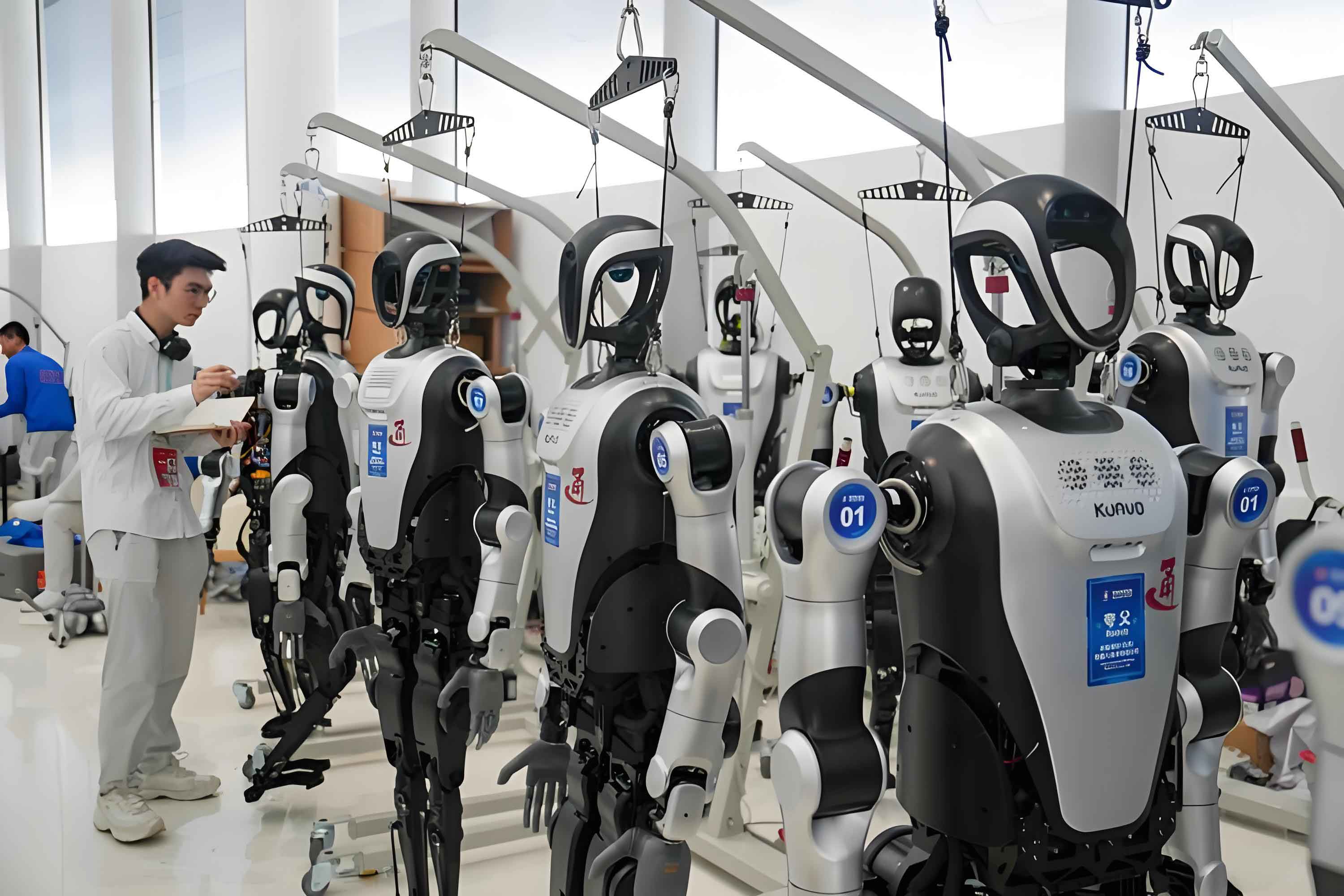
Using HAZOP analysis, I evaluated process nodes like workpiece handling and assembly, with elements including the robot’s limbs, sensors, and power systems. Table 2 provides an excerpt from the HAZOP worksheet, highlighting deviations such as incomplete emergency stop responses or insufficient gripping force. For instance, a “partial” deviation in external emergency stop signals could result from wireless communication delays, causing the robot to continue moving briefly after a stop command. This poses a collision risk, mitigated only by a local stop button. Recommended improvements include wired emergency connections or defining safe stopping procedures during locomotion. Similarly, a “less” deviation in battery capacity might lead to power loss and falls, suggesting the use of safety harnesses or auxiliary power sources. These findings emphasize the need for robust safety controls in humanoid robot applications.
| Guideword | Element | Deviation | Possible Causes | Consequences | Existing Safety Measures | Proposed Improvements |
|---|---|---|---|---|---|---|
| Partial | External Emergency Stop | Delay in stopping joint motors after trigger | Wireless emergency stop response latency; software/hardware limitations in bipedal emergency stops | Minor movements after stop, risking injury to nearby personnel | Local stop button | Use wired emergency stops compliant with safety certifications; define allowable bipedal motion range and stopping methods |
| Partial | Local Stop Button | Difficulty in achieving rapid, stable stop during locomotion | Software/hardware limitations in bipedal emergency stops; not all motors have brakes | Robot falls after stop, injuring collaborative workers | None | Evaluate use of fall prevention safety ropes; define allowable bipedal motion range and stopping methods |
| None or Less | Bipedal Support | Insufficient force for stable standing | Low battery charge; aging or damaged servo mechanisms | Robot falls, causing secondary damage | Battery level monitoring and warnings; periodic mechanical inspections | Assess use of fall prevention safety ropes |
| Less | Limb Mechanical Structure | Inadequate joint clearance | Design overlooks finger/arm anti-pinch requirements; servo motor positioning errors | Quasi-static collisions or crushing injuries | Operator training; axis zero-point calibration at startup | Add labels, limits, or guards to risk points; implement additional pose verification, e.g., periodic quick zero-point calibration or auxiliary fixtures |
One of the most critical issues identified in the HAZOP analysis is the emergency stop functionality for humanoid robots during locomotion. Unlike stationary robots, humanoid robots must manage balance and momentum when stopping abruptly, which can lead to falls and secondary hazards. Existing standards, such as GB/T 16754, require that emergency stops halt hazardous motions without introducing additional risks, but they do not specify how to achieve this for bipedal systems. I propose a detailed emergency stop process divided into six phases, as outlined in Table 3. This process begins at time $t_0$ when an emergency stop is triggered, with phases covering signal reception, leg placement, zero-moment point adjustment, deceleration, self-checking, and power disconnection. Key parameters include $t_r$ (time to receive external stops), $l_s$ (step length during walking), $t_b$ (joint brake engagement time), and $t_c$ (self-check duration for stability).
| Phase Number | Phase Start Time | Bipedal Action Phase | Upper Limb Action Phase | Safety-Related Parameters |
|---|---|---|---|---|
| 1 | $t_0$ | External emergency stop issued and received | / | $t_1 \approx t_r$ |
| 2 | $t_0 + t_1$ | Swing leg lands for support | / | $l_s$, $t_2$ |
| 3 | $t_0 + t_1 + t_2$ | Zero-moment point transition adjustment | / | $t_3$ |
| 4 | $\sum_{i=0}^{3} t_i$ | Center of mass deceleration motion | Joint motor deceleration | $t_4$ |
| 5 | $\sum_{i=0}^{4} t_i$ | Center of mass stops and self-checks | Center of mass stops and self-checks | $t_5 \approx t_b + t_c$ |
| 6 | $\sum_{i=0}^{5} t_i$ | Power shutdown | Power shutdown | / |
To optimize this emergency stop process for humanoid robots, I formulate an objective function that minimizes the total time and risk, subject to constraints ensuring stable stopping. The goal is to find parameters like step length $l_s$ and phase durations $t_2$, $t_3$, $t_4$ that achieve a safe halt without falling. The optimization problem can be expressed as:
$$\min_{t_2, t_3, t_4} J(l_s, t_2, t_3, t_4)$$
$$\text{subject to } f_v(l_s, t_2, t_3, t_4) = 0$$
Here, $J(\cdot)$ represents the overall optimization objective, such as minimizing the stopping distance or energy dissipation, and $f_v(\cdot)$ defines the condition for the center of mass to come to a complete stop without loss of balance. For example, $t_1$ depends on $t_r$, which can be reduced by using wired emergency stops instead of wireless ones to avoid delays. $t_2$ is influenced by $l_s$; shorter steps allow quicker adjustments but may reduce efficiency, so dynamic step length adjustment based on proximity to humans can enhance safety. Phases $t_3$ and $t_4$ are determined by the robot’s control algorithms and hardware, which should be validated through simulation and sensor data. In phase 6, power shutdown should be delayed until stability is confirmed, or safety ropes can be used initially to prevent falls during testing.
Implementing these emergency stop procedures requires collaboration between application designers and humanoid robot developers. For instance, in the automotive case study, a wired emergency stop system could be integrated to ensure rapid response, while defining acceptable bipedal motion ranges during stops reduces tipping risks. Additionally, operators should wear protective footwear to mitigate step-related injuries. This approach not only addresses immediate safety concerns but also contributes to the evolution of safety standards for humanoid robots in manufacturing.
Beyond emergency stops, the integrated safety analysis reveals other common risks, such as sensor failures under variable lighting or joint overheating due to excessive loads. For example, a deviation labeled “abnormal” in visual sensors might occur from sudden光照 changes, impairing object recognition and leading to collisions. Improvements include real-time image quality monitoring and ambient light control. Similarly, “more” deviations in upper arm motor positioning errors, caused by incremental encoder accumulations, can be mitigated with periodic calibration using auxiliary tools. These measures highlight the importance of continuous monitoring and adaptation in humanoid robot applications.
In conclusion, the integrated safety analysis method provides a robust framework for ensuring the safe deployment of humanoid robots in manufacturing scenarios. By combining 5M1E, HAZOP, and human-robot collaboration principles, it identifies potential hazards and guides effective improvements, from component-level adjustments to procedural changes. The case study on emergency stop functionality demonstrates how mathematical modeling and phased processes can enhance safety without compromising performance. As humanoid robot technology advances, this method will support the development of industry-specific regulations and foster greater adoption in diverse manufacturing environments. Ultimately, a proactive approach to safety analysis is essential for leveraging the full potential of humanoid robots while protecting human workers and maintaining operational efficiency.
Looking ahead, future work could expand this analysis to include dynamic risk assessment using real-time data from humanoid robots’ sensors, enabling adaptive safety controls. Moreover, as more humanoid robots are deployed, collective learning from multiple applications will refine these methods, leading to standardized best practices. I believe that through rigorous safety analysis, humanoid robots can revolutionize manufacturing by taking on repetitive, ergonomically challenging, or hazardous tasks, thereby enhancing productivity and workplace safety. The key lies in balancing innovation with precaution, ensuring that every deployment of humanoid robots is preceded by a thorough evaluation of all safety factors.