
In a significant advancement for robotics and artificial intelligence, researchers have developed a novel method to improve the affinity of humanoid robots, aiming to boost user acceptance and trust in everyday and commercial service settings. This innovative approach combines Kansei engineering with stable diffusion (SD) models to generate aesthetically pleasing and emotionally engaging designs for humanoid robots. The study addresses a critical challenge in robotics: the often cold and intimidating appearance of humanoid robots, which can lead to user reluctance and reduced interaction. By quantifying affinity traits and training AI models to incorporate these features, the research paves the way for more relatable and appealing humanoid robots.
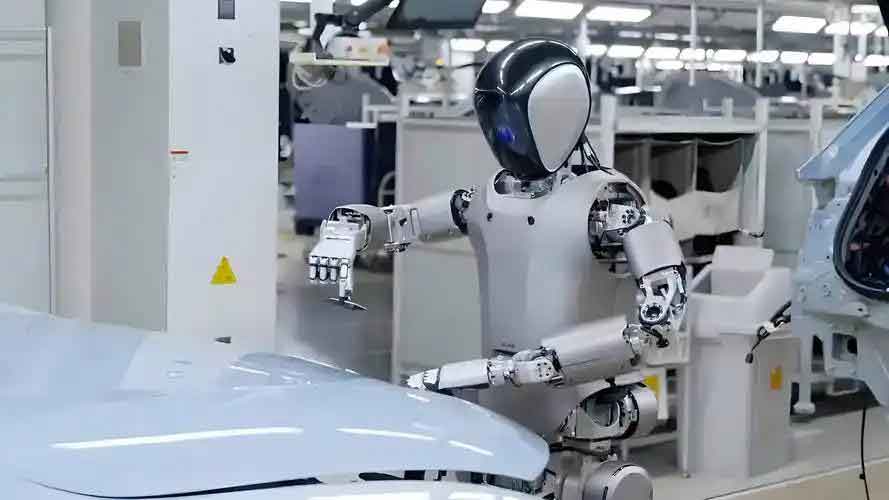
The growing integration of humanoid robots into various sectors, from healthcare to customer service, underscores the need for designs that foster positive human-robot interactions. Traditional design approaches for humanoid robots have often prioritized engineering efficiency over emotional appeal, resulting in rigid and uninviting exteriors. This can trigger negative emotional responses, such as fear or discomfort, ultimately hindering the adoption of humanoid robots. The latest research tackles this issue head-on by defining and implementing affinity-focused design elements, ensuring that humanoid robots not only perform tasks effectively but also connect with users on an emotional level.
-
Exploring Affinity in Humanoid Robot Appearance
The study employed Kansei engineering, a methodology that translates human emotions and perceptions into tangible design parameters. For humanoid robots, this involved breaking down affinity into evaluable dimensions: affinity degree (measuring closeness and approachability), gentleness degree (reflecting warmth and care), and liveliness degree (indicating energy and dynamism). These dimensions were correlated with specific design elements of humanoid robots, including shape, materials, and colors. Through a structured questionnaire and quantitative analysis, researchers gathered insights from 645 participants to understand user preferences and assign affinity scores to various design features of humanoid robots.
Key findings revealed that the head shape, facial expressions, and color schemes of humanoid robots had the most significant impact on perceived affinity. For instance, horizontal跑道-shaped heads and vertical跑道-shaped eyes were rated highest for affinity, while materials like fabric with textured surfaces and soft, low-saturation warm colors enhanced the gentle and lively aspects of humanoid robots. The data was compiled into an affinity scoring table, which served as a precise guideline for designing and evaluating humanoid robots with high affinity. This table highlighted that rounded, organic forms and avoidant of sharp edges in humanoid robots contribute to a more friendly appearance, aligning with human psychological preferences.
-
Questionnaire Design and Analysis for Humanoid Robots
The questionnaire was meticulously designed to abstract and test various design elements of humanoid robots, ensuring accurate measurement of affinity influences. Participants evaluated different head shapes (e.g., square, circular, horizontal跑道圆), eye shapes (e.g., circular, square, vertical跑道圆), body proportions (ranging from infant-like to adult figures), materials (including plastic, fabric, metal, and transparent options with varying surface treatments), and colors (covering冷暖色调 with adjustments in saturation and brightness). Statistical methods, such as Kruskal-Wallis H tests and Pearson correlation analyses, were used to analyze the responses, confirming strong consistency across the three affinity dimensions for humanoid robots.
Results showed that for humanoid robots, taller and more robust body proportions generally reduced affinity scores, whereas shorter, slimmer figures akin to青少年 proportions scored higher. In terms of materials, fabric-based humanoid robots with绒毛肌理 outperformed smooth plastic or metal surfaces, which were often perceived as cold and uninviting. Color analysis indicated that white and low-saturation warm tones, such as light yellows and oranges, significantly boosted the affinity of humanoid robots, while high-saturation cool colors and black scored lower. These insights were crucial for creating a reliable evaluation system to guide the AI training process for humanoid robots.
Design Element High-Affinity Features Affinity Score Head Shape Horizontal跑道圆, Circular 3 Eye Shape Vertical跑道圆 3 Body Proportion Teenage Slim 4 Material Fabric with Texture 3 Color Low-Saturation Warm Tones 3 This quantitative approach allowed researchers to move beyond subjective judgments, establishing a data-driven foundation for designing humanoid robots that resonate emotionally with users. The affinity scoring table became an essential tool for selecting and creating training samples, ensuring that the AI models for humanoid robots would learn to generate designs that consistently exhibit high affinity traits.
-
AI Model Training for Affinity-Focused Humanoid Robots
Leveraging the stable diffusion (SD) model, an advanced AI image generation technique, the research team trained models to produce affinity-optimized designs for humanoid robots. The training process involved several steps: sample preparation, annotation, iterative training, and model selection. Samples were carefully curated based on the affinity scores, featuring humanoid robots with high-affinity elements like soft contours, friendly facial features, and inviting color palettes. Tools like Controlnet and Photoshop were used to refine these samples, enhancing details such as material textures and proportional adjustments to align with affinity goals for humanoid robots.
Two primary training methods were employed: Dreambooth, which adjusts all layers of the SD model’s neural network to capture specific styles and features of humanoid robots, and Lora, a lighter approach that inserts new computational layers for efficient training. Dreambooth was used for the main model to generate diverse design variations of humanoid robots, while Lora models were trained as stylistic supplements to add unique touches. The training parameters included a learning rate of 1×10⁻⁴, 10 iterations, a batch size of 5, and 10 epochs, optimized using an 8bit-Adam optimizer and Cosine scheduler. Through multiple training cycles, the models gradually improved, with loss values decreasing to around 0.08 by the 7th to 9th epochs, indicating effective learning for humanoid robots.
Model evaluation involved generating cross-comparison charts (XY plots) to visualize output quality under different weights and epochs. By applying the affinity scoring table, researchers identified optimal model configurations—for instance, the 6th epoch model with weights between 0.6 and 0.8 produced the highest-affinity designs for humanoid robots. This iterative refinement ensured that the AI could generate a wide array of humanoid robot appearances, from minimalist to sci-fi styles, all maintaining core affinity characteristics. The trained models enable rapid generation of design matrices, allowing designers to quickly filter and select high-affinity options for humanoid robots based on quantitative scores.
-
Results and Implications for Humanoid Robot Design
The study demonstrated that AI-driven design methods can significantly enhance the efficiency and quality of creating affinity-focused humanoid robots. By integrating Kansei engineering with SD model training, the research achieved a seamless workflow from user perception analysis to automated design generation. The resulting humanoid robots exhibit features that promote approachability, such as rounded heads, expressive eyes, and soft materials, which collectively reduce the uncanny valley effect often associated with humanoid robots. This approach not only speeds up the design process but also ensures that humanoid robots are more likely to be accepted in real-world applications, such as elderly care, education, and retail services.
Moreover, the ability to generate style matrices—collections of designs varying in aesthetics while preserving affinity traits—offers unparalleled flexibility for customizing humanoid robots to different cultural and contextual needs. For example, a humanoid robot intended for a healthcare setting might emphasize gentle colors and fabrics, whereas one for entertainment could incorporate livelier elements without compromising affinity. The table below summarizes the affinity scores across different style variations of humanoid robots, highlighting how the method maintains high scores even in diverse design contexts.
Style Variation Average Affinity Score Key Characteristics Minimalist 15 Simple forms, neutral colors Organic 14 Curved shapes, natural materials Sci-Fi 13 Futuristic elements, soft edges Playful 14 Bright colors, dynamic proportions These outcomes underscore the potential of AI-assisted design to revolutionize the development of humanoid robots, making them more empathetic and integrated into human environments. The research provides a scalable framework that can be adapted to future advancements in robotics and AI, ensuring that humanoid robots evolve alongside user expectations for emotional connection.
-
Future Directions and Limitations in Humanoid Robot Affinity Design
While the study marks a substantial step forward, it acknowledges certain limitations, such as the relatively homogeneous participant pool, which may affect the generalizability of results for humanoid robots across diverse global audiences. Future research could expand to cross-cultural studies, examining how affinity perceptions of humanoid robots vary by region, age, or background. Additionally, integrating behavioral aspects—such as how a humanoid robot’s movements and interactions complement its appearance—could further enhance affinity and user trust in humanoid robots.
Another promising direction is the fusion of generative AI with real-time user feedback loops, allowing humanoid robots to adapt their designs based on ongoing interactions. This would enable more personalized and context-aware humanoid robots, fostering deeper emotional bonds. As AI technologies like stable diffusion continue to evolve, they could be combined with other modalities, such as voice and gesture analysis, to create holistic affinity models for humanoid robots. Ultimately, this research lays the groundwork for a new era of human-centered robotics, where humanoid robots are not only functional but also beloved companions in daily life.
In conclusion, the synergy between Kansei engineering and AI model training offers a powerful toolkit for designing humanoid robots that people want to engage with. By prioritizing affinity in appearance, this work addresses a critical barrier to the widespread adoption of humanoid robots, promising a future where these machines are welcomed as supportive partners in various spheres of human activity. The continued refinement of these methods will likely lead to even more innovative and appealing humanoid robots, driving progress in the field of emotional robotics.
The implications of this research extend beyond academic circles, offering practical benefits for industries deploying humanoid robots. As companies strive to create robots that assist in homes, hospitals, and businesses, the emphasis on affinity can lead to higher user satisfaction and adoption rates. This study serves as a benchmark for future endeavors, encouraging a shift from purely technical specifications to emotionally intelligent design in the development of humanoid robots. With ongoing advancements, humanoid robots may soon become ubiquitous, seamlessly blending into society as trusted and affectionate aides.