
In a groundbreaking move that is set to redefine the robotics industry, Songyan Power has launched the first consumer-grade humanoid robot priced under 10,000 yuan, signaling a significant shift towards affordability in the field of humanoid robots. The company’s latest product, Bumi Xiaobumi, with a limited pre-sale price of 9,998 yuan, challenges the long-standing perception of humanoid robots as high-cost luxury items. This development comes amid a broader trend of price reductions in the consumer robotics segment, with other players like Accelerate Evolution also introducing competitively priced models. As the market for humanoid robots expands, industry experts and founders alike are debating the implications of this price war, exploring whether it will spur innovation or lead to unsustainable competition. This in-depth analysis delves into the recent releases, founder perspectives, and the evolving landscape of humanoid robots, highlighting how these advancements could accelerate adoption across various sectors.
-
Songyan Power’s Bumi Xiaobumi: Breaking the Price Barrier in Humanoid Robots
Songyan Power’s announcement of Bumi Xiaobumi on October 22 has sent ripples through the robotics community, as it marks the first time a humanoid robot has been offered at such an accessible price point. Priced at 9,998 yuan during its pre-sale period from “Double 11” to “Double 12,” this humanoid robot stands approximately 94 centimeters tall, weighs around 12 kilograms, and boasts no less than 21 degrees of freedom, enabling a range of movements for entertainment, education, and exhibition purposes. Jiang Zheyuan, founder of Songyan Power, emphasized in an interview on October 23 that the primary consideration behind this launch was price, stating that achieving current performance levels at this cost is unprecedented. He drew parallels to historical examples like SpaceX reducing rocket launch costs and Xiaomi making smartphones affordable, arguing that humanoid robots should not inherently be expensive. The company is offering two versions of Bumi Xiaobumi: a standard consumer edition set to ship in March of the following year and an education edition expected to begin deliveries in January, both produced on the same production line. Jiang noted that the product’s毛利率 is low, with the company aiming to earn what he described as “conscience money,” reflecting a commitment to democratizing access to humanoid robots.
The release of Bumi Xiaobumi is not just a standalone event but part of a larger narrative in the humanoid robots industry, where prices are rapidly descending. Prior to this, models like Yu Shu Technology’s R1 were introduced at a starting price of 39,900 yuan, already considered a step towards affordability. However, Songyan Power’s move pushes the envelope further, potentially opening up new applications in home entertainment, companion robotics, and educational tools. Jiang Zheyuan believes that this price reduction is a healthy trend for the industry, as maintaining high profit margins could stifle growth and innovation. He predicts that all companies in the humanoid robots space will eventually lower their prices, converging on reasonable profit levels that foster wider adoption and exploration of diverse use cases. This aligns with the broader vision of making humanoid robots a common household item, much like personal computers or smartphones have become over the decades.
-
Accelerate Evolution’s Booster K1: A High-Performance Platform in the Humanoid Robots Arena
Shortly after Songyan Power’s announcement, Accelerate Evolution unveiled its own entry into the affordable humanoid robots market with the Booster K1, priced at a limited-time rate of 29,900 yuan starting from October 24. This humanoid robot, standing 95 centimeters tall and weighing 19.5 kilograms, features 22 degrees of freedom and is targeted at education, competitive events, and performance scenarios. Cheng Hao, founder and chairman of Accelerate Evolution, clarified that the Booster K1 is not merely a robot but a high-performance development platform validated by RoboCup (Robot World Cup), emphasizing its championship-level运动性能, robust computing power, comprehensive open-source ecosystem, and long-term developer support. This distinction highlights a different approach to pricing and product positioning in the humanoid robots market, where value is derived from advanced capabilities and community engagement rather than just cost reduction.
Cheng Hao’s comments suggest that while price is a factor, the true worth of humanoid robots lies in their functionality and scalability. He welcomed the increased participation in the industry, noting that the early stage of humanoid robots development necessitates collaboration and division of labor to drive technological progress. The Booster K1’s pricing strategy reflects this philosophy, as it aims to provide a versatile tool for researchers, educators, and enthusiasts, rather than competing solely on price. This perspective adds depth to the ongoing conversation about humanoid robots, indicating that affordability must be balanced with performance to ensure sustainable growth. As more companies like Accelerate Evolution enter the fray, the humanoid robots landscape is becoming increasingly diverse, with products catering to niche segments such as academic competitions and professional exhibitions, where reliability and advanced features are paramount.
-
Founder Perspectives on Pricing Strategies and the Future of Humanoid Robots
The contrasting views from Songyan Power’s Jiang Zheyuan and Accelerate Evolution’s Cheng Hao shed light on the complex dynamics shaping the humanoid robots industry. Jiang advocates for aggressive price reductions, arguing that they are essential for industry health and widespread adoption. He distinguishes between what he calls “malicious price wars” and strategic price band exploration, stating that if one company sells a humanoid robot for 40,000 yuan and another for 35,000 yuan, it could be seen as internal competition. However, moving to a entirely new price bracket, like the sub-10,000 yuan range, represents innovation in discovering new applications rather than destructive undercutting. Jiang revealed that Songyan Power is already considering further price drops for future iterations of Bumi Xiaobumi, suggesting that the current price is not the floor for consumer-grade humanoid robots.
On the other hand, Cheng Hao emphasizes the importance of maintaining quality and functionality in humanoid robots, even as prices decline. He points out that the Booster K1’s higher price is justified by its proven performance in international competitions and its role as a development platform, which requires significant investment in research and community support. This dichotomy highlights a key tension in the humanoid robots market: whether to prioritize affordability to accelerate mass adoption or to focus on high-end features that cater to specialized needs. Both founders agree that the industry is in its infancy and that price reductions are inevitable, but their approaches reflect different visions for how humanoid robots will evolve. Jiang’s prediction that prices will continue to fall aligns with historical patterns in technology sectors, where economies of scale and technological advancements drive down costs over time, making products like humanoid robots more accessible to a broader audience.
-
Industry Trends and the Divergence Between Consumer-Grade and Industrial Humanoid Robots
The recent price drops in humanoid robots are not uniform across all segments, according to industry experts. Meng Chuanjie, a robotics product负责人 at Kangdi Technology, observed that consumer-grade humanoid robots have experienced significant price reductions, with some models seeing decreases of approximately 50% compared to the previous year. This is largely due to factors such as localization of supply chains,替代 of imported components, and economies of scale that spread research and development costs across larger production volumes. In contrast, industrial-grade humanoid robots, designed for applications in manufacturing, logistics, and other specialized fields, have seen only slight price adjustments. Meng explained that this is because industrial robots often involve high levels of customization, substantial R&D investments, and are primarily used for proof-of-concept (POC) projects rather than mass deployment, making price reductions less impactful at this stage.
Jiang Zheyuan from Songyan Power echoed this sentiment, categorizing广义的消费级机器人 as those used in entertainment, education, and research, which are currently in a phase of rapid price decline. He noted that humanoid robots aimed at industrial settings, such as wheeled models with robotic arms or full-sized bipedal units for factory tasks, have not seen comparable price drops because they have not yet reached规模化 and产业化 stages. This divergence underscores the different maturity levels within the humanoid robots ecosystem. Consumer-grade humanoid robots are benefiting from faster innovation cycles and higher demand, driving prices down, while industrial humanoid robots remain in a more experimental phase where cost is secondary to functionality and reliability. As the industry evolves, however, experts predict that industrial humanoid robots will also become more affordable as technologies mature and production scales up, potentially mirroring the trajectory of consumer models.
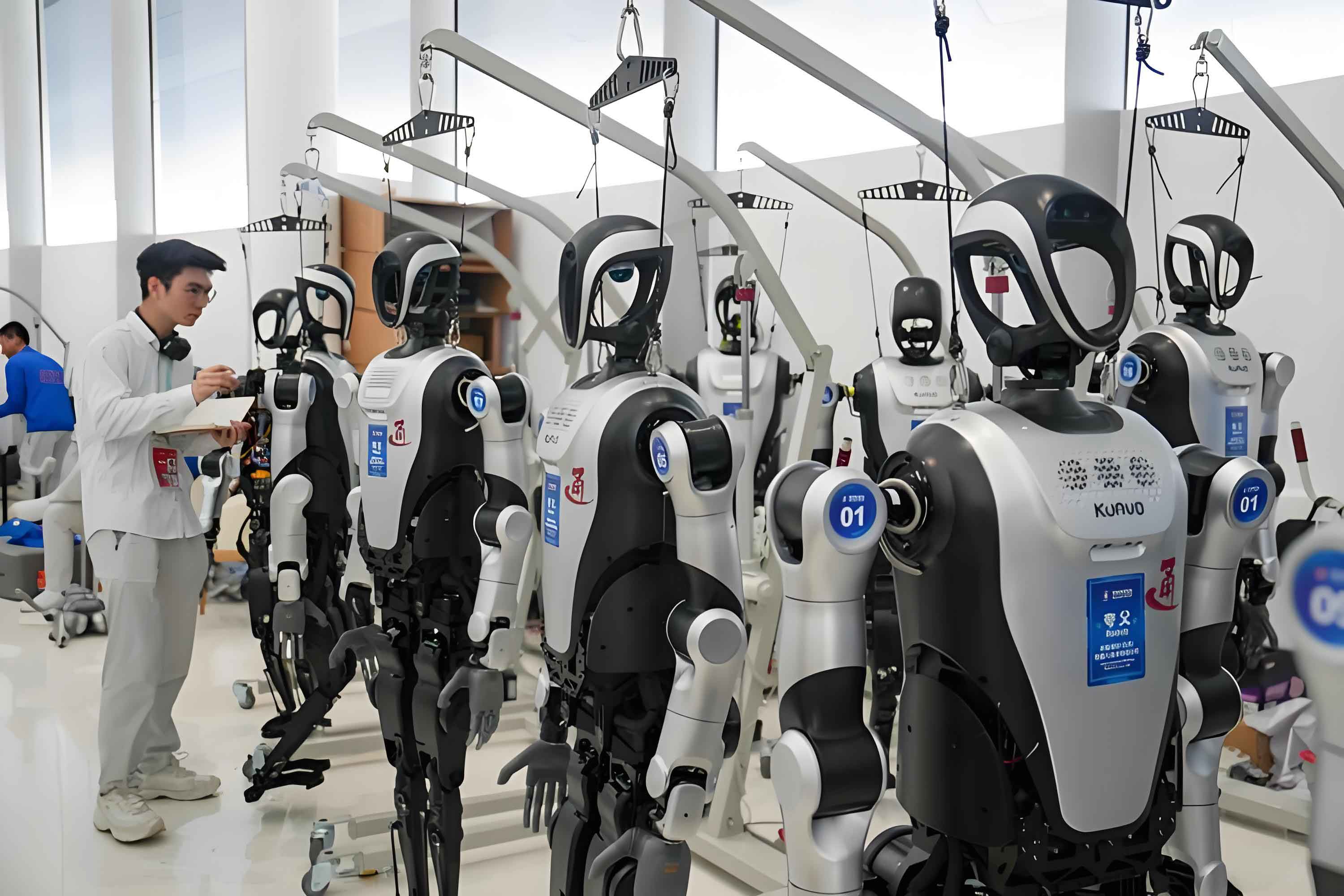
The image above illustrates the quality inspection processes involved in manufacturing humanoid robots, highlighting the attention to detail required as prices become more competitive. This visual representation underscores the balance between cost reduction and maintaining high standards in the production of humanoid robots, a challenge that companies across the spectrum must address as they navigate the evolving market.
-
Comparative Analysis of Recent Humanoid Robots Releases and Market Positioning
To better understand the current state of the humanoid robots market, it is useful to compare the specifications and pricing of recent models. The table below provides a detailed overview of key humanoid robots that have been introduced, highlighting their features and target applications. This comparison not only illustrates the trend towards affordability but also reveals the diverse strategies employed by different companies in the humanoid robots space.
Model Company Price (Yuan) Height (cm) Weight (kg) Degrees of Freedom Primary Applications Bumi Xiaobumi Songyan Power 9,998 (pre-sale) 94 12 21+ Entertainment, Education, Exhibition Booster K1 Accelerate Evolution 29,900 (limited) 95 19.5 22 Education, Competitions, Performance R1 Yu Shu Technology 39,900 (starting) Not specified Not specified Not specified Various, including consumer and research As evident from the table, the humanoid robots market is experiencing a stratification of products based on price and functionality. Songyan Power’s Bumi Xiaobumi leads the pack in terms of affordability, targeting a broad consumer base with its sub-10,000 yuan price tag. In contrast, Accelerate Evolution’s Booster K1 positions itself as a premium option within the affordable range, leveraging its RoboCup validation to appeal to developers and educational institutions. Yu Shu Technology’s R1, while still relatively accessible compared to earlier models, represents a middle ground that may cater to both consumer and professional users. This diversity in humanoid robots offerings is a positive sign for the industry, as it allows for experimentation and adaptation across different use cases, from home companionship to advanced research platforms. The increasing variety of humanoid robots is likely to drive further innovation, as companies compete not only on price but also on features, reliability, and ecosystem support.
-
Expert Insights and the Broader Implications for the Humanoid Robots Industry
Industry analysts and robotics experts have weighed in on the recent developments, offering perspectives on how the price reductions in humanoid robots could shape the future of automation and AI. Meng Chuanjie of Kangdi Technology highlighted that the dramatic price drops in consumer-grade humanoid robots are largely driven by technological advancements and supply chain optimizations. He noted that as more components are produced domestically and production volumes increase, the cost per unit decreases, making humanoid robots more accessible to everyday consumers. However, he cautioned that for industrial humanoid robots, the path to affordability is longer due to the need for robust performance in demanding environments and the high costs associated with customization and integration.
Jiang Zheyuan’s vision of humanoid robots becoming as ubiquitous as smartphones resonates with many in the industry, but experts point out that several challenges remain. These include improving the autonomy, battery life, and AI capabilities of humanoid robots to make them truly useful in daily life. Additionally, safety and regulatory concerns must be addressed as humanoid robots become more common in homes and workplaces. The current price war, while beneficial for adoption, could also lead to compromises on quality if not managed carefully. Therefore, a balanced approach that combines cost reduction with continuous innovation is essential for the sustainable growth of the humanoid robots market. As more players enter the field, collaboration on standards and best practices will be crucial to ensure that humanoid robots deliver on their promise of enhancing human productivity and quality of life.
-
Future Outlook: Where Are Humanoid Robots Headed in Terms of Price and Adoption?
Looking ahead, the trajectory for humanoid robots appears to be one of continued price erosion and expanded adoption. Jiang Zheyuan from Songyan Power hinted that the price of Bumi Xiaobumi could drop even further in subsequent generations, potentially bringing humanoid robots into the realm of everyday consumer goods. This aligns with historical trends in technology, where initial high costs give way to mass-market affordability as production scales and innovations accumulate. For instance, the evolution of personal computers and mobile devices saw prices plummet while capabilities soared, and humanoid robots may follow a similar path. As prices fall, new applications are likely to emerge, from personal assistants and educational tools to healthcare and elderly care solutions, further driving demand for humanoid robots.
However, the future of humanoid robots is not solely dependent on price. Factors such as AI integration, sensor technology, and user interface design will play critical roles in determining their success. Companies like Accelerate Evolution are focusing on these aspects by offering development platforms that encourage community involvement and customization, which could lead to faster innovation and more tailored solutions for specific needs. Moreover, as industrial humanoid robots mature, they may benefit from the same economies of scale that are currently driving down consumer prices, eventually making automation more accessible to small and medium-sized enterprises. In the long run, the humanoid robots industry is poised for exponential growth, with price reductions acting as a catalyst for widespread adoption across both consumer and industrial sectors. The ongoing developments suggest that we are on the cusp of a new era where humanoid robots become an integral part of society, transforming how we live, work, and interact with technology.
In conclusion, the recent announcements from Songyan Power and Accelerate Evolution mark a pivotal moment in the evolution of humanoid robots, demonstrating that affordability and performance can coexist. The sub-10,000 yuan price point for Bumi Xiaobumi and the competitive pricing of Booster K1 reflect a broader industry shift towards making humanoid robots accessible to a wider audience. While challenges remain in terms of quality, customization, and market segmentation, the overall trend is positive, with prices expected to continue falling as technology advances. As founders and experts emphasize, this price reduction is not about恶性竞争 but about exploring new possibilities and accelerating the integration of humanoid robots into everyday life. The future of humanoid robots looks bright, with the potential to revolutionize numerous fields and improve human experiences in ways we are only beginning to imagine.