
In an era marked by explosive technological advancements, humanoid robot technology has emerged as a highly prospective frontier, seamlessly integrating knowledge from mechanical engineering, electronic information technology, computer science, and other disciplines. This field showcases exceptional characteristics of high intelligence and realistic human-like simulation. As a foundational core course in electronic information majors, “Digital Electronics Technology” provides the underlying logical support for numerous high-tech applications. The integration of humanoid robot technology into the “Digital Electronics Technology” curriculum holds significant practical and theoretical importance for teaching. On one hand, it brings abstract and complex digital electronics knowledge to life, transforming it into tangible application scenarios that students can interact with, allowing them to genuinely perceive the real-world applications of their learning in cutting-edge fields, thereby extremely stimulating their interest and enthusiasm for exploration. On the other hand, it facilitates the cultivation of versatile talents who not only understand the principles of digital electronics but can also skillfully apply them to practical tasks such as humanoid robot development and maintenance, meeting the urgent demand for diversification skills in today’s industrial upgrading and transformation, and aligning with the talent cultivation goals of institutions like Yan’an University Xi’an Innovation College.
Globally, universities and research institutions have started exploring interdisciplinary education integration earlier, with some institutions boldly attempting to incorporate humanoid robot projects into electronic engineering-related curricula. These initiatives employ practice-oriented teaching models to guide students through the entire process of robot development. However, there remains room for optimization in the systematic integration of course knowledge. Domestically, education has increasingly emphasized the combination of preface technologies and basic courses in recent years, with many universities actively engaging in similar teaching reform explorations. However, most of these reforms focus on robot competition guidance and have not deeply penetrated routine teaching sessions, leaving aspects such as teaching method innovation and assessment system adaptation further exploration is needed.
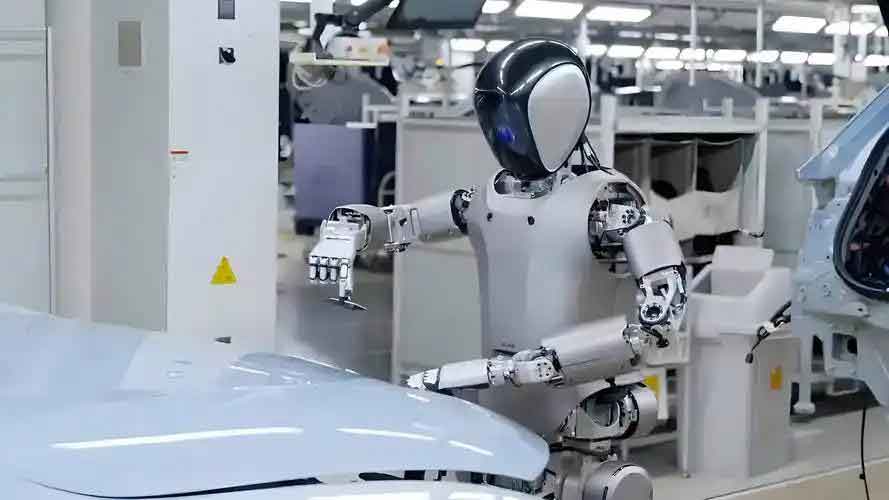
The technical composition of humanoid robots is multifaceted. The hardware system, akin to a robust body, includes precision mechanical skeletons, a variety of sensors (such as integrated visual, auditory, and tactile systems), and efficient actuators (e.g., motors, servos). Digital electronics technology plays a crucial role in the precise driving, coordinated control, and smooth operation of these hardware components. From a software perspective, the software system of a humanoid robot encompasses the robot operating system, motion control algorithms, and intelligent decision-making programs. Underlying operations like digital signal processing, complex logical operations, and data storage and retrieval all rely on digital electronics technology. For instance, the massive image data collected by visual sensors must undergo high-speed sampling, quantization, and encoding through digital circuits before being converted into digital signals that subsequent algorithms can deeply analyze and recognize, enabling the humanoid robot to achieve acute environmental perception and accurate cognition after analog-to-digital conversion.
Digital electronics technology finds extensive applications in humanoid robots. For example, the Microcontroller Unit (MCU) in digital electronics generates precise pulse signal sequences based on preset motion trajectory algorithms to drive motors and servos to operate steadily at desired speeds and angles, enabling smooth and natural limb movements of the humanoid robot. In the perception processing phase, it filters, screens, and identifies effective information from the continuous stream of data from the integrated sensor system, assisting the humanoid robot in real time and precise judging environmental states. In the core decision-making system, intelligent logic modules built on digital logic circuits make decisions in close combination with perceptual information, showcasing the integral role of digital electronics in the functionality of humanoid robots.
Currently, the “Digital Electronics Technology” course faces several challenges. Firstly, the teaching content is often disconnected from practical applications. The course emphasizes theoretical knowledge, with a complete theoretical system, but experimental teaching is typically limited to basic verification-level experiments like circuit build. Students struggle to relate classroom knowledge to complex and variable real-world scenarios, leading to a gap between teaching and practice. Secondly, teaching methods are single. Traditional instruction relies heavily on teacher lectures, and even with some reforms adopting online-offline hybrid models, they often remain theoretical, leaving students in a passive listening state. While tools like blackboards, PPTs, and assistance videos can clearly present theoretical derivations, students lack opportunities for autonomous exploration. In the face of engaging and practice-intensive frontier fields like humanoid robots, single lecturing can dampen student enthusiasm, making it difficult to motivate them to excavate the application potential embedded in digital electronics technology, resulting in suboptimal teaching outcomes. Thirdly, the assessment system is incomplete. The current evaluation for “Digital Electronics Technology” focuses on theoretical knowledge, typically dominated by closed-book final exams supplemented by attendance, usual performance, and lab reports. Subjective questions generally revolve around concepts, circuit analysis, small-scale circuit design, and simple calculations, rarely involving in-depth analysis of practical project cases like humanoid robots or hands-on operational assessments. This encourages rote memorization of theories, neglecting knowledge application, innovative thinking cultivation, and the ability to connect learned knowledge with frontier technologies, leaving graduates ill-prepared for practical combat demands.
The teaching reform aims to break old norms and reshape the “Digital Electronics Technology” course model, promoting students’ in-depth mastery of the digital electronics knowledge and skills essential for humanoid robot technology. Through project practice, it seeks to comprehensively train students’ hands-on abilities, carefully cultivate their excellence talent in applying digital electronics to solve complex engineering problems in humanoid robots—such as optimizing robot motion control circuit architectures and significantly improving perceptual data processing efficiency—while highly concerned igniting innovative thinking sparks and fostering teamwork spirit, equipping them with comprehensive qualities to take it easy future iterations and challenges in humanoid robot technology, and continuously supplying high-quality talent for related industries.
The reform principles emphasize the close integration of theory and practice, ensuring that course knowledge delivery and humanoid robot project practice resonate and advance synchronously. This allows students to grasp the importance of theory guiding practice and practice supporting deep theoretical understanding through hands-on operations, truly achieving a virtuous cycle of “learning by doing and doing by learning.” Additionally, student-centered and ability-oriented approaches are upheld, tailoring teaching to individual differences and focusing on cultivating comprehensive abilities like problem-solving and innovation.
Based on humanoid robot technology, the teaching reform strategies encompass several aspects. Firstly, optimizing teaching content involves introducing humanoid robot cases. At the course outset, showcasing hotspot application videos of humanoid robots—such as the agile and graceful dance performances of Hangzhou Yushu Technology’s robots at the 2025 Spring Festival Gala or rescue and disaster relief simulations—can capture student attention and stimulate strong curiosity about the underlying digital electronics support. When explaining key knowledge points like combinational logic circuits, Clever introduction humanoid robot hand motion control practical combat cases to analyze how logic gates are ingeniously designed to achieve magical conversion of finger grasping action instructions. In the sequential logic circuit section, using robot walking gait control as a vivid example to explain in a simple and profound manner the key roles of counters and registers in generating periodic control signals, making abstract circuit knowledge intuitively correspond to robot actions and extremely reducing comprehension difficulty. Furthermore, integrating course knowledge points involves attempt to break through traditional textbook chapter limitations and constructing a new knowledge acceptance system guided by applications. For instance, using humanoid robot technology applications as the main line, setting the teaching sequence according to the smooth workflow from perception to decision-making and execution, while gradually delivering related knowledge points based on application order and teaching regularity, helps students build a knowledge system. Integrating core knowledge like sensor interface circuit design, digital signal processing algorithms, and microcontroller programming guides students to meticulously construct a complete “information acquisition-processing-response” knowledge chain for robots, enabling them to thoroughly understand how various digital electronics technologies collaborative efforts to orchestrate the intelligentization operation of humanoid robots, comprehensively improve comprehensive application abilities, and making their knowledge system is becoming increasingly solid and powerful.
Secondly, innovating teaching methods includes project-driven teaching. Designing a series of practical combat projects covering the development of different functional modules of humanoid robots, such as a simple humanoid robot facial expression control system or an autonomous obstacle avoidance mobile platform empowering robots with the ability to flexibly navigate complex environments, and scientifically grouping students to each take on a project responsibility—from accurate requirement analysis, ingenious scheme design, careful circuit build to debugging and optimization—ensures responsible for the entire process. Virtual simulation teaching leverages professional software like Proteus, Multisim, and MATLAB to create near-real virtual work environments for humanoid robots, allowing students to experience the convenience of virtual settings, freely design and boldly test digital electronic circuits, simulate robot motion control and perceptual feedback processes, completely avoiding concerns about hardware damage or component shortages, and enabling repeated debugging and optimization of circuit parameters for continuous improvement. For example, when simulating the digital circuit of a robot visual tracking system, by constantly changing input image characteristics and flexibly adjusting circuit parameters, students can concentrate fully observe output tracking effects and intuitive and vivid experience how circuit performance changes impact results, thereby significantly increased design capabilities, effectively reducing teaching costs, and enhancing safety and repeatability. Group cooperative learning involves scientific and reasonable grouping based on differences in student abilities, personalities, proactiveness, and organizational skills, with size of each group is controlled within 4–6 members, requiring clear division of labor and close collaboration within groups. Tasks may include hardware build responsibilities, software programming fine living, document organization trivial affairs recording project growth drip, and testing and optimization key positions polishing the project to perfection, with regular honest communication of progress and joint problem-solving. For instance, in a humanoid robot music performance project, students skilled in circuit design focus on instrument sound circuit production, while those proficient in programming meticulously write music playback programs. Through collective collaboration to complete the robot’s performance of beautiful music, students cultivate teamwork and communication skills, promote knowledge sharing and mutual prosperity, and drive overall learning outcomes to new heights.
Thirdly, improving the assessment method involves diversifying evaluation indicators. Abandoning the dominant model of single theoretical exams, a diversified assessment system is constructed, including theoretical knowledge (30%–40%), practical ability (30%–40%), project outcomes (10%–20%), and teamwork (10%–20%). Theoretical knowledge assessments can cleverly integrate humanoid robot application scenario questions to encourage practical application; practical ability is strictly evaluated through hands-on operations, project defenses, and other rigorous sessions; project outcomes are fine rating based on key dimensions like innovation, functional completeness, and stability; teamwork focuses on aspects such as rationality of member division of labor, communication effectiveness, and collaborative problem-solving, providing an comprehensive objective evaluation of student learning outcomes and making assessment results truly reflect student growth footprint. Additionally, process evaluation is strengthened by intensifying the tracking of learning processes, incorporating classroom performance (10%–20%), project progress (30%–40%), and lab reports (30%–40%) into the process evaluation scope. This comprehensively assesses students’ participation in learning processes, hands-on proactiveness, and text writing abilities, reflecting their active learning, active practice, and document preparation and formatting skills. In class, students are encouraged to actively ask questions and participate in discussions, with exciting speech recorded; project progress is regularly checked, and feedback is provided promptly; lab reports require detailed recording of experiment objectives, steps, problems, and solutions, helping students develop the habit of documenting their learning journey.
In practical teaching reform case analysis, two classes in electronic information majors were selected: one as the experimental group implementing the above reform plan, and the other as the control group following traditional teaching methods for comparison. In the experimental group, the entire teaching process included introductory sessions on humanoid robots, such as popular science lecture to ignite student interest; mid-term grouping based on student strengths for project-driven teaching, equipped with virtual simulation software for assisted practice, regular project reporting to share experiences and disclose problems; and post-production organization of project outcome exhibitions and defense sessions, with diversified assessment and process evaluation mechanisms throughout the entire process. The control group, however, followed the textbook chapter sequence for instruction, primarily using teacher lectures and simple experimental verification, with traditional assessment methods.
After one semester of teaching practice, the teaching effects were evaluated by comparing the two classes’ final exam scores, project completion levels, and learning interest survey results. The experimental group’s average final exam score was nearly 10 points higher than the control group’s, showing significant performance advantage; the experimental group demonstrated stronger innovation capabilities in practical projects, such as designing more intelligent humanoid robot gesture recognition systems; the learning interest survey indicated that over 80% of students in the experimental group were highly interested in the course, far exceeding the control group’s approximately 25%. This indicates that the teaching reform, like spring breeze and rain, significantly enhanced student learning outcomes and subjective initiative.
However, the practical exploration was not without challenges. During teaching, some typical issues emerged, such as insufficient humanoid robot hardware equipment leading to limited student practice time, requiring queuing and additional increase workload; and some students with weak foundational knowledge struggling to adapt quickly to the interdisciplinary knowledge integration in the initial project phases. To address these, immediate improvement measures were taken: on one hand, actively seeking industry-academia cooperation to expand hardware equipment; on the other, introducing a new online-offline hybrid teaching model, with pre-class push of basic preview materials and post-class open online Q&A sessions, ensuring students at different levels could keep up with the learning pace in the reform.
In conclusion, by deeply integrating humanoid robot technology into the “Digital Electronics Technology” course teaching, significant progress has been made in key aspects such as teaching content, methods, and assessment. The teaching content successfully achieved case-based and integrated approaches, making knowledge lively and vivid; innovative teaching methods ignited student enthusiasm and unlocked practical potential; improved assessment methods accurately measured the incremental improvement of comprehensive qualities. Students not only solidified their theoretical foundation in digital electronics but also showed promise in the practical application of humanoid robots, laying a solid groundwork for future career development. Looking ahead, humanoid robot technology will advance towards greater intelligence and flexibility. Institutions will further expand the breadth and depth of interdisciplinary integration, boldly introducing frontier knowledge from biology and psychology to improve the blueprint for robot design; strengthen the build of international exchange and cooperation bridges to learn advanced teaching concept and exquisite craftsmanship; and develop more open and challenging practical projects to assist in cultivating outstanding talents leading the humanoid robot era. This reform not only enhances the “Digital Electronics Technology” course but also sets a precedent for integrating emerging technologies into education, preparing students for a future where humanoid robots play an increasingly vital role in various sectors.