
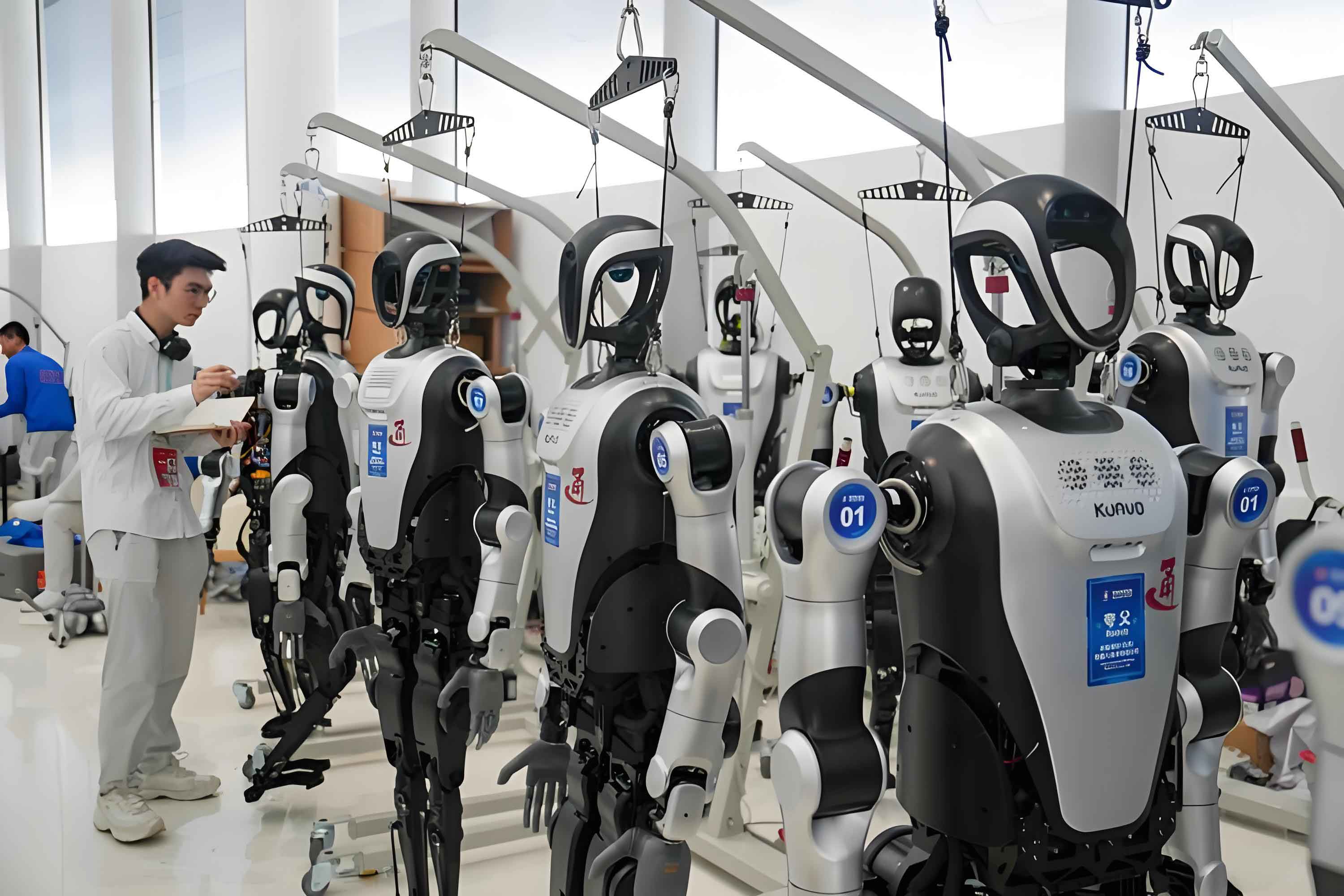
The dawn of mass production for humanoid robots has arrived, serving as a definitive test of technological maturity and a milestone for commercial success. Industry leaders emphasize that mass production is a complex system where errors in design, production, manufacturing, software, data, and model processing chains accumulate and magnify, ultimately posing significant constraints. Achieving high consistency across all stages—from production and design to execution—is critical, as it minimizes deviations and lays the groundwork for robust data sharing. This focus on precision is reshaping the landscape for humanoid robot development, with supply chain resilience and data-driven intelligence at the forefront.
Commercialization remains a central theme in the humanoid robot sector, as evidenced by recent industry events. The 2025 World Robot Conference showcased remarkable progress, with sales of 19,000 robots and related products, generating over 200 million yuan in revenue and attracting 1.481 billion yuan in financing. These figures have injected renewed confidence into the humanoid robot industry, highlighting its growing economic impact. Companies like Songyan Power (Beijing) Technology Co., Ltd. (Songyan Power) are leading the charge by combining productization with commercialization expertise, enabling them to approach humanoid robot development with a market-oriented mindset. In the first half of this year alone, Songyan Power secured more than 2,000 orders, with total contract values exceeding 100 million yuan, making it the second domestic humanoid robot firm after Yushu Technology to surpass the “thousand-unit sales” threshold and join the top tier of commercialized humanoid robot providers.
- Strategic Commercialization Pathways for Humanoid Robots
Accelerating the commercialization of humanoid robots hinges on identifying viable deployment scenarios. According to Han Shenren, CFO of Songyan Power, prioritizing areas with lower performance demands for humanoid robots—such as those capable of rapidly replacing low-value labor—allows for a smoother entry into the market. This approach facilitates a gradual transition to more complex environments requiring精细 operations. Songyan Power’s strategy exemplifies this logic: it first targets sectors like scientific research and education, exhibition displays, and cultural tourism guidance, where stable cash flows enable quick adoption. This “start simple, advance gradually” method reduces initial market-entry costs and provides a time buffer for technological refinement. As the company accumulates core competencies, it plans to expand into higher-stakes domains, building a comprehensive ecosystem that ranges from demonstrative applications to essential needs.
Mass production capability is indispensable for closing the commercial loop in the humanoid robot industry. Han Shenren noted that early mass production faced challenges, particularly from upstream supply chains that underestimated the surge in demand. However, domestic supply chains demonstrated remarkable agility, with suppliers adapting production lines and delivering components within one to two days of order spikes, thereby supporting large-scale humanoid robot deployment. To enhance delivery efficiency, Songyan Power has established production bases in Beijing, Changzhou, and Dongguan. Owning factories has endowed the company with deep manufacturing insights, allowing it to iterate processes rapidly based on client feedback and ensure timely humanoid robot shipments. Future plans include upgrading automation equipment and refining production tools to sustain this momentum. By the third quarter, mass production workflows are expected to streamline further, with a focus on overseas markets—including Europe, the United States, Southeast Asia, and Saudi Arabia—in the fourth quarter and beyond, ensuring stable supply chains for humanoid robot products.
- Data as the Critical Bottleneck in Humanoid Robot Commercialization
While hardware for humanoid robots has reached a relatively mature stage, commercialization hurdles persist in the realms of models and data. Han Shenren pinpointed this as a key issue, emphasizing that continuous technological breakthroughs are needed to meet the demands of specialized scenarios. Overcoming this bottleneck requires a paradigm shift: prioritizing data quality over mere volume and focusing on scenario adaptation rather than simple integration. As Yao Maoqing, partner and president of the embodied business department at Zhiyuan Robot, articulated, enhancing humanoid robot intelligence depends not on the quantity of data or the diversity of platforms but on the reliability of data and the variety of contexts in which it is applied.
In the domain of humanoid robot skill training, teleoperation data serves as a vital resource but faces significant challenges. Data collection capacity is currently insufficient, and acquisition costs remain prohibitively high, creating a supply-demand imbalance that hampers improvements in humanoid robot operational efficiency. To address this, companies like Yinhe Tongyong are leveraging computer graphics to simulate real-world physics in computational environments. By modeling interactive rigid bodies, flexible objects, and other diverse forms, they construct virtual platforms that support complex actions such as grasping, opening refrigerators, and operating remote controls. Through proprietary synthesis pipelines and reinforcement learning algorithms, these systems autonomously generate vast amounts of action data. After simulation validation and visual rendering, the data transitions from virtual to real-world applications, forming synthetic datasets on a trillion-scale basis. Yinhe Tongyong has pioneered the creation of the world’s first billion-scale grasping synthesis database. Its GraspVLA model, the inaugural grasping foundation model for humanoid robots, digests this billion-level synthetic data and demonstrates exceptional cross-scenario generalization capabilities.
With high-quality data available, the central challenge becomes effective utilization. Yao Maoqing stressed that humanoid robots must learn from a human perspective, absorbing actions and physical laws to comprehend how the world functions. Language, as a highly abstract information set, uses tokens to symbolize logical patterns, but the physical world is continuous and open-ended, with innumerable object types, each possessing unique materials and behaviors. Humanoid robots need to glean this foundational understanding from massive datasets—grasping the underlying principles of physical operations. The Zhiyuan Qiyuan large model acts as a “physical world expert”: it first self-learns general action rules, such as grasping and stacking, from extensive videos, images, texts, and humanoid robot operation data. Then, via a mixture of experts system, it tailors these rules to various humanoid robot hardware. Experiments reveal that this “learn principles, not just actions” approach enables models to adapt swiftly to new tasks; for instance, a model trained on Zhiyuan humanoid robots can teach other brands to fold clothes with minimal additional data. This technology holds promise for empowering humanoid robots to tackle novel challenges with human-like ease in the future.
Despite these advances, widespread adoption of humanoid robots in industrial settings remains a distant goal. Yao Maoqing highlighted that industrial applications impose high thresholds, with clients expecting humanoid robots to match human performance in cost, cycle time, and stability. This necessitates tight integration across the humanoid robot’s platform, data, algorithms, and applications, coupled with relentless iteration. The journey toward seamless industrial integration for humanoid robots is ongoing, demanding concerted efforts in innovation and practical deployment.
The humanoid robot industry stands at a pivotal juncture, where mass production capabilities and data intelligence are driving commercialization forward. Supply chain adaptability has proven crucial in meeting sudden demand surges for humanoid robots, while data quality and scenario diversity are emerging as the linchpins of advanced functionality. As companies like Songyan Power and Zhiyuan Robot refine their strategies, the focus on reliable data and scalable production will determine how quickly humanoid robots can transition from niche applications to mainstream adoption. The progress reported at the 2025 World Robot Conference underscores the potential for humanoid robots to revolutionize various sectors, but overcoming data-related bottlenecks will be essential for unlocking their full potential. With continued emphasis on innovation and collaboration, the humanoid robot market is poised for sustained growth and transformation.