
The global humanoid robot industry is rapidly transitioning from conceptual exploration to large-scale commercial deployment, with China emerging as a dominant force. According to the “2025 Humanoid Robot and Embodied Intelligence Industry Research Report,” China’s humanoid robot market size is projected to reach 82.39 billion yuan this year, capturing approximately 50% of the global market. This explosive growth is underscored by major commercial milestones, such as the 2.5 billion yuan order—reportedly the world’s largest single contract for humanoid robots—secured by Shenzhen Ubtech Technology Co., Ltd., often referred to as the “first stock of humanoid robots.” Furthermore, the National and Local Co-built Humanoid Robot Innovation Center forecasts that sales of humanoid robots in China will exceed 10,000 units in the current year, representing a staggering 125% year-on-year increase. These indicators collectively signal that the humanoid robot sector is entering a period of unprecedented expansion, poised to become a significant driver of economic development.
-
Diverse Product Offerings and a Sales Explosion
In Jiangsu province, enterprises specializing in humanoid robot manufacturing are reporting remarkable sales performances, reflecting the broader industry surge. Jiangsu Yunmu Intelligent Manufacturing Technology Co., Ltd., headquartered in Taicang, has witnessed its sales revenue from January to August this year soar to approximately 2.5 times the total sales recorded for the entire previous year. This company has distinguished itself by achieving full-stack in-house research and development for its humanoid robot products, encompassing core technologies from the “brain” and “cerebellum” to overall structural design. It has launched ten distinct models, positioning itself as one of the market’s most prolific developers in terms of product variety.
The company’s cultural tourism series of humanoid robots are particularly successful, available in both chassis-based and bipedal humanoid forms. These units are deployed in museums, science centers, shopping malls, and exhibition halls, where they perform guided tours and provide explanatory services. A prime example is the “Zheng He” humanoid robot at the Taicang Museum, which engages visitors in natural dialogue about historical and cultural topics. This advanced humanoid robot possesses 40 degrees of freedom, enabling sophisticated arm movements and expressive facial gestures. Enhanced voice interaction systems allow for human-like conversations and accurate intent recognition. Equipped with binocular cameras, the humanoid robot can identify and describe its surroundings, while also executing actions such as bowing, handshaking, greeting, and making heart gestures. Customization options include synthetic skin for exposed areas like the head and hands, with 26 facial degrees of freedom and 66 total body degrees of freedom, facilitating a wide array of nuanced expressions and motions. The base model is priced above 200,000 yuan, with custom versions commanding higher prices. Despite exploring leasing models, the company is currently prioritizing direct sales in response to overwhelming domestic and international demand for its humanoid robot solutions.
Another notable Jiangsu enterprise, Nanjing Avatar Robot Technology Co., Ltd., has experienced a sales increase of roughly 100% from January to August compared to the same period last year. Its flagship product is a child-companion humanoid robot, priced at over 50,000 yuan, which integrates陪伴, educational, and safety monitoring functionalities. This humanoid robot can sing songs, narrate stories, assist with learning activities, and, utilizing artificial intelligence detection algorithms, identify if an elderly person has fallen and automatically trigger an alert to predefined contacts. Primarily targeting institutional clients such as schools and nursing homes, this versatile humanoid robot exemplifies the growing practical applications and market acceptance of such technology.
The sales momentum for humanoid robots is not confined to these two companies. Across the sector, businesses are reporting significant order growth, indicating robust and expanding demand for humanoid robot products in various fields, from entertainment and education to specialized services.
-
Multiple Drivers Activating Industrial Innovation and Expansion
Jiangsu’s ascendancy in the humanoid robot industry is underpinned by a powerful combination of manufacturing prowess, academic resources, and strategic policy support. As a manufacturing powerhouse, the province boasts a comprehensive and mature supply chain that provides essential backing for the scaled production and innovation of humanoid robots.
A critical component in the humanoid robot ecosystem is the harmonic reducer, which determines the flexibility and precision of robot joints. Wuxi Weihan Intelligent Technology Co., Ltd. has made significant strides by developing a double-curve tooth profile harmonic reducer. This innovation reduces weight by 50% and volume by 40% compared to conventional designs, thereby enhancing the运动 performance and control accuracy of humanoid robots. This component has been utilized in high-profile projects, including stage lifting mechanisms for China Central Television’s Spring Festival Gala and robotic arms for the Jakarta Asian Games. The company has established partnerships with major clients like BYD and Chery, successfully penetrated the supply chains of overseas automotive Tier-1 suppliers, and entered the European market. Projections indicate its sales could multiply four to fivefold next year, highlighting the growing global appetite for advanced humanoid robot components.
Other enterprises within Jiangsu’s supply chain are also contributing to the humanoid robot ecosystem. Changzhou Economic Development Zone’s Xiangming Intelligent is progressing in the development of joint module technology specifically for humanoid robots. In Wuxi, Tianqi Co., Ltd. operates a dedicated data collection training base for humanoid robots, continuously gathering operational data to train and enhance the intelligence levels of these machines. These collaborative efforts across the supply chain are accelerating the journey of humanoid robots from research laboratories to industrial commercialization.
The province’s strong academic foundation provides a steady stream of talent and technological innovation for the humanoid robot sector. Soochow University and Leju Robot have jointly established the Soochow-Leju Humanoid Robot Collaborative Innovation Research Institute. This institution focuses on six key research directions, including basic component development and control algorithm creation, fostering cutting-edge research and application breakthroughs for humanoid robots. Similarly, the Wuxi Humanoid Robot Core Components Industry Alliance brings together leading companies like Weifu High-Tech and Weihan Intelligent with prestigious universities such as Jiangnan University, Nanjing University of Science and Technology, and Southeast University. This alliance promotes technology sharing and industrial collaboration, creating a synergistic environment for humanoid robot advancement.
Policy frameworks at both provincial and municipal levels are providing clear direction and substantial support for the humanoid robot industry. The “Jiangsu Province Robot Industry Innovation Development Action Plan,” released in April, delineates differentiated roles and development focuses for cities including Nanjing, Wuxi, Changzhou, Suzhou, and Nantong within the robot industry landscape. The plan outlines concrete measures to bolster innovation capacity and tackle key technological challenges. Local governments have responded with actionable plans. Nanjing’s “Robot Industry High-Quality Development Action Plan (2024-2026)” sets the goal of placing the city’s robot industry at the national forefront by 2026, detailing strategies for mechanism improvement, ecosystem cultivation, and talent acquisition. Wuxi’s “Humanoid Robot Innovation Development Three-Year Action Plan (2024-2026)” explicitly identifies humanoid robots as a pivotal direction for future industry development.
Wuxi’s Binhu District, home to more than 20 enterprises related to humanoid robotics, is actively cultivating an innovation cluster centered around the Fosun Humanoid Robot Industrial Park. District authorities have committed to refining specialized support policies for the humanoid robot sector, establishing expert advisory platforms, and aggressively attracting high-technology, high-growth-potential, and high-value-added enterprises and projects. The objective is to construct a complete industrial ecosystem that spans from technological research and development to successful market implementation, solidifying the district’s position as a leading hub for humanoid robot development within the Yangtze River Delta region.
-
Multidimensional Breakthroughs and the Future of Human-Robot Collaboration
The application landscape for humanoid robots is expanding beyond controlled environments into diverse real-world settings, marking a phase of multidimensional advancement. Companies like Jiangsu Xingyun Technology Co., Ltd. are concentrating on the dual core pillars of “service and interaction.” Their intelligent robots are already operational in campuses, judicial facilities, and government service centers, with ongoing development focused on evolving these systems into more advanced humanoid robot forms.
Wei Zhigang, a council member of the Jiangsu Provincial Artificial Intelligence Society and founder of Xingyun Technology, envisions a future where humanoid robots serve as versatile assistants. In educational settings, a humanoid robot could act as an “orientation guide” for new students, providing information on dormitory allocation, registration procedures, and class schedules. Within judicial complexes, a humanoid robot might autonomously conduct patrols, verify identities, perform headcounts, and monitor designated areas and individuals. In government service halls and exhibition centers, a humanoid robot could efficiently answer public inquiries regarding application processes, required documentation, and processing timeframes.
Xingyun Technology has completed the development of an integrated intelligent management platform. This system will eventually allow administrators to remotely monitor and manage humanoid robots in real-time using various terminals like smartphones and computers. Commands can be issued with a single click based on specific scenario requirements. This infrastructure not only promises to drastically improve operational efficiency but also enables deep analysis of performance data. Such insights can identify service bottlenecks and optimization opportunities, guiding the iterative enhancement of humanoid robot functionalities and facilitating a shift from reactive service models to proactive, intelligent assistance.
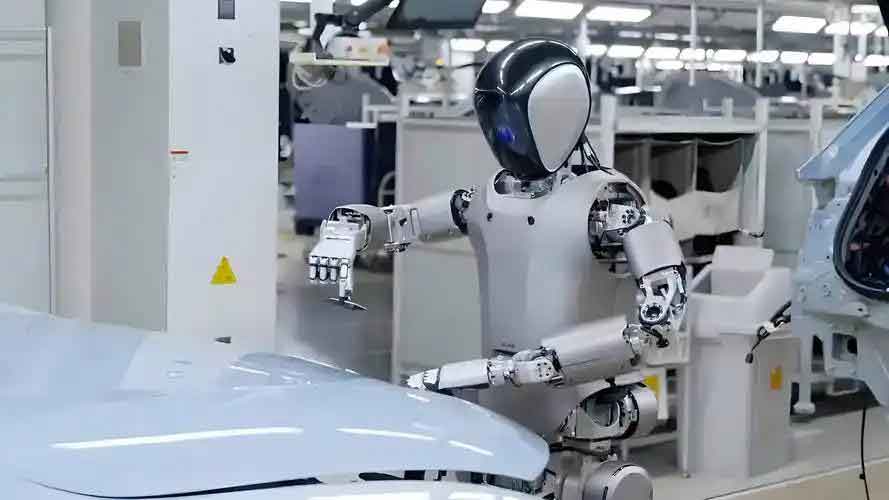
Despite being in a vibrant “adolescent” phase full of potential, the humanoid robot industry still confronts several challenges related to technology, cost, and application validation. Magic Atom, a prominent embodied intelligence technology company based in Suzhou and recognized as a hallmark of the city’s smart manufacturing, produces core hardware encompassing full-joint modules, dexterous hands, reducers, and drivers. Its commercial humanoid robot products include the MagicBot Gen1 (Xiao Mai), designed for industrial production lines and commercial guidance, and the MagicBot Z1, suited for industrial operations, scientific research, education, and commercial services. Both models have entered mass production and are being delivered to customers.
An engineer from Magic Atom, identified as Li Ming, highlighted several industry-wide hurdles. From a technical perspective, a significant challenge is enhancing the generalization capability and universality of humanoid robots within complex, unstructured environments. The goal is for a humanoid robot to perform not only standardized tasks like transporting and sorting items but also to adapt flexibly to a wider spectrum of operational demands. Regarding application scenarios, a common issue across the sector is the relative lack of diversity in deployment settings, coupled with the need for more demonstrable, quantifiable value creation by humanoid robots in those roles. On the commercial front, the humanoid robot models most anticipated for widespread adoption—particularly those targeting industrial manufacturing (especially repetitive or hazardous jobs) and domestic service scenarios—still carry high price tags. This cost barrier means that mass普及 will require further time and technological refinement to achieve economies of scale.
Addressing concerns about humanoid robots displacing human workers, Li Ming offered a forward-looking perspective. “We never regard humanoid robots as ‘replacements’ for humans,” he stated, “but rather as ‘collaborators’.” The overarching vision for the future of humanoid robots is to augment human capabilities and improve overall operational efficiency and quality for client organizations. By taking over monotonous, physically demanding, or dangerous tasks, humanoid robots can free human workers to concentrate on activities requiring creativity, innovation, and strategic thinking—domains where human intelligence excels. Furthermore, humanoid robots are expected to extend the boundaries of human potential, fostering new paradigms of “human-machine collaboration” that will fundamentally reshape production and service models across various industries.
In conclusion, the humanoid robot industry stands at a pivotal juncture. Backed by strong market demand, a robust industrial foundation, academic excellence, and supportive government policies, the sector is poised for sustained growth. While technical and economic challenges remain, the focus on human-robot collaboration promises a future where humanoid robots serve as intelligent partners, driving economic progress and enhancing societal well-being. The continued evolution and integration of humanoid robot technology will undoubtedly play a critical role in shaping the next wave of industrial and social transformation.