
- Global Humanoid Robot Games Showcase Technological Advances
- Supply Chain Expansion: Orders Surge Eightfold Amid Growing Demand
- Domestication of Core Components Exceeds 70%, Industry Scale Projected to Reach 37.9 Billion Yuan
- Cost Reduction in Joint Components: From Tens of Thousands to Hundreds of Yuan
- Leveraging Automotive Industry Expertise for Humanoid Robot Development
- Need for Specialized Core Components Drives In-House Research and Development
- High Costs and Stability Concerns Hinder Widespread Application of Humanoid Robots
- Product Stability and Consistency Emerge as Critical Factors for Humanoid Robot Adoption
- Future Outlook: Emphasizing Stability and Innovation in Humanoid Robot Development
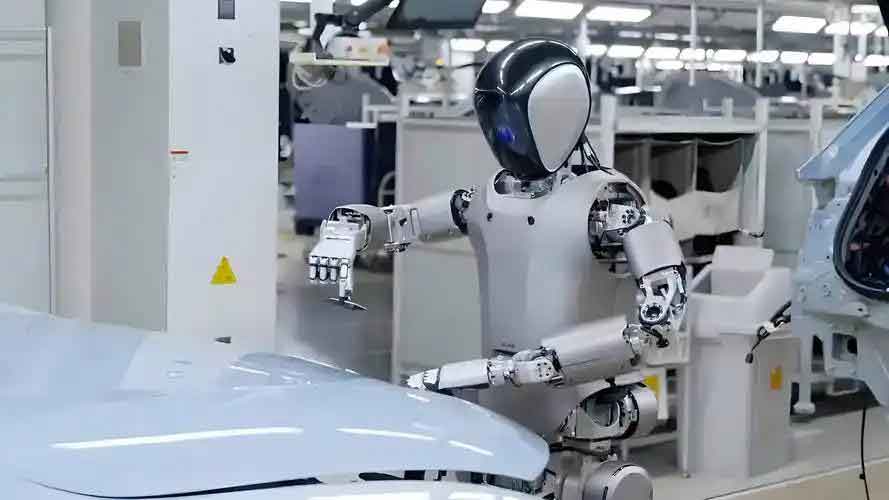
Bending knees, swinging arms, taking off, and landing—these are the most ordinary long jump movements; what is extraordinary is the participant—a humanoid robot. Recently, during the World Humanoid Robot Games, hundreds of humanoid robots demonstrated their capabilities across 26 competition events. This event highlighted the growing sophistication of humanoid robot technology, drawing attention from industry experts and investors worldwide. The performances included a range of activities from athletic contests to complex tasks, underscoring the versatility of these humanoid robot systems. As the humanoid robot sector gains momentum, such events serve as critical platforms for showcasing innovations and fostering collaboration among developers. The increasing participation in these games reflects a broader trend of accelerated development and deployment of humanoid robot solutions in various fields.
The industry’s core component supply chain is becoming increasingly vibrant, with significant growth in order volumes. According to Nie Xiangru, co-founder of Paxini Perception Technology, which specializes in multi-dimensional tactile sensors for robots, this year’s order volume has increased approximately eightfold compared to previous years. He emphasized that without tactile capabilities, humanoid robots cannot perform fine and precise operations, making sensors a crucial element in the advancement of humanoid robot technology. This surge in demand is not isolated; it is part of a larger pattern where companies across the supply chain are experiencing unprecedented growth. The expansion is driven by the need for more reliable and efficient humanoid robot systems, which require a wide array of components, from actuators to control units. As the humanoid robot market evolves, suppliers are scaling up production to meet the rising requirements, ensuring that the infrastructure supports the rapid innovation in this field.
Recent data indicates that the domestic production rate of core components for humanoid robots in China has surpassed 70%, with the industry’s scale expected to exceed 37.9 billion yuan this year. Zhang Qing, Director of the China Association for Science and Technology Enterprise Innovation Service Center, highlighted at the 2025 Enterprise Innovation Integration Event focused on embodied intelligent robot core components that achieving autonomous control and performance breakthroughs in core parts is essential for the stable and progressive development of the embodied intelligent robot industry. This milestone in localization reduces dependency on foreign technology and enhances the competitiveness of the humanoid robot sector. The growth in domestic production capabilities is a result of concerted efforts in research and development, as well as strategic investments in manufacturing infrastructure. As more companies enter the humanoid robot space, the emphasis on core component innovation is expected to drive further advancements, making humanoid robot systems more accessible and affordable globally.
The maturation of the supply chain has led to dramatic cost reductions in key components. Jiang Lei, Chief Scientist at the National-Local Joint Humanoid Robot Innovation Center, provided a striking example: in 2018, finding a joint motor with a torque density of 120 N·m/kg was considered impossible by all motor manufacturers, with 10 N·m/kg being the ceiling. However, by this year, the same metric for humanoid robot joints could exceed 200 N·m/kg. Concurrently, the cost of such joints has plummeted; whereas a single joint might have cost between 50,000 to 60,000 yuan in 2018, it now ranges from 500 to 600 yuan. This cost efficiency is pivotal for the widespread adoption of humanoid robot technology, as it lowers the barrier for entry for developers and end-users. The rapid iteration in component design and manufacturing processes has been instrumental in achieving these price points, enabling more experiments and deployments of humanoid robot applications across diverse sectors.
The progress in the humanoid robot industry is largely indebted to the mature automotive manufacturing sector. As Nie Xiangru noted, automobiles can be viewed as a form of robot, sharing essential elements such as batteries, electronic controls, vision systems, algorithms, models, motors, and peripheral components, all of which are indispensable in the evolution of humanoid robots. The influx of companies like Tesla, XPeng, Nio, and GAC into the humanoid robot arena further validates the technological synergy between robotics and new energy vehicles. This crossover benefits the humanoid robot field by providing established supply chains, advanced manufacturing techniques, and proven safety standards. However, the automotive industry alone cannot fulfill all the requirements for humanoid robots, as these systems demand specialized components tailored to bipedal locomotion and human-like interactions. Thus, while the automotive foundation offers a strong starting point, it necessitates adaptations and innovations specific to humanoid robot designs to achieve optimal performance.
Despite the advantages drawn from other industries, many core components for humanoid robots are still repurposed from existing sectors and are not specifically designed for humanoid robot applications. Chen Jianyu, founder and CEO of Xingdong Jiyuan, emphasized this point during an interview, stating that his company is engaging in in-house research and development to address this gap. He believes that the development of core components for humanoid robots is an ongoing process, hindered by the current scale of the humanoid robot market, which has not yet prompted massive investments from existing component suppliers. Chen advocates for an approach where software guides hardware development, and real-world scenarios inform software design, thereby creating a closed loop to define technology and products before collaborating with ecosystem partners to refine specialized components for humanoid robots. This strategy aims to accelerate the creation of purpose-built parts that enhance the functionality and reliability of humanoid robot systems, ensuring they meet the unique demands of various applications.
Although supply chain costs have decreased significantly, the relatively high price of humanoid robot units remains a major obstacle to broad-based application and scenario development. Zhang Tiejian, Director of the Driving Safety Technology Research Institute at Duolun Technology, which focuses on intelligent driver testing and training as well as smart city construction, explained in a telephone interview that the cost of humanoid robot bodies capable of secondary development for scenario-based applications is still prohibitively high for many enterprises. Duolun Technology recently collaborated with Starward Capital to invest in Zhongqing Robot and establish a Robotics Collaborative Innovation Research Center, aiming to promote the secondary development of humanoid robots in transportation scenarios. Jiang Lei argues that achieving low costs should be treated as a scientific challenge rather than an engineering one, proposing that low-cost intelligent hardware equals embodied intelligence plus core components, enabled by new manufacturing, sensing, and materials technologies. This perspective shifts the focus from mere scaling to innovative design and integration in humanoid robot production.
Beyond cost, issues of product stability and consistency are drawing increased attention from application-side companies. Duolun Technology plans to deploy humanoid robots in intelligent traffic management services and motor vehicle inspection scenarios, but Zhang Tiejian noted that the current stability and safety of humanoid robots still require significant improvement before they can be practically utilized. Ma Yang, General Manager of Tashan Technology, which also specializes in tactile sensor technology, echoed this concern, stating that physical stability failures can lead to irreversible consequences. He observed that the industry has shifted from emphasizing parameter indicators last year to focusing on practical usability this year, indicating that market priorities now center on product reliability and consistent performance in real-world tasks. For tactile sensors, this involves not only training with high-quality underlying data but also ensuring stability and consistency in execution, which are fundamental to the successful operation of humanoid robot systems in dynamic environments.
The humanoid robot industry is at a pivotal juncture, where advancements in core components and cost reductions are paving the way for broader adoption. However, the focus must now shift toward enhancing the stability and consistency of humanoid robot products to meet the rigorous demands of practical applications. As companies like Tashan Technology and Paxini Perception Technology continue to refine their sensor technologies, and as本体 manufacturers invest in specialized components, the humanoid robot ecosystem is expected to mature further. The integration of embodied intelligence with novel manufacturing and materials science will be crucial in driving down costs while improving performance. Ultimately, the success of humanoid robot deployments will depend on a collaborative effort across the supply chain to address these challenges, ensuring that humanoid robots can reliably and safely perform in diverse settings, from industrial automation to personal assistance.
The ongoing evolution of the humanoid robot sector underscores its potential to transform various industries, but realizing this potential hinges on overcoming the dual hurdles of cost and stability. With continued innovation and strategic partnerships, the humanoid robot market is poised for sustained growth, making these machines an integral part of the technological landscape in the coming years. The emphasis on core component development and practical application will be key to unlocking the full capabilities of humanoid robot systems, enabling them to undertake increasingly complex tasks and interact seamlessly with human environments.