
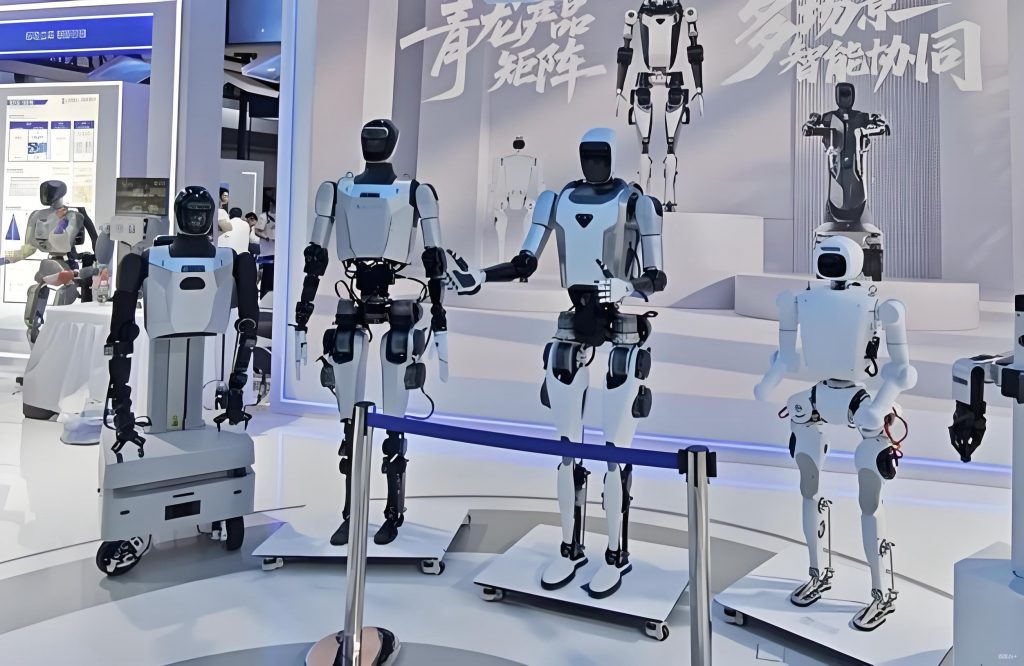
The Fourth Global Digital Trade Expo (GDTE) concluded on September 29, marking a significant milestone in the integration of digital trade and artificial intelligence. This year’s event highlighted the rapid ascent of embodied intelligence and embodied robot technologies, with the artificial intelligence exhibition area doubling in size compared to previous years, accounting for nearly one-third of the total space. According to statistics released by the Hangzhou Municipal Bureau of Commerce, the expo attracted 257,000 visitors, a 28.5% increase from the previous session, and featured 1,812 exhibiting enterprises, up 17.2%. Procurement deals reached 30.9 billion yuan, doubling from last year, with artificial intelligence, cultural exports, and cross-border e-commerce accounting for 82% of orders, and international orders making up 71.5%. This surge underscores the growing practical adoption of embodied intelligence systems across various sectors.
- Robot Band’s Packed Schedule Reflects Embodied Intelligence Boom
- Embodied Intelligence Cleaning Robots Enter the Market
- Data Collection Robots for Industrial Applications
- Policy Support and Industrial Collaboration
- Global Expansion of Embodied Intelligence Technologies
- AI Smart Glasses Gain Popularity
- Drones Expand into Civilian Sectors
- Low-Altitude Economy as a New Frontier
One of the standout attractions at the expo was a robot band, which has become a symbol of the embodied intelligence revolution. These embodied robots, designed to perform music and entertain, have seen their schedules fill up rapidly this year. The team behind these robots, acting as their managers, reported that the machines are in such high demand that they are selectively accepting paid engagements, with many events being turned down due to overflow. For instance, after performing late into the night at Beijing’s Shougang Park, the robot band was immediately transported back to Hangzhou for the GDTE, showcasing the non-stop nature of their engagements. This phenomenon is largely attributed to the viral success of companies like Unitree Robotics, which has propelled the entire embodied robot industry into the spotlight. The embodied intelligence demonstrated by these robots allows them to interact dynamically with their environment, making them ideal for entertainment and beyond. The band’s performances are not just for show; they represent a tangible application of embodied intelligence, where physical entities leverage AI to execute complex tasks in real-world settings. As the industry gains momentum, these embodied robots are evolving from novelty acts into reliable performers, with their controllers optimizing routines based on audience feedback and environmental cues.
In the cleaning sector, a new competitor has emerged: embodied intelligence cleaning robots. Unlike traditional扫地 robots that focus solely on floor surfaces, these advanced embodied robots are capable of performing 3D spatial cleaning, targeting areas like bathrooms in commercial buildings. Star Species, a joint venture, unveiled its first-of-its-kind embodied intelligence cleaning robot at the expo, which has entered small-batch delivery phases. According to Yu Jiping, co-founder of Star Species, this embodied robot utilizes high-temperature treatments and other methods instead of simple wiping, enabling it to handle污渍 intelligently. The goal is for the embodied robot to mimic human-like reasoning, identifying stains and applying appropriate solutions autonomously. Currently, these embodied intelligence systems are aimed at B2B clients, such as office buildings and public restrooms, where they accumulate real-world data to refine their algorithms. The emphasis is on practical iteration rather than immediate sales, with the company seeking open scenarios to enhance performance. This approach aligns with the broader trend of embodied intelligence driving innovation in mundane tasks, reducing labor costs and improving efficiency. The embodied robot has already garnered significant interest, with orders for over 1,600 units and approximately 3 billion yuan in deals, including 200 units预订 by a client from the UAE. As the embodied intelligence ecosystem matures, these robots are poised to redefine cleaning standards, with plans for mass production by next year and ongoing global expansion into markets like Singapore, Japan, South Korea, and Australia.
Another facet of the embodied intelligence wave is seen in industrial data collection robots. A humanoid embodied robot from Shaoxing’s Shangyu District, developed by the Hangzhou Bay Embodied Intelligence Innovation Center, is currently employed for data acquisition in manufacturing environments. This embodied robot is trained to perform tasks such as grabbing, sorting, and packaging, with the potential to achieve autonomous decision-making as it accumulates more data. The innovation center, established in June and backed by local government and industry leaders like Wolong Group and Zhiyuan Robot, focuses on creating a closed-loop system for data collection, storage, training, and application. By selling mature data sets to other manufacturers, the center has already turned a profit, addressing a critical need in the embodied intelligence landscape. The director of the center noted that while the current intellectual capacity of these embodied robots is comparable to a child’s, continuous data ingestion could lead to breakthroughs, necessitating early positioning in the market. This highlights the importance of embodied intelligence in bridging the gap between digital and physical worlds, particularly in industrial settings where precision and adaptability are paramount. The collaboration across the Yangtze Delta region aims to foster innovation, leveraging Zhejiang’s strengths in digital economy and manufacturing to advance embodied robot technologies.
The rise of embodied intelligence and embodied robots has been bolstered by strong policy backing. In 2025, embodied intelligence was included in the Chinese government work report for the first time, becoming a key focus in provincial industrial plans. This has accelerated funding and support for tech innovators, as evidenced by companies like Star Species reporting enhanced access to resources. The embodied intelligence sector, however, remains in its early stages of technological breakthrough and mass production, requiring long-term integration of supply chains and increased participation from upstream and downstream partners. Cross-regional initiatives, such as the Hangzhou Bay Embodied Intelligence Innovation Center, exemplify efforts to overcome regional disparities. While Zhejiang has a head start in certain areas like quadruped robots, it still trails behind Beijing, Shanghai, and Shenzhen, prompting collaborations that pool expertise and resources. The GDTE served as a platform for such synergies, with Chen Weiqing, Deputy Director of the Hangzhou Municipal Bureau of Commerce, emphasizing the expo’s role in facilitating deals that drive the embodied intelligence economy forward. This policy-driven environment encourages practical applications of embodied robots, ensuring that they transition from theoretical concepts to actionable solutions in fields ranging from manufacturing to daily services.
Globalization is a key priority for companies in the embodied intelligence space. Star Species, for instance, is concurrently pursuing international markets while refining its products, targeting regions with high cleanliness standards such as Singapore, Japan, South Korea, and Australia. Similarly, other embodied robot developers are exploring overseas opportunities to scale their innovations. The embodied intelligence framework enables these robots to adapt to diverse environments, leveraging AI to handle varying conditions and requirements. This global push is not limited to cleaning robots; it extends to entertainment, industrial, and consumer applications, reflecting the versatility of embodied intelligence. The success at the GDTE, where international orders constituted a significant portion of deals, underscores the global appetite for embodied robot solutions. As companies accumulate more data from different regions, they can enhance the embodied intelligence of their products, making them more robust and capable. This outward expansion is crucial for establishing China’s leadership in the embodied intelligence domain, moving from a follower to a pioneer in certain niches, as seen with AI smart glasses and drones.
Beyond embodied robots, AI-powered smart glasses have witnessed unprecedented demand, further illustrating the breadth of embodied intelligence applications. Rokid, a brand specializing in AI glasses, reported selling 40,000 units of its Glass series in the first five days of pre-sales starting September 1, with deliveries scheduled for late October. Originally focused on entertainment, Rokid pivoted to include displays in its glasses, capitalizing on the market ignited by Meta. This move positioned the Chinese brand ahead of competitors, as Meta plans to launch its first high-end smart glasses with built-in displays on September 30, 2025. The embodied intelligence in these glasses enables functions like translation and is being expanded to more life-oriented scenarios, with iterations aimed at lightweight design and enhanced usability. However, supply chain challenges, particularly shortages of imported chips, pose constraints on production. The popularity of these devices highlights how embodied intelligence is permeating consumer electronics, offering intuitive interactions that blend digital and physical experiences. As Rokid continues to refine its offerings based on market feedback, it exemplifies the rapid iteration characteristic of the embodied intelligence sector, where practical utility drives adoption.
Drones, as flying embodiments of intelligent systems, are also gaining traction in civilian applications. Companies like Linzhou (Ningbo) Technology Co. are extending their drone and tethered aerostat technologies to areas such as weather monitoring, maritime patrol, and search and rescue. These embodied intelligence systems provide prolonged support in emergencies, leveraging advanced flight control and customization capabilities. Another notable player, Zhongce Aviation Technology (Zhejiang) Co., launched a heavy-lift drone in August capable of carrying 150 kg, a rarity in the market. This embodied robot can be equipped with firefighting bombs, water guns, window breakers, and loudspeakers, making it suitable for消防 and rescue operations. Within a month, the company secured hundreds of orders and established over 200 dealerships nationwide, projecting revenues to reach billions by year-end. Plans are underway to develop even larger payload capacities. The low-altitude economy, highlighted at the GDTE, is emerging as a battleground for new productive forces, with China hosting 1,400整机 enterprises in low-altitude equipment and numerous drones and eVTOLs in development. However, as Professor Liu Daxiang from Beihang University pointed out, China’s general aircraft count is only 2% of that in the U.S., calling for focused efforts on core technologies like new energy power systems and integrated air-ground networks to prioritize scenarios such as emergency response and public services.
The low-altitude economy represents a promising frontier for embodied intelligence, with drones and other aerial systems serving as key enablers. At the GDTE’s low-altitude economy对接会, experts emphasized the need to address technical bottlenecks and build comprehensive safety frameworks to facilitate the adoption of embodied robots in this domain. The embodied intelligence in these systems allows for autonomous navigation and real-time data processing, critical for applications like disaster relief and logistics. For instance, drones capable of long-endurance flights can provide communication support in remote areas, while heavy-lift models can transport essential supplies. The growth in this sector is fueled by policy initiatives and increasing investment, with the embodied intelligence community collaborating to standardize operations and ensure reliability. As these technologies mature, they are expected to unlock new economic opportunities, reducing costs and enhancing service delivery in urban and rural settings. The integration of embodied intelligence into low-altitude platforms underscores the trend toward practical, scalable solutions that address real-world challenges, from environmental monitoring to infrastructure maintenance.
In summary, the embodied intelligence and embodied robot industry in China is experiencing a transformative shift from viral trends to substantive applications. Events like the GDTE demonstrate the widespread enthusiasm for these technologies, driven by policy support, cross-sector collaboration, and a focus on real-world data collection. Companies are moving quickly to capitalize on this momentum, with embodied robots appearing in entertainment, cleaning, industrial, and civilian roles. The repeated emphasis on embodied intelligence across these domains highlights its role as a cornerstone of modern AI development, enabling machines to interact meaningfully with their surroundings. As the industry continues to evolve, the focus will remain on refining embodied intelligence capabilities, expanding global footprints, and addressing supply chain challenges to ensure sustainable growth. The journey from internet sensation to practical tool is well underway, positioning China as a key player in the global embodied intelligence landscape.
| Robot Type | Primary Application | Key Data/Orders |
|---|---|---|
| Robot Band | Entertainment and Performances | Fully booked schedules, selective paid engagements |
| Cleaning Robot | 3D Spatial Cleaning in B2B Settings | Over 1,600 units ordered, approximately 3 billion yuan in deals, including 200 units for UAE client |
| Data Collection Robot | Industrial Manufacturing and Training | Profitable data sales, focus on autonomous task execution |
| AI Smart Glasses | Consumer Electronics and Life Scenarios | 40,000 units pre-sold in five days, supply chain challenges with chips |
| Heavy-Lift Drone | Firefighting, Search and Rescue | Hundreds of orders, 200+ dealerships, projected billion-yuan revenue by year-end |
The embodied intelligence revolution is not just about technological prowess; it is about creating systems that learn and adapt, much like humans. This embodied robot ecosystem thrives on continuous improvement, with each iteration bringing us closer to seamless human-machine collaboration. As embodied intelligence becomes more embedded in everyday life, its potential to drive economic growth and societal benefits will only expand, solidifying its status as a pillar of the digital age.