
In recent years, parallel intelligent robots have emerged as a pivotal research direction in robotics, with the Stewart platform standing out as a quintessential example due to its versatility and high performance. This article delves into the structural characteristics, classification, and diverse applications of Stewart-based intelligent robots, emphasizing their role in motion simulation and vibration control. By integrating advanced mathematical models, control strategies, and empirical data, we explore how these systems address complex engineering challenges. The discussion extends to future trends, underscoring the potential for intelligent robots to revolutionize high-precision industries.
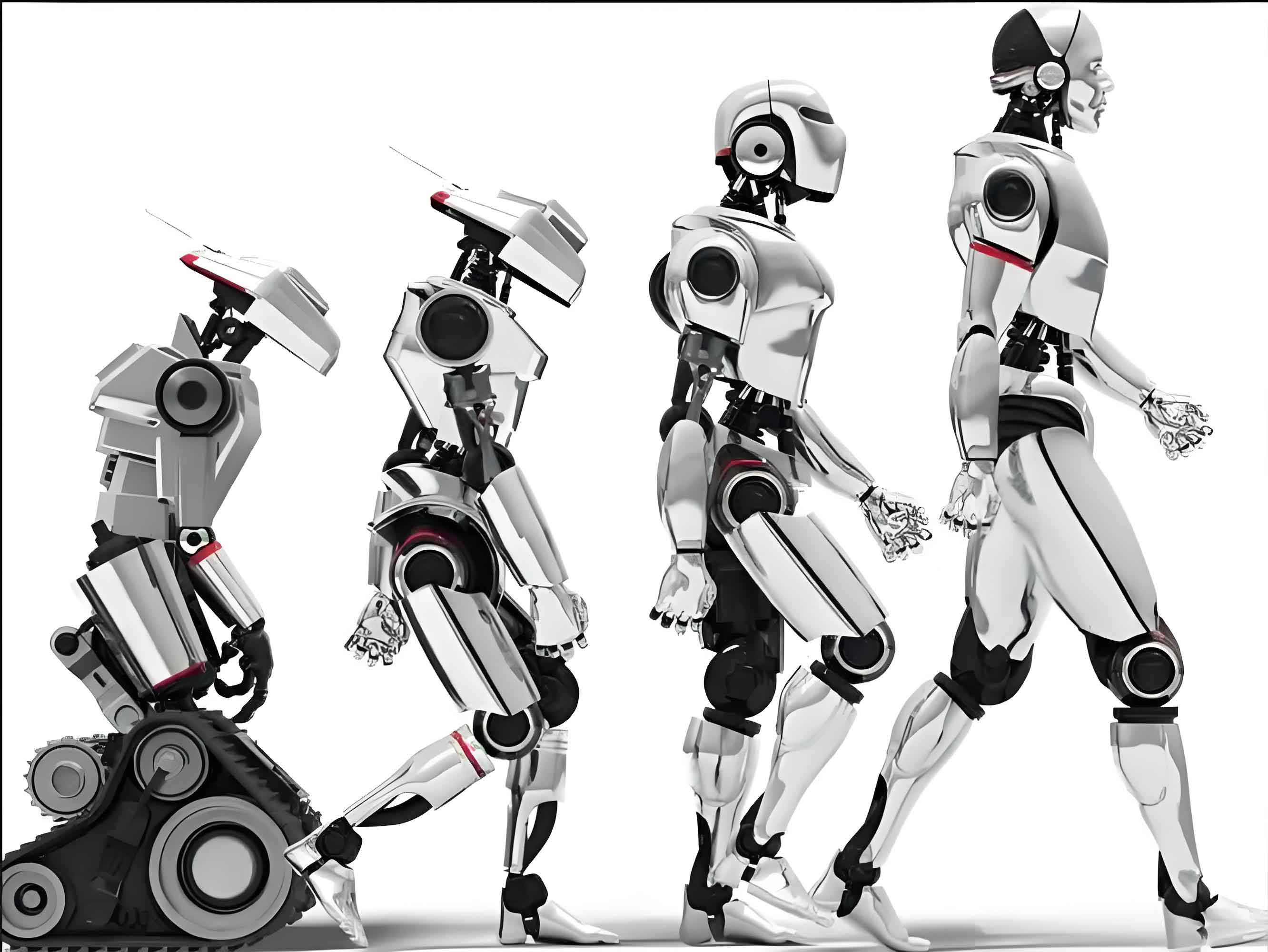
The Stewart platform, a six-degree-of-freedom (6-DOF) parallel mechanism, consists of a fixed base and a movable platform connected by six independently actuated legs. This configuration enables precise control over translational and rotational movements, making it ideal for applications requiring high stiffness, accuracy, and dynamic response. The inverse kinematics of the Stewart platform can be expressed as:
$$ l_i = \sqrt{(x – x_{bi})^2 + (y – y_{bi})^2 + (z – z_{bi})^2} $$
where \( l_i \) is the length of the i-th leg, \( (x, y, z) \) represents the position of the moving platform, and \( (x_{bi}, y_{bi}, z_{bi}) \) denotes the coordinates of the base attachment points. This equation highlights the deterministic nature of inverse kinematics, which simplifies control compared to serial robots. However, forward kinematics involves solving nonlinear equations, often requiring iterative methods like Newton-Raphson, which can be computationally intensive:
$$ f(\mathbf{q}) = \mathbf{0} $$
where \( \mathbf{q} \) is the pose vector of the moving platform. The dynamics of the Stewart platform are governed by the Lagrangian formulation, accounting for mass distribution and external forces:
$$ \frac{d}{dt} \left( \frac{\partial L}{\partial \dot{\mathbf{q}}} \right) – \frac{\partial L}{\partial \mathbf{q}} = \boldsymbol{\tau} $$
Here, \( L \) is the Lagrangian, \( \mathbf{q} \) the generalized coordinates, and \( \boldsymbol{\tau} \) the generalized forces. This model facilitates the design of controllers for intelligent robots, ensuring stability and precision in dynamic environments.
Classification of Stewart Intelligent Robots
Stewart intelligent robots can be categorized based on driving mechanisms, structural configurations, and control objectives. Each category influences the system’s performance, such as load capacity, bandwidth, and accuracy, as summarized in Table 1.
| Driving Type | Actuator Examples | Advantages | Disadvantages | Typical Applications |
|---|---|---|---|---|
| Smart Material-Driven | Piezoelectric (PZT), Magnetostrictive (Terfenol-D) | Nanometer resolution, kHz frequency response | Limited stroke, high cost | Micro-vibration suppression in aerospace |
| Mechanical Transmission | Ball screws, Hydraulic cylinders | High load capacity, large workspace | Lower bandwidth, friction issues | Industrial robotics, heavy-duty machining |
| Electromagnetic | Voice coil actuators, Magnetorheological fluids | Fast response, high precision | Sensitivity to thermal effects | Satellite pointing systems, precision optics |
Structural configurations further define the capabilities of intelligent robots. Common variants include symmetric 6-6 designs, which offer isotropic stiffness, and asymmetric layouts that optimize specific DOFs. For instance, a 3-3 Stewart platform reduces coupling but may sacrifice workspace volume. The Jacobian matrix \( \mathbf{J} \) relates leg velocities to platform velocities:
$$ \dot{\mathbf{l}} = \mathbf{J} \dot{\mathbf{q}} $$
where \( \dot{\mathbf{l}} \) is the vector of leg velocities. Condition number of \( \mathbf{J} \) serves as a measure of dexterity; values close to 1 indicate optimal performance. Non-dimensional analysis of workspace volume \( V \) can be expressed as:
$$ V = \int_{\Omega} d\mathbf{q} $$
where \( \Omega \) represents the feasible pose space. Control objectives for intelligent robots bifurcate into trajectory tracking and vibration suppression. Trajectory control often employs PID or adaptive algorithms:
$$ u(t) = K_p e(t) + K_i \int e(t) dt + K_d \frac{de(t)}{dt} $$
where \( u(t) \) is the control input and \( e(t) \) the tracking error. For vibration isolation, \( H_\infty \) control minimizes the transfer function norm from disturbances to outputs, enhancing robustness.
Applications in Motion Simulation
Stewart intelligent robots excel in simulating realistic motion environments for training and testing. In flight simulators, they replicate aircraft attitudes with high fidelity. The equations of motion for a simulated aircraft can be integrated with platform kinematics to generate real-time poses. For example, the rotation matrix \( \mathbf{R} \) from body to inertial frame is used to compute leg lengths:
$$ \mathbf{l} = f(\mathbf{R}, \mathbf{p}) $$
where \( \mathbf{p} \) is the translational vector. Table 2 compares performance metrics across different simulator types.
| Simulator Type | Workspace Volume (m³) | Max Acceleration (m/s²) | Bandwidth (Hz) | Application Examples |
|---|---|---|---|---|
| Flight Simulator | 10-50 | 15-30 | 5-100 | Pilot training, emergency scenario replication |
| Driving Simulator | 5-20 | 10-20 | 1-50 | Vehicle dynamics testing, NVH analysis |
| Marine Simulator | 15-60 | 5-15 | 0.1-20 | Ship maneuver simulation, wave compensation |
In precision machining, Stewart platforms serve as parallel kinematics machines (PKMs), offering advantages over serial counterparts. The error model for a PKM can be derived using differential kinematics:
$$ \delta \mathbf{l} = \mathbf{J} \delta \mathbf{q} + \mathbf{H} \delta \mathbf{\theta} $$
where \( \delta \mathbf{\theta} \) represents geometric errors. Minimizing these errors through calibration enhances accuracy. For satellite antenna positioning, intelligent robots achieve sub-arcsecond precision by solving the inverse kinematics in real-time. The pointing error \( \epsilon \) is modeled as:
$$ \epsilon = \| \mathbf{q}_{desired} – \mathbf{q}_{actual} \| $$
which is minimized using feedback control loops. These applications demonstrate the adaptability of intelligent robots in high-stakes environments.
Applications in Vibration Control
Vibration suppression is critical in aerospace and automotive industries, where Stewart intelligent robots provide multi-DOF isolation. For spacecraft, micro-vibrations from reaction wheels can degrade optical performance. The transfer function \( G(s) \) from disturbance \( d(s) \) to output \( y(s) \) is minimized using active control:
$$ y(s) = G(s) d(s) $$
An \( H_\infty \) controller design ensures stability while attenuating disturbances across a broad frequency range. The cost function is:
$$ \min \| W(s) G(s) \|_\infty $$
where \( W(s) \) is a weighting function. Table 3 lists vibration isolation performance for different configurations.
| Application Domain | Frequency Range (Hz) | Attenuation (dB) | Control Strategy | Key Challenges |
|---|---|---|---|---|
| Spacecraft Micro-vibration | 0.1-100 | 20-40 | Active damping with piezoelectric actuators | Coupling between DOFs, thermal stability |
| Vehicle Seat Suspension | 1-30 | 10-25 | Semi-active control with magnetorheological dampers | Nonlinear dynamics, passenger comfort |
| Vibration Testing Systems | 0.5-200 | 15-35 | Multi-axis random vibration control | Real-time data acquisition, signal processing |
In automotive applications, Stewart platforms isolate seats from road-induced vibrations. The equation of motion for a seat suspension system is:
$$ m \ddot{z} + c \dot{z} + k z = f_{disturbance} $$
where \( m \), \( c \), and \( k \) are mass, damping, and stiffness, respectively. Skyhook control algorithms improve comfort by emulating a fixed reference frame:
$$ f_{control} = -c_{sky} \dot{z} $$
For vibration testing, intelligent robots replicate environmental conditions by solving inverse dynamics to generate required actuator forces. The power spectral density (PSD) of the output is matched to reference profiles, ensuring accurate simulation of real-world conditions.
Future Trends and Conclusions
The evolution of Stewart intelligent robots is poised to integrate artificial intelligence and machine learning for enhanced autonomy. Adaptive control algorithms, such as model reference adaptive systems (MRAS), will enable real-time parameter tuning:
$$ \dot{\mathbf{\theta}} = -\Gamma \mathbf{e} \mathbf{\phi} $$
where \( \mathbf{\theta} \) are adjustable parameters, \( \Gamma \) a gain matrix, \( \mathbf{e} \) the error, and \( \mathbf{\phi} \) the regressor vector. Additionally, digital twin technology will facilitate virtual commissioning and predictive maintenance, reducing downtime. The continued miniaturization of actuators and sensors will expand applications in medical robotics and nanotechnology.
In summary, Stewart parallel intelligent robots represent a cornerstone of modern robotics, offering unparalleled precision and adaptability. Their ability to perform complex tasks in motion simulation and vibration control underscores their importance in advancing industrial automation. As research progresses, these intelligent robots will undoubtedly unlock new frontiers, driven by innovations in materials, control theory, and computational intelligence.