
In recent years, hydraulic quadruped robots, often referred to as robot dogs, have gained significant attention for their ability to perform complex tasks in unstructured environments. These quadruped robots leverage hydraulic actuation to achieve high power-to-weight ratios, making them suitable for applications such as rescue operations, object manipulation, and industrial tasks. However, controlling the dynamic contact forces during interactions with the environment remains a challenge due to the nonlinearities in multiple hydraulic joint systems. In this study, we propose an interactive force control strategy that utilizes a floating base operation through force control. This approach transforms base motion, robot end-effector motion, leg motion, interactive force control, joint constraints, and friction cone constraints into a quadratic programming optimization problem. Task priorities are adjusted via a weight matrix, and robot tasks are decomposed under position constraints to resolve conflicts between interactive force control and optimal control based on dynamic models. This enables coordinated motion and force control at the robot’s end-effector. Through simulations and experiments, we validate the effectiveness of our control strategy, demonstrating that hydraulic quadruped robots can handle large payloads while maintaining appropriate contact forces during interactive operations.
The control of quadruped robots involves addressing multiple degrees of freedom and nonlinear dynamics, particularly in hydraulic systems. Traditional methods often focus on motion tracking in free space, but for tasks requiring physical interaction, such as pushing or manipulating objects, force control becomes crucial. Our work builds on existing research by integrating force feedback and optimization-based control to enhance the performance of robot dogs in contact-rich environments. The key innovation lies in the formulation of a multi-task optimization framework that balances various objectives, including stability, force accuracy, and joint limits. This paper is structured as follows: First, we present the theoretical modeling of the quadruped robot, including coordinate systems and contact dynamics. Next, we detail the control methodology, emphasizing the quadratic programming approach. Finally, we discuss simulation and experimental results that highlight the robustness and efficiency of our strategy.
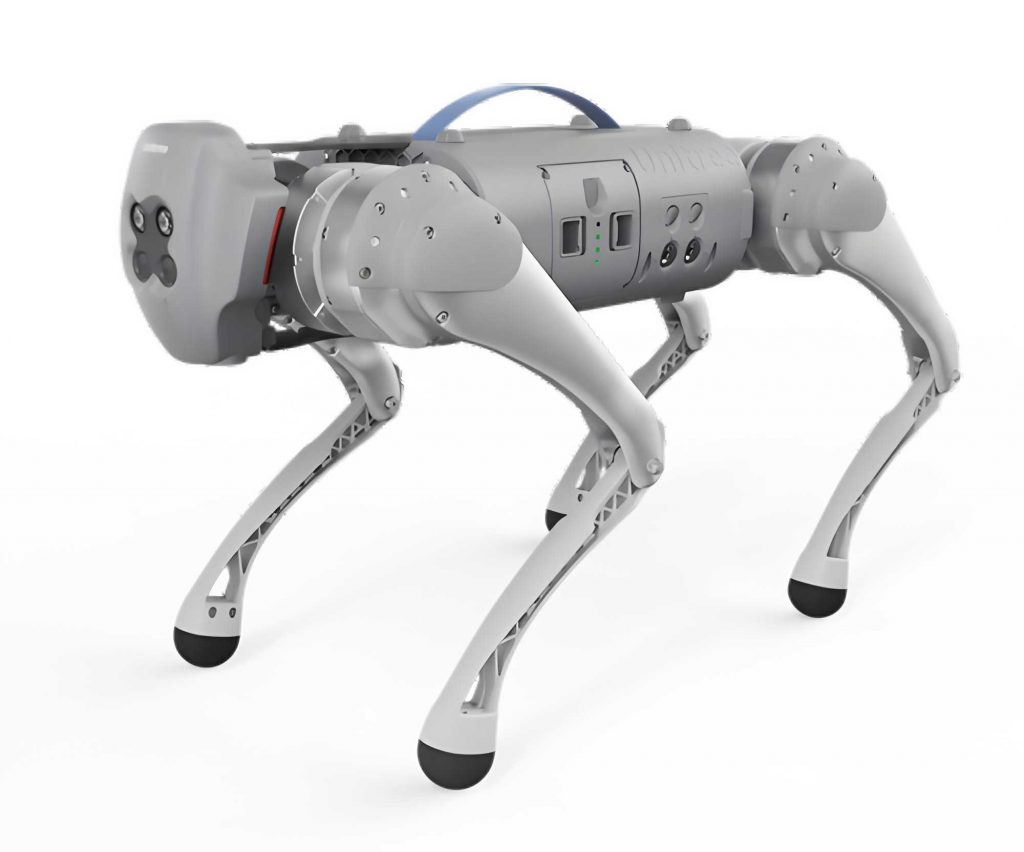
To model the hydraulic quadruped robot, we define a global coordinate system {I} = {O_I, x_I, y_I, z_I}, where O_I is an arbitrary origin, and the axes are unit vectors with z_I opposing the gravity vector. The robot’s base coordinate system {R} = {O_R, x_R, y_R, z_R} is attached to the center of mass (CoM), with x_R pointing in the forward direction. The end-effector coordinate system {E} = {O_E, x_E, y_E, z_E} is located at the point of interaction. The distance vectors, such as r from the CoM to the contact point and h from the robot to the object, are critical for kinematic calculations. The floating base of the quadruped robot allows for independent motion relative to the ground, enhancing adaptability on uneven terrain. We represent the generalized coordinates as q = [q_b^T, q_j^T]^T, where q_b ∈ ℝ^{n_b} denotes the virtual degrees of freedom for the base (position and orientation), and q_j ∈ ℝ^{n_j} represents the joint degrees of freedom. This formulation facilitates the description of the robot’s dynamics and interactions.
The contact model for the quadruped robot involves interactions with rigid surfaces, common in industrial tasks like polishing or welding. The vector h_e describes the pose of the end-effector relative to the target object in {I}, and h_l = [h_{l1}^T, h_{l2}^T, h_{l3}^T, h_{l4}^T]^T represents vectors from the CoM to the support points of the legs. The contact force at O_E is f_e, and the forces on the support legs are f_l = [f_{l1}^T, f_{l2}^T, f_{l3}^T, f_{l4}^T]^T. The velocity mapping from the contact point to the CoM is given by:
$$ \dot{h}_e = J_e \dot{q} $$
where J_e ∈ ℝ^{6 × (n_b + n_j)} is the Jacobian matrix relating generalized velocities to end-effector velocities. For a rigid planar environment, we impose constraints to prevent separation and limit interaction forces. These constraints are holonomic and can be expressed as:
$$ S_e \dot{h}_e = 0 $$
Here, S_e ∈ ℝ^{n_c × 6} is a selection matrix that defines the constrained directions of motion, with n_c being the number of constrained degrees of freedom. By differentiating the constraints, we derive the equations for free motion and constrained motion, which are essential for the control strategy. The leg contact constraints ensure no slipping during support, formulated as:
$$ S_l \dot{h}_l = S_l J_l \dot{q} = J_l^c \dot{q} = 0 $$
where J_l^c = S_l J_l ∈ ℝ^{3n_s × (n_b + n_j)} is the support leg Jacobian, and n_s is the number of support legs. The dynamics of the floating base system in {I} are described by:
$$ M \ddot{q} + C \dot{q} + g = S_\tau^T \tau + J_l^{cT} f_l + J_e^{cT} f_e $$
In this equation, M ∈ ℝ^{(n_b + n_j) × (n_b + n_j)} is the mass matrix, C ∈ ℝ^{(n_b + n_j) × (n_b + n_j)} represents Coriolis and centrifugal forces, g ∈ ℝ^{(n_b + n_j)} is the gravity vector, τ ∈ ℝ^{n_j} is the joint torque vector, and S_τ = [0_{n_b × n_j}, I_{n_j × n_j}]^T ∈ ℝ^{n_j × (n_b + n_j)} is the actuator selection matrix. This dynamic model forms the basis for our control optimization.
Our control strategy for the hydraulic quadruped robot focuses on achieving precise force and motion control through a quadratic programming framework. The decision variables are defined as ξ = [τ^T, f_e^T, f_l^T]^T ∈ ℝ^{n_j + n_c + 3n_s}, which include joint torques, contact forces, and leg forces. The task outputs encompass base motion p_b ∈ ℝ^{n_b}, joint motion q_j ∈ ℝ^{n_j}, end-effector contact force f_e ∈ ℝ^{n_c}, end-effector free motion p_ef ∈ ℝ^{6 – n_c}, and swing leg motion p_lf ∈ ℝ^{3(4 – n_s)}. These are combined into a vector δ = [p_b^{T}, q_j^{T}, f_e^{T}, p_ef^{T}, p_lf^{T}]^T. The desired system output δ* is designed based on motion and force control laws, such as proportional-derivative (PD) controllers for motion tasks and proportional control for force tasks. For instance, the desired acceleration for motion tasks is:
$$ \ddot{p}_m = \ddot{p}_m^d + K_{pm}(p_m^d – p_m) + K_{dm}(\dot{p}_m^d – \dot{p}_m) $$
where m denotes the task type (e.g., base, joint, end-effector, or swing leg), and K_{pm} and K_{dm} are diagonal gain matrices. For force control, we use:
$$ f_e = f_e^d + K_{pf}(f_e^d – f_e) $$
with K_{pf} ∈ ℝ^{n_c × n_c} as the proportional gain matrix. The optimization problem minimizes the deviation between actual and desired outputs while satisfying constraints:
$$ \min_{\xi} (\delta – \delta^*)^T W (\delta – \delta^*) + \xi^T S \xi $$
subject to:
$$ J^c \ddot{q} + \dot{J}^c \dot{q} = 0 $$
$$ \underline{d} \leq H \xi \leq \overline{d} $$
Here, W ∈ ℝ^{(n_b + n_j – 3n_s + 18) × (n_b + n_j – 3n_s + 18)} is a weight matrix that prioritizes tasks, S ∈ ℝ^{(n_j + n_c + 3n_s) × (n_j + n_c + 3n_s)} is a torque-weight matrix for regularization, J^c = [J_e^{cT}, J_l^{cT}]^T ∈ ℝ^{(n_c + 3n_s) × (n_b + n_j)} is the stacked Jacobian for constraints, and H ∈ ℝ^{(n_j + 3n_s) × (n_j + n_c + 3n_s)} defines inequality constraints for friction and joints. The matrices A and B relate δ to ξ through δ = Aξ + B, where A and B are derived from the dynamics and kinematic equations.
Inequality constraints are critical for ensuring stability and feasibility. Friction constraints for the support legs are modeled using a friction cone approximation:
$$ |f_{x_{li}}| \leq \mu_i f_{z_{li}} $$
$$ |f_{y_{li}}| \leq \mu_i f_{z_{li}} $$
$$ f_{i_{\min}} \leq f_{z_{li}} \leq f_{i_{\max}} $$
where μ_i is the friction coefficient for leg i, and f_{i_{\min}} and f_{i_{\max}} are the minimum and maximum normal forces. These can be written in matrix form as d_f ≤ H_f ξ ≤ d_f, where H_f includes coefficients for the friction constraints. Joint constraints ensure that joint angles and torques remain within limits, expressed as d_j ≤ H_j ξ ≤ d_j, with H_j derived from the driven part of the dynamics. For example, the joint acceleration limits are computed using Taylor series expansion:
$$ \ddot{q}_j \approx \frac{2}{\Delta t^2} (q_j – q_{j0} – \dot{q}_j \Delta t) $$
where Δt is the control time step. This allows us to enforce joint limits effectively during optimization.
To validate our control strategy, we conducted simulations and experiments on a hydraulic quadruped robot platform. The robot dog features three active degrees of freedom per leg, driven by hydraulic cylinders controlled via servo valves, with displacement and force sensors for feedback. The manipulator arm has five active joints without joint force sensors, but a six-axis force sensor is mounted at the end-effector. Key parameters of the quadruped robot are summarized in Table 1.
| Parameter | Value |
|---|---|
| Body Mass m_b (kg) | 139.6 |
| Body Length L_b (m) | 1.203 |
| Body Width W_b (m) | 0.630 |
| Leg Mass m_1 (kg) | 14.3 |
| Upper Leg Length L_0 (m) | 0.036 |
| Middle Leg Length L_1 (m) | 0.4 |
| Lower Leg Length L_2 (m) | 0.4 |
| Manipulator Mass m_a (kg) | 31.5 |
| First Link D_0 (m) | 0.169 |
| Second Link D_1 (m) | 0.500 |
| Third Link D_2 (m) | 0.365 |
| Fourth Link D_3 (m) | 0.262 |
In simulations, we tested scenarios such as fixed contact force application and pushing objects during trotting gait. The control algorithm ran at 250 Hz, and the quadratic optimization problem was solved using the qpOASES solver. The weight matrix W was set to diag[W_b, W_j, W_f, W_e, W_li] to adjust task priorities, as detailed in Table 2. For example, W_b = diag(2, 12, 15, 5, 8, 10) for base motion, and W_f = diag(20) for contact force tasks. The torque-weight matrix S was diag[I_{n_j × n_j}, 0_{(n_c + 3n_s) × (n_c + 3n_s)}] to minimize joint efforts. Gain matrices for PD controllers were tuned based on trajectory tracking performance.
| Task | Value |
|---|---|
| Base Motion W_b | diag(2, 12, 15, 5, 8, 10) |
| Joint Motion W_j | diag(0.1, …, 0.1) |
| Contact Force W_f | diag(20) |
| End-Effector Free Motion W_e | diag(1, 1, 1, 1, 1) |
| Swing Leg Motion W_li | diag(0.6, 0.6, 0.6) |
In one simulation, the quadruped robot applied a fixed contact force to a target object. The desired force was set to 10 N initially, increased to 40 N at time t_1, and returned to 10 N at t_2. The actual contact force tracked the desired values closely, demonstrating the robot’s ability to modulate forces through base motion. The foot forces in the x and z directions adjusted accordingly, with the front legs reducing normal force and the rear legs increasing it to maintain balance. This highlights the coordination between force control and base dynamics in the robot dog.
Another simulation involved the quadruped robot executing a standing gait while following a circular trajectory with an 8 cm radius and applying a constant 10 N force. The actual force converged rapidly to the desired value, and the end-effector accurately tracked the circular path in unconstrained directions. This shows that the control strategy effectively decomposes tasks into force and motion subspaces, avoiding conflicts. For comparison, we tested a position-based control approach without force feedback, which resulted in force fluctuations up to 10 N due to base movements and environmental uncertainties. This underscores the necessity of our force control method for precise interactions in mobile manipulation.
During trotting gait, the hydraulic quadruped robot pushed a 20 kg object with a friction coefficient of 0.6. The desired contact force was set to 135 N initially to overcome static friction and reduced to 125 N once the robot reached a velocity of 0.3 m/s. The actual force maintained consistency with minor oscillations caused by torso vibrations during locomotion. The robot’s velocity in the x-direction gradually increased to 0.5 m/s, indicating successful object pushing. The force control ensured that the object was moved without damage, even under dynamic conditions. These simulations confirm that our strategy enables quadruped robots to perform large-payload operations while controlling contact forces effectively.
Experiments on the physical hydraulic quadruped robot platform further validated our approach. The control system utilized a NI cRIO-9039 onboard computer with a 1 kHz bandwidth, and hydraulic circuits were controlled with a switch time of 0.1 s. Sensors provided filtered data at 150 Hz cutoff frequency. In one test, the robot dog grasped a handle and applied a 42 N force in the x-direction while performing a dynamic gait. The actual contact force exhibited periodic fluctuations due to discrete foot placements and torso vibrations, but it overall matched the desired force profile. The robot’s velocity in the x-direction increased steadily, achieving slow acceleration of the object, while the y-direction velocity remained near zero. This demonstrates the practical feasibility of our control strategy in real-world scenarios for quadruped robots.
In conclusion, our proposed force control strategy for hydraulic quadruped robots addresses the challenges of nonlinear hydraulic joint systems through a quadratic programming-based optimization framework. By decomposing tasks under position constraints and integrating direct force feedback, we achieve coordinated motion and force control at the end-effector. Simulations and experiments show that the robot dog can handle large payloads and maintain appropriate contact forces during interactive operations, such as pushing objects in various gaits. The use of a floating base allows for force modulation without requiring force control in multiple manipulator joints, leveraging the robot’s structural redundancy. Future work could focus on enhancing robustness to external disturbances and extending the approach to more complex environments. Overall, this research contributes to the advancement of hydraulic quadruped robots in applications demanding precise force interaction.
The effectiveness of our method is further highlighted by its ability to handle dynamic interactions, making it suitable for real-world tasks where robot dogs must adapt to varying loads and surfaces. The integration of optimization with force control ensures that the quadruped robot remains stable and efficient, even under significant external forces. As quadruped robots continue to evolve, strategies like ours will play a crucial role in enabling them to perform sophisticated manipulation tasks alongside locomotion, bridging the gap between mobile and industrial robotics.