
In recent years, the study of quadruped robots has gained significant attention in the field of robotics due to their adaptability to various terrains and potential applications in exploration, surveillance, and rescue operations. As a researcher focused on robotic mechanisms and control technologies, I embarked on a project to design and simulate a quadruped robot dog, leveraging compound cycloid trajectories for gait planning to achieve stable and efficient locomotion. This article details the comprehensive process, from mechanical design and material selection to kinematic analysis and simulation in MATLAB, emphasizing the use of tables and equations to summarize key aspects. The quadruped robot dog, with its 12 degrees of freedom, was modeled in SOLIDWORKS and integrated into a MATLAB-based simulation environment for multi-body contact force feedback and gait control. Through inverse kinematics and optimized compound cycloid gait planning, I successfully implemented a simulation that demonstrates stable walking, highlighting the importance of precise parameter tuning and trajectory optimization for real-world applications of quadruped robots.
The development of quadruped robots, often referred to as robot dogs, has evolved rapidly, with advancements in stability, load-bearing capacity, and terrain adaptability. Unlike bipedal or wheeled robots, quadruped robots offer a balanced combination of simplicity and robustness, making them ideal for navigating complex environments. In this study, I focused on a lightweight quadruped robot dog design, utilizing ABS material for its excellent mechanical properties, such as high impact strength and resistance to environmental factors. The selection of components, including DS3230 servos for joint actuation and a Raspberry Pi 4B as the control system, was based on rigorous analysis to ensure reliability and performance. The robot dog’s leg configuration, specifically an all-elbow type, was chosen to facilitate smooth gait transitions and enhance stability during motion. This design approach aligns with bio-inspired principles, mimicking the natural movement of canine legs to achieve efficient locomotion in the quadruped robot.
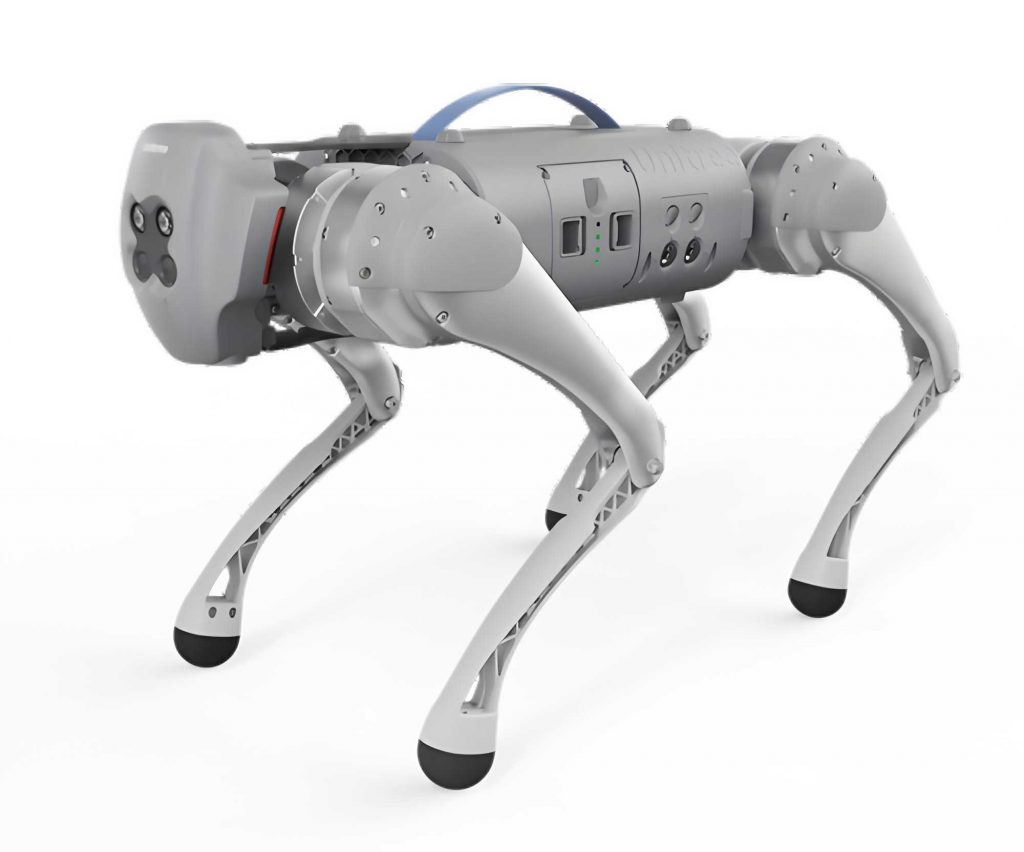
To build the quadruped robot dog model, I began with mechanical design in SOLIDWORKS, creating a detailed 3D representation of the robot’s structure. The model included 12 degrees of freedom, distributed across shoulder and knee joints, allowing for movements such as side swaying, leg lifting, and directional changes. After defining the joint axes and parameters, I exported the model as a URDF file, which was then imported into MATLAB’s Simulink environment for simulation. This process involved generating a physical mesh and integrating modules for position, rotation, and ground contact. The multi-body contact force feedback was implemented using the Simscape Multibody Contact Forces Library, where I configured sphere-to-plane contact parameters, such as stiffness and damping, to simulate realistic interactions between the robot dog’s feet and the ground. This setup enabled me to visualize and optimize the contact forces, ensuring that the quadruped robot could maintain balance during gait cycles. The integration of these components formed a robust simulation framework for testing and refining the robot dog’s locomotion.
Kinematic analysis was crucial for controlling the servo motors in the quadruped robot dog’s legs. I derived inverse kinematics equations to determine the joint angles required for specific foot trajectories. For instance, in the yoz plane view, the angle ∠gamma was calculated based on the projections of leg segments and their relationships. The equations are summarized as follows: ∠gamma_yz is given by $$ \angle \text{gamma\_yz} = -\arctan\left(\frac{y}{z}\right) $$, where y and z are coordinates in the negative direction. Then, ∠gamma_h_offset is computed as $$ \angle \text{gamma\_h\_offset} = \arctan\left(\frac{z_h}{l_{yz}}\right) $$, where z_h is the shoulder joint length and l_{yz} is the projection length. Finally, ∠gamma is obtained by $$ \angle \text{gamma} = \angle \text{gamma\_yz} – \angle \text{gamma\_h\_offset} $$. Similarly, in the xoz’ plane, the angle α was derived using parameters like thigh length h_u, shank length h_l, and projection l_{xz’}. The value n is given by $$ n = \frac{l_{xz’}^2 – h_l^2 – h_u^2}{2h_u} $$, and β is calculated as $$ \beta = -\arccos\left(\frac{n}{h_l}\right) $$. The angles α1 and α2 are $$ \alpha_1 = \arccos\left(\frac{h_u + n}{l_{xz’}}\right) $$ and $$ \alpha_2 = -\arctan\left(\frac{x}{l_{yz}}\right) $$, leading to $$ \alpha = \alpha_1 + \alpha_2 = \arccos\left(\frac{h_u + n}{l_{xz’}}\right) – \arctan\left(\frac{x}{l_{yz}}\right) $$. These equations formed the basis for the inverse kinematics function in Simulink, allowing precise control of the quadruped robot’s leg movements.
Gait planning for the quadruped robot dog involved using a compound cycloid trajectory to ensure smooth and stable walking. The basic cycloid equation is $$ x = r(t – \sin t) $$ and $$ y = r(1 – \cos t) $$, but I added constraints to minimize impact and jerks during foot placement. The constraints for position, velocity, and acceleration in the X and Y directions are outlined in Table 1, ensuring that the robot dog’s legs lift and lower gradually without sudden forces. After optimization, the compound cycloid equations were modified to $$ x = S \left[ \frac{t}{T_m} – \frac{\sin\left(\frac{2\pi t}{T_m}\right)}{2\pi} \right] $$ and $$ y = H \left[ \frac{1}{2} – \frac{\cos\left(\frac{2\pi t}{T_m}\right)}{2\pi} \right] $$ for a period T = 2T_m, where S is the step length, H is the lift height, and T_m is the swing phase period. However, to eliminate acceleration discontinuities, I segmented the Y-direction equation as follows: for $$ 0 \leq t \leq \frac{T_m}{2} $$, $$ y = 2H \left[ \frac{t}{T_m} – \frac{\sin\left(\frac{n\pi t}{T_m}\right)}{n\pi} \right] $$, and for $$ \frac{T_m}{2} \leq t \leq T_m $$, $$ y = 2H \left[ 1 – \frac{t}{T_m} + \frac{\sin\left(\frac{n\pi t}{T_m}\right)}{n\pi} \right] $$. By testing different values of n, I found that n=4 provided the smoothest gait with no rigid or flexible impacts, as shown in the simulation results. This compound cycloid approach enabled the quadruped robot to achieve stable, continuous motion in the simulated environment.
| Servo Type | Operating Voltage (V) | No-Load Speed (sec/60°) | Stall Torque (N·m) | Stall Current (A) |
|---|---|---|---|---|
| RDS3225 | 5.0 | 0.20 | 2.45 | 2.10 |
| TD-8125MG | 4.80 | 0.18 | 2.35 | 2.60 |
| DS3230 | 4.80 | 0.15 | 2.80 | 1.90 |
In the simulation phase, I integrated the inverse kinematics and gait planning functions into the Simulink model. The function blocks computed joint angles for the shoulder, thigh, and shank segments based on the compound cycloid trajectories. Parameters such as swing period, step length, and lift height were input to generate continuous gait curves, which were visualized in MATLAB. The simulation waveform diagrams confirmed that the quadruped robot dog’s legs followed the planned paths without oscillations or instabilities. For example, with n=4, the acceleration profiles showed no abrupt changes, ensuring that the robot dog could walk smoothly on various surfaces. The multi-body contact forces were monitored to adjust damping and stiffness parameters, further enhancing the realism of the simulation. The entire control system, as depicted in the Simulink diagram, included modules for position control, contact force feedback, and trajectory generation, all working in harmony to emulate the locomotion of a real quadruped robot. This comprehensive setup allowed me to debug and optimize the gait in a virtual environment before physical implementation, reducing development time and costs for the robot dog project.
| Constraint Point | X | v_x | a_x | Y | v_y | a_y |
|---|---|---|---|---|---|---|
| t = 0 | 0 | 0 | 0 | 0 | 0 | 0 |
| t = T/2 | S | 0 | 0 | H | 0 | 0 |
| t = T | 0 | 0 | 0 | 0 | 0 | 0 |
The simulation results demonstrated that the quadruped robot dog could achieve stable walking using the compound cycloid gait. By iteratively adjusting parameters like step length S, lift height H, and period T_m, I minimized the contact forces and ensured that the robot maintained balance during motion. The gait curves for different n values were plotted, and n=4 was selected as optimal due to its smooth acceleration profile. The inverse kinematics module accurately converted the trajectory points into joint angles, enabling the servos to move the legs in a coordinated manner. The integration of the URDF model with Simulink allowed for real-time visualization of the robot dog’s movement, showing how each leg alternated between swing and stance phases. This simulation not only validated the gait planning approach but also provided insights into potential improvements for future iterations of the quadruped robot. For instance, varying the leg configurations or incorporating adaptive control could enhance performance on uneven terrains, expanding the applications of robot dogs in real-world scenarios.
In conclusion, this study successfully implemented a simulation-based control system for a quadruped robot dog using compound cycloid gait planning. The mechanical design, material selection, and kinematic analysis formed a solid foundation for achieving stable locomotion. The MATLAB and Simulink environment facilitated the integration of multi-body dynamics and contact forces, allowing for detailed optimization of the gait parameters. The compound cycloid trajectory, with constraints on position, velocity, and acceleration, proved effective in reducing impacts and ensuring smooth motion. This research highlights the potential of simulation tools in advancing quadruped robot technologies, paving the way for more efficient and adaptable robot dogs in various fields. Future work could focus on real-world testing, dynamic gait adjustments, and incorporating machine learning for autonomous control, further pushing the boundaries of quadruped robotics.
Throughout this project, the emphasis on keywords like “robot dog” and “quadruped robot” underscores the focus on legged robotics, which continues to be a vibrant area of research. The use of equations and tables not only summarizes the technical details but also provides a reference for other researchers working on similar quadruped robot systems. By sharing these findings, I hope to contribute to the ongoing development of robotic technologies that can navigate complex environments with the agility and stability of biological counterparts. The simulation outcomes confirm that compound cycloid-based gaits are a viable solution for enhancing the performance of quadruped robots, making them more reliable for practical applications such as search and rescue, exploration, and industrial automation. As the field evolves, further innovations in control algorithms and hardware design will undoubtedly lead to even more advanced robot dogs capable of overcoming greater challenges.