
In recent years, the rapid advancement of robotics technology has highlighted the exceptional environmental adaptability and mobility of quadruped robots, making them invaluable in applications such as industrial inspection and rescue operations. As a core component of these systems, the drive motor’s performance directly influences the overall effectiveness of the robot. However, current drive systems for quadruped robots often suffer from insufficient control precision and low energy utilization, particularly in high-frequency sampling and complex terrain adaptation. Moreover, existing research tends to focus on optimizing individual performance metrics rather than providing a holistic improvement approach. In this study, we address these challenges by conducting an in-depth investigation into the structural optimization, control strategies, and energy efficiency enhancement of drive motor systems for quadruped robots, with a specific emphasis on robot dog applications.
The drive system of a quadruped robot must meet stringent requirements due to the robot’s bionic nature, demanding high-precision position control, rapid dynamic response, and reliable torque output. The core drive control unit typically comprises components like the MSP430 and ADS3300B, forming a complete data acquisition and control loop. Key performance indicators include operation under a 5 V power supply with excellent voltage stability, control signal precision of ±0.1% for accurate joint positioning, and a sampling frequency of at least 10 kHz to fulfill real-time control needs. For instance, during平地行走, the motor must deliver a peak torque of approximately 5 N·m and a continuous torque of 2.5 N·m, while in爬坡 or obstacle-crossing scenarios, the peak torque requirement can reach 8 N·m. Additionally, the response time should be under 1 ms to ensure quick adaptation to terrain changes. Leveraging the high-performance capabilities of chips like the ADS3300B, the system can achieve rapid force feedback control, thereby enhancing stability during motion for the quadruped robot.
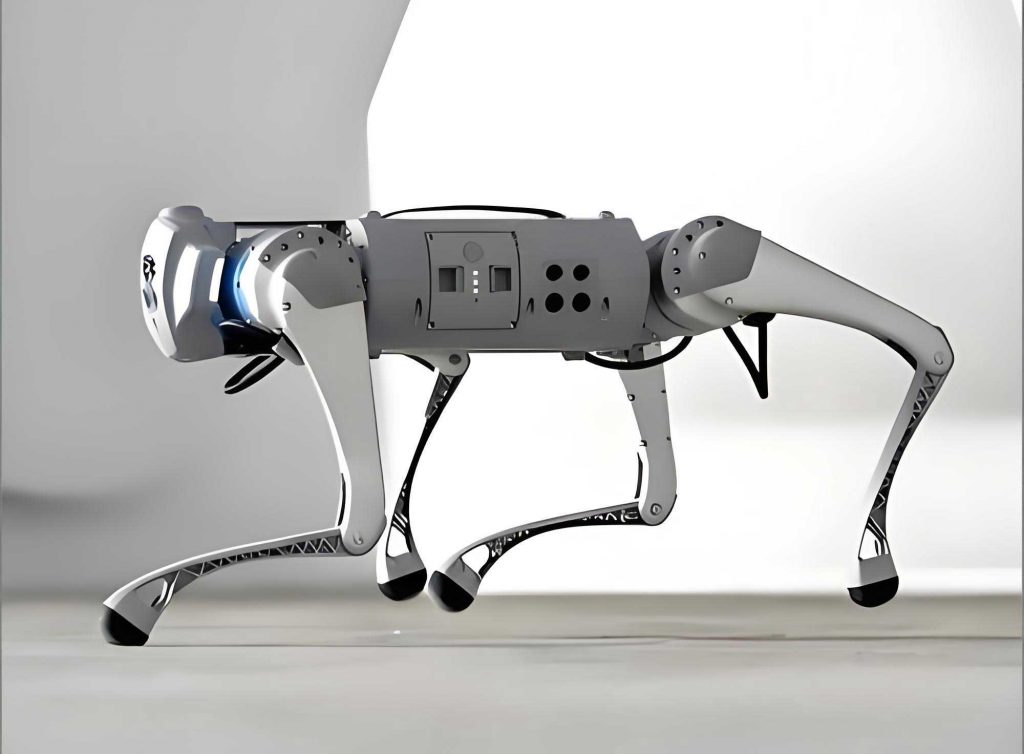
To optimize the drive motor structure for quadruped robots, we begin by analyzing fundamental parameters tailored to the robot dog’s demands, such as a maximum torque of 8 N·m and a continuous torque of 2.5 N·m. Critical elements like stator core, rotor structure, and winding layout are examined, leading to the establishment of a detailed parameter system. The table below summarizes the core structural parameters of the drive motor, highlighting design values and allowable tolerances to ensure mechanical integrity and electromagnetic performance.
| Parameter Category | Parameter Name | Design Value | Allowable Error |
|---|---|---|---|
| Stator Parameters | Stator Outer Diameter (mm) | 68 | ±0.02 |
| Slot Depth (mm) | 12.5 | ±0.01 | |
| Number of Slots | 24 | 0 | |
| Rotor Parameters | Rotor Outer Diameter (mm) | 42 | ±0.015 |
| Magnet Thickness (mm) | 3.2 | ±0.01 | |
| Number of Pole Pairs | 8 | 0 | |
| Performance Parameters | Rated Speed (rpm) | 3000 | ±50 |
| Phase Resistance (Ω) | 0.45 | ±0.02 | |
| Phase Inductance (mH) | 0.82 | ±0.03 |
In the stator design, we employ a silicon steel lamination process with optimized slot geometry to achieve a slot fill factor of 78% while maintaining mechanical strength. The 24-slot configuration reduces torque ripple to below 1.8%, and the surface-mounted permanent magnet rotor with 8 pole pairs ensures high torque output and dynamic response. The air gap is precisely controlled at 0.8 mm, balancing assembly reliability and electromagnetic performance, with a maximum air gap flux density of 1.2 T under rated conditions. Additionally, fractional-slot concentrated windings are adopted to decrease end-winding length and increase power density, calculated at 850 W/kg, which is crucial for the agility of a robot dog.
Material selection plays a pivotal role in enhancing the performance of drive motors for quadruped robots. We focus on magnetic, conductive, and insulating materials, systematically evaluating their properties to meet the torque demands. The table below presents the key performance parameters of these materials, comparing实测值 with standard requirements to ensure optimal performance in robot dog applications.
| Material Category | Material Name | Key Performance Indicator | Measured Value | Standard Requirement |
|---|---|---|---|---|
| Magnetic Materials | N45SH NdFeB | Remanence Density (T) | 1.32 | ≥1.30 |
| B35A300 Silicon Steel | Iron Loss (W/kg) | 1.65 | ≤1.70 | |
| B35A300 Silicon Steel | Magnetic Induction (T) | 1.75 | ≥1.70 | |
| Conductive Materials | T2 Copper | Conductivity (%IACS) | 58 | ≥56 |
| Insulating Materials | F-Class Insulating Varnish | Temperature Rating (°C) | 155 | ≥150 |
| F-Class Insulating Varnish | Breakdown Voltage (kV) | 2.8 | ≥2.5 |
For the drive circuit and control algorithm, we optimize the design based on the interaction between components like the MSP430 and ADS3300B, aiming for a control precision of ±0.1%. A dual-loop control strategy is implemented, with the core control equation expressed as:
$$G(s) = K_P \left(1 + \frac{1}{T_I s} + T_D s\right)$$
where \(K_P\), \(T_I\), and \(T_D\) are the proportional, integral, and derivative coefficients, respectively. Through system identification, we determine optimal parameters: \(K_P = 0.85\), \(T_I = 0.012\) s, and \(T_D = 0.008\) s. For torque control, a flux-based equation is used:
$$T_e = n_p \psi_f [i_q \cos(\theta) – i_d \sin(\theta)]$$
where \(T_e\) is the electromagnetic torque, \(n_p\) is the number of pole pairs, \(\psi_f\) is the permanent magnet flux linkage, \(i_q\) and \(i_d\) are the q-axis and d-axis current components, and \(\theta\) is the rotor position angle. Incorporating the sampling characteristics of the ADS3300B, a current prediction control algorithm is designed:
$$i_d(k+1) = i_d(k) + \frac{V_d – R_s i_d + \omega_e L_q i_q}{L_d} T_s$$
This strategy improves position control accuracy to ±0.08% under a 5 V power supply and enhances system efficiency to 83% by optimizing the PWM modulation strategy with a switching frequency of 20 kHz, reducing switching losses in the quadruped robot drive.
To further enhance performance, we refine the control strategy by addressing signal crosstalk issues in high-frequency sampling between components like the MSP430 and ADS3300B. An adaptive fuzzy control strategy is introduced, incorporating a dynamic compensation mechanism and a two-layer fuzzy rule base with 25 rules covering common motion states of the quadruped robot. This reduces signal distortion from 3% to 0.6% at a 10 kHz sampling frequency. For torque control, a compensator based on a torque observer is developed, dynamically adjusting compensation based on real-time load torque estimation and feedback. This achieves a position control precision of ±0.05% under 5 V supply, a 50% improvement, and shortens response time to 0.6 ms, significantly boosting the dynamic performance of the robot dog.
In terms of drive design and optimization, we focus on improving power conversion efficiency and signal quality through hardware enhancements. The signal acquisition circuit is redesigned with differential routing for DIN and SCLK lines, spacing optimized to 0.3 mm, and impedance matching controlled within \(100 \pm 5\%\) Ω. A second-order Butterworth low-pass filter is added to the VCTL output, with a cutoff frequency of 30 kHz, suppressing high-frequency interference and reducing crosstalk by 85%. The power management system employs a multi-stage filter structure, including an LC filter network with a 220 μH inductor and 470 μF low-impedance solid capacitors, lowering power ripple to 15 mV from the original 45 mV. Synchronous rectification technology is integrated using MOSFETs with an on-resistance of 8 mΩ, increasing power conversion efficiency from 78% to 86%. For thermal management, a composite散热方案 uses thermal copper pillars and aluminum heat sinks with a fin spacing of 3 mm, increasing effective散热面积 by 40% and reducing junction temperature by 18°C under full load, keeping it below 75°C. Reliability is ensured through protection mechanisms like overcurrent protection at 150% of rated current with a response time under 2 μs, overtemperature protection at 85°C, and a watchdog timer in the MSP430 programming for safe reset in abnormal conditions, all critical for the durability of quadruped robots.
Energy efficiency is elevated through a segmented management approach tailored to the power demands of different运动状态 in robot dogs. Under a 5 V supply, dynamic power management is applied: in low-load conditions (below 30% of rated power), the system switches to ECO mode, reducing switching frequency to 10 kHz and optimizing PWM modulation to cut losses; in high-load scenarios (above 80%), it enters high-efficiency mode with a 20 kHz switching frequency and activated synchronous rectification. This raises average efficiency from 78% to 86% and reduces power consumption by 25% at rated conditions. Collaboration between components like the MSP430 and ADS3300B is optimized with an on-demand wake-up mechanism, lowering sampling frequency during idle or low-speed periods while maintaining VCTL output precision within ±0.08%. Testing shows a 32% reduction in average power consumption over 2 hours of continuous operation and a temperature rise controlled within 42 K, extending the operational endurance of the quadruped robot.
In conclusion, our comprehensive study on the drive motor system for quadruped robots presents systematic optimizations across structural design, control algorithms, and energy management. The results demonstrate significant improvements: dynamic response time shortened to 0.6 ms, position control accuracy enhanced to ±0.05%, and power conversion efficiency increased to 86%. These advancements provide reliable support for the stable operation of robot dogs in complex environments. Future research could explore AI-based adaptive control strategies for extreme conditions and focus on lightweight design and modular integration to further advance quadruped robot capabilities.