
In the evolving landscape of liquefied natural gas (LNG) terminals, the demand for intelligent inspection systems has become paramount. Traditional manual methods, reliant on human operators, often fall short in efficiency and safety, particularly in complex and hazardous environments. As a researcher in this field, I have observed how quadruped robots, often referred to as robot dogs, are emerging as a transformative solution. These quadruped robots leverage advanced mobility and sensor integration to address the unique challenges of LNG facilities. In this paper, we delve into the design, application, and future potential of quadruped robots in smart inspection systems, emphasizing their adaptability, safety features, and integration with cutting-edge technologies. Through detailed analysis, including mathematical models and comparative tables, we aim to provide a comprehensive framework for deploying robot dogs in high-risk settings, ensuring enhanced operational reliability and risk mitigation.
The inspection of LNG terminals is critical for maintaining safety and efficiency, as these facilities handle volatile substances under extreme conditions. Conventional approaches, such as human patrols or fixed sensors, are prone to limitations like coverage gaps and delayed response times. Quadruped robots, with their biomimetic design, offer superior terrain navigation capabilities, enabling them to traverse uneven surfaces, stairs, and obstructed areas that challenge wheeled or tracked systems. For instance, the dynamic stability of a robot dog can be modeled using the following equation for center of mass control: $$\vec{F}_{net} = m \cdot \vec{a} = \sum \vec{F}_{ext} – m \cdot \vec{g}$$ where \(\vec{F}_{net}\) is the net force, \(m\) is the mass, \(\vec{a}\) is acceleration, \(\vec{F}_{ext}\) represents external forces, and \(\vec{g}\) is gravity. This allows quadruped robots to maintain balance on slopes or debris-laden paths, reducing the risk of toppling in confined spaces. Moreover, their modularity facilitates the integration of specialized sensors, such as gas detectors and thermal cameras, for real-time data acquisition. As we explore the global progress in inspection robotics, it becomes evident that quadruped robots are not merely an alternative but a necessity for modernizing LNG terminal operations.
Globally, the development of inspection robots has advanced significantly, with early innovations in industrial settings paving the way for specialized applications. In the 1980s, initial research focused on robotic systems for substations, where mobility and sensor payloads were prioritized. Over time, these evolved to include adaptations for hazardous environments, such as oil and gas facilities. For example, early wheeled and tracked robots demonstrated basic functionality but struggled with complex terrains like pipe racks or staircases. In contrast, modern quadruped robots excel in such scenarios due to their legged locomotion, which can be optimized using kinematic equations: $$\theta_i = f(\vec{q}, \vec{p})$$ where \(\theta_i\) denotes joint angles, \(\vec{q}\) represents generalized coordinates, and \(\vec{p}\) is the position vector. This enables a robot dog to adjust its gait dynamically, as shown in Table 1, which compares different robot types based on key performance metrics. The progression towards quadruped robots highlights a shift from rigid, limited-mobility systems to agile, multi-functional platforms capable of autonomous decision-making.
| Robot Type | Terrain Adaptability | Energy Efficiency | Payload Capacity | Typical Applications |
|---|---|---|---|---|
| Wheeled Robot | Low (flat surfaces only) | High | Moderate | Basic patrolling, data collection |
| Tracked Robot | Moderate (handles mild obstacles) | Medium | High | Rugged environments, emergency response |
| Quadruped Robot (Robot Dog) | High (stairs, rough terrain) | Variable (optimizable) | Moderate to High | Complex inspections, multi-sensor fusion |
In recent years, the integration of artificial intelligence and IoT technologies has further enhanced the capabilities of quadruped robots. A robot dog can perform tasks such as gas leakage detection using sensor arrays that follow a probabilistic model for hazard assessment: $$P(\text{leak}) = \int_{0}^{t} \lambda(\tau) e^{-\int_{0}^{\tau} \lambda(s) ds} d\tau$$ where \(P(\text{leak})\) is the probability of a leak event over time \(t\), and \(\lambda\) is the hazard rate derived from sensor data. This mathematical approach allows for predictive maintenance, reducing downtime and improving safety. Additionally, the modular design of quadruped robots supports the attachment of various tools, such as robotic arms for valve manipulation or ultrasonic sensors for thickness measurement. As we transition to discussing the specific advantages of quadruped robots in LNG terminals, it is clear that their versatility and intelligence set them apart from earlier robotic systems.
The advantages of quadruped robots in LNG terminal inspections are multifaceted, spanning terrain adaptability, safety compliance, and data-driven insights. Firstly, their ability to navigate complex environments stems from dynamic gait control, which can be described by the following equation for leg trajectory planning: $$\vec{r}(t) = \vec{r}_0 + \vec{v}_0 t + \frac{1}{2} \vec{a} t^2$$ where \(\vec{r}(t)\) is the position vector of a foot over time \(t\), \(\vec{r}_0\) is the initial position, \(\vec{v}_0\) is initial velocity, and \(\vec{a}\) is acceleration. This enables a robot dog to step over obstacles or ascend stairs with minimal instability. Secondly, explosion-proof design is critical in LNG facilities, where flammable gases pose risks. Quadruped robots can be certified to international standards, such as IEC 60079-14, ensuring that all electrical components are housed in enclosures that prevent ignition. The safety aspect can be quantified using a risk index formula: $$R = \sum_{i=1}^{n} w_i \cdot s_i$$ where \(R\) is the overall risk score, \(w_i\) are weights for different hazards, and \(s_i\) are sensor readings. This allows for real-time risk assessment during inspections.
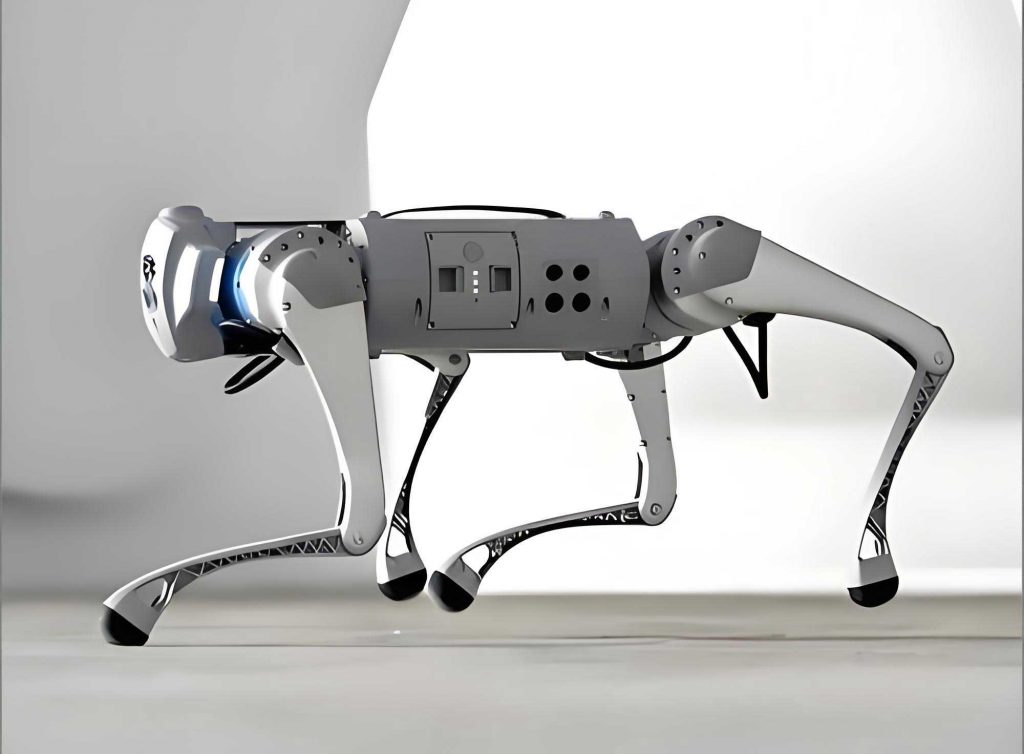
Furthermore, the智能化 of quadruped robots enables advanced data analytics through fused sensor inputs. For instance, a robot dog equipped with LiDAR and cameras can perform simultaneous localization and mapping (SLAM), represented by the Bayesian update equation: $$p(x_t | z_{1:t}, u_{1:t}) = \eta \cdot p(z_t | x_t) \int p(x_t | x_{t-1}, u_t) p(x_{t-1} | z_{1:t-1}, u_{1:t-1}) dx_{t-1}$$ where \(x_t\) is the state at time \(t\), \(z_t\) are observations, \(u_t\) are controls, and \(\eta\) is a normalization constant. This facilitates autonomous navigation in GPS-denied areas, such as indoor processing units. Additionally, thermal imaging modules allow for temperature monitoring of equipment, with heat dissipation modeled by Fourier’s law: $$\vec{q} = -k \nabla T$$ where \(\vec{q}\) is heat flux, \(k\) is thermal conductivity, and \(\nabla T\) is the temperature gradient. By integrating these capabilities, quadruped robots not only enhance inspection coverage but also enable predictive diagnostics, as summarized in Table 2 for sensor applications. The cumulative benefits underscore why robot dogs are becoming indispensable in high-stakes environments like LNG terminals.
| Sensor Type | Function | Data Output | Application Example |
|---|---|---|---|
| Gas Sensor | Detect methane leaks | Concentration levels (ppm) | Early warning in storage areas |
| Infrared Camera | Monitor equipment temperature | Thermal images (°C) | Overheat detection in pumps |
| LiDAR | 3D mapping and obstacle avoidance | Point cloud data | Autonomous path planning |
| Vibration Sensor | Assess mechanical health | Acceleration spectra | Bearing failure prediction |
The system architecture of a quadruped robot for LNG terminal inspection is structured into three layers: terminal, data, and application layers. The terminal layer comprises the robot dog itself, along with communication modules and embedded controllers. Central to this is the main control unit, which orchestrates navigation, data acquisition, and actuator commands via standardized buses. For energy management, the power consumption of a quadruped robot can be modeled as: $$E_{total} = \int_{0}^{T} P_{motion}(t) + P_{sensors}(t) + P_{comms}(t) dt$$ where \(E_{total}\) is total energy used over time \(T\), and \(P\) terms represent power for motion, sensors, and communications. This equation helps optimize battery life, ensuring sustained operation during extended patrols. The data layer handles storage and processing of inspection data, utilizing databases and servers to maintain historical records for trend analysis. For instance, gas concentration trends can be analyzed using time-series models: $$C(t) = C_0 + \alpha \sin(\omega t + \phi) + \epsilon(t)$$ where \(C(t)\) is concentration at time \(t\), \(C_0\) is baseline, \(\alpha\) is amplitude, \(\omega\) is frequency, \(\phi\) is phase, and \(\epsilon(t)\) is noise. This facilitates anomaly detection and reporting.
In the application layer, user interfaces enable task scheduling, remote control, and data visualization. This layer integrates with external systems, such as digital twins, to simulate real-time scenarios. The synergy between layers ensures that the quadruped robot operates as an intelligent node within a broader IoT ecosystem. For example, when a robot dog detects an anomaly, it can trigger alerts through the application layer, prompting immediate human intervention or automated responses. This architectural robustness is vital for scaling inspections across large LNG facilities, where multiple robot dogs might collaborate. The integration of these layers not only enhances operational efficiency but also builds a foundation for continuous improvement through machine learning algorithms.
Specific application schemes for quadruped robots in LNG terminals encompass autonomous navigation, energy efficiency, modular design, remote operation, standardization, and digital twin integration. Autonomous navigation relies on SLAM algorithms, which can be enhanced by multi-sensor fusion. The pose estimation in SLAM is often refined using an Extended Kalman Filter (EKF), with the prediction step given by: $$\hat{x}_{k|k-1} = f(\hat{x}_{k-1|k-1}, u_k)$$ $$P_{k|k-1} = F_k P_{k-1|k-1} F_k^T + Q_k$$ where \(\hat{x}\) is the state estimate, \(P\) is the covariance matrix, \(F\) is the state transition matrix, \(u\) is control input, and \(Q\) is process noise covariance. This enables a robot dog to map unfamiliar areas while avoiding obstacles, achieving定位 errors below 0.3 meters in practice. For energy efficiency, optimization strategies include regenerative braking and adaptive gait control, minimizing power dissipation. The energy recovery during deceleration can be expressed as: $$E_{recovered} = \frac{1}{2} I \omega^2 \eta$$ where \(I\) is moment of inertia, \(\omega\) is angular velocity, and \(\eta\) is efficiency. Such measures extend operational endurance to over 8 hours, crucial for comprehensive coverage.
Modular design allows a quadruped robot to swap payloads quickly, such as replacing a gas sensor with a thermal camera for night inspections. This flexibility is quantified by a modularity index: $$M = \frac{N_{modules}}{T_{swap}}$$ where \(N_{modules}\) is the number of interchangeable modules, and \(T_{swap}\) is the average swap time. Higher \(M\) values indicate greater versatility, enabling a single robot dog to perform diverse tasks without downtime. Remote operation leverages VR/AR interfaces for telepresence, with latency requirements modeled by: $$L_{total} = L_{transmission} + L_{processing} + L_{actuation}$$ where \(L\) represents latency components. In emergency responses, this allows operators to guide a robot dog through hazardous zones, such as during gas leaks, while receiving real-time video feeds. Standardization ensures compliance with industry guidelines, such as API RP 580, which frameworks risk-based inspection priorities. Digital twin integration synchronizes robot-collected data with virtual models, enabling predictive simulations. For instance, vibration data from a robot dog can feed into a digital twin to forecast equipment failures using prognostic equations: $$RUL(t) = \int_{t}^{\infty} f(\tau | \theta) d\tau$$ where \(RUL\) is remaining useful life, and \(f\) is the failure probability density function conditioned on parameters \(\theta\). This holistic approach maximizes the utility of quadruped robots in dynamic environments.
In conclusion, the future of quadruped robots in LNG terminal inspections is poised for exponential growth, driven by advancements in autonomy, intelligence, and networking. As a researcher, I believe that robot dogs will evolve towards greater cognitive abilities, capable of learning from inspection data to refine their behaviors. For example, reinforcement learning algorithms could optimize path planning: $$Q(s,a) \leftarrow Q(s,a) + \alpha [r + \gamma \max_{a’} Q(s’,a’) – Q(s,a)]$$ where \(Q\) is the action-value function, \(s\) is state, \(a\) is action, \(r\) is reward, \(\alpha\) is learning rate, and \(\gamma\) is discount factor. This would enable a quadruped robot to adapt to changing conditions without human intervention. Moreover, the integration of 5G technology will facilitate low-latency communication, supporting real-time collaboration between multiple robot dogs and drones. Energy harvesting techniques, such as solar panels or kinetic recovery, could further enhance sustainability, modeled by: $$P_{harvest} = \eta_{solar} \cdot A \cdot G + \eta_{kinetic} \cdot \frac{1}{2} m v^2$$ where \(P_{harvest}\) is harvested power, \(\eta\) are efficiencies, \(A\) is area, \(G\) is solar irradiance, \(m\) is mass, and \(v\) is velocity. As standardization efforts mature, quadruped robots will become integral to smart LNG terminals, reducing human exposure to risks and elevating operational benchmarks. The ongoing innovation in this field promises not only to solve current challenges but to redefine the paradigms of industrial automation.