
The development of legged robots has garnered significant attention due to their potential to traverse complex terrains where wheeled or tracked vehicles struggle. Among these, the quadruped robot, often inspired by biological counterparts like the robot dog, represents a promising direction in robotics research. These systems combine static and dynamic stability, enabling robust locomotion across uneven surfaces while maintaining efficiency and load-bearing capacity. However, conventional quadruped robot designs frequently face challenges such as high energy consumption, complex control systems due to multiple actuators, and substantial leg inertia. To address these issues, this paper proposes a novel leg structure for a quadruped robot driven by a single hydraulic cylinder. This design simplifies the actuation mechanism, reduces the number of drivers, and enhances energy efficiency, making it suitable for applications in search and rescue, exploration, and industrial inspection. The kinematic model of the leg structure is established using the Denavit-Hartenberg (D-H) parameter method, and comprehensive kinematic analysis is conducted. Simulation via ADAMS dynamics software validates the motion characteristics and the correctness of the model, demonstrating the feasibility of the proposed approach for advanced quadruped robot development.
In recent years, the field of quadruped robotics has evolved rapidly, with researchers drawing inspiration from mammalian locomotion to improve performance. The robot dog, for instance, exhibits remarkable agility and stability, which engineers aim to replicate in mechanical systems. Traditional quadruped robots often employ electric motors at each joint, leading to increased complexity and weight. In contrast, this work introduces a simplified leg mechanism that mimics the skeletal structure of quadruped animals, utilizing linkages to transmit motion from a single hydraulic actuator to multiple joints. This not only reduces the overall weight and inertia but also streamlines control algorithms. The primary contribution of this paper lies in the integration of a hydraulic drive system with a bio-inspired leg design, offering a practical solution for enhancing the mobility and efficiency of quadruped robots. Subsequent sections detail the structural principles, kinematic modeling, and simulation results, providing a foundation for future physical prototyping and optimization.
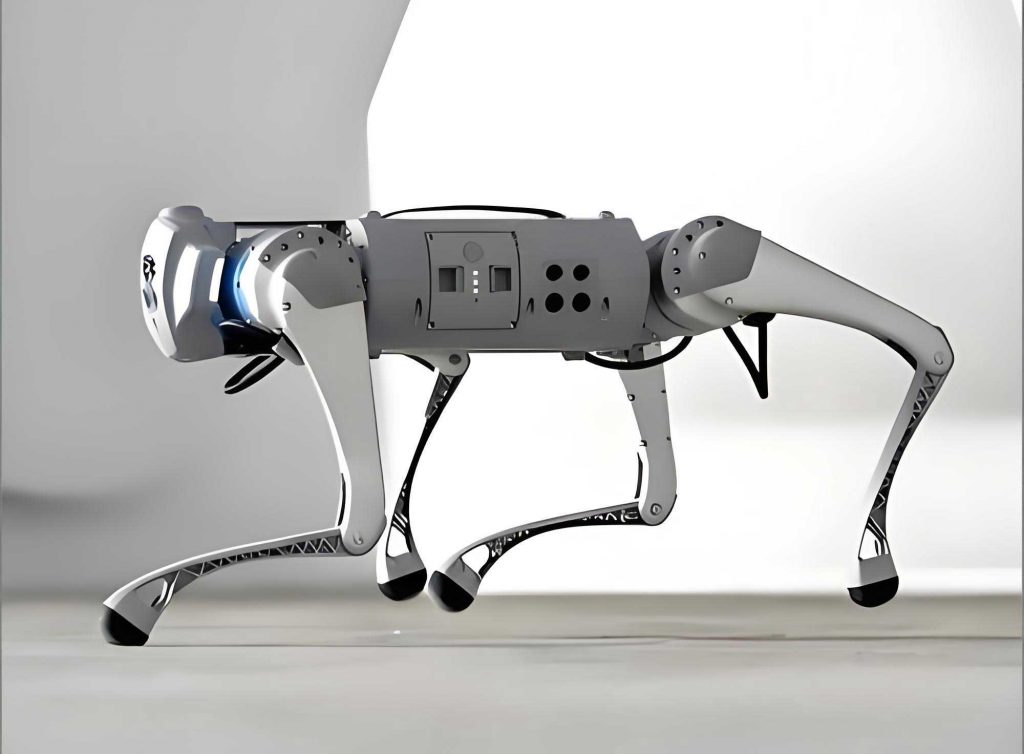
The leg structure of the quadruped robot is inspired by the anatomy of common quadruped animals, such as dogs, which feature a shoulder joint and an elbow joint connected by bones and muscles. In typical robotic implementations, each joint is driven by an individual motor, resulting in multiple actuators per leg. This approach, while precise, introduces drawbacks like high energy consumption, complex control, and increased leg inertia. To overcome these limitations, the proposed design employs a single hydraulic cylinder as the primary actuator, driving a linkage system that coordinates the motion of both the thigh and shank segments. The schematic of the leg mechanism illustrates how the hydraulic cylinder is hinged to a connecting rod, which in turn interacts with the thigh and another linkage to control the shank’s movement. This arrangement allows for synchronized lifting and extending motions, mimicking the natural gait of a robot dog while minimizing the number of active components.
The自由度 of the leg mechanism is calculated to ensure it operates as a single-degree-of-freedom system, simplifying control and analysis. In planar mechanisms, the自由度 formula is given by:
$$ F = 3n – 2p_L – p_H – F_0 – F_v $$
where \( n \) is the number of moving links, \( p_L \) is the number of lower pairs (revolute or prismatic joints), \( p_H \) is the number of higher pairs, \( F_0 \) represents local degrees of freedom, and \( F_v \) denotes redundant constraints. For the proposed leg structure, there are 7 moving links, 10 lower pairs, and no higher pairs, local freedoms, or redundant constraints. Substituting these values:
$$ F = 3 \times 7 – 2 \times 10 = 1 $$
This confirms that the mechanism has one degree of freedom, meaning the motion of all components can be controlled by the single hydraulic actuator. This simplification is crucial for reducing the computational load in real-time control systems for quadruped robots.
To facilitate kinematic analysis, the D-H parameter method is employed to establish a coordinate system for the leg structure. This approach assigns a frame to each link, enabling the description of transformations between adjacent links. The D-H parameters include the link offset \( d_i \), link length \( a_i \), twist angle \( \alpha_i \), and joint angle \( \theta_i \). For the quadruped robot leg, the D-H parameters are summarized in Table 1.
| Link | \( a_i \) (mm) | \( \alpha_i \) (rad) | \( d_i \) (mm) | \( \theta_i \) (rad) |
|---|---|---|---|---|
| 1 | 0 | 0 | 0 | \( \theta_1 \) |
| 2 | L1 | 0 | 0 | \( \theta_2 \) |
Here, \( L1 \) represents the length of the thigh link. The homogeneous transformation matrix between consecutive links is derived as:
$$ T_i^{i-1} = \begin{bmatrix}
\cos\theta_i & -\sin\theta_i \cos\alpha_i & \sin\theta_i \sin\alpha_i & a_i \cos\theta_i \\
\sin\theta_i & \cos\theta_i \cos\alpha_i & -\cos\theta_i \sin\alpha_i & a_i \sin\theta_i \\
0 & \sin\alpha_i & \cos\alpha_i & d_i \\
0 & 0 & 0 & 1
\end{bmatrix} $$
This matrix combines rotation and translation components, allowing the computation of the end-effector position relative to the base frame. The overall transformation from the base to the foot tip is obtained by multiplying the individual transformation matrices:
$$ T = T_1^0 \cdot T_2^1 $$
For the quadruped robot leg, the position of the foot tip in the base coordinate system can be expressed as:
$$ P = \begin{bmatrix} x \\ y \\ z \end{bmatrix} = \begin{bmatrix}
L1 \cos\theta_1 + L2 \cos(\theta_1 + \theta_2) \\
L1 \sin\theta_1 + L2 \sin(\theta_1 + \theta_2) \\
0
\end{bmatrix} $$
where \( L2 \) is the length of the shank link. This equation represents the forward kinematics solution, providing the foot position based on the joint angles. The inverse kinematics, which determines the joint angles for a desired foot position, can be derived using geometric relationships, but for brevity, the focus remains on the forward analysis.
The velocity of the foot tip is a critical performance metric for the quadruped robot, influencing its ability to adapt to dynamic environments. The foot velocity is computed using the Jacobian matrix, which relates the joint velocities to the end-effector velocity. The Jacobian matrix \( J \) for the leg mechanism is derived from the position equations:
$$ J = \begin{bmatrix}
\frac{\partial x}{\partial \theta_1} & \frac{\partial x}{\partial \theta_2} \\
\frac{\partial y}{\partial \theta_1} & \frac{\partial y}{\partial \theta_2}
\end{bmatrix} = \begin{bmatrix}
-L1 \sin\theta_1 – L2 \sin(\theta_1 + \theta_2) & -L2 \sin(\theta_1 + \theta_2) \\
L1 \cos\theta_1 + L2 \cos(\theta_1 + \theta_2) & L2 \cos(\theta_1 + \theta_2)
\end{bmatrix} $$
Thus, the foot velocity vector \( \dot{P} \) is given by:
$$ \dot{P} = J \dot{\theta} $$
where \( \dot{\theta} = [\dot{\theta}_1, \dot{\theta}_2]^T \) is the joint velocity vector. This relationship is essential for motion planning and control algorithms in quadruped robots, ensuring smooth and stable locomotion.
The relationship between the hydraulic cylinder’s extension and the joint angles is fundamental for actuation control. Using planar geometry, the extension distance \( \Delta L \) of the hydraulic cylinder can be linked to the joint angle \( \theta_1 \) through the cosine law in the triangle formed by the cylinder and connecting rods. Specifically, if \( A \) and \( B \) represent the fixed and moving attachment points of the cylinder, respectively, with initial length \( L_0 \), then:
$$ \Delta L = \sqrt{L_0^2 + r^2 – 2 L_0 r \cos(\phi_0 – \theta_1)} – L_0 $$
where \( r \) is the distance from the pivot to the cylinder attachment, and \( \phi_0 \) is the initial angle. Similarly, the thigh joint angle \( \theta_1 \) and shank joint angle \( \theta_2 \) can be expressed as functions of \( \Delta L \) by solving geometric constraints in the linkage system. For instance, in the thigh mechanism, the angle \( \theta_1 \) relates to \( \Delta L \) as:
$$ \theta_1 = \cos^{-1}\left( \frac{L_0^2 + r^2 – (\Delta L + L_0)^2}{2 L_0 r} \right) $$
These equations enable the translation of hydraulic actuator commands into joint motions, facilitating precise control of the quadruped robot’s leg movements.
To validate the kinematic model and assess the dynamic behavior of the leg structure, a simulation was conducted using ADAMS software. The leg mechanism was modeled in SolidWorks based on the dimensions of an adult dog’s forelimb, with key parameters listed in Table 2. The model was simplified to reduce computational complexity and exported to ADAMS in Parasolid format. Fixed joints were applied to the base, and revolute and prismatic joints were added according to the mechanical connections. A translational drive was implemented to simulate the hydraulic actuator, with a drive function defined to replicate the leg’s motion cycle: lifting to a highest point and extending to a lowest point. The material was set to aluminum with a density of 2700 kg/m³, and a load of 250 N was applied vertically downward on the base, with a corresponding reaction force on the foot tip to simulate weight-bearing conditions.
| Component | Length (mm) |
|---|---|
| Thigh | 450 |
| Shank | 380 |
| Base Frame | 300 |
| Connecting Rod 1 | 315 |
| Connecting Rod 2 | 330 |
The simulation results over three motion cycles demonstrate consistent leg behavior. The foot trajectory, as shown in the displacement plot, reaches a maximum height of 0.150 m from the fully extended position, confirming the designed motion range. The velocity profile of the foot tip exhibits smooth transitions, with peak magnitudes of approximately ±159 mm/s, indicating stable and controlled movement. Notably, the velocity changes gradually around static equilibrium points, reducing impact forces during locomotion. The torque at the thigh joint was analyzed, revealing maximum values of 4.46 N·m when the foot is at the highest position, and minimum values when fully extended. This torque analysis aids in selecting appropriate hydraulic components for the quadruped robot, ensuring sufficient force output for various terrains.
Comparative plots of foot displacement and velocity over time highlight the synchronization between kinematic predictions and simulated behavior. The leg mechanism successfully emulates the biological motion patterns of a robot dog, validating the effectiveness of the single-actuator design. These findings underscore the potential of this approach for developing efficient and agile quadruped robots capable of operating in challenging environments.
In conclusion, this paper presents a bio-inspired leg structure for a quadruped robot driven by a single hydraulic cylinder, addressing common issues of multiple actuators and high energy consumption. The kinematic model, developed using D-H parameters, provides accurate descriptions of leg motion, while the simulation in ADAMS verifies the design’s functionality and stability. The proposed mechanism reduces complexity and inertia, making it suitable for practical applications in robotics. Future work will focus on constructing a physical prototype, refining control strategies, and integrating the leg into a full quadruped robot system for real-world testing. This research contributes to the advancement of legged robotics, paving the way for more adaptive and efficient robot dog platforms.
The development of quadruped robots continues to evolve, with innovations in actuation and control enhancing their capabilities. The robot dog concept, in particular, serves as a benchmark for performance and agility. By leveraging biological principles and simplified mechanics, this study demonstrates a viable path toward more accessible and robust quadruped robot designs. As research progresses, the integration of sensors and advanced algorithms will further improve the autonomy and responsiveness of these systems, expanding their utility in diverse fields such as disaster response, agriculture, and logistics. The quadruped robot, with its inherent stability and versatility, remains a key focus in the pursuit of next-generation robotic solutions.