
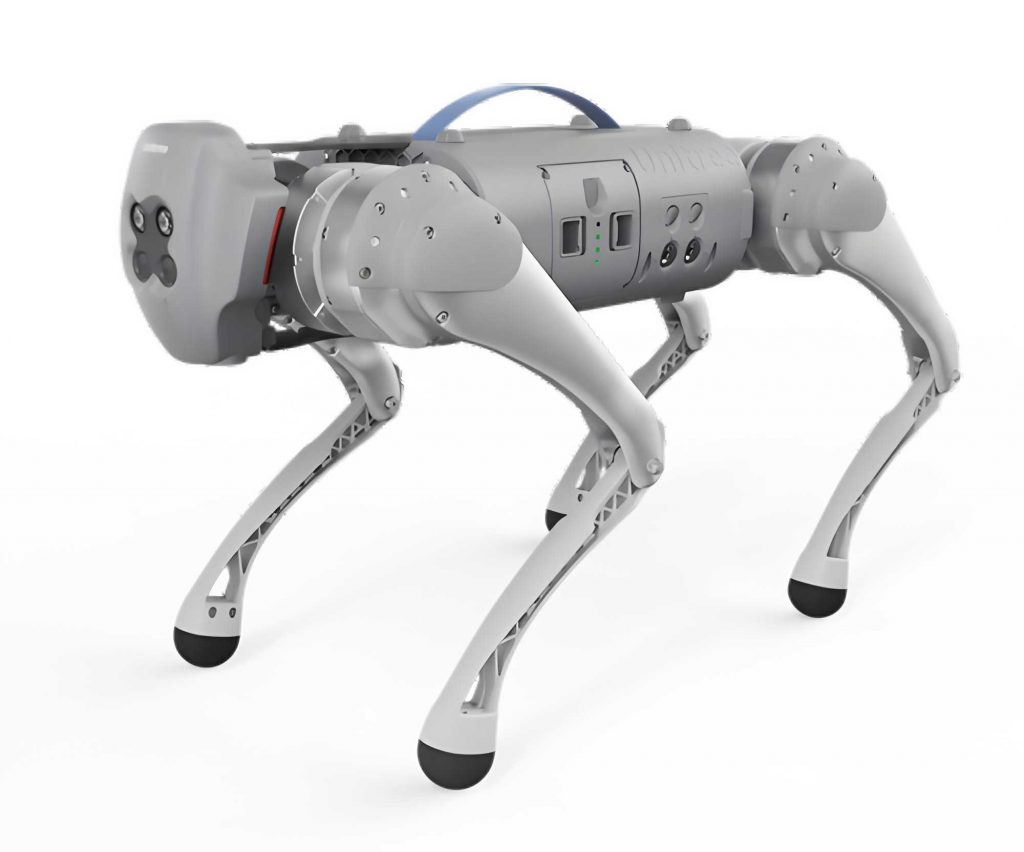
In recent years, the demand for advanced robotic systems has surged, particularly in applications such as search and rescue operations and automated production lines, where traditional wheeled or tracked robots face limitations in complex terrains. Among these, quadruped robots, often referred to as robot dogs, have gained prominence due to their biomimetic locomotion, which allows for discontinuous contact with the ground, enabling superior adaptability in uneven environments. The hip joints of these quadruped robots are critical for dynamic movement, and the driving motors must exhibit high torque density to support agile and efficient motion. As labor shortages and rising costs drive automation, the development of high-performance joint motors becomes essential for enhancing the capabilities of robot dogs. In this study, we focus on designing a permanent magnet synchronous motor (PMSM) tailored for the hip joints of quadruped robots, with an emphasis on maximizing torque density while adhering to constraints such as temperature rise and mass limitations.
The joint drive motor is a pivotal component in legged robots, directly influencing their motion performance. PMSMs are widely adopted in robot joints due to their simple structure, rapid response, high power density, and reliability, which contribute to the lightweight design of robotic systems. For quadruped robots, the hip joint motors must deliver high torque outputs at varying speeds, often requiring peak torques several times the rated value to handle dynamic loads during running or climbing. This paper addresses the specific performance requirements for a quadruped robot hip joint motor, including an outer diameter of 70 mm, a mass under 400 g, a rated torque of 1 Nm at speeds exceeding 7,000 rpm, and a peak torque of 5 Nm. To meet these demands, we propose an analytical design method that optimizes torque density by establishing relationships between motor parameters, such as stator split ratio and stack length, and performance metrics like temperature rise and mass.
The design process begins with defining the motor’s performance indicators and key parameters. The torque density, denoted as \( g_T \), is a critical measure, expressed as the ratio of electromagnetic torque \( T_{em} \) to motor mass \( G_M \). To achieve high torque density, we prioritize increasing the linear load \( A \) and air-gap magnetic flux density \( B_{\delta m1} \), as shown in the fundamental equation:
$$ A B_{\delta m1} = 6.1 \frac{P’}{n \alpha_i K_{dq1} l_{ef} D_{il}^2} $$
where \( P’ \) is the calculated power, \( n \) is the rotational speed, \( \alpha_i \) is the pole arc coefficient, \( K_{dq1} \) is the fundamental winding factor, \( l_{ef} \) is the effective stack length, and \( D_{il} \) is the inner diameter of the armature core. Enhancing \( A \) boosts torque density but escalates copper losses and temperature rise, necessitating a balanced approach. For the magnetic circuit, we selected a surface-mounted permanent magnet structure due to its superior air-gap flux density and sinusoidal waveform, which improves magnetic loading. Using neodymium-iron-boron magnets with high coercivity and remanence, we optimized the magnet dimensions, setting the pole arc coefficient to 0.86 and thickness to 2.5 mm after analyzing the relationship between air-gap flux density and magnet parameters, as illustrated in simulations.
The pole-slot combination is crucial for PMSM performance, especially in fractional-slot concentrated windings, which reduce cogging torque and enhance overload capability. After evaluating various configurations through finite element analysis, we chose a 20-pole, 18-slot design for its high torque output, minimal unbalanced magnetic pull, and acceptable cogging torque. This configuration supports the high torque demands of quadruped robot applications, ensuring stable operation under peak loads. The following table summarizes the key performance parameters for the motor design:
| Parameter | Value |
|---|---|
| Voltage Level (V) | 270 |
| Outer Diameter (mm) | 70 |
| Rated Torque (Nm) | 1 |
| Peak Torque (Nm) | 5 |
| Maximum Speed at Rated Torque (rpm) | 7,000 |
| Mass (g) | 400 |
| Thermal Balance Temperature Rise (K) | 150 |
To achieve high torque density, we developed an analytical method that focuses on optimizing decision variables, primarily the stator split ratio \( \lambda \) and stack length \( l_{ef} \), while considering thermal constraints. The total heat generation \( Q_t \) in the motor comprises copper losses \( P_{Cu} \) and iron losses \( P_{Fe} \). The copper loss is derived from the resistance and current density, expressed as:
$$ P_{Cu} = \frac{96 \rho_{Cu} (l_{ef} + l_{ed}) T_{em}^2}{\pi^3 B_{\delta}^2 l_{ef}^2 k_s k_N^2 D_o^4 \lambda^2 F_A(x)} $$
where \( \rho_{Cu} \) is the copper resistivity, \( l_{ed} \) is the end-winding length, \( k_s \) is the slot fill factor, \( k_N \) is the winding coefficient, \( D_o \) is the stator outer diameter, and \( F_A(x) \) is a function dependent on motor parameters like pole arc coefficient and air-gap flux density. The iron loss, accounting for hysteresis, eddy current, and additional losses, is given by:
$$ P_{Fe} = \pi \sigma_{Fe} l_{ef} D_o^2 B_{\delta} \left( k_h f B_m^{\alpha} + k_c f^2 B_m^2 + k_e f^{1.5} B_m^{1.5} \right) \left[ \frac{\pi}{4p B_m} + \frac{1}{2B_m} \lambda – \frac{1}{2B_m} + \frac{\pi B_{\delta}}{4p B_m^2} + \frac{\pi^2 B_{\delta}}{16p^2 B_m^2} \lambda^2 \right] $$
Here, \( \sigma_{Fe} \) is the density of the stator core material, \( k_h \), \( k_c \), and \( k_e \) are loss coefficients, \( f \) is the frequency, \( B_m \) is the stator core flux density amplitude, and \( p \) is the number of pole pairs. The temperature rise \( \Delta \tau \) is calculated using the heat dissipation model:
$$ \Delta \tau = \frac{Q_t}{\gamma A_m} \approx \frac{P_{Cu} + P_{Fe}}{\gamma \pi D_o l_{ef}} $$
where \( \gamma \) is the heat transfer coefficient, which depends on factors like air thermal conductivity \( k_{air} \), casing diameter \( D_c \), and environmental conditions. The heat transfer coefficient is elaborated as:
$$ \gamma = \frac{k_{air}}{D_c} \cdot a \cdot \left( \frac{\beta_{te} g \Delta \tau \rho_{air}^2 D_c^3}{\mu^2} \right) \cdot \left( \frac{c_p \mu}{k_{air}} \right)^b + \frac{\varepsilon \sigma \left[ (\tau_1 + 273.15)^4 – (\tau_0 + 273.15)^4 \right]}{\Delta \tau} $$
with \( a \) and \( b \) as empirical coefficients, \( \beta_{te} \) as the thermal expansion coefficient, \( g \) as gravity, \( \rho_{air} \) as air density, \( \mu \) as dynamic viscosity, \( c_p \) as specific heat capacity, \( \varepsilon \) as surface emissivity, \( \sigma \) as the Stefan-Boltzmann constant, \( \tau_1 \) as motor temperature, and \( \tau_0 \) as ambient temperature. The motor mass \( G_M \) is computed considering the stator, rotor, and permanent magnet components:
$$ G_M = \frac{\pi D_o^2 l_{ef} \sigma_{Fe} [1 – \lambda^2 – F_A(x)]}{4} + \frac{\pi^2 \sigma_{Cu} k_s D_o^2 (l_{ef} + l_{ed}) F_A(x)}{16} + \pi \alpha_i l_{ef} \sigma_{pm} h_m (D_s – 2\delta – 2h_m) + \frac{\pi l_{ef} \sigma_{Fe} [(D_s – 2\delta – 2h_m)^2 – D_{sf}^2]}{4} $$
where \( D_s \) is the stator inner diameter, \( \delta \) is the air-gap length, \( \sigma_{pm} \) is the magnet density, \( h_m \) is the magnet thickness, and \( D_{sf} \) is the shaft diameter. The torque density \( g_T \) is then:
$$ g_T = \frac{T_{em}}{G_M} $$
By analyzing the relationships between \( \lambda \), \( l_{ef} \), and performance metrics, we identified the optimal design point. For instance, varying \( \lambda \) from 0.5 to 0.8 and \( l_{ef} \) from 0.15 to 0.20, we solved the optimization problem to maximize \( g_T \) and minimize the loss per torque \( G_q = Q_t / T_{em} \), subject to \( \Delta \tau \leq 150 \, \text{K} \) and \( G_M \leq 0.4 \, \text{kg} \). The optimal values were found at \( \lambda = 0.65 \) and \( l_{ef} = 0.18 \, \text{m} \), yielding a torque density of 15.24 Nm/kg and a loss per torque of 509.6 W/Nm at peak torque, with a mass of 0.328 kg. This approach ensures that the motor meets the rigorous demands of quadruped robot hip joints, where high torque output and compact size are paramount.
To validate the analytical design, we conducted finite element simulations for five different combinations of \( \lambda \) and \( l_{ef} \), including the optimal point. The simulations assessed torque-speed characteristics, air-gap flux density, cogging torque, and losses. For example, at rated torque, the calculated and simulated losses showed a maximum error of 6.8%, while torque density errors were within 2.45%, confirming the method’s accuracy. Under peak torque conditions, the error increased to 11.2% due to magnetic saturation, which affects the linearity between current and torque. Nonetheless, the optimal design point demonstrated the best performance among the evaluated cases. Additionally, thermal simulations at 5 Nm load and 3,000 rpm, with natural convection in a 25°C environment, revealed a maximum temperature of 169°C and a temperature rise of 144 K, complying with the 150 K limit. These results underscore the effectiveness of our design for robot dog applications, where thermal management is critical for sustained operation.
We fabricated a prototype based on the optimal design and tested it using a platform comprising a DC power supply, power analyzer, servo drive, and torque loading system. The prototype achieved a speed of 7,034 rpm at a load of 0.9734 Nm, with three-phase currents of 3.2 A, 2.7 A, and 3.4 A, meeting the rated performance specifications. Under peak torque of 5 Nm, the speed dropped to 3,412 rpm, with currents reaching 30.9 A, 25.2 A, and 32.8 A, satisfying the overload requirements. Temperature tests involved applying peak load pulses over 20 minutes, resulting in a maximum temperature of 156.3°C, which is within the allowable range. The comparison between calculated, simulated, and measured losses across different torque levels showed consistent trends, validating our analytical model. The following table summarizes the experimental results for key parameters:
| Test Condition | Parameter | Value |
|---|---|---|
| Rated Torque (1 Nm) | Speed (rpm) | 7,034 |
| Current (A, RMS) | 3.2, 2.7, 3.4 | |
| Temperature Rise (K) | — | |
| Peak Torque (5 Nm) | Speed (rpm) | 3,412 |
| Current (A, RMS) | 30.9, 25.2, 32.8 | |
| Maximum Temperature (°C) | 156.3 |
In conclusion, this study presents a comprehensive approach to designing high-torque-density motors for quadruped robot hip joints. By leveraging analytical models and finite element simulations, we optimized key parameters to achieve a compact, efficient motor that meets the demanding performance criteria of robot dogs. The experimental validation confirms the practicality of our design, with the prototype exhibiting robust performance under both rated and peak conditions. This work contributes to the advancement of legged robotics, enabling more agile and capable quadruped robots for diverse applications. Future research could explore advanced cooling techniques or alternative materials to further push the boundaries of torque density in robotic joint motors.