
In my work, I have focused on developing advanced radiation monitoring solutions to address the challenges of inspecting hazardous environments, such as border ports and areas with potential radioactive contamination. Traditional monitoring systems, including vehicle-mounted or airborne detectors, often lack the mobility to navigate complex terrains like slopes, stairs, or rough ground. This limitation inspired me to design and implement a radiation monitoring system based on a quadruped robot, commonly referred to as a robot dog. This system leverages the robot dog’s exceptional adaptability to harsh conditions, allowing for remote monitoring without exposing personnel to risks. The quadruped robot serves as a mobile platform, equipped with cameras and radiation detectors, to perform functions like horizontal radiation mapping, fixed-point measurements, and nuclide identification. By utilizing WIFI wireless communication, the system transmits real-time data to a central monitoring interface, displaying radioactive dose distributions and the robot dog’s trajectory on online maps. In this article, I will detail the design, testing, and practical applications of this system, emphasizing how the robot dog enhances safety and efficiency in radiation monitoring tasks.
The development of this quadruped robot radiation monitoring system was driven by the need to comply with regulatory standards, such as the industry standard for imported mineral products, which specifies that gamma-ray dose equivalent rates must be below 1 μSv/h at a distance of 0.1 meters from the material. If rates exceed this threshold, further analysis of radionuclide activity concentrations is required. My system integrates a robot dog with specialized components to meet these demands, providing a versatile tool for daily environmental monitoring, nuclear emergencies, and large-scale radiation surveys. Throughout this work, I have prioritized the robot dog’s ability to operate autonomously or via remote control, ensuring it can handle diverse scenarios while maintaining accurate data acquisition.
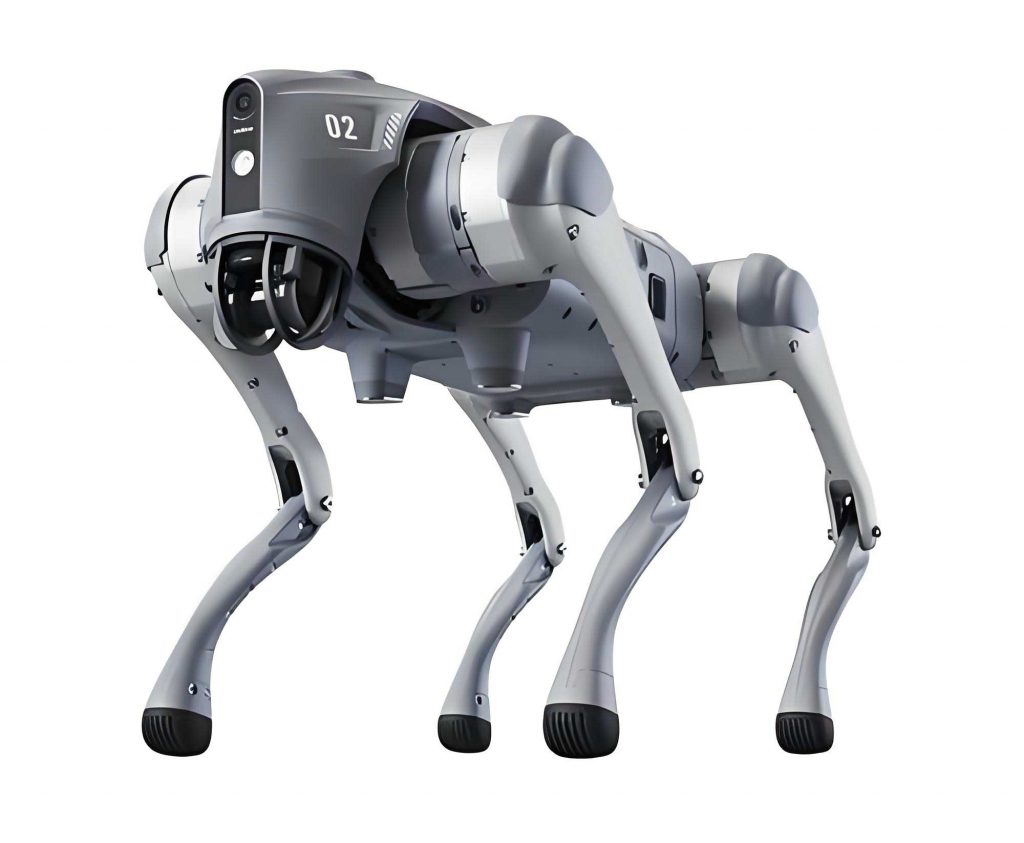
The core of the quadruped robot radiation monitoring system consists of several integrated modules: the robot dog itself, a positioning unit, a radiation detection unit, a control unit, and a remote monitoring interface. Each component was carefully selected and tested to ensure reliability and performance. The robot dog, a quadruped robot with 12 degrees of freedom, employs high-performance servo motors and force control technology for stable movement across uneven surfaces like gravel paths and grasslands. Its power unit includes a 12,600 mAh battery pack, providing sufficient energy for extended operations. The multi-vision system, comprising depth cameras and a visual odometry camera, enables real-time image transmission at 720p/30fps, along with features like person following and obstacle avoidance. This quadruped robot’s design allows it to carry additional payloads, such as radiation detectors, without compromising mobility.
To quantify the system’s capabilities, I incorporated mathematical models and formulas. For instance, the radiation dose rate D at a point can be described by the inverse square law for point sources: $$ D = \frac{k \cdot A}{r^2} $$ where D is the dose rate, k is a constant specific to the radionuclide, A is the activity, and r is the distance from the source. This equation helps in calibrating the detectors and interpreting field measurements. Additionally, the energy resolution R of the NaI detector, crucial for nuclide identification, is given by: $$ R = \frac{\text{FWHM}}{E} \times 100\% $$ where FWHM is the full width at half maximum of a spectral peak, and E is the energy of the gamma ray. In my tests, the quadruped robot’s detector consistently achieved resolutions below 7.2%, ensuring accurate nuclide discrimination.
| Parameter | Value | Unit |
|---|---|---|
| Dose Rate Range | 0.01 to 100 | μSv/h |
| Energy Range | 30 keV to 3 MeV | keV |
| Resolution at 662 keV | < 7.2 | % |
| Nuclide Identification Accuracy | 100 | % |
| Communication Range | Up to 500 | meters |
The positioning unit of the quadruped robot radiation monitoring system utilizes LiDAR technology to construct electronic maps of the environment and plan autonomous navigation paths. This allows the robot dog to perform SLAM (Simultaneous Localization and Mapping) operations, dynamically avoiding obstacles while updating map data in real-time. The LiDAR component has a field of view of 360 degrees, with a range of up to 100 meters, enabling the quadruped robot to operate in large, unstructured areas. I integrated this with GPS data to overlay radiation measurements on geographic information system (GIS) maps, providing a visual representation of dose rate distributions. The control unit includes both handheld remote controllers and tablet-based interfaces, allowing operators to manipulate the robot dog’s movements, such as walking, running, or climbing stairs, via Bluetooth or WIFI connections. The remote monitoring software displays live video feeds, radiation data, and alert notifications, ensuring comprehensive oversight.
Radiation detection is a critical aspect of this system, and I equipped the quadruped robot with a dual-detector setup: a NaI scintillator crystal for gamma spectroscopy and a G-M tube for dose rate measurements. The NaI detector, coupled with a photomultiplier tube and a digital multichannel analyzer, enables nuclide identification through spectral analysis. The process involves smoothing the raw spectrum using adaptive wavelet methods, peak searching via symmetric zero-area transformation, and spectrum unfolding to match nuclide libraries. For example, the count rate N in a detector can be modeled as: $$ N = \epsilon \cdot A \cdot e^{-\mu x} $$ where ε is the detection efficiency, A is the source activity, μ is the attenuation coefficient, and x is the material thickness. This formula aids in correcting for environmental factors during measurements. The robot dog’s ability to carry this instrumentation allows for on-the-fly analysis, with data transmitted wirelessly to the base station.
| Nuclide | Energy Peaks (keV) | Identification Rate (%) | Average Dose Rate (μSv/h) |
|---|---|---|---|
| 137Cs | 662 | 100 | 1.2 |
| 60Co | 1173, 1332 | 100 | 1.5 |
| 241Am | 59.5 | 100 | 0.8 |
| 152Eu | 121, 344, 1408 | 100 | 1.1 |
| 133Ba | 356 | 100 | 1.0 |
| 228Th | 583, 2614 | 100 | 1.3 |
| 226Ra | 186, 1120 | 100 | 1.4 |
During testing, I evaluated the quadruped robot radiation monitoring system under various conditions to validate its performance. The detector module was calibrated using standard sources, and the dose rate accuracy was confirmed to be within ±20% of reference values. For nuclide identification, I conducted multiple trials with single and mixed nuclides, all achieving 100% recognition rates. The robot dog’s mobility was tested on different terrains, including slopes up to 30 degrees and stairs with step heights of 20 cm, demonstrating stable operation without tipping. The battery life of the quadruped robot was measured under continuous use, lasting approximately 2 hours, which is sufficient for typical inspection tasks. However, I noted that heavier payloads could reduce this duration, highlighting an area for future improvement.
The remote monitoring unit plays a vital role in the system, providing a user-friendly interface for data visualization and control. I developed software that integrates real-time video from the robot dog’s cameras with radiation data, plotted on interactive maps. Alerts are triggered when dose rates exceed predefined thresholds, such as 1 μSv/h, enabling prompt responses. The software also logs historical data, allowing for trend analysis and reporting. In one test scenario, the quadruped robot was deployed in a simulated nuclear emergency, where it autonomously navigated to hotspots, identified radionuclides like 137Cs and 60Co, and transmitted data back to the command center. This demonstrated the robot dog’s utility in minimizing human exposure to radiation.
In practical applications, the quadruped robot radiation monitoring system has been deployed in real-world settings, such as port areas for inspecting imported minerals like iron ore and coal. For instance, in a recent operation at a coastal port, the robot dog was remotely controlled to survey stockpiles, providing dose rate measurements and nuclide identification that matched results from handheld devices. This not only ensured compliance with safety standards but also reduced the time required for inspections by 50%. The quadruped robot’s ability to access confined or dangerous areas, such as under conveyor belts or near unstable structures, proved invaluable. Moreover, in nuclear emergency drills, the robot dog successfully located and characterized radioactive sources, showcasing its potential for disaster response.
| Nuclide Combination | Identified Nuclides | Identification Rate (%) | Typical Dose Rate Range (μSv/h) |
|---|---|---|---|
| 60Co + 232Th | 60Co, 232Th | 100 | 1.5–2.0 |
| 241Am + 232Th | 241Am, 232Th | 100 | 1.0–1.8 |
| 137Cs + 232Th | 137Cs, 232Th | 100 | 1.2–1.7 |
| 241Am + 137Cs + 60Co | 241Am, 137Cs, 60Co | 100 | 1.5–2.5 |
| 226Ra + 137Cs | 226Ra, 137Cs | 100 | 1.3–1.9 |
| 226Ra + 60Co | 226Ra, 60Co | 100 | 1.6–2.2 |
Despite its successes, I have identified several areas for enhancement in the quadruped robot radiation monitoring system. The current 3D mapping algorithms, while functional, could be refined to produce more detailed environmental models. Additionally, the robot dog’s payload capacity is limited to about 5 kg, restricting the size of detectors that can be carried. To address this, I am exploring ways to increase the quadruped robot’s strength through mechanical optimizations, such as reinforced joints and lightweight materials. Battery life is another concern; I am investigating higher-capacity batteries or hybrid power systems to extend operational time. Furthermore, I plan to integrate advanced machine learning algorithms for improved autonomous navigation and anomaly detection, making the robot dog more intelligent and responsive.
From a technical perspective, the radiation detection process involves complex signal processing. The pulse height distribution from the NaI detector can be represented by a Gaussian function for each peak: $$ P(E) = \frac{1}{\sigma \sqrt{2\pi}} e^{-\frac{(E – \mu)^2}{2\sigma^2}} $$ where P(E) is the probability density at energy E, μ is the mean energy, and σ is the standard deviation related to the resolution. This model helps in peak fitting and nuclide quantification. In field tests, the quadruped robot’s system demonstrated a minimum detectable activity (MDA) of approximately 0.1 kBq for 137Cs at a distance of 1 meter, calculated using: $$ \text{MDA} = \frac{2.71 + 4.65 \sqrt{B}}{t \cdot \epsilon} $$ where B is the background count rate, t is the measurement time, and ε is the efficiency. Such calculations ensure that the robot dog meets sensitivity requirements for various monitoring tasks.
In conclusion, the quadruped robot radiation monitoring system represents a significant advancement in remote radiation surveillance, combining the mobility of a robot dog with precise detection capabilities. My experiences in designing and deploying this system have shown that it effectively reduces risks to personnel while providing accurate, real-time data. The robot dog’s versatility makes it suitable for a wide range of applications, from routine environmental checks to emergency response. As I continue to refine the technology, I aim to enhance the quadruped robot’s autonomy, durability, and integration with other smart systems. This work underscores the potential of quadruped robots in safeguarding public health and safety, and I believe that future iterations will set new standards in radiation monitoring.
Overall, the development of this quadruped robot-based system has been a rewarding endeavor, highlighting the importance of innovation in tackling environmental challenges. By leveraging the unique attributes of the robot dog, I have created a tool that not only meets current regulatory demands but also adapts to evolving needs. I encourage further research and collaboration to expand the capabilities of quadruped robots in radiation monitoring and beyond, ultimately contributing to a safer world.