
In this article, we present a comprehensive control strategy for enhancing the lateral impact resistance of quadruped robots, specifically focusing on robot dogs with active trunk joints. The approach leverages the Variable Height Inverted Pendulum (VHIP) model to manage disturbances during dynamic locomotion. Quadruped robots, often referred to as robot dogs, face significant challenges in maintaining stability under external lateral forces, which can lead to destabilization or even tipping over. Our method integrates capture point theory with real-time adjustments in center of mass height and trunk joint actuation, validated through simulations and experiments. The key contributions include a novel framework for classifying impacts using Zero Moment Point (ZMP) criteria, planning ideal footholds based on disturbance characteristics, and coordinating joint movements via a Central Pattern Generator (CPG) model. By repeatedly emphasizing the adaptability of robot dogs and quadruped robots, we demonstrate how this strategy reduces perturbation amplitudes, shortens lateral capture distances, and suppresses yaw deviations effectively.
The locomotion of quadruped robots, such as advanced robot dogs, involves complex dynamics where external lateral impacts can disrupt balance. Traditional methods often rely on fixed-height inverted pendulum models, which limit responsiveness to varying disturbances. In contrast, our VHIP-based approach allows the robot dog to dynamically adjust its center of mass height, improving stability. For instance, the energy of the center of mass trajectory is modeled as: $$E(y, \dot{y}) = \frac{1}{2} \dot{y}^2 – \frac{g}{2z_0} y^2$$ where \(E\) represents the orbital energy, \(y\) is the lateral displacement, \(\dot{y}\) is the lateral velocity, \(g\) is gravitational acceleration, and \(z_0\) is the initial center of mass height. This equation helps in determining the instantaneous capture point, crucial for balance recovery in a quadruped robot.
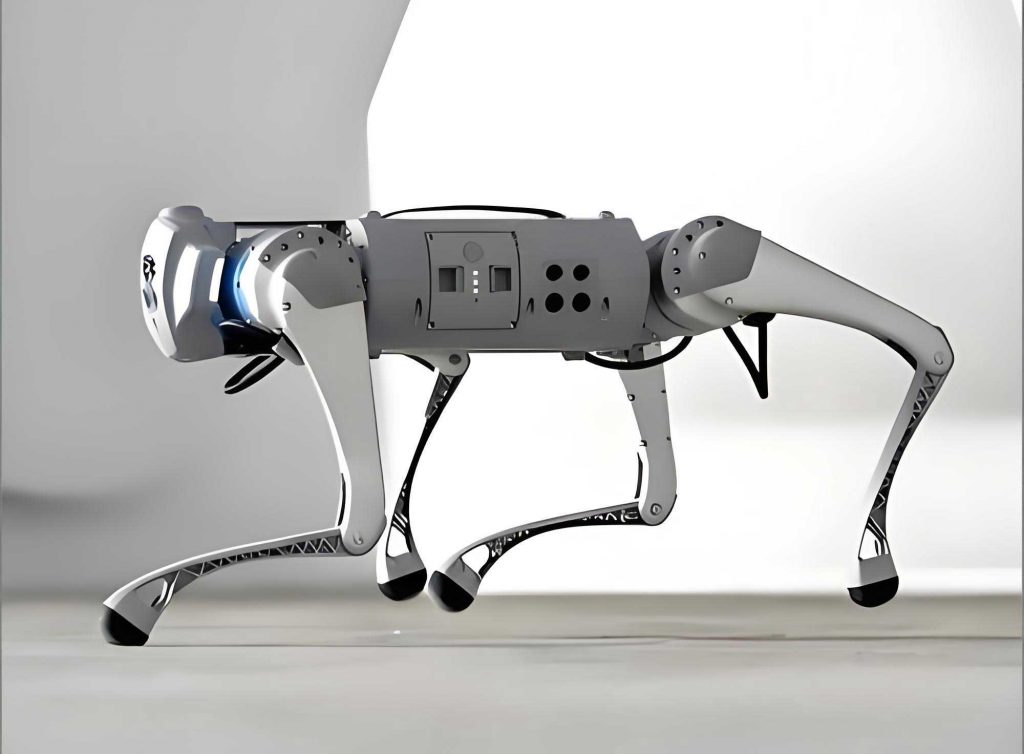
To contextualize our work, we first describe the kinematic model of an active trunk joint quadruped robot. The robot dog features a segmented body with articulated joints, enabling flexible movements. The forward kinematics for a leg, such as the right front leg, can be derived using Denavit-Hartenberg parameters. The end-effector position \(P_4^0\) in the base coordinate system is given by: $$P_4^0 = \begin{bmatrix} P_x \\ P_y \\ P_z \end{bmatrix} = \begin{bmatrix} l_4 c_1 c_{23} + l_3 c_1 c_2 + \omega l_1 s_1 + l_2 c_1 \\ l_4 s_1 c_{23} + l_3 s_1 c_2 – \omega l_1 c_1 + l_2 s_1 \\ l_4 s_{23} + l_3 s_2 \end{bmatrix}$$ where \(s_i = \sin \theta_i\), \(c_i = \cos \theta_i\), \(s_{ij} = \sin(\theta_i + \theta_j)\), \(c_{ij} = \cos(\theta_i + \theta_j)\), and \(\theta_1, \theta_2, \theta_3\) represent the roll hip, pitch hip, and pitch knee joint angles, respectively. Parameters like link lengths are summarized in Table 1, which provides a quick reference for the robot dog’s design specifications.
| Parameter | Value | Description |
|---|---|---|
| Total Mass | 4.5 kg | Overall weight of the robot dog |
| Front/Rear Body Length | 0.2010 m | Length of the anterior or posterior segment |
| Lateral Base Length | 0.0175 m | Distance in the transverse direction |
| Longitudinal Base Length | 0.0430 m | Distance along the sagittal plane |
| Thigh Length | 0.1375 m | Length of the upper leg link |
| Shank Length | 0.1620 m | Length of the lower leg link |
| Distance to Trunk Axis | 0.2200 m | From body end to trunk joint rotation axis |
| Hip Joint Half-Span | 0.1410 m | Half the distance between hip joints |
The inverse kinematics for leg positioning are essential for real-time control. For a given foot position \((x, y, z)\), the joint angles can be computed as: $$\theta_1 = \arcsin\left(\frac{l_1}{\sqrt{x^2 + y^2}}\right) + \arctan\left(\frac{y}{x}\right)$$ $$\theta_2 = \arccos\left(\frac{(l_{yz} – l_2)^2 + z^2 – l_3^2 – l_4^2}{2 l_3 l_4 \sqrt{l_{yz}}}\right) – \arctan\left(\frac{z}{l_{yz}}\right)$$ $$\theta_3 = \arccos\left(\frac{(l_{yz} – l_2)^2 + z^2 – l_3^2 – l_4^2}{2 l_3 l_4}\right)$$ where \(l_{yz} = \sqrt{x^2 + y^2 – l_1^2}\). This formulation allows the quadruped robot to precisely place its feet during impact recovery.
Our control strategy begins with classifying lateral impacts using the ZMP criterion. The ZMP coordinates \((x_{\text{ZMP}}, y_{\text{ZMP}})\) are derived from the dynamics: $$x_{\text{ZMP}} = x_{\text{COM}} + \frac{z}{\ddot{z} + g} a_x$$ $$y_{\text{ZMP}} = y_{\text{COM}} + \frac{z}{\ddot{z} + g} a_y$$ where \((x_{\text{COM}}, y_{\text{COM}})\) is the projection of the center of mass on the ground, \(z\) is the height, \(\ddot{z}\) is the vertical acceleration, and \((a_x, a_y)\) are the lateral accelerations. If the ZMP lies within the support polygon, the impact is non-capsizing; otherwise, it is capsizing. For non-capsizing impacts, the robot dog simply lowers its center of mass by adjusting the trunk joint angle \(\theta_{\text{spine}}\). The relationship between trunk angle and height change is: $$\Delta h_{\text{com}} = (1 – \cos(\frac{1}{2} \theta_{\text{spine}})) l_{fh} + \sin(\frac{1}{2} \theta_{\text{spine}}) \cdot \frac{1}{2} l$$ where \(l_{fh}\) is the distance from foot to hip during support phase, and \(l\) is the trunk length. This reduction in height decreases the disturbance amplitude, as verified in experiments.
For capsizing impacts, we employ the VHIP capture point model. The instantaneous capture point \(y_{\text{cp}}\) is calculated as: $$y_{\text{cp}} = \sqrt{\frac{z_0}{g}} \cdot \dot{y}_0$$ where \(\dot{y}_0\) is the initial lateral velocity after impact. This point represents the ideal foothold for stabilizing the quadruped robot. To plan the center of mass trajectory, we use an energy-based polynomial function \(f(y) = \sum_{i=0}^n a_i y^i\). For \(n=3\), the coefficients \((a_0, a_1, a_2, a_3)\) are solved using constraints: $$f(0) = a_0 = z_f$$ $$f'(y_0) = a_1 + 2a_2 y_0 + 3a_3 y_0^2 = \frac{z_0}{y_0}$$ $$f(y_0) = a_0 + a_1 y_0 + a_2 y_0^2 + a_3 y_0^3 = z_0$$ $$\frac{3}{2} a_0 g y_0^2 + a_1 g y_0^3 + \frac{3}{4} a_2 g y_0^4 + \frac{3}{5} a_3 g y_0^5 = e$$ where \(e\) is the energy integral derived from initial conditions. This trajectory ensures that the robot dog returns to a stable height after lateral adjustment.
Coordination of joint movements is achieved through a CPG model based on Hopf and sinusoidal oscillators. The oscillator dynamics for each leg \(k\) are: $$\begin{bmatrix} \dot{\phi}_1^k \\ \dot{\phi}_2^k \end{bmatrix} = \begin{bmatrix} \alpha (\mu – r_k^2) & -\omega_k \\ \omega_k & \alpha (\mu – r_k^2) \end{bmatrix} \begin{bmatrix} \phi_1^k – \sigma_1^k \\ \phi_2^k – \sigma_2^k \end{bmatrix} + \sum_{j=1}^4 R(\theta_j^k) \begin{bmatrix} \phi_1^j \\ \phi_2^j \end{bmatrix}$$ where \(r_k^2 = (\phi_1^k – \sigma_1^k)^2 + (\phi_2^k – \sigma_2^k)^2\), \(\omega_k\) is the frequency, and \(\sigma_i^k\) are adjustment terms. The joint angles \(\theta_1^k, \theta_2^k, \theta_3^k\) for pitch knee, pitch hip, and roll hip are generated from these oscillators. The trunk joint angle \(\theta_{\text{spine}}\) is integrated into the CPG network, with compensation for foot displacement due to trunk motion: $$l_F = l_H = l_{fh} \sin(\frac{1}{2} \theta_{\text{spine}}) + l_5 \cos(\frac{1}{2} \theta_{\text{spine}}) – l_5$$ This ensures accurate foot placement despite trunk movements in the quadruped robot.
To address yaw deviations post-impact, we adjust the footholds in the body frame. The updated foot position \((x_k’, y_k’)\) is computed as: $$(x_k’, y_k’) = R_Z(\gamma) (x_k, y_k)$$ where \(R_Z(\gamma)\) is the rotation matrix for yaw angle \(\gamma\). The corresponding joint adjustments \(\delta_i^k\) are incorporated into the CPG signals, maintaining alignment in the robot dog.
Simulations and experiments validate our strategy. In Webots and Simulink co-simulations, the quadruped robot subjected to lateral impacts shows improved stability. For non-capsizing impacts, increasing the trunk joint angle from 0° to 20° reduces roll and pitch perturbations by up to 30% and 40%, respectively. Table 2 summarizes the reduction in perturbation amplitudes for different trunk angles, highlighting the effectiveness of height adjustment in a robot dog.
| Trunk Joint Angle | Roll Angle Reduction | Pitch Angle Reduction |
|---|---|---|
| 0° | 0% | 0% |
| 10° | 15% | 20% |
| 15° | 25% | 30% |
| 20° | 30% | 40% |
For capsizing impacts, our VHIP-based method shortens the lateral capture distance by 32% compared to traditional capture point strategies, from 0.175 m to 0.119 m. The energy trajectory coefficients for a typical scenario are \((a_0, a_1, a_2, a_3) = (0.250, 0.502, 3.781, 9.389)\), guiding the center of mass smoothly. The CPG-generated joint signals exhibit seamless integration, with the trunk angle \(\theta_4\) following the planned trajectory. Stability margins, computed as the distance from ZMP to support polygon edges, recover faster with our approach, ensuring the quadruped robot remains stable during dynamic walks.
In experimental tests on a physical robot dog prototype, similar results are observed. The active trunk joint, driven by servo motors, enables real-time height adjustments. For instance, under a 4.0 kg pendulum impact, the lateral displacement is reduced to 0.12 m with our strategy, versus 0.17 m for traditional methods. The yaw correction mechanism prevents drifting, allowing the robot dog to maintain its path. The CPG model, implemented on an STM32F4 controller, demonstrates low computational overhead and high robustness, making it suitable for real-world applications of quadruped robots.
In conclusion, our VHIP-based control strategy significantly enhances the lateral impact resistance of quadruped robots with active trunk joints. By dynamically adjusting the center of mass height and planning energy-efficient trajectories, the robot dog can recover from disturbances more effectively. Future work will explore adapting this strategy to complex terrains, where terrain constraints interact with trunk adjustments and capture points. The integration of machine learning could further optimize parameters for diverse environments, advancing the capabilities of quadruped robots in practical scenarios.
The mathematical formulations and experimental data consistently support the efficacy of our approach. For example, the orbital energy equation $$E_f(y, \dot{y}) = \frac{1}{2} \dot{y}^2 f^{-}(y) + g y^2 f^2(y) – 3g \int_0^y f(\zeta) \zeta d\zeta$$ ensures conservation during movements, while the CPG dynamics enable adaptive coordination. As robot dogs and quadruped robots evolve, such strategies will be crucial for achieving reliable autonomy in unpredictable settings.