
In recent years, the development of quadruped robots, often referred to as robot dogs, has gained significant attention due to their potential in unstructured environments such as search and rescue, military operations, and industrial inspections. However, maintaining stability and smooth motion on rough terrain remains a critical challenge. Traditional control methods often rely on visual systems, which can be computationally intensive and fail in dynamic conditions. This paper addresses these limitations by proposing a vision-free control scheme that integrates terrain perception and stiffness adaptation for enhanced stability and adaptability. We focus on developing a robust framework that allows the quadruped robot to navigate complex landscapes without prior environmental knowledge, leveraging state estimation and adaptive impedance control.
The core of our approach lies in three main components: a state observer using Kalman filtering, a terrain-aware adaptation controller, and a stiffness-based whole-body controller. By fusing sensor data from IMUs, GPS, and joint encoders, we achieve accurate state estimation without visual inputs. The terrain perception module mitigates high-frequency body oscillations, while the stiffness adaptation ensures rapid convergence of posture errors. Through extensive simulations and prototype experiments, we demonstrate that our method significantly improves the robot dog’s performance on uneven terrain, reducing jitter and enhancing dynamic stability. This work contributes to the broader field of legged robotics by providing a computationally efficient and reliable solution for real-world applications.
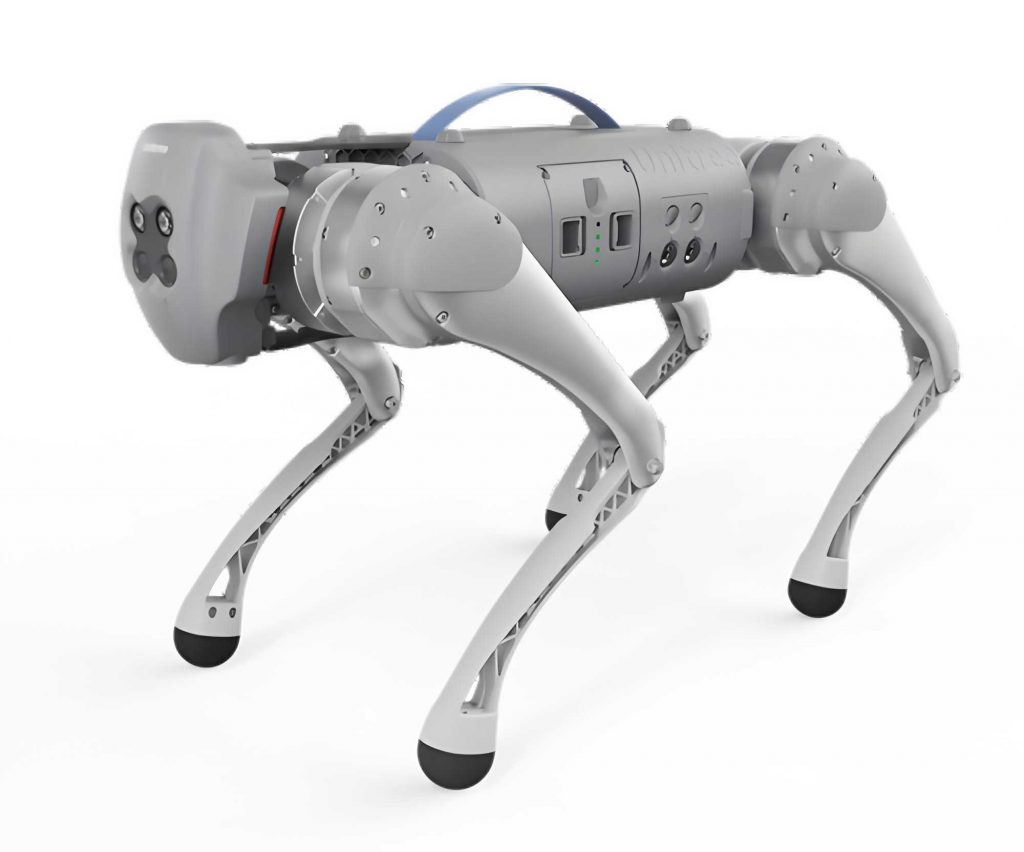
To model the quadruped robot, we consider a dynamic system comprising a rigid body and four leg mechanisms. Each leg consists of thigh and shin links, actuated by hip and knee motors. The robot’s pose is defined in an inertial frame {W}, with the body frame {B} describing orientation through Euler angles $\phi$, $\theta$, and $\psi$. The generalized coordinates are given by $\mathbf{q} = [\mathbf{P}_{\text{com}}^T, \mathbf{\Phi}_B^T, \mathbf{q}_j^T]^T \in \mathbb{R}^{18}$, where $\mathbf{P}_{\text{com}} = [x, y, z]^T$ is the center of mass position, $\mathbf{\Phi}_B = [\phi, \theta, \psi]^T$ represents orientation, and $\mathbf{q}_j$ denotes joint angles. The dynamics are governed by the floating-base equation:
$$ \mathbf{M}_{\text{com}} \ddot{\mathbf{q}} + \mathbf{h}_{\text{com}} = \mathbf{S} \mathbf{J}_{\text{com}}^T \mathbf{F}_{\text{grf}} $$
Here, $\mathbf{M}_{\text{com}}$ is the inertia matrix, $\mathbf{h}_{\text{com}}$ combines Coriolis, centrifugal, and gravitational forces, $\mathbf{F}_{\text{grf}} \in \mathbb{R}^{12}$ is the ground reaction force vector, $\mathbf{S}$ is a selection matrix for swing legs, and $\mathbf{J}_{\text{com}}$ is the Jacobian mapping foot positions to the center of mass. The desired torque $\mathbf{T}_{\text{com},d}$ is derived from $\mathbf{F}_{\text{grf},d}$ via $\mathbf{T}_{\text{com},d} = \mathbf{J}_{\text{com}} \mathbf{F}_{\text{grf},d}$, and an optimization problem is solved to compute optimal control inputs.
We formulate a quadratic programming (QP) problem to minimize errors in torque tracking while adhering to constraints such as friction cones and joint limits. The optimization variable $\mathbf{u} = [\ddot{\mathbf{q}}^T, \mathbf{F}_{\text{grf}}^T]^T$ is found by solving:
$$ \min_{\mathbf{u}} \| \mathbf{T}_{\text{com},d} – \mathbf{T}_{\text{com}} \|^2 + \alpha \| \mathbf{u} \|^2 + \beta \| \mathbf{u} – \mathbf{u}^*_{\text{prev}} \|^2 $$
subject to constraints $\Sigma$ and $\Xi$, where $\Sigma$ ensures non-negative normal forces and friction cone adherence, and $\Xi$ enforces joint acceleration and torque bounds. The solution yields joint torques $\boldsymbol{\tau}_d = -\mathbf{J}_{\text{kine}}^T \mathbf{F}^*_{\text{grf}}$ through kinematic mapping.
For state estimation, we employ an error-state Kalman filter (ErKF) that integrates data from GPS, IMU, and encoders. The true state $\mathbf{X}_t = [\mathbf{P}_{\text{com},t}^T, \mathbf{v}_t^T, \mathbf{Q}_t^T, \mathbf{a}_{bt}^T, \boldsymbol{\omega}_{bt}^T]^T \in \mathbb{R}^{16}$ includes position, velocity, orientation (as a quaternion $\mathbf{Q}_t$), and sensor biases. The estimated state $\hat{\mathbf{X}}_k$ is updated recursively using:
$$ \delta \hat{\mathbf{X}}_k = \delta \hat{\mathbf{X}}_k^- + \mathbf{K}_k (\mathbf{Z}_k – \hat{\mathbf{Z}}_k) $$
where $\mathbf{K}_k$ is the Kalman gain, $\mathbf{Z}_k$ is the measurement vector from odometry and GPS, and $\hat{\mathbf{Z}}_k$ is the predicted measurement. This approach minimizes noise and drift, providing accurate state estimates for control.
The terrain-aware adaptation controller (TAAC) computes optimal orientation angles $\mathbf{\Phi}^*_{B,d} = [\phi^*_d, \theta^*_d, \psi^*_d]^T$ to suppress high-frequency jitter. By modeling the support polygon formed by ground contacts, we define a normal vector $\mathbf{n}_{\text{sup}}$ and solve a QP problem to align the body’s Z-axis with $\mathbf{n}_{\text{sup}}$ smoothly. For instance, the optimal roll angle $\phi^*_d$ is derived from:
$$ \Omega = \min_{\phi^*_i} | \phi_i – \phi_{R_d,i} |^2 + S^{\phi}_{\text{TCI},i} | \phi_i – \phi_{\text{sup},i} |^2 $$
where $S^{\phi}_{\text{TCI},i}$ is a terrain complexity coefficient calculated over a sliding window. This ensures adaptive posture adjustments without excessive oscillations.
The stiffness adaptive whole-body controller (SAWBC) translates the desired orientation into torque commands using variable impedance. The Cartesian impedance law is:
$$ \mathbf{T}_{\text{com},d} = \mathbf{M}_{\text{com}} \ddot{\mathbf{E}}_{\text{com}} + \mathbf{D}_{\text{com}} \dot{\mathbf{E}}_{\text{com}} + (\mathbf{K}_{\text{com},0} + \mathbf{K}_{\text{com},v}) \mathbf{E}_{\text{com}} + \mathbf{T}_g $$
where $\mathbf{E}_{\text{com}} = [\Delta \mathbf{x}_{\text{com}}^T, \Delta \boldsymbol{\phi}_{\text{rpy}}^T]^T$ is the generalized error, $\mathbf{K}_{\text{com},0}$ is the base stiffness, $\mathbf{K}_{\text{com},v}$ is the adaptive term, and $\mathbf{T}_g$ is gravity compensation. The optimal stiffness variation is computed to minimize a cost function $\Gamma_{\text{com}}$:
$$ \nabla \Gamma_{\text{com}} = \frac{d \Gamma_{\text{com}}}{d (\mathbf{K}_{\text{com},v} \mathbf{E}_{\text{com}})} = \dot{\mathbf{E}}_{\text{com}} \mathbf{D}_{\text{com}}^{-1} – \mathbf{B} \mathbf{T}_{\text{com},e} $$
leading to the update rule $\mathbf{K}_{\text{com},v}(t) = \mathbf{K}_{\text{com},v}(t – \lambda) – \gamma_1 \nabla \Gamma_{\text{com}}$. Similarly, for swing legs, we define $\mathbf{F}_{\text{sw},d}$ with adaptive stiffness $\mathbf{K}_{\text{sw},v}$ to ensure smooth foot placement.
Stability analysis using Lyapunov theory confirms system-wide passivity. We define a Lyapunov function $V = V_{\text{still}} + V_{\text{sw}}$ and show that its derivative $\dot{V} < 0$ under the proposed controllers, ensuring asymptotic stability for both the robot and the ErKF estimator.
In simulation experiments, we evaluate the ErKF’s performance on a sloped terrain defined by $\alpha_{\text{slop}} = 0.4$ rad for $2 < x < 7$ m and $\alpha_{\text{slop}} = 0.2$ rad for $7 < x < 12$ m. The state estimates closely track true values, with errors summarized in Table 1.
| Variable | Max Error | Min Error | Mean Error | RMSE |
|---|---|---|---|---|
| $E_X$ | 0.025 m | -0.023 m | 0.0001 m | 0.0083 |
| $E_Y$ | 0.0409 m | -0.0016 m | 0.0316 m | 0.0075 |
| $E_Z$ | 0.1333 m | -0.0192 m | 0.0023 m | 0.0127 |
| $E_\phi$ | 0.0054 rad | -0.0132 rad | -0.0021 rad | 0.0043 |
| $E_\theta$ | 0.0058 rad | -0.0184 rad | -0.0037 rad | 0.0067 |
| $E_\psi$ | 0.0055 rad | -0.0024 rad | -0.0020 rad | 0.0019 |
For rugged terrain testing, we compare our method (SI) with baseline approaches (HP and SP). The terrain includes a structured slope and a randomized section with height variations up to 1.6 m. Orientation angles $\phi$, $\theta$, and $\psi$ under SI control exhibit minimal oscillation, as shown in Figure 7, with errors converging faster due to adaptive stiffness. For example, after a disturbance, SI reduces roll error $E_\phi$ to within ±0.02 rad in 0.978 s, compared to 1.456 s for SP and 1.95 s for HP.
Anti-disturbance tests involve applying a 100 N force to the robot dog’s lateral direction. The quadruped robot under SI control recovers swiftly, with posture errors damped within seconds. Standard deviations of orientation angles are lower for SI, as listed in Table 2, confirming enhanced stability.
| Method | $\sigma_\phi$ (°) | $\sigma_\theta$ (°) | $\sigma_\psi$ (°) |
|---|---|---|---|
| SI | 1.6500 | 2.2409 | 0.6344 |
| HP | 2.7827 | 4.4980 | 2.3116 |
| SP | 2.0721 | 3.2449 | 1.2188 |
Prototype experiments on unstructured terrain with vegetation and pits further validate the approach. The robot dog equipped with SI controller maintains smoother posture curves compared to HP and SP, with reduced high-frequency oscillations. The physical parameters of the quadruped robot are summarized in Table 3.
| Parameter | Symbol | Value |
|---|---|---|
| Total Mass | $M_{\text{total}}$ | 16.440 kg |
| Body Mass | $M_{\text{body}}$ | 14.668 kg |
| Leg Mass | $M_{\text{legs}}$ | 1.772 kg |
| Body Length | $l$ | 0.545 m |
| Body Width | $w$ | 0.315 m |
| Leg Length | $l_1, l_2$ | 0.180 m |
In conclusion, our vision-free control scheme for quadruped robots demonstrates superior terrain adaptation and motion smoothness. The integration of state estimation, terrain perception, and stiffness adaptation enables the robot dog to navigate complex environments reliably. Future work will explore reinforcement learning for multi-robot coordination, further advancing the capabilities of legged robotics in real-world scenarios.