
In modern transportation infrastructure, tunnels represent critical passages through natural barriers such as mountains, rivers, and seabeds. These enclosed environments create unique challenges for safety management, significantly increasing the probability and severity of accidents. Historical data from tunnel incidents reveals that secondary accidents often occur shortly after the initial event, particularly in cases involving fires or hazardous chemical leaks. Such scenarios can rapidly generate toxic smoke, posing grave threats to human life. Therefore, rapid and effective emergency response is paramount to minimizing casualties, controlling accident escalation, restoring traffic flow, and bolstering public confidence in transportation safety. The integration of advanced unmanned systems, including drones and quadruped robot dogs, has emerged as a transformative solution. These devices operate independently of time and environmental constraints, excelling in conditions with thick smoke or toxic gases. By enabling immediate intervention, they reduce losses and enhance emergency efficiency while mitigating risks for rescue personnel. This article explores the synergistic use of drones and robot dogs in tunnel emergencies, focusing on system design, operational workflows, and performance analysis.
The enclosed nature of tunnels amplifies the consequences of accidents, as limited escape routes and ventilation systems can exacerbate hazards. For instance, in fire-related incidents, visibility drops rapidly due to smoke, hindering traditional rescue efforts. Similarly, chemical leaks demand swift detection and containment to prevent widespread harm. Unmanned systems like drones and quadruped robot dogs address these challenges by providing remote reconnaissance, data collection, and guidance capabilities. Their ability to navigate complex terrains and transmit real-time data ensures that emergency responders can make informed decisions without direct exposure to dangers. This approach not only accelerates response times but also introduces a new paradigm in tunnel safety management, where automation and intelligence play pivotal roles.
Current Applications of Unmanned Systems in Tunnels
Unmanned systems have seen varied adoption in tunnel environments, with轨道巡检机器人 (rail-inspection robots) being widely deployed in highway tunnels across regions like Guangdong, Shandong, and Beijing. These robots perform routine inspections and emergency handling, including environmental monitoring, traffic event detection, infrastructure checks, and mobile law enforcement. However, their reliance on standardized tracks poses limitations, as incompatibility between manufacturers hinders scalability and technological exchange. Additionally, high development and operational costs restrict widespread use, particularly for budget-constrained entities. In contrast, drones face challenges in tunnels due to weak navigation signals, but they excel in open-air scenarios like highway network patrols and emergency command. Quadruped robot dogs, though less common in tunnels, show promise in fields such as power inspection, campus patrols, and fire rescue, leveraging their agile mobility to access confined spaces.
The potential of quadruped robot dogs in tunnel emergencies lies in their ability to replace costly track-based systems with more flexible and affordable alternatives. Their four-legged design allows them to traverse uneven surfaces and narrow passages, making them ideal for reconnaissance and guidance tasks. As technology advances, further exploration into their capabilities could expand their role to daily tunnel inspections, enhancing overall safety protocols. The following table summarizes the key characteristics of these unmanned systems in tunnel applications:
| Device Type | Primary Applications | Advantages | Limitations |
|---|---|---|---|
| Rail-Inspection Robots | Routine inspections, environmental monitoring | High precision, automated patrols | Track dependency, high cost, compatibility issues |
| Drones | Aerial reconnaissance, traffic警示 | Rapid deployment, wide coverage | Signal loss in tunnels, limited indoor use |
| Quadruped Robot Dogs | Search and rescue, gas detection, guidance | Terrain adaptability, cost-effectiveness | Limited battery life, emerging technology |
To quantify the operational efficiency of these systems, consider the response time model: $$ T_{response} = T_{detection} + T_{deployment} + T_{operation} $$ where \( T_{detection} \) is the time to identify an incident, \( T_{deployment} \) is the time to dispatch devices, and \( T_{operation} \) is the time to execute tasks. By integrating drones and robot dogs, \( T_{deployment} \) and \( T_{operation} \) can be reduced significantly, leading to faster overall response.
System Design Methodology
The design of an integrated system for tunnel emergencies involves careful selection of unmanned devices, development of a robust software platform, and definition of operational workflows. This system aims to leverage the strengths of drones and quadruped robot dogs while addressing their individual limitations through协同作业 (collaborative operations).
Unmanned Device Selection
For drones, medium-sized models are preferred due to their balance of size and functionality. They are equipped with high-resolution cameras for detailed imagery, warning lights to attract driver attention, and loudspeakers for remote communication. To ensure reliable data transmission, 4G image enhancement modules are incorporated, allowing continuous operation even if self-organizing network signals fail. Additionally, automatic drone nests with uninterruptible power supply (UPS) batteries enable autonomous deployment and charging, facilitated by 4G communication modules for cloud connectivity. The relationship between drone components can be expressed as a functional matrix: $$ \mathbf{F}_{drone} = \begin{bmatrix} \text{Camera} & \text{Warning Lights} & \text{Loudspeaker} & \text{4G Module} \end{bmatrix} $$ where each element contributes to the overall mission capability.
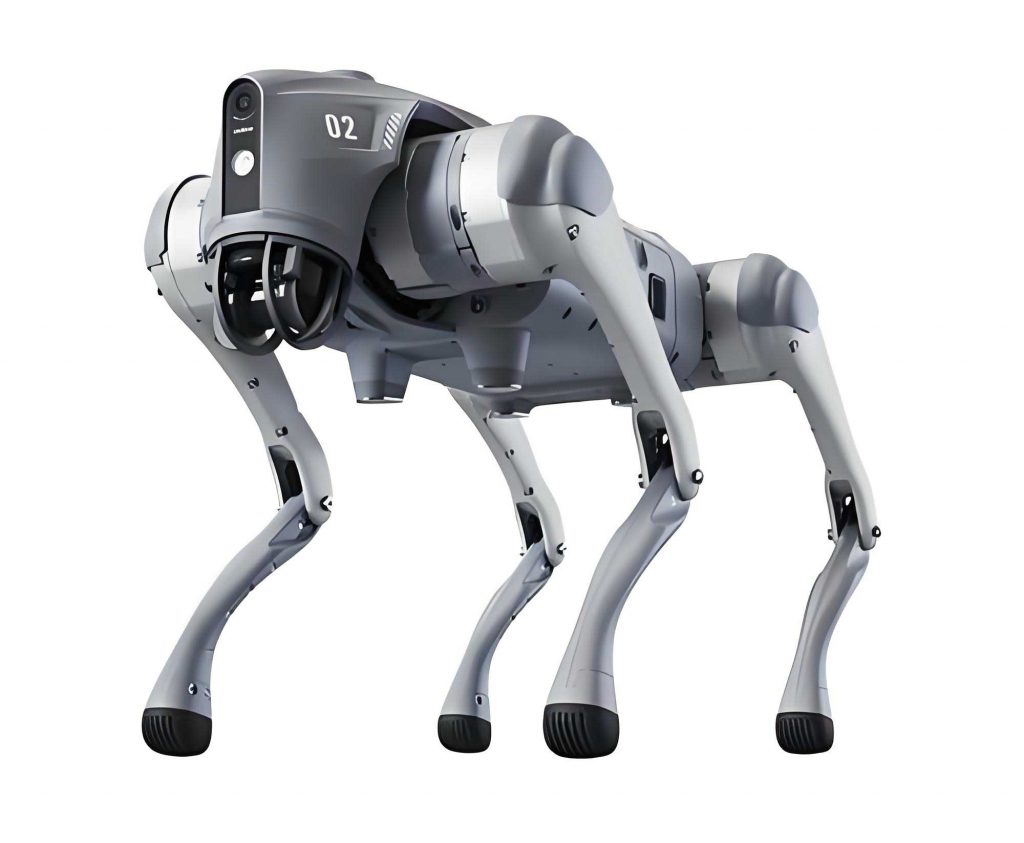
For the robot dog, a quadruped robot platform is chosen for its stability and mobility. It is outfitted with high-definition cameras, gas sensors for air quality monitoring, and loudspeakers for on-site communication. Charging stations and UPS batteries ensure operational continuity, with wireless self-organizing networks enabling communication through station proxies. If the network fails, 4G backup links maintain cloud connectivity. The robot dog’s payload capacity can be modeled as: $$ P_{robot\,dog} = \sum_{i=1}^{n} w_i \cdot c_i $$ where \( w_i \) is the weight of each component (e.g., camera, sensor) and \( c_i \) is its functional coefficient. This ensures optimal load distribution for efficient performance.
Software Platform Development
The software platform serves as the backbone for managing unmanned devices, providing centralized control, data processing, and integration with business systems. It is structured into business, application, and technical architectures to ensure scalability and efficiency.
Business Architecture
The business architecture emphasizes enterprise-level middleware capabilities, avoiding redundant constructions across departments. It facilitates data centralization, device sharing, and resource optimization. Key modules include:
- Device Management: Unified management of drones, robot dogs, nests, and payloads.
- Task Path Management: Automated path planning for devices.
- Plan Management: Scheduling and recording of operational tasks.
- Data Management: Storage and analysis of collected data, including historical trajectories.
- Real-Time Monitoring: Live streaming and remote control during operations.
- Application Management: Integration with business applications.
- Data Analysis: Statistical insights from operational data.
- System Management: Organizational, role, user, and log management.
The efficiency of this architecture can be represented by the formula: $$ E_{system} = \frac{\sum_{i=1}^{k} U_i \cdot A_i}{T_{total}} $$ where \( U_i \) is the utilization rate of each module, \( A_i \) is its availability, and \( T_{total} \) is the total operational time.
Application Architecture
The application architecture adopts a demand-oriented design, incorporating cloud computing, GIS engines, IoT, AI, and unmanned technologies. It is layered as follows:
- Technical Platform Layer: Utilizes private cloud for resource deployment, DevOps for streamlined development, and monitoring platforms for system observability.
- Basic Capability Layer: Employs GIS engines for geospatial visualization and AI platforms for video analysis and automated path planning using digital elevation models (DEM).
- Platform Service Layer: Features modular services for device access, application operations, and standardized API integration.
- Presentation Layer: Web-based PC applications for functional display and user interaction.
The interoperability between layers ensures seamless operation, as shown in the compatibility matrix: $$ \mathbf{C} = \begin{bmatrix} \text{Cloud} & \text{GIS} & \text{AI} & \text{API} \end{bmatrix} $$ where each element supports cross-layer functionality.
Technical Architecture
The technical architecture builds on the application framework, leveraging data center private clouds and cloud services. It comprises:
- Infrastructure Layer: Provides compute, storage, and network resources.
- Data Management Layer: Uses relational databases for business data, time-series databases for system metrics, object storage for media files, and document databases for logs. Caching databases handle user credentials and device statuses.
- Basic Function Layer: Integrates GIS engines for 2D/3D mapping and path planning algorithms, along with streaming media services for live broadcasts.
- Middleware Service Layer: Developed with Java 17 and SpringBoot for backend services, MyBatis-plus for data access, XXL-Job for task scheduling, and EMQX/Redis for message queues.
- API Interface Layer: Uses Nginx for load balancing, RESTful APIs for standard communication, and WebSocket for real-time device status updates.
- User Interface Layer: Built with Vue2, Element-UI, CSS, and GIS SDKs for responsive web interfaces.
The reliability of this architecture is quantified by the equation: $$ R_{system} = \prod_{j=1}^{m} (1 – \lambda_j) $$ where \( \lambda_j \) is the failure rate of each component, emphasizing the importance of redundancy.
Workflow Example
In an emergency scenario, such as a tunnel fire or chemical leak, predefined paths for drones and quadruped robot dogs are activated. The emergency command system interfaces with the unmanned middleware via APIs to initiate tasks. Drones fly to positions 500 meters ahead of the tunnel entrance, performing traffic警示 through往返飞行 (back-and-forth patterns) and using lights and loudspeakers to alert drivers. Simultaneously, the robot dog enters the tunnel to conduct reconnaissance, capturing images and gas readings. AI-based image recognition on the cloud platform identifies incidents like fires or accidents, with infrared cameras locating trapped individuals. Operators can remotely adjust device paths, control cameras, and issue evacuation instructions. The workflow efficiency is measured by the task completion rate: $$ \eta = \frac{N_{completed}}{N_{total}} \times 100\% $$ where \( N_{completed} \) is the number of successfully executed tasks and \( N_{total} \) is the total assigned tasks.
Application Analysis
The collaborative system demonstrates significant improvements in emergency response. Key performance metrics include response speed, data acquisition, environmental adaptability, and reliability. For instance, response times are reduced from tens of minutes to just a few minutes, representing a several-fold increase in efficiency. The following table compares traditional methods with the unmanned system:
| Metric | Traditional Response | Drone-Robot Dog System | Improvement |
|---|---|---|---|
| Response Time (minutes) | 30-60 | 5-10 | $$ \Delta T = 80\% $$ reduction |
| Data Accuracy | Moderate (human-dependent) | High (sensor-based) | Enhanced decision-making |
| Risk to Personnel | High | Low | Significant safety gain |
In fire accidents, the system enables rapid侦察 (reconnaissance) and gas monitoring, while in chemical leaks, it detects harmful concentrations and guides evacuations. The quadruped robot dog’s terrain adaptability ensures stable movement on uneven surfaces, and the drone’s flight stability in open areas complements this by providing aerial oversight. Redundant designs, such as backup links and UPS, enhance reliability, with system availability calculated as: $$ A = \frac{Uptime}{Uptime + Downtime} \times 100\% $$ typically exceeding 99% in simulated tests.
Conclusion
The integration of drones and quadruped robot dogs into tunnel emergency response systems offers a robust solution to enhance safety and efficiency. By leveraging their complementary strengths, this approach addresses the limitations of traditional methods, such as slow response and high risks. Future developments could expand the use of robot dogs to daily tunnel inspections and extend drone applications to highway slopes and bridges, optimizing resource utilization and improving overall maintenance quality. As technology evolves, continued innovation in AI, path planning, and device interoperability will further solidify the role of unmanned systems in transportation safety, ensuring they become indispensable tools for modern infrastructure management.