
In recent years, the development of legged robots, particularly quadruped robots, has gained significant attention due to their superior mobility and adaptability in complex environments. As a researcher in robotics, I have focused on enhancing human-robot interaction for these systems. Traditional control methods, such as remote controllers or keyboards, often limit the flexibility and intelligence of robot dogs in dynamic scenarios. To address this, I designed a multimodal control system based on natural language voice interaction for a quadruped robot. This system integrates voice recognition, command parsing, and real-time feedback to enable seamless control over various locomotion modes, including omnidirectional movement, gait transitions, personnel following, and autonomous navigation. In this article, I will detail the hardware and software components, the self-organizing feature map (SOFM) network for voice recognition, the integration with the Robot Operating System (ROS), and experimental validations. The goal is to provide a comprehensive framework that improves the usability and intelligence of quadruped robots in practical applications, such as search and rescue or industrial inspections.
The core of this system revolves around a robust voice interaction module that captures, processes, and executes commands. For the hardware, I utilized a high-performance electric quadruped robot, which weighs approximately 38 kg and features 12 degrees of freedom, allowing it to perform gaits like trot, walk, and flying trot at speeds up to 5.2 m/s. The voice module consists of a six-microphone array for 360-degree sound capture, an offline voice recognition controller, and a speaker for feedback. This setup ensures reliable voice input even in noisy environments, with a pickup range of 3.5 meters. The overall hardware framework, as illustrated in the system diagram, connects these components via power and data lines to minimize electromagnetic interference and ensure stable operation. Below is a table summarizing the key hardware specifications:
| Component | Specification |
|---|---|
| Quadruped Robot | Mass: 38 kg, DOF: 12, Max Speed: 5.2 m/s, Battery Life: 1.5 h |
| Microphone Array | 6 microphones, 360° pickup, Range: 3.5 m, Resolution: 1° |
| Voice Recognition Controller | Offline processing, Supports ROS integration |
| Speaker | For audio feedback and status reporting |
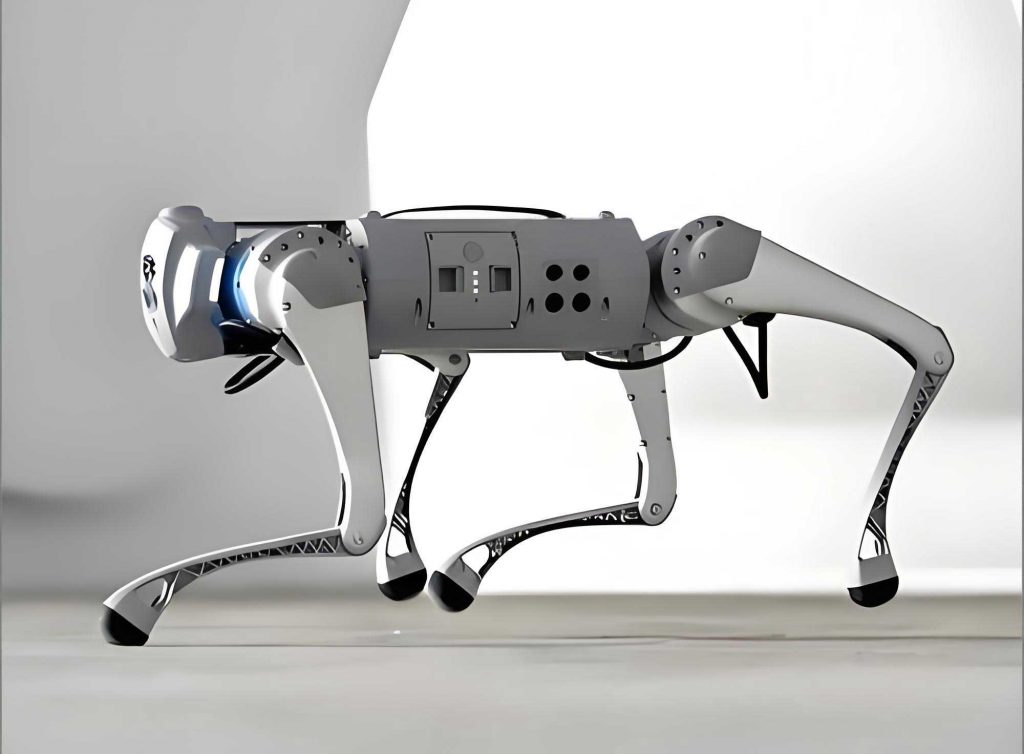
To give a visual representation of the robot dog in action, here is an image of the quadruped robot used in this study:
The voice recognition algorithm is based on the self-organizing feature map (SOFM) neural network, which excels in handling noisy environments by learning the topological structure of input data. The SOFM process involves two phases: competition and cooperation. In the competition phase, the input feature vector, derived from voice signals, is compared to all neurons in the competitive layer to find the best-matching neuron, known as the winning neuron. This is mathematically represented as: $$ i = \arg\min_j \| \mathbf{x} – \mathbf{w}_j \| $$ where $\mathbf{x}$ is the input feature vector and $\mathbf{w}_j$ is the weight vector of neuron $j$. In the cooperation phase, the weights of the winning neuron and its neighbors are updated to better approximate the input: $$ \mathbf{w}_j(t+1) = \mathbf{w}_j(t) + \eta(t) \cdot h_{ji}(t) \cdot (\mathbf{x} – \mathbf{w}_j(t)) $$ Here, $\eta(t)$ is the learning rate that decreases over time, and $h_{ji}(t)$ is the neighborhood function, typically a Gaussian kernel that shrinks as training progresses. This approach allows the SOFM network to cluster voice features effectively, enabling accurate command recognition for the quadruped robot. The feature extraction step converts voice signals into Mel-frequency cepstral coefficients (MFCCs), which are then fed into the SOFM for training. After training, the network can classify new voice inputs into predefined categories, such as movement commands or gait transitions.
Integration with ROS is crucial for real-time control and feedback. I established a communication mechanism where the voice module publishes recognized commands to ROS topics, which are subscribed to by the robot’s motion control nodes. This enables seamless translation of voice instructions into motion parameters, such as step height, frequency, and velocity. For instance, a command like “move forward” triggers the publication of a message that sets the robot dog’s linear velocity in the x-direction. The motion controller then computes joint torques and positions using optimization algorithms, ensuring stable locomotion. The voice interaction system also includes a feedback loop where the robot dog broadcasts its status via the speaker, confirming command execution. This bidirectional communication enhances user trust and interaction efficiency. The overall control flow can be summarized in the following steps: voice capture, SOFM-based recognition, command parsing into ROS messages, motion execution, and audio feedback. To handle multiple modes, I designed a command parser that categorizes inputs into basic movements, gait switches, autonomous behaviors, and emergency actions. For example, autonomous navigation involves laser mapping and person-following modules, which are activated by specific voice commands.
In the experimental phase, I conducted two main tests to evaluate the system’s performance: voice recognition accuracy and the integration of voice control with locomotion. For the recognition tests, I used a set of common commands, such as “stand up,” “move forward,” “turn left,” “go to target,” “stop,” and “lie down.” These were tested in both static and dynamic environments, with the quadruped robot either stationary or moving. The results, compiled over 100 trials per command, are presented in the table below:
| Voice Command | Recognition Success Rate (Static) | Recognition Success Rate (Dynamic) |
|---|---|---|
| Stand Up | 98% | 88% |
| Move Forward | 97% | 86% |
| Turn Left | 96% | 85% |
| Go to Target | 95% | 84% |
| Stop | 99% | 90% |
| Lie Down | 97% | 87% |
As shown, the success rate exceeds 95% in static conditions but drops to around 85% during motion due to environmental noise and robot-induced vibrations. This highlights the robustness of the SOFM network in adapting to varying conditions. For the motion control integration tests, I instructed the quadruped robot to perform tasks like navigating to a specified point or switching gaits based on voice input. The robot dog successfully executed these commands with minimal latency, demonstrating the system’s practicality. For example, when given the command “switch to trot gait,” the robot adjusted its parameters in real-time, achieving a smooth transition. The motion dynamics can be modeled using equations derived from robot kinematics. For instance, the relationship between joint angles and foot positions in a quadruped robot can be expressed as: $$ \mathbf{p} = f(\boldsymbol{\theta}) $$ where $\mathbf{p}$ is the foot position vector and $\boldsymbol{\theta}$ is the joint angle vector. The control law for maintaining balance during voice-commanded movements involves solving an optimization problem to minimize tracking error: $$ \min_{\boldsymbol{\tau}} \| \dot{\mathbf{x}}_{des} – \dot{\mathbf{x}} \|^2 + \lambda \| \boldsymbol{\tau} \|^2 $$ Here, $\boldsymbol{\tau}$ represents the joint torques, $\dot{\mathbf{x}}_{des}$ is the desired velocity from voice commands, $\dot{\mathbf{x}}$ is the actual velocity, and $\lambda$ is a regularization parameter. This ensures stable and responsive control for the robot dog across different terrains.
Further analysis involved testing the quadruped robot in scenarios requiring complex interactions, such as person following and autonomous navigation. In these cases, voice commands like “follow me” activated visual perception modules that tracked a person using onboard sensors. The robot dog maintained a safe distance while adapting its path, showcasing the integration of voice with autonomous capabilities. The success of these experiments underscores the potential of voice interaction to enhance the versatility of quadruped robots in real-world applications. For instance, in a simulated rescue mission, the robot dog responded to commands like “search the area” by initiating a mapping routine, with status updates provided through audio feedback. This multimodal approach not only improves usability but also reduces the cognitive load on operators, making robot dogs more accessible for non-expert users.
In conclusion, the voice-controlled multimodal system for quadruped robots presented here effectively addresses the limitations of traditional control methods. By leveraging SOFM-based voice recognition and ROS integration, the robot dog achieves high accuracy in command execution across various locomotion modes. Experimental results confirm that the system maintains over 85% recognition accuracy in dynamic environments, ensuring reliable performance in practical settings. Future work will focus on refining the algorithm to handle more complex commands and integrating additional sensors for enhanced environmental awareness. This research contributes to the advancement of intelligent human-robot interaction, paving the way for broader adoption of quadruped robots in diverse fields. The combination of voice interaction and robust motion control makes the robot dog a powerful tool for tasks ranging from industrial inspections to emergency response, highlighting the transformative impact of multimodal systems in robotics.