
As a core component in precision transmission systems for robotics and aerospace applications, the harmonic drive gear continues to be a focal point of research. This technology relies on the elastic deformation of a flexspline to transmit motion and torque, offering advantages such as high reduction ratios, minimal backlash, and superior accuracy. The flexspline, a thin-walled cup or ring with external teeth, undergoes significant and complex stress during assembly with the wave generator. This assembly deformation is the fundamental basis for tooth profile design and meshing analysis. Therefore, a precise understanding of the deformation and stress state of the flexspline tooth ring is paramount for performance and longevity.
Existing theoretical models for harmonic drive gear analysis, often based on thin-ring or constant-thickness shell theories, typically assume that the neutral line of the deformed flexspline tooth ring conforms perfectly to an equidistant curve of the cam profile of the wave generator along its entire circumference. This assumption implicitly prescribes a wrap angle of 90 degrees for an elliptical cam. However, this model overlooks two critical practical factors: the presence of fit clearance and the circumferential elongation of the neutral surface. In reality, manufacturing tolerances for the flexspline bore, the radial internal clearance (play) of the flexible bearing, and machining errors result in a slight oversizing of the flexspline inner diameter relative to the wave generator’s outer surface. This creates a fit clearance. Furthermore, the deformation induces tensile stresses that cause the neutral surface to stretch, invalidating the assumption of a constant arc length. Consequently, the actual contact region between the flexspline and the wave generator is significantly smaller than a full quadrant, and the forces and deformations differ substantially from classical predictions. Accurately determining this wrap angle and the subsequent non-contact zone is crucial for stress analysis, predicting bearing load distribution, minimizing wear, and ultimately, for precise tooth positioning in meshing simulations.
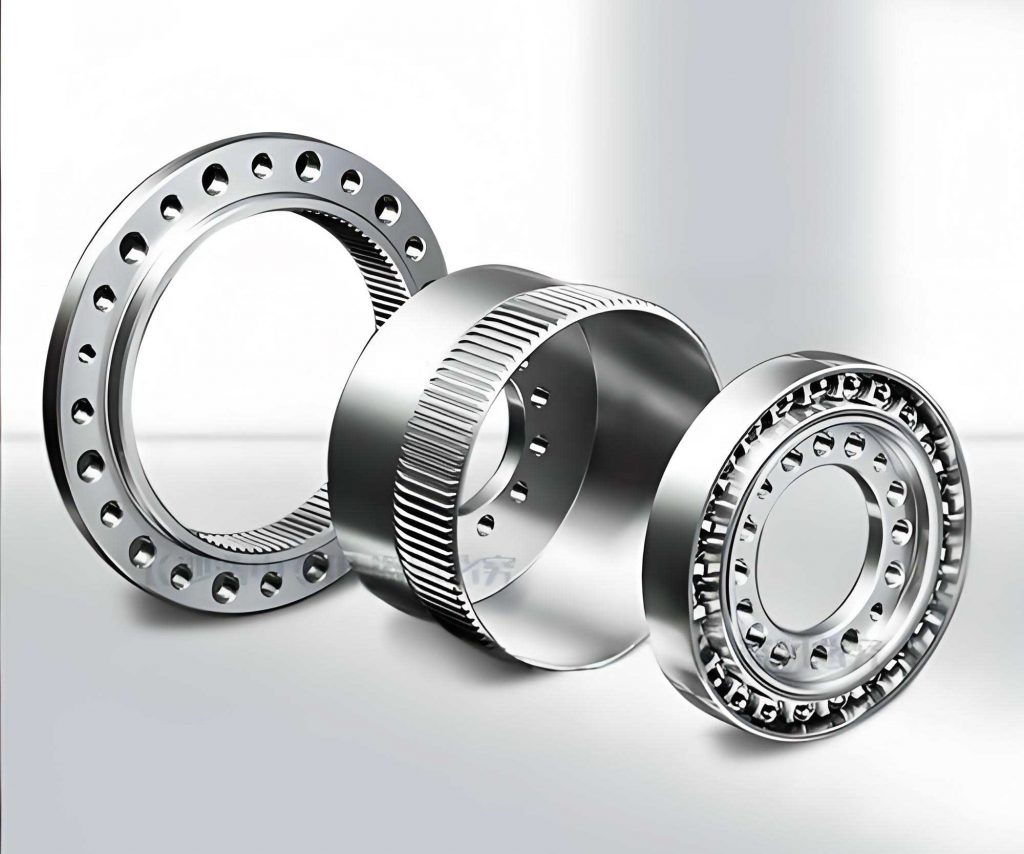
This study introduces an enhanced contact mechanical model for the flexspline tooth ring in a harmonic drive gear, explicitly accounting for the fit clearance and the elongation of the neutral line. The model treats the post-deformation wrap angle as a primary unknown. The deformed neutral line is partitioned into a contact zone and a non-contact zone. The contact zone is modeled as an equidistant curve to the elliptical cam, while the non-contact zone is treated as a cantilevered curved beam fixed at the boundary of the contact zone. Using force equilibrium, curvature compatibility, and an energy method (Castigliano’s theorem), the model iteratively solves for the wrap angle, the internal forces, and the deformed shape. The results are validated against detailed finite element analysis (FEA), and the implications for tooth positioning are thoroughly examined.
Theoretical Contact Mechanics Model for the Flexspline
The model considers an elliptical cam wave generator acting on the flexspline tooth ring under no-load conditions. The key parameters and coordinate system are defined as follows. The nominal radius of the undeformed flexspline neutral line is $r_m$. The total change in this radius due to fit clearance is $\Delta r = \Delta r_1 + \Delta r_2$, where $\Delta r_1$ corresponds to the flexible bearing radial play and $\Delta r_2$ corresponds to the clearance between the flexspline bore and the cam. Thus, the effective initial radius is $R_m = r_m + \Delta r$. The elliptical cam has a known semi-major axis $a$ and a semi-minor axis $b$, where $b$ is determined based on the condition of constant perimeter of the flexspline’s neutral line in its free state. The ratio $c = a/b$ is used extensively.
The undeformed tooth ring neutral line is represented by arc AC, a segment of a circle with radius $R_m$ and center $O_1$. Under deformation, point A is considered fixed, and point C displaces vertically by the maximum radial deformation $u_0$ to point $C_2$. The deformation process is conceptually driven by a bending moment $X_1$ and a circumferential force $X_2$ applied at C. The deformed neutral line $AC_2$ is divided into two distinct regions at point $B_1$:
- Contact Zone ($AB_1$): The flexspline is in full contact with the cam. Its shape is described by the equidistant curve (offset by the wall thickness) of the ellipse. In terms of the neutral line itself, its curvature is defined by the ellipse’s geometry.
- Non-Contact Zone ($B_1C_2$): The flexspline lifts off from the cam and is free of contact pressure. This zone is modeled as a curved beam cantilevered at $B_1$ and loaded by the internal forces $X_1$ and $X_2$ at its free end $C_2$.
The angle $\gamma$ denotes the wrap angle after deformation (the angular coordinate of $B_1$ on the ellipse), and $\gamma_1$ is the corresponding angular coordinate on the undeformed circle. Due to elongation, $\gamma_1 \neq \gamma$. The neutral line experiences circumferential tension, leading to a stretch $\Delta S_{AB}$ in the contact zone.
Governing Equations and Internal Forces
1. Contact Zone Analysis ( $0 \le \theta < \gamma$ )
The curvature of the ellipse as a function of the angular parameter $\theta$ is:
$$ K_E(\theta) = \frac{c}{b} \frac{(c^2 \cos^2\theta – \cos^2\theta – c^2)^{3/2}}{(c^4\cos^2\theta – \cos^2\theta – c^4)^{3/2}} $$
The change in curvature from the undeformed state is:
$$ \chi(\theta) = K_E(\theta) – \frac{1}{R_m} $$
From beam theory, the bending moment in the contact zone is proportional to the curvature change:
$$ M(\theta) = EI_z \, \chi(\theta) = EI_z \left[ K_E(\theta) – \frac{1}{R_m} \right] $$
where $E$ is the elastic modulus, and $I_z = b_1 h^3 / 12$ is the area moment of inertia of the tooth ring cross-section (width $b_1$, thickness $h$). The corresponding bending stress is:
$$ \sigma_1(\theta) = \frac{h}{2I_z} M(\theta) $$
The shear force $F_S(\theta)$ and circumferential (membrane) force $F_N(\theta)$ are derived from equilibrium conditions:
$$ F_S(\theta) = \frac{1}{R_m} \frac{dM(\theta)}{d\theta} $$
$$ F_N(\theta) = \frac{EI_z}{R_m} \left[ K_E(\gamma) – K_E(\theta) \right] + F_N(\gamma) $$
Here, $F_N(\gamma)$ is the circumferential force at the wrap angle boundary, a key unknown linking the two zones. The contact pressure $q_r(\theta)$ between the flexspline and cam is:
$$ q_r(\theta) = \frac{1}{R_m} \left[ F_N(\theta) – \frac{dF_S(\theta)}{d\theta} \right] $$
2. Non-Contact Zone Analysis ( $\gamma_1 \le \phi \le \pi/2$ )
In this region, the internal forces are constant along the arc. At any cross-section defined by angle $\phi$ on the undeformed arc $B_1C_1$, the internal forces due to the end loads $X_1$ and $X_2$ are:
$$ \begin{aligned}
M_1(\phi) &= X_1 + X_2 R_m (\cos \alpha – \sin(\phi + \alpha)) \\
F_{N1}(\phi) &= X_2 \sin(\phi + \alpha) \\
F_{S1}(\phi) &= X_2 \cos(\phi + \alpha)
\end{aligned} $$
where $\alpha = \gamma_0 – \gamma_1$ is the rigid-body rotation of the non-contact zone segment, and $\gamma_0$ is the angle of the normal at $B_1$ relative to the y-axis, given by $\gamma_0 = \arctan(c^2 / \cot \gamma)$.
The bending stress in the non-contact zone is:
$$ \sigma_2(\phi) = \frac{h}{2I_z} M_1(\phi) $$
3. Compatibility and Equilibrium Conditions for Solution
The solution requires satisfying several coupled conditions:
A. Circumferential Elongation and Arc Length Compatibility:
The elongation in the contact zone due to the membrane force is:
$$ \Delta S_{AB} = \frac{R_m}{ES} \int_0^{\gamma} F_N(\theta) \, d\theta $$
where $S = b_1 h$ is the cross-sectional area. The relationship between the deformed wrap angle $\gamma$ and the original angle $\gamma_1$ is given by equating the lengths of the material before and after deformation:
$$ \gamma_1 = \frac{a}{R_m} \int_0^{\gamma} \frac{\sqrt{c^4 \sin^2\theta + \cos^2\theta}}{(c^2 \sin^2\theta + \cos^2\theta)^{3/2}} \, d\theta – \frac{\Delta S_{AB}}{R_m} $$
B. Force Continuity at the Wrap Angle ($B_1$):
The circumferential force must be continuous at the boundary between zones:
$$ F_N(\gamma) = F_{N1}(\gamma_1) = X_2 \sin(\gamma_1 + \alpha) $$
The bending moment must also be continuous. Equating $M(\gamma)$ from the contact zone with $M_1(\gamma_1)$ from the non-contact zone gives:
$$ EI_z \left( K_E(\gamma) – \frac{1}{R_m} \right) = X_1 + X_2 R_m (\cos \alpha – \sin(\gamma_1 + \alpha)) $$
C. Geometric Boundary Conditions at the Minor Axis ($C_2$):
At the free end (the minor axis position $C_2$), the rotation is $-\alpha$ (clockwise) and the vertical displacement is $y_{C_1}$ (the coordinate of point $C_1$ before elastic deformation of the non-contact zone). These are enforced using Castigliano’s theorem, minimizing the total strain energy $U$ of the non-contact zone:
$$ U = \frac{R_m}{2EI_z} \int_{\gamma_1}^{\pi/2} M_1^2(\phi) \, d\phi + \frac{R_m}{2ES} \int_{\gamma_1}^{\pi/2} F_{N1}^2(\phi) \, d\phi $$
The boundary conditions are:
$$ \frac{\partial U}{\partial X_1} = -\alpha \quad \text{and} \quad \frac{\partial U}{\partial X_2} = y_{C_1} $$
This yields two linear equations in $X_1$ and $X_2$:
$$
\begin{aligned}
-G_1 X_1 – G_2 X_2 &= \alpha \, EI_z / R_m \\
G_2 X_1 + (G_3 + G_4) X_2 &= y_{C_1} \, EI_z / R_m
\end{aligned}
$$
where $G_1, G_2, G_3, G_4$ are geometric integrals dependent on $\gamma_1$ and $\alpha$.
4. Iterative Solution Scheme
The four primary unknowns are: the deformed wrap angle $\gamma$, the original angle $\gamma_1$, the end moment $X_1$, and the end circumferential force $X_2$. They are governed by the four equations: the arc-length compatibility equation (1), the two Castigliano boundary condition equations (2), and the moment continuity equation (3). These form a nonlinear system solved iteratively, for example, using the Newton-Raphson method, with a convergence criterion on the moment discontinuity at the wrap angle (e.g., $|\Delta M| < 10^{-7}$ N·mm).
| Symbol | Description | Unit |
|---|---|---|
| $r_m$ | Nominal neutral line radius | mm |
| $\Delta r$ | Total radial fit clearance (neutral line offset) | mm |
| $R_m$ | Effective initial neutral line radius ($r_m + \Delta r$) | mm |
| $a, b$ | Semi-major and semi-minor axes of elliptical cam | mm |
| $c$ | Ellipse axis ratio ($a/b$) | – |
| $h, b_1$ | Flexspline tooth ring thickness and width | mm |
| $\gamma$ | Deformed wrap angle (contact zone boundary) | rad |
| $\gamma_1$ | Undeformed angular coordinate corresponding to $\gamma$ | rad |
| $X_1, X_2$ | Bending moment and circumferential force at minor axis | N·mm, N |
| $F_N(\theta), M(\theta)$ | Circumferential force and bending moment in contact zone | N, N·mm |
Model Application, Results, and Validation
A specific harmonic drive gear case is analyzed to demonstrate the model. Parameters are: $r_m = 21.312$ mm, $h = 0.902$ mm, $b_1 = 1$ mm, $a = 21.662$ mm, $E = 196$ GPa. The minor axis $b$ is calculated for the ideal no-clearance, no-elongation case. The fit clearance is varied and expressed as a percentage rate of change of the neutral line radius: $\zeta = \Delta r / r_m$.
Theoretical Predictions: Effect of Fit Clearance
The model clearly shows the profound impact of even small clearances on the harmonic drive gear assembly state.
Wrap Angle and Shear Force Jump: A critical finding is that even with zero fit clearance ($\zeta = 0$), the wrap angle $\gamma$ is approximately $41^\circ$, far less than the $90^\circ$ assumed in classical theory. This reduction is solely due to the circumferential elongation of the neutral line. As the fit clearance increases, the wrap angle decreases sharply. For instance, at $\zeta = 5.2‱$ (equivalent to $\Delta r \approx 0.011$ mm), $\gamma \approx 27^\circ$, and at $\zeta = 11.7‱$ ($\Delta r \approx 0.025$ mm), $\gamma$ drops to about $13^\circ$. Concurrently, the jump in shear force at the wrap angle boundary increases monotonically with clearance. This jump, representing a concentrated load transition, is a primary contributor to localized wear on both the flexspline and the outer race of the flexible bearing. The results are summarized below:
| ζ (‱) | Δr (mm) | Wrap Angle γ (deg) | Shear Force Jump at γ (N) | Minor Axis Length (mm) |
|---|---|---|---|---|
| 0.0 | 0.000 | 41.0 | 0.93 | 20.96* |
| 5.2 | 0.011 | ~27.0 | ~1.85 | ~21.02 |
| 11.7 | 0.025 | ~13.0 | ~2.95 | ~21.08 |
*Theoretical value based on perimeter match; actual minor axis in assembly is longer due to clearance.
Bending Stress Distribution: The bending stress distribution around the tooth ring circumference changes significantly with clearance. A smaller wrap angle (larger clearance) leads to:
- Increased bending stress at the major axis.
- Decreased bending stress at the minor axis.
- A more pronounced stress peak in the transition region just outside the contact zone.
This shift in stress concentration is critical for fatigue life prediction in harmonic drive gear design.
Tooth Positioning: Accurate tooth positioning on the deformed flexspline is essential for proper meshing with the rigid circular spline (rigid gear). The position of each tooth is defined by the polar coordinates ($\rho$, $\theta$) of its corresponding point on the deformed neutral line. The model calculates these coordinates for any initial angular position $\phi$. The results indicate that while the polar angle $\theta$ is relatively insensitive to fit clearance, the radial coordinate $\rho$ is highly affected, especially in the non-contact zone. The radial deviation at the minor axis increases with increasing clearance.
Finite Element Validation
A detailed finite element model was constructed using shell elements (SHELL181) for the flexspline and surface-to-surface contact elements (CONTA174/TARGE170) between the flexspline and a rigid elliptical cam. Both small deformation and large deformation (geometric nonlinear) analyses were performed for comparison with the theoretical model.
The FEA results confirm the central premise: the flexspline contacts the cam only within a specific wrap angle, lifting off cleanly in the non-contact region. The contact pressure cloud plot clearly shows a well-defined pressure zone ending at the wrap angle, with zero pressure beyond it.
Quantitative comparisons between the present theoretical model, FEA with large deformation (FEA-LD), and FEA with small deformation (FEA-SD) show:
- Wrap Angle: The theoretical wrap angles lie between the FEA-LD and FEA-SD results, showing closer agreement with FEA-LD for smaller clearances. The trend of sharply decreasing $\gamma$ with increasing $\zeta$ is confirmed by all methods.
- Minor Axis Length/Deformation: The theoretical model predicts the final minor axis length (radial position of the free end) with good accuracy, closely matching the FEA-LD results.
- Internal Forces: The circumferential force $X_2$ at the minor axis from the theoretical model aligns well with FEA-LD. The bending moment $X_1$ shows a larger deviation as clearance increases, attributable to the increased influence of the larger non-contact zone’s complex deformation.
- Bending Stress: The bending stress distribution from the theoretical model closely follows the FEA-LD results within the contact zone and through most of the non-contact zone, validating the stress calculation method.
- Radial Pressure & Shear Force: The theoretical radial pressure $q_r(\theta)$ drops to zero at the calculated wrap angle, while FEA shows a localized spike at the separation point due to numerical contact mechanics before dropping to zero. The overall shear force distribution is very similar between theory and FEA-LD.
Tooth Positioning Accuracy Analysis
Using the FEA-LD results as the benchmark, the accuracy of tooth positioning from the present theoretical model and from an FEA-SD analysis was evaluated. The relative deviations in polar angle ($\theta$) and polar radius ($\rho$) were calculated. The key findings are:
- Polar Angle: The theoretical model shows extremely small deviation in $\theta$ (less than 0.07‱ maximum) across almost the entire circumference, significantly outperforming the FEA-SD model, which showed deviations up to 1.3‱.
- Polar Radius: The deviation in $\rho$ is negligible within the contact zone for the theoretical model. The maximum deviation occurs at the minor axis. The theoretical model’s maximum radial deviation was 0.47‱, which is about 86% lower than the 3.42‱ maximum deviation from the FEA-SD model.
This demonstrates that the present analytical model, by accurately accounting for the wrap angle and neutral line elongation, provides superior precision for determining the deformed position of teeth on a harmonic drive gear flexspline, which is fundamental for accurate tooth contact analysis and profile modification design.
Conclusion
This study has developed and validated an advanced analytical contact mechanics model for the harmonic drive gear flexspline, explicitly incorporating the effects of practical fit clearance and the circumferential elongation of the neutral surface. The model successfully treats the nonlinear contact problem as a solvable moving-boundary problem by introducing the deformed wrap angle as a primary unknown and using energy methods to satisfy all compatibility conditions.
The analysis leads to several crucial insights for harmonic drive gear design and analysis:
- The classical assumption of a full 90-degree wrap angle for an elliptical cam is invalid. Even with zero manufacturing clearance, the wrap angle is significantly less than 90° due to neutral surface elongation. In practical assemblies with fit clearances, the wrap angle can be very small (e.g., 13°-40°), drastically reducing the bearing contact area.
- Minimizing fit clearance is critically important. Smaller clearance increases the wrap angle, which:
- Enlarges the load-bearing contact zone on the flexible bearing, distributing the radial load more favorably.
- Reduces the concentrated shear force jump at the wrap angle boundary, thereby mitigating a key source of wear.
- Alters the bending stress distribution, affecting fatigue life predictions.
- The model provides a highly accurate method for determining the deformed shape of the flexspline tooth ring. By correctly calculating the wrap angle and accounting for stretch, it enables precise tooth positioning, which is the essential foundation for subsequent steps in harmonic drive gear design, such as tooth meshing analysis, contact pattern prediction, and optimal tooth profile modification.
In summary, this work provides a more realistic and accurate theoretical foundation for analyzing the assembly state of harmonic drive gears. It highlights the importance of considering fit clearances and membrane effects, moving beyond idealized models to better predict real-world mechanical behavior, stress states, and geometric configurations for high-performance design.