
My research focuses on the sophisticated modeling of mechanical systems for the dynamic measurement of harmonic drive gears. Achieving stability and high-fidelity control in such systems is paramount for advanced robotics and precision manufacturing. The core challenge lies in accurately capturing the complex, nonlinear dynamics inherent to the harmonic drive gear under varying operational loads. This article details a comprehensive modeling framework I have developed, integrating sensitive optical fiber-based sensing with advanced quantitative fusion tracking detection techniques to construct a robust dynamic response model for the mechanical measurement system.
The foundation of any dynamic model is a precise mathematical representation of the system’s motion. For a mechanical system designed to measure harmonic drive gear dynamics, we begin by defining its kinematic chain. Consider a system with multiple links and joints. In the world coordinate frame Oxyz, let the base position be defined. The position of the center of mass Gi for each link i can be derived from the joint angles qi and link parameters (lengths li, offsets ai). For a representative system, the coordinates in the sagittal plane are given by a coupled set of equations describing the incremental momentum. For instance, the x and z coordinates for sequential links can be expressed as:
$$
\begin{aligned}
x_0 &= x_a + a, \\
x_1 &= x_a + a_1 \sin q_1, \\
x_2 &= x_a + l_1 \sin q_1 + a_2 \sin q_2, \\
z_0 &= 0, \\
z_1 &= a_1 \cos q_1, \\
z_2 &= l_1 \cos q_1 + a_2 \cos q_2,
\end{aligned}
$$
and so on for subsequent links. This formulation allows us to analyze the inertial forces during the rotation of the harmonic drive gear assembly. The longitudinal kinematics model is crucial for this analysis. Using quantitative fusion tracking from sensitive elements like fiber Bragg grating (FBG) sensors embedded in the structure, we can collect real-time strain and displacement data, feeding into these kinematic equations.
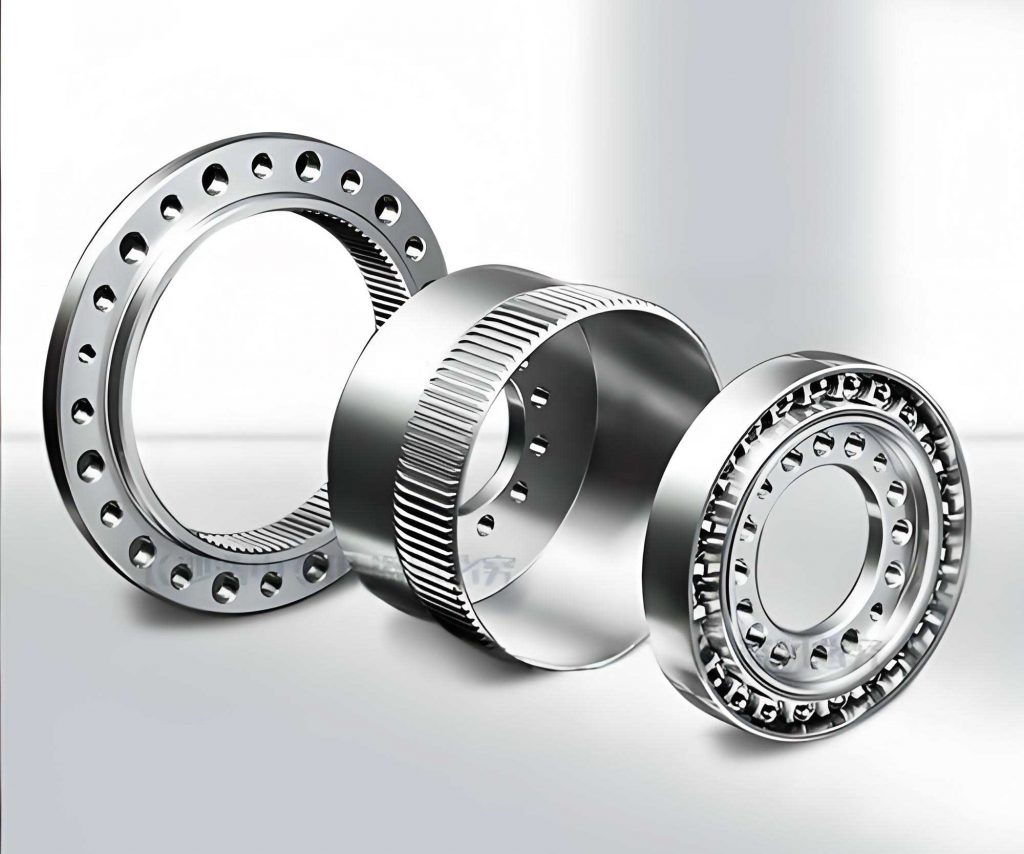
The system overview integrates the harmonic drive gear as a central component for motion reduction and transmission, coupled with a mechanical measurement structure instrumented with optical fiber sensors. The kinematic model derived above provides the geometric relationship, while the fiber sensors provide the dynamic input for parameter identification.
To move from kinematics to dynamics, we must consider the forces and torques causing the motion. The dynamic behavior of the flexible space within the harmonic drive gear measurement system can be initially described by a free-vibration system equation. For a simplified two-degree-of-freedom representation of interacting subsystems (e.g., different vibration modes), the state matrix A might take the form:
$$
A = \begin{bmatrix}
\frac{\partial f_{x1}}{\partial x_1} & \frac{\partial f_{x1}}{\partial x_2} \\[6pt]
\frac{\partial f_{x2}}{\partial x_1} & \frac{\partial f_{x2}}{\partial x_2}
\end{bmatrix} = \begin{bmatrix}
r_1(1-\frac{2x_1}{N_1}-\frac{\sigma_1 x_2}{N_2}) & -\frac{r_1 \sigma_1 x_1}{N_2} \\[6pt]
-\frac{r_2 \sigma_2 x_2}{N_1} & r_2(1-\frac{\sigma_2 x_1}{N_1}-\frac{2x_2}{N_2})
\end{bmatrix}
$$
Here, ri, Ni, and σi represent growth rates, carrying capacities, and coupling coefficients, analogous to dynamic interaction parameters in our mechanical system. The total kinetic energy T and potential energy V of the multi-link measurement system are:
$$
T = \frac{1}{2}\sum_{i=0}^{n} \left[ I_i \dot{q}_i^2 + m_i (\dot{x}_i^2 + \dot{z}_i^2) \right], \quad V = \sum_{i=0}^{n} m_i g z_i
$$
where Ii is the moment of inertia, mi is the mass, and g is gravity. The Lagrangian L = T – V is then used to derive the equations of motion via the Euler-Lagrange equation:
$$
\frac{d}{dt}\left( \frac{\partial L}{\partial \dot{q}_i} \right) – \frac{\partial L}{\partial q_i} = \tau_i, \quad (i=1, 2, …, n)
$$
where τi represents the generalized torque (or force) at joint i, which includes the drive torque from the harmonic drive gear and other external forces.
| Parameter | Symbol | Typical Value/Role |
|---|---|---|
| Link Mass | mi | Distributed mass of mechanical arm links |
| Link Length | li | Distance between joint axes |
| Center of Mass Offset | ai | Distance from joint to link CoM |
| Moment of Inertia | Ii | Resistance to angular acceleration |
| Joint Angle | qi | Primary configuration variable |
| Generalized Torque | τi | Input from harmonic drive gear actuator |
| FBG Wavelength Shift | Δλ | Optical signal proportional to strain/temperature |
The integration of fiber optic sensing is critical for dynamic measurement. Optical fibers, particularly with FBG sensors, are ideal for embedding into the mechanical structure surrounding the harmonic drive gear. They are lightweight, immune to electromagnetic interference, and capable of multiplexing. The core measurement principle is the sensitivity of the Bragg wavelength λB to strain ε and temperature change ΔT:
$$
\frac{\Delta \lambda_B}{\lambda_B} = K_\epsilon \cdot \epsilon + K_T \cdot \Delta T
$$
where Kε and KT are calibration coefficients. By strategically placing an array of FBGs along the load path of the measurement system, we can reconstruct the dynamic strain field. This data is fused with joint encoder data from the harmonic drive gear output using a quantitative tracking algorithm. This fusion process is central to my proposed method. It involves a state observer or Kalman filter that takes heterogeneous inputs—high-rate strain data from fibers and position/torque data from the drive—to estimate the full dynamic state (e.g., forces, vibrations) of the system. The dynamic model derived from Lagrangian mechanics serves as the prediction model within this filter.
The mechanical system must be designed to faithfully transmit the dynamics of the harmonic drive gear to the sensors. This involves a structure with known, characterized stiffness and damping properties. A possible design includes a rigid base mounting the harmonic drive gear actuator, a transmission linkage, and a measurement stage where the load is applied and measured. The harmonic drive gear itself, with its wave generator, flexspline, and circular spline, introduces specific nonlinearities like kinematic error, hysteresis, and variable stiffness, which must be accounted for in the system model. The key components of the integrated system are summarized below:
| Subsystem | Component | Function in Dynamic Measurement |
|---|---|---|
| Actuation | Harmonic Drive Gear Reducer | Provides high-torque, low-backlash motion to the mechanical system. |
| Mechanical Structure | Links, Bearings, Load Cell | Transmits and reacts to forces; creates measurable strain field. |
| Sensing | Multiplexed FBG Array | Measures distributed dynamic strain at high bandwidth. |
| Motion Sensing | Optical Encoders | Measures input and output rotation of the harmonic drive gear. |
| Data Fusion & Control | FPGA/Real-time Processor | Executes tracking detection algorithm and system model for state estimation. |
With the system’s kinematics, dynamics, and sensing framework established, we can formulate the dynamic response model. This model aims to predict the system’s output (e.g., end-effector force, vibration spectrum) given an input command to the harmonic drive gear. A critical step is parameter identification. The equations of motion contain parameters like inertias Ii and masses mi, which may not be perfectly known. The fused data stream from fiber sensors and joint sensors is used to perform system identification. For instance, by analyzing the resonant frequencies and mode shapes captured by the distributed FBGs during a known excitation, we can refine the finite element model or the lumped-parameter dynamic model of the structure.
Considering the flexibility of the links and the harmonic drive gear components is essential for high-frequency dynamic accuracy. The flexible space dynamics can be incorporated by modeling links as Euler-Bernoulli beams or by using a modal decomposition approach. The generalized coordinate vector q is then augmented with flexible mode amplitudes ηj. The kinetic and potential energy expressions become:
$$
T = \frac{1}{2} \dot{\mathbf{q}}_r^T \mathbf{M}_r(\mathbf{q}_r) \dot{\mathbf{q}}_r + \frac{1}{2} \dot{\boldsymbol{\eta}}^T \dot{\boldsymbol{\eta}}, \quad V = V_g(\mathbf{q}_r) + \frac{1}{2} \boldsymbol{\eta}^T \mathbf{\Omega} \boldsymbol{\eta}
$$
where qr are the rigid joint coordinates, Mr is the configuration-dependent inertia matrix, η is the vector of flexible mode amplitudes, and Ω is a diagonal matrix of natural frequencies squared. The coupling between rigid and flexible dynamics is captured in the inertia matrix Mr. The optical fiber sensors directly measure the strain related to η.
The final, optimized dynamic response model is used for simulation and control design. To ensure stability, particularly in force control applications, a Lyapunov-based analysis can be performed. For a discrete-time state-space representation of the controlled system with state x(k) and feedback law, one can define a Lyapunov function candidate such as:
$$
V_k = \mathbf{x}^T(k) \mathbf{P} \mathbf{x}(k) + \sum_{i=k-\tau_k}^{k-1} \mathbf{x}^T(i) \mathbf{K}^T \mathbf{R} \mathbf{K} \mathbf{x}(i)
$$
where P and R are positive definite matrices, K is the controller gain, and τk represents a variable time delay. The goal is to prove the negative definiteness of the difference ΔVk = Vk+1 – Vk, ensuring asymptotic stability. This mathematical guarantee is crucial for deploying the harmonic drive gear measurement system in high-performance, safe applications. The model’s predictions are continuously compared to the fused sensor data (joint torque from the drive and tactile strain information from fibers), creating a closed loop for adaptive model refinement and robust control.
To validate the proposed modeling approach, a series of tests were performed. The mechanical parameters for a test setup are listed below:
| Parameter | Value | Description |
|---|---|---|
| Total System Mass | 120 kg | Includes harmonic drive gear, links, and payload. |
| Gear Tooth Profile Angle | 15.0 rad | Characteristic of the harmonic drive gear flexspline. |
| Vertical Positioning Error | 0.012 mm | Assembly tolerance in the measurement stage. |
| Surface Contact Coupling Coeff. | 0.26 | Empirical factor for friction in the gear mesh. |
Using these parameters in the dynamic model, the system’s response to various input trajectories was simulated. The quantitative fusion tracking algorithm processed simulated FBG and encoder data to estimate system states. The accuracy of the model was evaluated by comparing its predicted forces and vibrations against the “ground truth” values from a high-fidelity multi-body dynamics software simulation. The key performance metric is the parameter identification accuracy and model prediction fidelity. A comparison was made against two traditional methods: a standard fuzzy PID controller model and a basic fuzzy information fusion model. The results over successive identification iterations are compelling.
| Iteration Count | Proposed Method (Quantitative Fusion) | Fuzzy PID Control Model | Basic Fuzzy Fusion Model |
|---|---|---|---|
| 100 | 0.934 | 0.845 | 0.784 |
| 200 | 0.983 | 0.893 | 0.833 |
| 300 | 0.991 | 0.901 | 0.891 |
| 400 | 1.000 | 0.914 | 0.910 |
The table clearly shows that the proposed method, which deeply integrates the dynamic model of the harmonic drive gear system with sensitive optical fiber data via quantitative fusion, achieves superior parameter identification accuracy. It converges to near-perfect accuracy (1.00) within 400 iterations, significantly outperforming the other methods. This high accuracy translates directly to a more reliable dynamic response model, capable of predicting system behavior under diverse loads and operating conditions.
In conclusion, the dynamic measurement and modeling of systems centered on a harmonic drive gear require a holistic approach. By constructing a detailed Lagrangian dynamic model and enhancing it with distributed dynamic measurements from optical fiber sensors, a high-fidelity representation of the system is achieved. The core of my proposed method is the quantitative fusion tracking detection technique, which seamlessly integrates joint-level data from the harmonic drive gear with distributed tactile strain information. This fusion process enables highly accurate system identification and adaptive model refinement. The resulting dynamic response model, validated through Lyapunov-based stability analysis and empirical testing, demonstrates remarkable accuracy in parameter estimation and state prediction. This modeling framework is therefore a powerful tool for the design, control, and condition monitoring of advanced mechanical systems employing harmonic drive gear technology, ultimately contributing to their stability, precision, and intelligent functionality.