
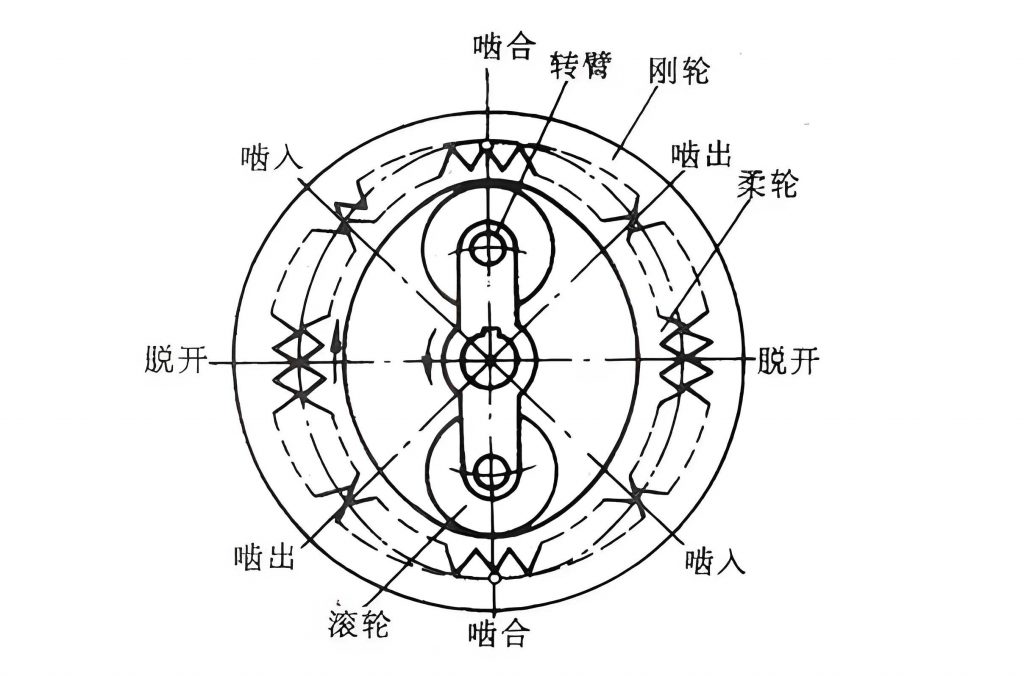
In the field of precision mechanical transmission, harmonic drive gears represent a pivotal technology that leverages controlled elastic deformation of a thin-walled flexspline to transmit motion and torque. Invented in the late 1950s, this mechanism, consisting of a wave generator, a flexspline, and a circular spline, offers exceptional advantages including compact size, high reduction ratios, low backlash, and superior positional accuracy. These attributes have cemented its role in demanding applications such as robotic manipulators, aerospace actuators, and satellite positioning systems. A critical element dictating the performance of a harmonic drive gear is the tooth profile geometry of the flexspline. Among various profiles, the double-circular-arc (DCA) tooth profile has emerged as a superior design, effectively mitigating issues like cusp engagement and uneven stress distribution, thereby enhancing load capacity and transmission stability. This article, from my research perspective, delves into a detailed analysis of how specific geometric parameters of the DCA flexspline tooth profile influence the conjugate meshing characteristics. Utilizing an exact conjugate theory based on a modified kinematic method and extensive numerical computation, I aim to provide a comprehensive guide for optimizing harmonic drive gear performance through informed parameter selection.
The foundational step in analyzing any harmonic drive gear system is the precise definition of its coordinate systems. For a DCA tooth profile, which comprises two circular arcs connected by a common tangent line, establishing a clear kinematic framework is essential. The flexspline tooth profile coordinate system {O1, X1, Y1} is attached to the tooth itself. The origin O1 is located at the intersection of the tooth’s symmetry axis (Y1-axis) and the neutral curve of the undeformed flexspline. The X1-axis is tangential to this neutral curve at O1. Within this frame, the tooth profile is parametrized by the arc length \( s \), starting from the tooth tip (point A). The profile is segmented into three distinct segments, each with its own vector equation for position \( \mathbf{r} \) and unit normal vector \( \mathbf{n} \).
The first segment, AB, is the convex circular arc:
$$ \mathbf{r}_{AB}(s) = \begin{bmatrix} \rho_a \cos(\alpha_a – s/\rho_a) + x_{oa} \\ \rho_a \sin(\alpha_a – s/\rho_a) + y_{oa} \\ 1 \end{bmatrix}, \quad \mathbf{n}_{AB}(s) = \begin{bmatrix} \cos(\alpha_a – s/\rho_a) \\ \sin(\alpha_a – s/\rho_a) \\ 1 \end{bmatrix} $$
for \( s \in (0, l_1) \), where \( l_1 = \rho_a (\alpha_a – \delta_l) \). Here, \( \rho_a \) is the radius of the convex arc, \( \alpha_a = \arcsin[(h_a + X_a)/\rho_a] \), \( x_{oa} = -l_a \), and \( y_{oa} = h_f + d_s – X_a \). Parameters \( h_a \), \( h_f \), \( X_a \), \( l_a \), and \( d_s \) represent the addendum, dedendum, convex center offset, convex center shift, and distance from the root circle to the neutral layer, respectively.
The second segment, BC, is the straight common tangent:
$$ \mathbf{r}_{BC}(s) = \begin{bmatrix} \rho_a \cos \delta_l + x_{oa} + (s – l_1)\sin \delta_l \\ \rho_a \sin \delta_l + y_{oa} – (s – l_1)\cos \delta_l \\ 1 \end{bmatrix}, \quad \mathbf{n}_{BC}(s) = \begin{bmatrix} \cos \delta_l \\ \sin \delta_l \\ 1 \end{bmatrix} $$
for \( s \in (l_1, l_2) \), where \( l_2 = l_1 + (\rho_a + \rho_f)\tan \delta_l \). The angle \( \delta_l \) is the inclination of the common tangent.
The third segment, CD, is the concave circular arc:
$$ \mathbf{r}_{CD}(s) = \begin{bmatrix} x_{of} – \rho_f \cos[\delta_l + (s – l_2)/\rho_f] \\ y_{of} – \rho_f \sin[\delta_l + (s – l_2)/\rho_f] \\ 1 \end{bmatrix}, \quad \mathbf{n}_{CD}(s) = \begin{bmatrix} \cos[\delta_l + (s – l_2)/\rho_f] \\ \sin[\delta_l + (s – l_2)/\rho_f] \\ 1 \end{bmatrix} $$
for \( s \in (l_2, l_3) \), where \( l_3 = l_2 + \rho_f\{ \arcsin[(X_f + h_f)/\rho_f] – \delta_l \} \). Here, \( \rho_f \) is the radius of the concave arc, \( x_{of} = \pi m/2 + l_f \), and \( y_{of} = h_f + d_s + X_f \).
For the overall harmonic drive gear assembly, a global coordinate system {O2, X2, Y2} is fixed to the circular spline, with its origin at the circular spline’s center. A moving coordinate system {O, X, Y} is attached to the wave generator, aligning its Y-axis with the major axis of the deformed flexspline. The kinematic variables are defined in the table below, which is crucial for the subsequent conjugate analysis.
| Variable | Description |
|---|---|
| \( \phi \) | Angle between wave generator major axis and undeformed flexspline end. |
| \( \phi_1 \) | Angle between wave generator major axis and the mating radius vector on the deformed flexspline. |
| \( \phi_2 \) | Rotation angle of the wave generator. |
| \( \alpha \) | Angle of the undeformed flexspline end. |
| \( \gamma \) | Angle of the deformed flexspline end. |
| \( \beta \) | Angle between Y1-axis and Y2-axis. |
| \( \omega \) | Radial deformation component. |
| \( \nu \) | Tangential deformation component. |
| \( \mu \) | Angular deformation component (normal rotation). |
| \( \rho \) | Radius vector of the neutral curve after deformation. |
| \( r_m \) | Radius of the neutral curve in the undeformed state. |
The core of analyzing any harmonic drive gear lies in its conjugate meshing theory. Traditional approximate methods often simplify the relationship between the deformation angle \( \phi_1 \) and the undeformed angle \( \phi \) using integral approximations, which can introduce inaccuracies. The modified kinematic method adopted in this work treats \( \phi_1 \) as the primary independent variable, leading to an exact formulation. For a cosine cam wave generator, the radial deformation is \( \omega(\phi_1) = \omega_0 \cos(\phi_1) \), where \( \omega_0 \) is the maximum radial deformation. The deformed neutral curve radius is \( \rho(\phi_1) = r_m + \omega(\phi_1) \). The other deformation components and angles are derived precisely as functions of \( \phi_1 \):
Tangential deformation: \( \nu(\phi_1) = -\int \omega \, d\phi_1 \).
Normal rotation: \( \mu(\phi_1) = \arctan(\rho / \rho’) \), where \( \rho’ = d\rho/d\phi_1 \).
Undeformed angle: \( \phi(\phi_1) = \frac{1}{r_m} \int_0^{\phi_1} \sqrt{\rho^2 + (\rho’)^2} \, d\phi_1 \).
Wave generator angle: \( \phi_2 = \frac{z_g}{z_r} \phi(\phi_1) \), with \( z_g \) and \( z_r \) being the tooth numbers of the circular spline and flexspline, respectively.
Deformed end angle: \( \gamma(\phi_1) = \phi_1 – \phi_2 \).
Key angle for coordinate transformation: \( \beta(\phi_1) = \gamma(\phi_1) + \mu(\phi_1) \).
The fundamental conjugate condition, ensuring continuous contact between the flexspline and circular spline tooth profiles in the harmonic drive gear, is expressed by the equation:
$$ \mathbf{n}^T \cdot \mathbf{B} \cdot \mathbf{r} = 0 $$
where \( \mathbf{n} \) is the unit normal vector of the flexspline tooth profile in its local coordinate system, \( \mathbf{r} \) is the position vector of the profile point, and \( \mathbf{B} \) is the meshing matrix. This matrix is derived from the coordinate transformation matrix \( \mathbf{M}_{21} \) (from {O1, X1, Y1} to {O2, X2, Y2}) and the base vector change matrix \( \mathbf{W}_{21} \):
$$ \mathbf{M}_{21} = \begin{bmatrix} \cos \beta & \sin \beta & \rho \sin \gamma \\ -\sin \beta & \cos \beta & \rho \cos \gamma \\ 0 & 0 & 1 \end{bmatrix}, \quad \mathbf{W}_{21} = \begin{bmatrix} \cos \beta & \sin \beta & 0 \\ -\sin \beta & \cos \beta & 0 \\ 0 & 0 & 1 \end{bmatrix} $$
The meshing matrix \( \mathbf{B} = \mathbf{W}_{21}^T \frac{d\mathbf{M}_{21}}{dt} \), when expressed in terms of \( \phi_1 \), becomes:
$$ \mathbf{B} = \begin{bmatrix} 0 & \beta’ & \rho \gamma’ \cos \mu – \rho’ \sin \mu \\ -\beta’ & 0 & \rho \gamma’ \sin \mu + \rho’ \cos \mu \\ 0 & 0 & 0 \end{bmatrix} $$
where \( \beta’ = d\beta/d\phi_1 \) and \( \gamma’ = d\gamma/d\phi_1 \). The derivatives \( \beta’ \) and \( \gamma’ \) are calculated directly from their functional forms involving \( \rho \) and \( \rho’ \), avoiding complex integral terms and ensuring computational precision for the harmonic drive gear analysis.
To investigate the influence of DCA profile parameters, I performed numerical computations using MATLAB. A specific harmonic drive gear configuration was chosen for case study: a hat-type flexspline with module \( m = 0.38 \, \text{mm} \), flexspline tooth number \( z_r = 160 \), circular spline tooth number \( z_g = 162 \), and nominal radial deformation \( \omega_0 = 0.38 \, \text{mm} \). The base DCA flexspline profile parameters are listed in the following table.
| Parameter | Symbol | Base Value |
|---|---|---|
| Convex Arc Radius | \( \rho_a \) | 0.645 mm |
| Concave Arc Radius | \( \rho_f \) | 0.700 mm |
| Convex Center Offset | \( X_a \) | 0.1586 mm |
| Convex Center Shift | \( l_a \) | 0.3212 mm |
| Concave Center Offset | \( X_f \) | 0.1046 mm |
| Concave Center Shift | \( l_f \) | 0.4015 mm |
| Common Tangent Inclination | \( \delta_l \) | 13.0° |
| Common Tangent Length | \( h_l \) | 0.040 mm |
| Root to Neutral Layer Distance | \( d_s \) | 0.470 mm |
Solving the conjugate equation for the base parameters reveals the theoretical conjugate existence domain (TCED) and the theoretical conjugate tooth profile (TCTP) for the circular spline. The TCED plot maps the flexspline arc length \( s \) against the conjugate angle \( \phi_1 \). It typically shows two conjugate regions. Region 1, associated with the primary meshing zone, spans a larger angular interval (e.g., \( \phi_1 \in [16.63°, 62.1°] \)). Region 2 is a smaller secondary zone (e.g., \( \phi_1 \in [-0.072°, 8.766°] \)). Each region consists of three branches corresponding to the convex arc, common tangent, and concave arc of the flexspline profile. The TCTP plot shows the corresponding circular spline profiles. Only one set of profiles from Region 1 (the “effective” conjugate profiles) is typically usable without interference in a practical harmonic drive gear. A key optimization goal is to adjust parameters so that the convex arc conjugate profile from Region 2 coincides with the concave arc conjugate profile from Region 1, effectively merging the two regions and significantly expanding the usable meshing zone, which enhances load sharing and smoothness of the harmonic drive gear.
The following sections present a detailed parametric study, analyzing how variations in each key DCA parameter affect the TCED and TCTP. This analysis provides critical insights for designing high-performance harmonic drive gears.
Influence of Convex Arc Radius (\( \rho_a \))
Varying the convex arc radius \( \rho_a \) primarily affects the position of the conjugate solutions. When \( \rho_a \) is increased from 0.60 mm to 0.65 mm and 0.70 mm, the conjugate region for the convex arc segment shifts along the negative direction of the arc length axis. This means that for a larger convex arc radius, meshing initiation occurs at a smaller flexspline arc length value. Crucially, the angular span (the range of \( \phi_1 \)) of the conjugate region and the overall conjugate interval remain virtually unchanged. The shape of the theoretical conjugate tooth profile for the circular spline, corresponding to the flexspline’s convex arc, remains constant, but its position in the global coordinate system shifts along the positive X-direction. The conjugate profiles for the concave arc and common tangent segments are completely unaffected by changes in \( \rho_a \). This parameter is therefore a powerful tool for fine-tuning the initial contact position in the harmonic drive gear without altering the meshing kinematics.
Influence of Concave Arc Radius (\( \rho_f \))
The concave arc radius \( \rho_f \) exerts a more nuanced influence on the conjugate characteristics of the harmonic drive gear. Increasing \( \rho_f \) (e.g., from 0.65 mm to 0.75 mm) causes a noticeable convergence effect between the two conjugate regions. Specifically, the angular range of conjugate Region 1 decreases, while that of conjugate Region 2 increases; both regions move closer together along the \( \phi_1 \) axis. Furthermore, the arc length span for meshing in both regions decreases, with changes being more pronounced near the tooth root. On the TCTP plot, the conjugate profile derived from the flexspline’s concave arc maintains its shape but translates along the negative X-direction as \( \rho_f \) increases. The conjugate profiles for the convex arc and common tangent remain unaffected. This behavior makes \( \rho_f \) a critical parameter for controlling the separation and potential merging of the two conjugate zones, directly impacting the multi-tooth contact nature of the harmonic drive gear.
Influence of Common Tangent Length (\( h_l \))
The length of the common tangent \( h_l \) has a localized yet significant effect. Altering \( h_l \) (e.g., 0.02 mm, 0.04 mm, 0.06 mm) does not influence the conjugate region or the conjugate tooth profile associated with the flexspline’s convex arc. Its impact is isolated to the conjugate region corresponding to the concave arc segment. As \( h_l \) increases, this region shifts along the positive direction of the arc length axis. The angular parameters (\( \phi_1 \) range) of this region remain constant, meaning the meshing timing is unchanged, but the physical arc length on the flexspline tooth where meshing occurs increases. Since the common tangent is a straight line and its geometry is simple, the resulting conjugate tooth profile on the circular spline for this segment remains unchanged in shape. Thus, \( h_l \) serves as a parameter to adjust the effective contact length on the flank of the harmonic drive gear tooth without affecting the pressure angle or profile curvature.
Influence of Common Tangent Inclination (\( \delta_l \))
The inclination angle \( \delta_l \) of the common tangent is a potent parameter for adjusting the meshing kinematics. Changes in \( \delta_l \) (e.g., 12.5°, 13.0°, 13.5°) leave the conjugate region for the convex arc entirely unaffected. However, it has a pronounced effect on the conjugate region for the concave arc. For conjugate Region 1, a larger \( \delta_l \) results in a larger maximum conjugate angle \( \phi_1 \), but the angular width of the region (the interval) becomes smaller. Simultaneously, the associated meshing arc length decreases. For conjugate Region 2, all metrics—maximum conjugate angle, angular interval, and meshing arc length—decrease with increasing \( \delta_l \). This parameter effectively controls the “spread” of the conjugate zones along the engagement cycle of the harmonic drive gear, influencing the load transition between successive tooth pairs.
Influence of Radial Deformation Amount (\( \omega_0 \))
The maximum radial deformation \( \omega_0 \), determined by the wave generator cam, is a system-level parameter with global effects on the harmonic drive gear’s conjugate behavior. Increasing \( \omega_0 \) (e.g., from 0.38 mm to 0.40 mm) expands the angular range of conjugate Region 1 (larger \( \phi_1 \)) but reduces its angular interval, while the meshing arc length stays constant. For conjugate Region 2, both the maximum angle and the angular interval decrease, with arc length again constant. On the TCTP plot, the conjugate profile for the convex arc rotates clockwise (while maintaining its shape) as \( \omega_0 \) increases. Most importantly, the two theoretical conjugate profiles for the concave arc (from Region 1 and Region 2) move closer together. This is a vital finding: by carefully selecting \( \omega_0 \) in conjunction with \( \rho_f \) and \( \delta_l \), designers can aim to make these two profiles coincide, thereby creating a continuous, enlarged conjugate zone that dramatically improves the meshing performance and load capacity of the harmonic drive gear.
In summary, this detailed parametric investigation into the double-circular-arc flexspline tooth profile for harmonic drive gears yields several critical conclusions for design optimization. The modified kinematic method, using \( \phi_1 \) as the independent variable, provides an exact and computationally efficient framework for conjugate analysis, superior to traditional approximate methods. The analysis clearly demonstrates that parameters can be strategically tuned to enhance performance. The convex arc radius \( \rho_a \) and concave arc radius \( \rho_f \) significantly influence the position and shape of the conjugate tooth profiles, respectively. The common tangent length \( h_l \) and inclination \( \delta_l \) are primary levers for controlling the extent and timing of the conjugate regions without altering the profile geometry itself. Finally, the radial deformation \( \omega_0 \), along with \( \rho_f \) and \( \delta_l \), plays a decisive role in enabling the merger of the two conjugate zones. The overarching design strategy for an optimal harmonic drive gear should focus on selecting a parameter set that promotes the coincidence of the convex arc conjugate profile from Region 2 with the concave arc conjugate profile from Region 1. This merger maximizes the total arc length of engagement and creates a more uniform load distribution across multiple teeth, leading directly to higher torque capacity, smoother motion transmission, reduced wear, and increased longevity of the harmonic drive gear assembly. Future work could integrate these geometric findings with elastodynamic analysis and advanced manufacturing tolerances to push the boundaries of harmonic drive gear performance even further.