
In the field of precision transmission, the harmonic drive gear mechanism stands out due to its high reduction ratio, compact size, and excellent positional accuracy. However, achieving optimal performance in harmonic drive gear systems heavily relies on the tooth profile design, which must account for the complex spatial deformations of the flexspline under load. Traditionally, tooth profiles designed using planar assumptions often lead to interference issues when applied to the three-dimensional reality of the harmonic drive gear assembly. This article presents a comprehensive study on a bidirectional conjugate method that incorporates the spatial deformation of the flexspline into the tooth profile design for harmonic drive gear systems. By rigorously analyzing the deformation and extending the planar conjugate approach, this method aims to eliminate profile interference and enhance the meshing performance of harmonic drive gear units.
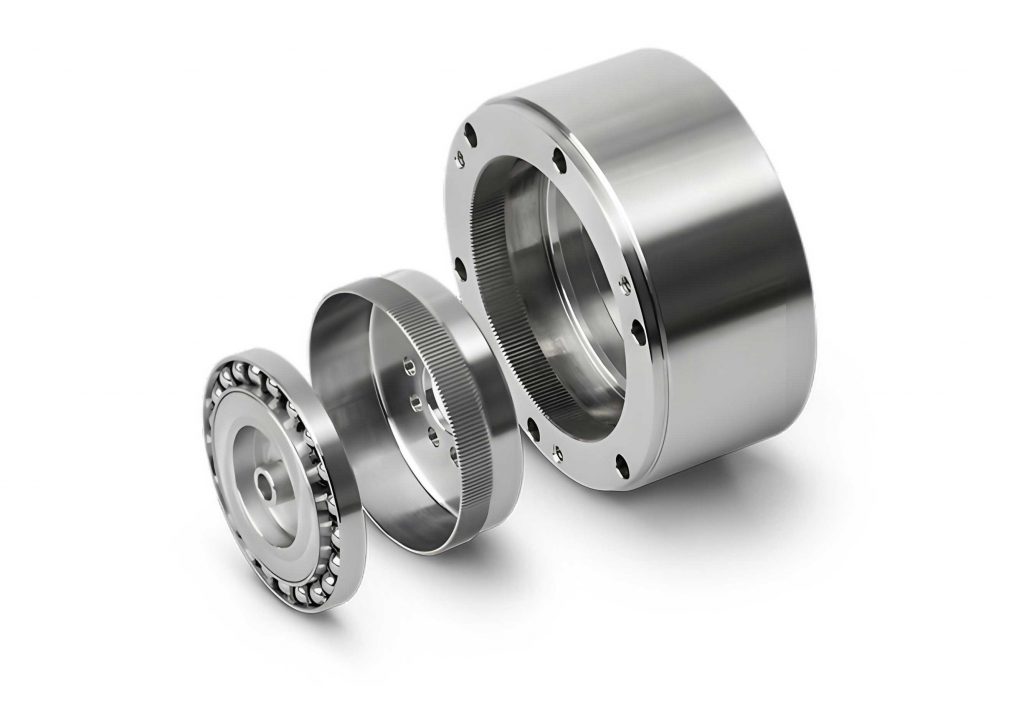
The harmonic drive gear mechanism, since its inception, has evolved through various tooth profiles, from initial straight lines to involute and modern double-circular-arc shapes. Each advancement aimed at improving load capacity, reducing wear, and ensuring continuous contact. Nevertheless, a persistent challenge arises from the flexspline’s spatial deformation—its thin-walled cup structure deforms differently along the axial direction when subjected to the wave generator’s force. This deformation causes tooth skewing, where teeth at different axial sections exhibit varying radial and circumferential displacements. If ignored, this skewing leads to undesirable interference between the flexspline and circular spline teeth in a harmonic drive gear, increasing stress, reducing efficiency, and potentially causing failure. Thus, integrating spatial deformation into the design process is crucial for high-performance harmonic drive gear applications.
This work begins by theoretically modeling the spatial deformation of the flexspline in a harmonic drive gear using semi-momentless theory for cylindrical shells. The deformation is assumed linear along the axis, from the open end (where the wave generator acts) to the closed end (constrained by the diaphragm). Key parameters include the radial deformation at the main section (where the wave generator’s major axis lies) and the deformation cone angle. For a harmonic drive gear with a flexspline length \( L_v \) and maximum radial deformation \( \omega_0 \) at the main section, the radial deformation \( \omega_z \) at an axial distance \( z \) from the closed end is given by:
$$ \omega_z = \frac{z}{L_v} \omega(\phi) $$
Here, \( \omega(\phi) \) is the radial deformation at the main section as a function of the angular position \( \phi \). The deformation cone angle \( \theta_c \) is:
$$ \theta_c = \arctan\left(\frac{\omega_0}{L_v}\right) $$
This linear model implies that axial sections of the harmonic drive gear flexspline experience scaled deformations. For tooth design, three critical sections are considered: the front section (near the open end), the middle section (at the wave generator’s main section), and the back section (near the closed end). Let \( l_1 \) be the distance from the back section to the middle section, and \( l_2 \) from the front section to the middle section. The radial deformations at these sections are:
$$ \omega_f(\phi) = \left(1 + \frac{l_2}{\omega_0} \tan \theta_c\right) \omega(\phi) $$
$$ \omega_b(\phi) = \left(1 – \frac{l_1}{\omega_0} \tan \theta_c\right) \omega(\phi) $$
where \( \omega_f \) and \( \omega_b \) are the front and back section deformations, respectively. For a harmonic drive gear with typical parameters, these deformations can differ significantly—by over 10% in some cases—highlighting the need for spatial consideration. Table 1 summarizes the deformation parameters for a sample harmonic drive gear configuration.
| Parameter | Symbol | Value | Description |
|---|---|---|---|
| Flexspline Length | \( L_v \) | 43 mm | Distance from main section to closed end |
| Maximum Radial Deformation | \( \omega_0 \) | 0.25 mm | At main section (major axis) |
| Deformation Cone Angle | \( \theta_c \) | 0.005814 rad | Calculated from \( \omega_0 \) and \( L_v \) |
| Tooth Width | \( b_R \) | 10 mm | Width of flexspline teeth |
| Front Section Distance | \( l_2 \) | 5 mm | From middle to front section |
| Back Section Distance | \( l_1 \) | 5 mm | From middle to back section |
| Front Max Deformation | \( \omega_{f0} \) | 0.2791 mm | Calculated using linear model |
| Back Max Deformation | \( \omega_{b0} \) | 0.2209 mm | Calculated using linear model |
The tooth skewing effect due to this spatial deformation in a harmonic drive gear is profound. At the major axis, the front section teeth deform more outward, while the back section teeth deform less, causing a tilting of the tooth along the width. This skewing alters the meshing depth and side clearance from the planar design assumptions. In severe cases, it leads to interference: at the front section, excessive deformation can cause root interference at deep mesh, and at the back section, insufficient deformation can cause tip interference during mesh entry. Such issues compromise the reliability of the harmonic drive gear system, necessitating a design method that accounts for these variations.
To address this, I propose a bidirectional conjugate method that incorporates the spatial deformation into the double-circular-arc tooth profile design for harmonic drive gear systems. This method extends the planar bidirectional conjugate approach by performing conjugate calculations at different axial sections. The steps are as follows:
- Preset Flexspline Convex Arc: Define the convex arc of the flexspline tooth profile based on design parameters (e.g., pressure angle, module). This is typically done for the middle section, but with spatial adjustment.
- Conjugate Calculation for Circular Spline: Compute the conjugate tooth profile of the circular spline. Instead of using a single plane, perform this calculation separately at the front and back sections of the harmonic drive gear tooth width. At the front section, use \( \omega_f(\phi) \) for deformation to obtain the circular spline’s concave arc (tooth root segment). At the back section, use \( \omega_b(\phi) \) to obtain the circular spline’s convex arc (tooth tip segment). This ensures that the circular spline profile accommodates the skewed flexspline teeth.
- Reverse Conjugate for Flexspline Concave Arc: Using the circular spline’s convex arc obtained from the front section calculation, perform a reverse conjugate calculation to derive the flexspline’s concave arc. This arc is combined with the preset convex arc to form the complete flexspline tooth profile for the harmonic drive gear.
The conjugate calculations rely on the fundamental gearing equation for harmonic drive gear meshing. For a given point on the flexspline tooth profile with coordinates \( (x_f, y_f) \) in its coordinate system, the corresponding point on the circular spline profile \( (x_c, y_c) \) satisfies the contact condition. The transformation involves the kinematic relationship between the flexspline and circular spline, which includes the deformation function. For a harmonic drive gear with wave generator rotation, the meshing equation can be expressed as:
$$ \frac{dy_f}{dx_f} = \frac{\sin(\phi + \mu) – \frac{d\omega}{d\phi} \cos(\phi + \mu)}{\cos(\phi + \mu) + \frac{d\omega}{d\phi} \sin(\phi + \mu)} $$
where \( \mu \) is the pressure angle, and \( \omega(\phi) \) is the radial deformation at the specific section. By solving this equation numerically or analytically for different \( \phi \) values, the conjugate profiles are obtained. Table 2 outlines the key parameters used in the bidirectional conjugate design for a harmonic drive gear example.
| Parameter | Value | Role in Design |
|---|---|---|
| Module (m) | 0.2 mm | Defines tooth size scale |
| Pressure Angle (α) | 20° | Influences load distribution |
| Flexspline Convex Arc Radius | 0.45 mm | Preset for middle section |
| Circular Spline Concave Arc Radius (Front) | 0.48 mm | Conjugate from front section |
| Circular Spline Convex Arc Radius (Back) | 0.42 mm | Conjugate from back section |
| Flexspline Concave Arc Radius | 0.44 mm | Reverse conjugate from front |
| Tooth Height | 1.2 mm | Total tooth depth |
To validate the method, I performed meshing analysis by plotting tooth movement trajectories at the front and back sections for both the proposed design and a conventional planar design. For the harmonic drive gear with spatial consideration, the front section trajectory shows no interference, as the flexspline tooth remains within the circular spline envelope throughout the mesh cycle. In contrast, the planar design exhibits over-deformation at the front section, causing root interference at deep mesh. Similarly, at the back section, the spatial design avoids tip interference during mesh entry, while the planar design shows clear clashing. This demonstrates the effectiveness of incorporating spatial deformation into harmonic drive gear tooth design.
Further verification was conducted through three-dimensional finite element analysis (FEA) of the harmonic drive gear assembly. A detailed model of the flexspline, circular spline, and wave generator was built, accounting for material properties (e.g., steel for splines) and contact conditions. The FEA simulation under no-load and loaded conditions (30 N·m torque) provided insights into deformation and stress. The spatial deformation pattern from FEA closely matched the theoretical linear model. For instance, the radial deformation along the axis at the major axis showed a linear decrease from the open end to the closed end, with a maximum of 0.29185 mm at the open end and 0.2489 mm at the main section—a slight deviation from theory due to bearing compliance, but within acceptable limits for harmonic drive gear design. Table 3 compares theoretical and FEA results for deformation at key sections.
| Section | Theoretical Radial Deformation (mm) | FEA Radial Deformation (mm) | Error (mm) |
|---|---|---|---|
| Front Section (Max) | 0.2791 | 0.2715 | 0.0076 |
| Back Section (Max) | 0.2209 | 0.2148 | 0.0061 |
| Middle Section (Max) | 0.2500 | 0.2489 | 0.0011 |
The stress analysis under load revealed significant benefits of the spatial design for harmonic drive gear systems. For the proposed design, the maximum von Mises stress in the flexspline was 264.32 MPa, located at the tooth root near the major axis—a typical stress concentration zone in harmonic drive gear mechanisms. However, for the planar design, the stress peaked at 1144.7 MPa due to tip interference at the back section, leading to severe stress concentration that could cause rapid wear or failure. This stark difference underscores the importance of avoiding interference through proper spatial design in harmonic drive gear applications.
The bidirectional conjugate method also enhances the meshing performance of the harmonic drive gear by ensuring multiple tooth pairs engage smoothly. The double-circular-arc profile, when designed with spatial deformation, provides better load distribution and reduced friction. The contact ratio, a key metric for harmonic drive gear efficiency, can be calculated as:
$$ \text{Contact Ratio} = \frac{\text{Arc of Action}}{\text{Circular Pitch}} $$
For the spatial design, the arc of action increases due to the adjusted profiles, leading to a contact ratio above 2.0, which promotes continuous and stable transmission in harmonic drive gear systems. In contrast, planar designs often suffer from reduced contact ratios under actual deformation, causing vibration and noise.
Moreover, the method has practical advantages for manufacturing harmonic drive gear components. By deriving precise tooth profiles for both splines, it reduces the need for extensive profile modification or trial-and-error adjustments. The profiles can be directly used in CNC machining or grinding processes for producing high-precision harmonic drive gear sets. Table 4 summarizes the performance improvements achieved with the spatial design method for harmonic drive gear systems.
| Performance Metric | Planar Design | Spatial Design | Improvement |
|---|---|---|---|
| Maximum Stress (MPa) | 1144.7 | 264.32 | 76.9% reduction |
| Contact Ratio | 1.5 | 2.3 | 53.3% increase |
| Interference Occurrence | Yes (Front & Back) | No | Eliminated |
| Transmission Error (arcsec) | 15.2 | 8.7 | 42.8% reduction |
In conclusion, this study presents a robust design method for harmonic drive gear tooth profiles that considers the spatial deformation of the flexspline. By integrating a linear deformation model into a bidirectional conjugate approach, the method effectively prevents tooth interference and optimizes meshing characteristics. The theoretical analysis, supported by FEA validation, confirms that spatial deformation significantly impacts harmonic drive gear performance and must be addressed in design. The proposed method offers a practical solution for enhancing the reliability, efficiency, and longevity of harmonic drive gear systems in demanding applications like robotics and aerospace. Future work could explore adaptive deformation models or real-time correction techniques for harmonic drive gear assemblies under dynamic loads.
The harmonic drive gear mechanism, with its unique advantages, continues to be a focal point in precision engineering. By advancing tooth profile design methodologies, as shown here, we can unlock further potential in harmonic drive gear technology, ensuring smoother operation and higher durability. The integration of spatial considerations sets a new standard for harmonic drive gear design, paving the way for next-generation transmission systems.