
The pursuit of high precision, compactness, and high torque-to-weight ratio in modern mechanical systems has positioned the harmonic drive gear as a cornerstone technology. Its unique operating principle, relying on the controlled elastic deformation of a flexible spline (flexspline) by a wave generator to mesh with a rigid circular spline (circular spline), enables exceptional performance. The geometry of the tooth profile is paramount in realizing the full potential of a harmonic drive gear. Among various profiles, the Double-Circular-Arc Tooth Profile (DCTP), characterized by its convex-concave arc segments connected by a common tangent, has proven superior. It facilitates a larger contact area, improves load distribution, and crucially, enables a “dual-conjugate” meshing phenomenon where two distinct sections of the flexspline tooth simultaneously engage with the circular spline. This phenomenon is key to enhancing the torsional stiffness and transmission accuracy of the harmonic drive gear. This article presents a comprehensive methodology for the parametric optimization of the DCTP flexspline, specifically targeting the maximization of this dual-conjugate meshing zone.
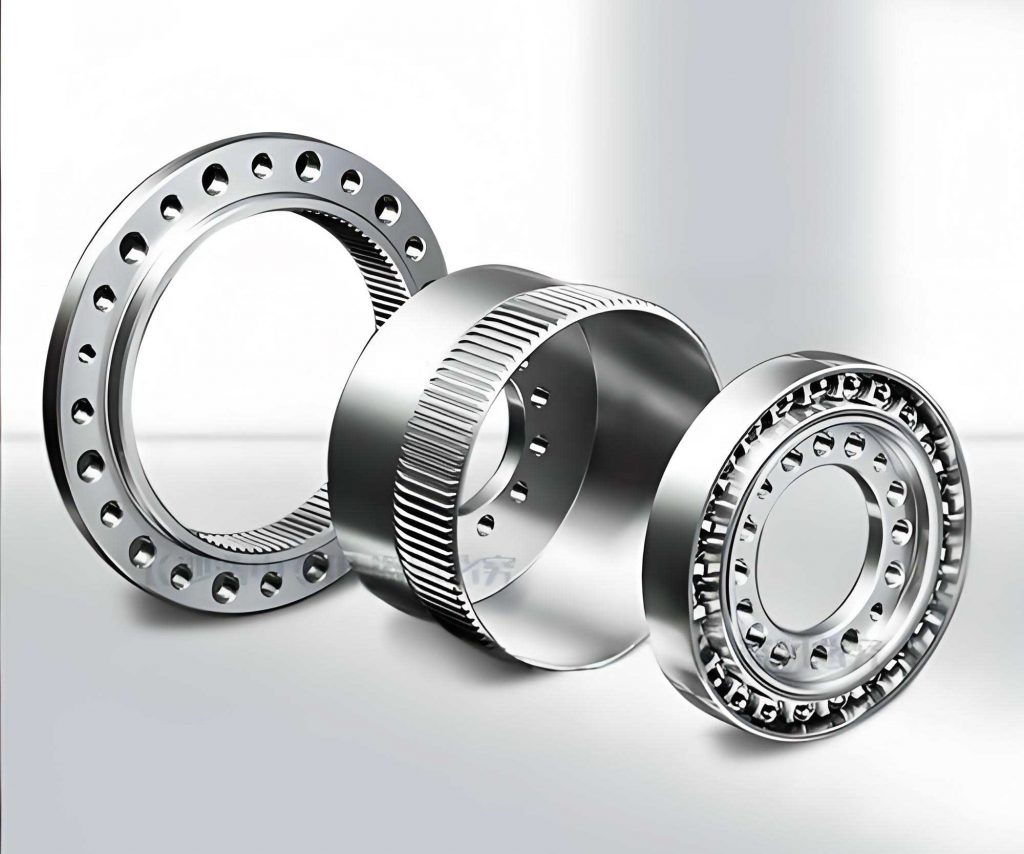
The core of the harmonic drive gear’s operation lies in the non-linear, elastic conjugation between the flexspline and the circular spline. To make the complex spatial-elastic conjugation problem tractable for design analysis, standard simplifying assumptions are adopted. The system is discretized into planar cross-sections, treating the meshing in each section as a planar gear engagement problem. Furthermore, the interaction between individual teeth is neglected, allowing the focus to shift to the kinematic motion of a single flexspline tooth relative to the circular spline over one cycle of the wave generator. Due to the periodicity and symmetry of the deformation, the behavior of this single tooth pair is representative of the entire harmonic drive gear assembly.
Theoretical Modeling of the DCTP Flexspline
Parameterization of the Tooth Profile
The DCTP is defined by several geometric parameters. For clarity and to establish a foundation for the optimization, these parameters are summarized below.
| Symbol | Description |
|---|---|
| $h_a$ | Addendum |
| $h_f$ | Dedendum |
| $h$ | Whole depth ($h = h_a + h_f$) |
| $\\rho_a$ | Radius of convex arc segment |
| $\\rho_f$ | Radius of concave arc segment |
| $\\gamma$ | Inclination angle of common tangent |
| $h_l$ | Longitudinal length of common tangent |
| $t$ | Distance from dedendum circle to neutral layer |
To ensure a unique and continuous mathematical description of the segmented profile, the right-side flank of a single flexspline tooth is parameterized using the arc length coordinate $u$. The profile is divided into three segments: the convex arc $AB$, the common tangent $BC$, and the concave arc $CD$. The position vector $\\mathbf{r}_i(u)$ and unit normal vector $\\mathbf{n}_i(u)$ for each segment in the local tooth coordinate system $S_1$ are defined as piecewise functions.
Segment 1: Convex Arc ($u \\in [0, l_1]$)
Arc length limit: $l_1 = \\rho_a (\\theta – \\gamma)$.
$$
\\mathbf{r}_1(u) = \\begin{bmatrix}
\\rho_a \\cos(\\theta – u/\\rho_a) + x_{oa} \\\\
\\rho_a \\sin(\\theta – u/\\rho_a) + y_{oa} \\\\
1
\\end{bmatrix}, \\quad
\\mathbf{n}_1(u) = \\begin{bmatrix}
\\cos(\\theta – u/\\rho_a) \\\\
\\sin(\\theta – u/\\rho_a) \\\\
0
\\end{bmatrix}
$$
where $x_{oa} = -l_a$, $y_{oa} = h_f + t – X_a$, and $\\theta = \\arcsin((h_a + X_a)/\\rho_a)$.
Segment 2: Common Tangent ($u \\in [l_1, l_2]$)
Arc length limit: $l_2 = l_1 + h_l / \\cos\\gamma$.
$$
\\mathbf{r}_2(u) = \\begin{bmatrix}
x_B + (u – l_1)\\sin\\gamma \\\\
y_B – (u – l_1)\\cos\\gamma \\\\
1
\\end{bmatrix}, \\quad
\\mathbf{n}_2(u) = \\begin{bmatrix}
\\cos\\gamma \\\\
\\sin\\gamma \\\\
0
\\end{bmatrix}
$$
where $x_B = \\rho_a \\cos\\gamma + x_{oa}$ and $y_B = \\rho_a \\sin\\gamma + y_{oa}$.
Segment 3: Concave Arc ($u \\in [l_2, l_3]$)
Arc length limit: $l_3 = l_2 + \\rho_f (\\arcsin((X_f + h_f)/\\rho_f) – \\gamma)$.
$$
\\mathbf{r}_3(u) = \\begin{bmatrix}
x_{of} – \\rho_f \\cos(\\gamma + (u – l_2)/\\rho_f) \\\\
y_{of} – \\rho_f \\sin(\\gamma + (u – l_2)/\\rho_f) \\\\
1
\\end{bmatrix}, \\quad
\\mathbf{n}_3(u) = \\begin{bmatrix}
\\cos(\\gamma + (u – l_2)/\\rho_f) \\\\
\\sin(\\gamma + (u – l_2)/\\rho_f) \\\\
0
\\end{bmatrix}
$$
where $x_{of} = (\\rho_a + \\rho_f) \\cos\\gamma + h_l \\tan\\gamma – l_a$ and $y_{of} = h_f + t + X_f$.
Kinematic Model and Conjugation Theory
The conjugate motion between the flexspline and the circular spline in a harmonic drive gear is governed by the fundamental equation of meshing. An efficient approach utilizes the matrix of meshing invariant, $\\mathbf{B}$. This matrix encapsulates the complex relative motion (radial deformation $\\omega(\\phi)$, tangential deformation $\\nu(\\phi)$, and rotation $\\mu(\\phi)$ of the neutral layer) induced by the wave generator, independent of the specific tooth profile geometry. For a standard elliptical wave generator, the $\\mathbf{B}$ matrix is given by:
$$
\\mathbf{B} = \\begin{bmatrix}
0 & \\dot{\\beta} & -\\dot{\\omega}(\\phi)\\sin\\mu(\\phi) + \\rho \\dot{\\Delta\\phi}\\cos\\mu(\\phi) \\\\
-\\dot{\\beta} & 0 & \\dot{\\omega}(\\phi)\\cos\\mu(\\phi) + \\rho \\dot{\\Delta\\phi}\\sin\\mu(\\phi) \\\\
0 & 0 & 0
\\end{bmatrix}
$$
where $\\dot{\\beta}$, $\\dot{\\omega}$, $\\dot{\\Delta\\phi}$ are time derivatives, $\\rho$ is the radial distance of the tooth origin, and $\\phi$ is the angular coordinate on the neutral line.
The condition for conjugation at any point on the flexspline profile, defined by its local position vector $\\mathbf{r}_i^{(1)}(u)$ and normal $\\mathbf{n}_i^{(1)}(u)$, is expressed using this invariant matrix:
$$
(\\mathbf{n}_i^{(1)}(u))^T \\, \\mathbf{B} \\, \\mathbf{r}_i^{(1)}(u) = 0 \\quad \\text{(Meshing Equation)}
$$
For a given arc length parameter $u$, solving this equation yields the wave generator angle $\\alpha$ at which that specific point on the flexspline tooth enters into conjugate contact. The set of all $\\alpha$ values for which a solution exists defines the conjugate zone for that profile segment. The corresponding locus of points on the circular spline, found via the coordinate transformation $\\mathbf{r}_i^{(2)} = \\mathbf{M}_{21}(\\alpha) \\, \\mathbf{r}_i^{(1)}(u)$, defines the theoretical conjugate tooth profile.
Optimization Strategy for Dual-Conjugate Meshing
Problem Definition and Objective Function
In a standard DCTP harmonic drive gear design process, the theoretical conjugate profiles derived from the flexspline’s convex arc and its concave arc are not coincident. To achieve the desired “dual-conjugate” meshing—where both the convex arc and the concave arc (via the common tangent transition) are simultaneously in proper contact during a portion of the engagement—these two theoretical profiles must be aligned. The goal of this optimization is to adjust key flexspline profile parameters to force this alignment, thereby maximizing the angular range of dual-conjugate action and boosting the performance of the harmonic drive gear.
The core of the optimization lies in quantifying the difference between the two critical theoretical conjugate profiles:
- Profile $\\Gamma_2$: The conjugate profile generated by the second engagement zone of the flexspline’s convex arc.
- Profile $\\Gamma_5$: The conjugate profile generated by the first engagement zone of the flexspline’s concave arc.
For perfect dual-conjugate potential, $\\Gamma_2$ and $\\Gamma_5$ should be identical.
Let these profiles be represented by functions $f_1(x)$ and $f_2(x)$, respectively, within their common $x$-domain. Discretizing this domain into $n$ points, we define vectors characterizing each profile:
$$
\\mathbf{F}_1 = [f_1(x_1), f_1(x_2), …, f_1(x_n)], \\quad \\mathbf{F}_2 = [f_2(x_1), f_2(x_2), …, f_2(x_n)]
$$
The values of $f_1$ and $f_2$ depend on the flexspline design parameters, most sensitively on the concave arc radius $\\rho_f$, the common tangent length $h_l$, and its inclination $\\gamma$. Therefore, the objective function $T$ is defined as the Euclidean distance between these profile vectors:
$$
T(\\gamma, h_l, \\rho_f) = || \\mathbf{F}_1 – \\mathbf{F}_2 || = \\sqrt{\\sum_{k=1}^{n} [f_1(x_k) – f_2(x_k)]^2}
$$
Optimization Goal: Find the parameter set $(\\gamma^*, h_l^*, \\rho_f^*)$ that minimizes $T$.
$$
\\Psi = \\min T(\\gamma, h_l, \\rho_f)
$$
Minimizing $T$ directly minimizes the difference between $\\Gamma_2$ and $\\Gamma_5$, leading to the maximization of the usable dual-conjugate zone in the harmonic drive gear.
| Component | Mathematical Representation | Key Variables |
|---|---|---|
| Flexspline Profile | Piecewise $\\mathbf{r}_i(u)$, $\\mathbf{n}_i(u)$ ($i=1,2,3$) | Arc length $u$, $\\rho_a$, $\\rho_f$, $\\gamma$, $h_l$ |
| Meshing Condition | $(\\mathbf{n}_i^{(1)})^T \\mathbf{B} \\mathbf{r}_i^{(1)} = 0$ | Matrix $\\mathbf{B}$ (Motion Invariant) |
| Theoretical Conjugate Profile | $\\mathbf{r}_i^{(2)} = \\mathbf{M}_{21}(\\alpha) \\mathbf{r}_i^{(1)}$ | Wave generator angle $\\alpha$ |
| Optimization Objective | $\\min T(\\gamma, h_l, \\rho_f) = ||\\mathbf{F}_1 – \\mathbf{F}_2||$ | Profile vectors $\\mathbf{F}_1$, $\\mathbf{F}_2$ |
Single-Parameter Sensitivity Analysis
Before performing a full multi-parameter optimization, it is instructive to analyze the influence of each parameter individually on the objective function $T$. This reveals sensitivity trends and provides initial bounds for the global search. The base parameters for this analysis are: module $m=0.3175\\text{ mm}$, $h_a=0.6m$, $h_f=0.9m$, $\\rho_a=0.60\\text{ mm}$, with other parameters from the reference design.
1. Influence of Common Tangent Inclination ($\\gamma$):
Holding $h_l=0.050\\text{ mm}$ and $\\rho_f=0.65\\text{ mm}$ constant, $\\gamma$ is varied. Analysis shows that for $\\gamma < 11^\\circ$, the common tangent segment does not generate a conjugate profile, leading to detrimental point contact. Within the feasible range $\\gamma \\in [11^\\circ, 15^\\circ]$, the function $T(\\gamma)$ exhibits a distinct minimum. A refined search around $12^\\circ$ pinpoints the optimum near $\\gamma^* \\approx 12.1^\\circ$ for this specific parameter combination.
2. Influence of Common Tangent Length ($h_l$):
With $\\gamma=12^\\circ$ and $\\rho_f=0.65\\text{ mm}$ fixed, varying $h_l$ in the range $[0.02, 0.08]\\text{ mm}$ also produces a convex function $T(h_l)$ with a clear minimum. For this case, the optimum is found at $h_l^* \\approx 0.047\\text{ mm}$.
3. Influence of Concave Arc Radius ($\\rho_f$):
Fixing $\\gamma=12^\\circ$ and $h_l=0.050\\text{ mm}$, and varying $\\rho_f$ in $[0.55, 0.65]\\text{ mm}$ similarly yields a function $T(\\rho_f)$ with a minimum, located near $\\rho_f^* \\approx 0.62\\text{ mm}$ for this combination.
| Fixed Parameters | Varied Parameter | Found Optimal Value | Minimum $T$ Value (Relative) |
|---|---|---|---|
| $h_l=0.050$, $\\rho_f=0.65$ | $\\gamma$ | $\\approx 12.1^\\circ$ | Lowest |
| $\\gamma=12.0^\\circ$, $\\rho_f=0.65$ | $h_l$ | $\\approx 0.047\\text{ mm}$ | Lowest |
| $\\gamma=12.0^\\circ$, $h_l=0.050$ | $\\rho_f$ | $\\approx 0.62\\text{ mm}$ | Lowest |
This single-parameter analysis confirms that each variable can be tuned to improve conjugacy for a given set of other parameters. However, the optimal value for one parameter (e.g., $\\gamma^*$) shifts when another parameter (e.g., $h_l$ or $\\rho_f$) is changed, highlighting the coupled nature of the problem and the necessity for a simultaneous multi-parameter optimization in harmonic drive gear design.
Multi-Parameter Optimization and Results
To find the global optimum that best aligns profiles $\\Gamma_2$ and $\\Gamma_5$, a simultaneous optimization over the three key parameters is performed. The search domains are defined based on the sensitivity analysis: $\\gamma \\in [11.0^\\circ, 13.0^\\circ]$, $h_l \\in [0.02, 0.08]\\text{ mm}$, and $\\rho_f \\in [0.55, 0.65]\\text{ mm}$. A discrete search grid is employed for computational efficiency.
The global minimum of the objective function is found at:
$$
\\Psi = T(\\gamma^*, h_l^*, \\rho_f^*) = T(11.52^\\circ, 0.0408\\text{ mm}, 0.562\\text{ mm}) \\approx 2.1 \\times 10^{-3} \\text{ mm}
$$
At this optimal point, the maximum profile deviation is $\\max|f_1(x_k)-f_2(x_k)| \\approx 7.75 \\times 10^{-4} \\text{ mm}$ and the average deviation is about $3.97 \\times 10^{-4} \\text{ mm}$. This level of congruence is sufficient for practical engineering purposes, indicating that the dual-conjugate condition is effectively achieved for this harmonic drive gear configuration.
Discussion on Parameter Sensitivity and Manufacturing
A crucial insight from the multi-parameter optimization study is the differential sensitivity of the objective function $T$ to the three design variables. While all parameters influence the result, $T$ is markedly more sensitive to changes in the common tangent parameters $\\gamma$ and $h_l$ than to changes in the concave arc radius $\\rho_f$.
This has significant implications for the design and manufacturing of the harmonic drive gear. The parameters $\\gamma$ and $h_l$, often controlled by the geometry of the cutting tool or grinding wheel, are typically easier to specify and maintain with high precision. In contrast, the concave arc radius $\\rho_f$ might be constrained by available standard tooling or economic factors.
The lower sensitivity of $T$ to $\\rho_f$ is a beneficial characteristic. It allows the designer to slightly adjust $\\rho_f$ away from its theoretical optimal value $\\rho_f^*$ to accommodate manufacturing constraints (e.g., selecting a standard cutter size) without causing a substantial degradation in the dual-conjugate performance of the harmonic drive gear. This flexibility enables a more cost-effective and practical design process while still preserving the key performance benefits of the optimized tooth profile.
| Aspect | Finding | Implication for Harmonic Drive Gear Design |
|---|---|---|
| Global Optimum | $(\\gamma^*, h_l^*, \\rho_f^*) = (11.52^\\circ, 0.0408\\text{ mm}, 0.562\\text{ mm})$ | Defines the ideal parameter set for maximum dual-conjugate zone. |
| Objective Value | $\\Psi \\approx 2.1 \\times 10^{-3}\\text{ mm}$ | Indicates very high congruence between critical conjugate profiles. |
| Parameter Sensitivity | High sensitivity to $\\gamma$, $h_l$; Lower sensitivity to $\\rho_f$. | Provides design flexibility: $\\rho_f$ can be adjusted for manufacturability with minimal performance loss. |
| Primary Benefit | Maximized dual-conjugate meshing zone. | Directly leads to increased torsional stiffness and transmission accuracy. |
Conclusion
This article has detailed a systematic methodology for the optimization of flexspline tooth profile parameters in a double-circular-arc harmonic drive gear. The approach synergistically combines an arc-length parameterization of the segmented DCTP profile with the efficiency of the meshing invariant matrix method, significantly simplifying the derivation of theoretical conjugate profiles. The central optimization problem was formulated around minimizing the difference between two key theoretical conjugate profiles, $\\Gamma_2$ and $\\Gamma_5$, with the explicit goal of maximizing the angular extent of dual-conjugate meshing—a critical factor for enhancing the stiffness and precision of the harmonic drive gear.
The analysis progressed from single-parameter sensitivity studies to a full multi-parameter optimization, identifying a global optimal parameter combination. A key practical finding is the lower sensitivity of the system to the concave arc radius $\\rho_f$ compared to the common tangent parameters $\\gamma$ and $h_l$. This insight grants valuable flexibility in the design process, allowing for minor adjustments to $\\rho_f$ to meet manufacturing or tooling constraints without substantially compromising the optimized meshing performance of the harmonic drive gear.
While demonstrated on a specific set of base parameters, the core methodology—integrating precise kinematic modeling, a well-defined objective function based on conjugate profile alignment, and coupled parameter optimization—is universally applicable. It provides a powerful and rational framework for designing high-performance, double-circular-arc harmonic drive gears, ensuring they achieve their theoretical potential in terms of load capacity, rigidity, and motion fidelity.